Ziclor
Italy
Table of Contents
Package leaflet: Information for the patient
ZICLOR 1 mg/g / 2.5 mg/g eye gel
betamethasone/chloramphenicol
Equivalent medicine
Please read all of this leaflet carefully before using this medicine because it contains important information for you.
- Keep this leaflet. You may need to read it again.
- If you have any questions, ask your doctor or pharmacist.
- This medicine has been prescribed for you only. Do not give it to other people, even if their symptoms are the same as yours, as it may be harmful.
- If you experience any side effects, including those not listed in this leaflet, consult your doctor or pharmacist. See section 4. Contents of this leaflet:
- What ZICLOR is and what it is used for
- What you need to know before using ZICLOR
- How to use ZICLOR
- Possible side effects
- How to store ZICLOR
- Contents of the pack and other information
1. What ZICLOR is and what it is used for
ZICLOR is a gel containing betamethasone, a corticosteroid with anti-inflammatory action, and chloramphenicol, an antibiotic.
ZICLOR is indicated for the treatment of ocular infections when it is beneficial to combine the anti-inflammatory action of betamethasone.
Consult your doctor if you do not feel better or if you feel worse.
2. What you need to know before using ZICLOR
Do not use ZICLOR
- if you are allergic to betamethasone or chloramphenicol, or to any of the other ingredients of this medicine (listed in section 6). Inform your doctor before using ZICLOR if you are or have previously been affected by any of the following conditions:
a) Elevated intraocular pressure (endocular hypertension);
b) Acute viral eye infections caused by Herpes simplex virus and most other viral corneal diseases in the acute ulcerative phase, ulcerative conjunctivitis with keratitis even in the initial stage. In viral corneal infections, use is not recommended but may exceptionally be allowed only under strict supervision by an ophthalmologist;
c) Eye infection caused by the tuberculosis bacterium;
d) Eye infection caused by fungi (fungal eye infections, mycosis);
e) Ocular infections with evident pus production such as purulent conjunctivitis and purulent blepharitis, which may be masked or worsened by corticosteroids.
Warnings and precautions
Long-term use of ZICLOR may:
- increase intraocular pressure, with risk of progressive optic nerve damage (glaucoma). However, the amount of betamethasone contained in ZICLOR gel reduces the risk of glaucoma;
- cause visual disturbances;
- promote cataract development;
- favor new ocular infections.
During prolonged treatment, frequent monitoring of intraocular pressure is advisable. Continuous use of ZICLOR for longer than one month without specialist supervision is not recommended. If your eye condition is associated with thinning of the cornea and sclera, regular medical check-ups are necessary, as cases of corneal perforation caused by corticosteroids have been reported. Contact your doctor if blurred vision or other visual disturbances occur. Prolonged topical use of steroids and antibiotics may increase the likelihood of developing non-sensitive microorganisms (bacterial resistance development) and fungal corneal infections. If this occurs or if no clinical improvement is observed within a reasonable time, inform your doctor. Do not wear contact lenses if you have an eye infection. Rare cases of reduced bone marrow cell count (medullary hypoplasia), including aplastic anaemia, have been reported following prolonged topical use of chloramphenicol in patients with pre-existing haematological disorders. For this reason, the product should be used only for short periods unless otherwise directed by a physician.
Children
Do not administer ZICLOR to a child unless specifically prescribed by a doctor, and the child must be regularly monitored by a physician.
Other medicines and ZICLOR
Inform your doctor or pharmacist if you are currently using, have recently used, or might use any other medicines.
Pregnancy and breastfeeding
If you are pregnant, think you might be pregnant, planning to become pregnant, or breastfeeding, consult your doctor or pharmacist before using this medicine.
Pregnancy
Data on the use of betamethasone in pregnant women are limited.
Do not use ZICLOR during pregnancy unless under the direct supervision of your doctor.
Breastfeeding
Chloramphenicol has been detected in newborns/infants breastfed by treated women.
Your doctor will decide whether to discontinue breastfeeding or avoid using ZICLOR, taking into account the benefits of breastfeeding for the child and the benefits of therapy for the mother.
Driving and using machines
ZICLOR may slightly affect your ability to drive or operate machinery, as it may cause blurred vision for a few minutes after application.
ZICLOR in the 5 g multidose tube contains methyl hydroxybenzoate and propyl hydroxybenzoate, which may cause allergic reactions (including delayed-type reactions).
3. How to use ZICLOR
Use this medicine exactly as instructed by your doctor or pharmacist. If you have
any doubts, consult your doctor or pharmacist.
The recommended dose for adolescents and adults, including the elderly, is 1 application into the conjunctival sac, 2 to 3 times daily, as prescribed by a physician.
If you are using other eye drops at the same time, wait 10 to 15 minutes before applying the next product.
Multi-dose bottle
Do not use the bottle if the seal around the cap is broken before first opening.
Wash your hands thoroughly before opening the bottle. Tilt your head backwards and look at the ceiling.
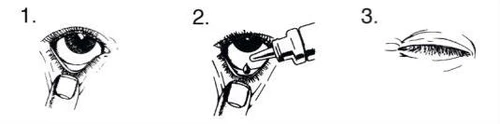
- Gently pull down the lower eyelid of the eye to be treated until a small "pocket" is formed (fig.1).
- Turn the bottle upside down and squeeze it to release one drop into the "pocket" (fig.2).
- Release the lower eyelid and blink a few times (fig.3).
- Repeat steps 1 to 3 for the other eye, if treatment is needed.
To help prevent infection, do not let the tip of the bottle touch the eye, surrounding tissue, or anything else. Immediately after use, close the bottle with the screw cap.
Between uses, keep the bottle in an upright vertical position with the tip pointing downwards.
Single-dose containers
Before use, ensure that the single-dose container is intact.
Wash your hands thoroughly before opening the container.
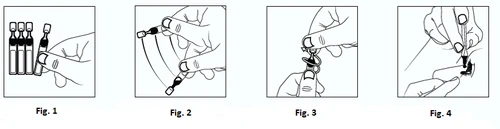
- Detach the single-dose container from the strip (fig. 1).
- Hold the single-dose container by the base and shake downward (fig. 2).
- Open by twisting the top and pulling it off (fig. 3).
- Gently pull down the lower eyelid of the eye to be treated until a small "pocket" is formed.
- Turn the container upside down and squeeze it to release one drop into the "pocket" (fig. 4).
To help prevent infection, do not let the tip of the container touch the eye, surrounding tissue, or anything else.
Use in children
The safety and efficacy of ZICLOR in children under one year of age have not yet been established.
Do not administer ZICLOR to children over one year of age unless prescribed by a doctor and used under direct medical supervision.
If you use more ZICLOR than you should
Cases of overdose have not been reported.
If you forget to use ZICLOR
Do not use a double dose to make up for the missed dose.
If you stop using ZICLOR
If you have any doubts about how to use this medicine, consult your doctor or pharmacist.
4. Possible adverse effects
Like all medicines, ZICLOR may cause adverse effects, although not everyone experiences them.
The adverse effects are listed below according to frequency:
Very rare (may affect fewer than 1 in 10,000 people)
Eye disorders:
Prolonged topical use of chloramphenicol may lead to local irritations (burning or stinging sensation) and allergic reactions; treatment must be discontinued if such symptoms occur.
After prolonged use of corticosteroids, the risk of ocular hypertension should be considered.
Immune system disorders:
Transient allergic reactions are possible, including burning, rapid swelling of the skin and mucous membranes, urticaria, dermatitis; if such symptoms occur, discontinue treatment.
Not known (frequency cannot be estimated from the available data)
Eye disorders:
After prolonged use of corticosteroids, corneal thinning should be considered, which may lead to perforation.
Blurred vision has been reported.
Blood and lymphatic system disorders:
It is unlikely that adverse reactions due to systemic absorption will occur. However, with prolonged use or a previous history (medical history) of quantitative or qualitative abnormalities in blood composition, the risk of chloramphenicol-induced reduction in bone marrow cell count (aplastic anaemia) should be considered.
Reporting of adverse effects
If you experience any adverse effect, including those not listed in this leaflet, consult your doctor or pharmacist. You may also report adverse effects directly via the national reporting system at https://www.aifa.gov.it/content/segnalazioni-reazioni-avverse. By reporting adverse effects, you can help provide more information on the safety of this medicine.
5. How to store ZICLOR
Store in the refrigerator (2-8°C).
Multi-dose vial
Store below 25°C for a period of 28 days after first opening of the vial.
Single-dose containers
After first opening of the aluminium pouch: store below 25°C and use within 10 days; after this period, the containers must be discarded.
The medicinal product in the single-dose container must be used immediately after opening the vial; any remaining medicinal product must be discarded.
Keep this medicine out of the sight and reach of children.
Do not use this medicine after the expiry date stated on the carton after "Exp". The expiry date refers to the last day of that month.
Do not use this medicine if you notice an intense yellow colouration.
Do not dispose of any medicine via wastewater or household waste. Ask your pharmacist how to dispose of medicines no longer required. This will help protect the environment.
6. Package contents and other information
What ZICLOR contains
Multidose bottle
The active substances are betamethasone sodium phosphate and chloramphenicol.
The other components are: macrogol 300, polyvinyl alcohol (E1203), carbomer, disodium edetate (E385), methyl parahydroxybenzoate (E218), propyl parahydroxybenzoate (E216), sodium hydroxide 2M (E524), purified water.
Single-dose containers
The active substances are betamethasone sodium phosphate and chloramphenicol.
The other components are: macrogol 300, polyvinyl alcohol (E1203), carbomer, disodium edetate (E385), sodium hydroxide 2M (E524), purified water.
Description of the appearance of ZICLOR and the contents of the pack
ZICLOR is a gel. It is available in multidose and single-dose presentations.
The multidose bottle is made of polyethylene. The pack contains one 5 g bottle.
The single-dose containers are made of polyethylene. The pack contains 30 single-dose containers of 0.25 g, divided into 3 strips of 10 single-dose containers each; each strip of 10 single doses is packaged in a pouch.
Marketing Authorization Holder and Manufacturer
ALFA INTES Industria Terapeutica Splendore S.r.l.
Via F.lli Bandiera 26 - 80026 Casoria (NA)