Zeposia
Italy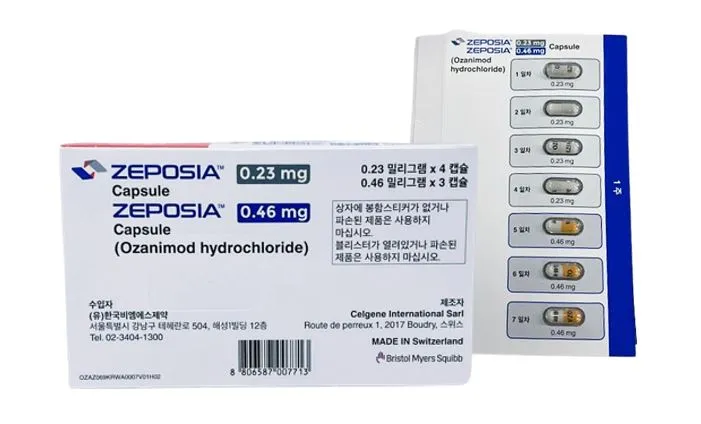
Table of Contents
- Package leaflet: Information for the patient
- Zeposia 0.23 mg hard capsules, 0.46 mg hard capsules, 0.92 mg hard capsules
- 1. What Zeposia is and what it is used for
- 2. What you need to know before taking Zeposia
- 3. How to take Zeposia
- 4. Possible side effects
- 5. How to store Zeposia
- 6. Package contents and other information
Package leaflet: Information for the patient
Zeposia 0.23 mg hard capsules, 0.46 mg hard capsules, 0.92 mg hard capsules
ozanimod
Please read this leaflet carefully before taking this medicine because it contains
important information for you.
- Keep this leaflet. You may need to read it again.
- If you have any questions, ask your doctor or pharmacist.
- This medicine has been prescribed for you only. Do not give it to other people, even if their symptoms are the same as yours, because it could be harmful.
- If you experience any adverse reactions, including those not listed in this leaflet, consult your doctor or pharmacist. See section 4.
Contents of this leaflet
- What Zeposia is and what it is used for
- What you need to know before taking Zeposia
- How to take Zeposia
- Possible side effects
- How to store Zeposia
- Contents of the pack and other information
1. What Zeposia is and what it is used for
Zeposia contains the active substance ozanimod, which belongs to a group of medicines that can reduce the number of white blood cells (lymphocytes) circulating freely in the body.
Zeposia is indicated for the following diseases:
- multiple sclerosis
- ulcerative colitis
Multiple sclerosis
Zeposia is indicated for the treatment of adult patients with relapsing-remitting multiple sclerosis (RRMS) with active disease.
- Multiple sclerosis (MS) is a disease in which the immune system (the body's defences, including white blood cells) mistakenly attacks the protective covering surrounding nerve fibres in the brain and spinal cord. This prevents nerve fibres from functioning properly and may cause symptoms such as numbness, difficulty walking, and vision and balance problems.
- In relapsing-remitting multiple sclerosis, attacks on nerve cells are followed by periods of recovery. Symptoms may disappear during recovery periods, but some problems may persist.
Zeposia helps protect against attacks on nerve fibres by preventing certain white blood cells from reaching the brain and spinal cord, where they could cause inflammation and damage to the nerves' protective covering.
Ulcerative colitis
Zeposia is indicated for the treatment of adult patients with moderately to severely active ulcerative colitis (UC).
- Ulcerative colitis is an inflammatory bowel disease. If you have ulcerative colitis, you will first be treated with other medicines. If you do not respond adequately or are intolerant to these medicines, Zeposia may be given to reduce the signs and symptoms of the disease.
Zeposia helps reduce inflammation in ulcerative colitis by preventing certain white blood cells from reaching the inner lining of the intestine.
2. What you need to know before taking Zeposia
Do not take Zeposia:
- if you are allergic to ozanimod or to any of the other ingredients of this medicine (listed in section 6);
- if your healthcare provider has told you that your immune system is severely weakened;
- if you have had a heart attack, angina, stroke, or mini-stroke (transient ischemic attack, TIA) within the past 6 months, or certain types of severe heart failure;
- if you have certain types of irregular or abnormal heart rhythms (arrhythmias); your doctor will perform a heart check before starting treatment;
- if you have a serious infection, such as hepatitis or tuberculosis;
- if you have cancer;
- if you have severe liver problems;
- if you are pregnant or are a woman of childbearing potential and are not using effective contraceptive measures.
Warnings and precautions
Talk to your doctor or pharmacist before taking Zeposia if:
- you have a slow heart rate or are taking or have recently taken medicines that slow the heart rate (such as beta-blockers or calcium channel blockers);
- you have untreated severe breathing problems during sleep (severe sleep apnea);
- you have liver problems;
- you have an infection;
- you have low levels of a type of white blood cells called lymphocytes;
- you have never had chickenpox or are unsure whether you have had it;
- you have recently received or plan to receive a vaccination;
- you or others notice worsening of MS symptoms or new or unusual symptoms. These may be due to a rare brain infection called progressive multifocal leukoencephalopathy (PML). If PML is confirmed, your doctor will stop treatment with Zeposia. However, some people may develop a reaction when Zeposia is discontinued. This reaction (known as IRIS or immune reconstitution inflammatory syndrome) may lead to worsening of your condition, including worsening of brain function;
- you have ever had vision problems or other symptoms of fluid accumulation in the central area of the retina called the macula (a condition called macular edema);
- you have inflammation of the eye (uveitis);
- you have diabetes (which can cause eye problems);
- you have severe lung disease (pulmonary fibrosis or chronic obstructive pulmonary disease).
Before starting treatment with Zeposia, your doctor will perform a heart check using an electrocardiogram (ECG).
If you have certain heart conditions, your doctor will monitor you for at least the first 6 hours after your first dose.
Since Zeposia may increase blood pressure, your doctor may need to check your blood pressure regularly.
During treatment with Zeposia, if you experience unexplained nausea, vomiting, pain in the right side of your abdomen (abdominal pain), fatigue, loss of appetite, yellowing of the skin or the whites of your eyes (jaundice), and/or dark urine, contact your doctor immediately.
These symptoms may be caused by a liver problem.
Before, during, and after treatment, your doctor will ask you to have blood tests to monitor liver function. If test results indicate a liver problem, you may need to stop treatment with Zeposia.
During treatment with Zeposia (and for up to 3 months after stopping it), you may be more likely to develop infections. An existing infection may worsen. Contact your doctor if you develop an infection.
During treatment with Zeposia, if you develop vision disturbances, progressive weakness, clumsiness, memory loss, or confusion, or if you have MS and think your disease is worsening progressively, speak to your doctor immediately. These symptoms could be caused by PML, a rare brain infection that could lead to severe disability or death.
If during treatment with Zeposia you experience a severe headache, confusion, seizures (fits), or loss of vision, contact your doctor immediately. These symptoms may be due to a condition called posterior reversible encephalopathy syndrome (PRES).
Since Zeposia may increase the risk of skin cancer, you should limit exposure to sunlight and UV (ultraviolet) light by wearing protective clothing and applying regular sunscreen (with high protection factor).
Women of childbearing potential
Zeposia may cause harm to the unborn child if used during pregnancy. Before starting treatment with Zeposia, your doctor will explain the risks to you and will ask you to take a pregnancy test to make sure you are not pregnant. Your doctor will give you a card explaining why you must not become pregnant during treatment with Zeposia. This card also explains what you need to do to avoid pregnancy during treatment with Zeposia. You must use effective contraception during treatment and for 3 months after stopping it (see section “Pregnancy and breastfeeding”).
If any of the above apply to you, talk to your doctor or pharmacist before taking Zeposia.
Worsening of MS after stopping Zeposia
Inform your doctor immediately if you suspect worsening of MS after stopping treatment with Zeposia (see “If you stop taking Zeposia” in section 3).
Children and adolescents
Do not give this medicine to children and adolescents under 18 years of age, as Zeposia has not been studied in children and adolescents.
Other medicines and Zeposia
Tell your doctor or pharmacist if you are taking, have recently taken, or might take any other medicines. This is because Zeposia may affect the action of other medicines and other medicines may affect the action of Zeposia.
In particular, inform your doctor or pharmacist before taking Zeposia if you are taking or have recently taken any of the following medicines:
- medicines that suppress or modulate the immune system (e.g., cyclosporine);
- medicines used to treat MS, such as alemtuzumab, interferon beta, dimethyl fumarate, glatiramer acetate, mitoxantrone, natalizumab, or teriflunomide;
- medicines used to treat ulcerative colitis, such as azathioprine and 6-mercaptopurine;
- gemfibrozil, used to lower blood fat or cholesterol levels;
- clopidogrel, a medicine used to prevent blood clots;
- rifampicin, an antibiotic used to treat tuberculosis and other serious infections;
- medicines called monoamine oxidase inhibitors used to treat depression (e.g., phenelzine) or Parkinson’s disease (e.g., selegiline);
- medicines that slow heart rate (such as beta-blockers or calcium channel blockers);
- certain types of vaccines. The use of live attenuated vaccines should be avoided during treatment and for 3 months after it.
Pregnancy and breastfeeding
If you are pregnant, suspect you may be pregnant, are planning to become pregnant, or are breastfeeding, ask your doctor for advice before taking this medicine.
Pregnancy
Do not use Zeposia during pregnancy, if you intend to become pregnant, or if you are a woman of childbearing potential who is not using effective contraceptive measures. If Zeposia is used during pregnancy, there is a risk of harm to the unborn child. If you are a woman of childbearing potential, your doctor will inform you of this risk before starting treatment with Zeposia and will ask you to take a pregnancy test to confirm you are not pregnant. You must use effective contraception during treatment with Zeposia and for at least 3 months after stopping it. Ask your doctor for advice on reliable contraceptive methods.
Your doctor will give you a card explaining why you must not become pregnant during treatment with Zeposia.
If you become pregnant while taking Zeposia, inform your doctor immediately. Your doctor will decide whether to stop treatment (see “If you stop taking Zeposia” in section 3). Specialist prenatal monitoring will be performed.
Breastfeeding
You must not breastfeed during treatment with Zeposia. Zeposia may pass into breast milk and there is a risk of serious adverse effects in the infant.
Driving and using machines
Zeposia has no effect or has a negligible effect on the ability to drive vehicles and use machines.
Zeposia contains sodium
This medicine contains less than 1 mmol (23 mg) of sodium per capsule, i.e., essentially ‘sodium-free’.
Zeposia contains potassium
This medicine contains less than 1 mmol (39 mg) of potassium per capsule, i.e., essentially ‘potassium-free’.
3. How to take Zeposia
Take this medicine exactly as your doctor has told you. If you are unsure, consult your doctor or pharmacist.
Dosage
When you start taking Zeposia, you must begin with a low dose and gradually increase it to reduce the potential effect of slowing your heart rate.
- You will be given a “starter pack” to help you begin treatment in this way. The pack contains:
o 4 light grey capsules, each containing 0.23 mg of ozanimod. You must take one of these capsules on days 1 to 4 of treatment;
o 3 light grey and orange capsules, each containing 0.46 mg of ozanimod. You must take one of these capsules on days 5, 6 and 7. - From day 8 onwards, once you have completed the “starter pack”, you will switch to a “maintenance pack” containing orange capsules, each with the recommended maintenance dose of 0.92 mg of ozanimod. You will continue regular treatment with one 0.92 mg capsule daily. If you have mild or moderate chronic liver problems, your doctor may reduce your maintenance dose to one 0.92 mg capsule taken on alternate days.
How to take Zeposia
- Zeposia is for oral use.
- Swallow the capsule whole.
- You may take the capsule with or without food.
If you take more Zeposia than you should
If you take more Zeposia than prescribed, consult your doctor or go to hospital immediately.
Take the medicine pack and this leaflet with you.
If you forget to take Zeposia
- If you miss one or more doses during the first 14 days of treatment with Zeposia, consult your doctor for instructions on how to resume treatment.
- If you miss a dose of Zeposia after the first 14 days of treatment, take it as soon as you remember. However, if you forget to take the dose for the entire day, skip the missed dose and take the next dose at your usual time.
- Do not take a double dose to make up for a forgotten dose.
If you stop taking Zeposia
- Do not stop taking Zeposia without first consulting your doctor.
- Consult your doctor about how to resume treatment if you have stopped taking Zeposia:
- for 1 day or more during the first 14 days of treatment;
- for more than 7 consecutive days between day 15 and day 28 of treatment;
- for more than 14 consecutive days after day 28 of treatment. In this case, you will need to restart the “starter pack”.
Zeposia remains in your body for up to 3 months after stopping treatment. The number of white blood cells in your blood (lymphocyte count) may remain low during this time, and the side effects described in this leaflet may still occur (see section 2 and “Possible side effects” in section 4).
Inform your doctor immediately if you think your multiple sclerosis (MS) is getting worse after stopping Zeposia.
If you have any doubts about how to use this medicine, consult your doctor or pharmacist.
4. Possible side effects
Like all medicines, this medicine can cause side effects, although not everybody gets them.
Serious side effects
Contact your doctor or pharmacist immediately if you notice any of the following serious side effects:
- Common: may affect up to 1 in 10 people
- slow heart rate
- urinary tract infection
- increased blood pressure
- Uncommon: may affect up to 1 in 100 people
- allergic reaction, signs of which may include a rash
- blurred vision (macular edema)
- Rare: may affect up to 1 in 1,000 people
- brain infection called progressive multifocal leukoencephalopathy (PML) (see section 2)
- liver damage
Other side effects
Inform your doctor or pharmacist if you notice any of the following side effects:
- Very common: may affect more than 1 in 10 people
- viral infections of the nose or nostrils, nasal cavity, mouth, throat (pharynx), or larynx
- low levels of a type of white blood cells called lymphocytes
- Common: may affect up to 1 in 10 people
- inflammation of the throat (pharyngitis)
- viral respiratory infection (signs of lung infection)
- herpes zoster (shingles)
- herpes simplex or cold sores (oral herpes)
- headache
- low blood pressure
- swelling, especially in the ankles and feet, due to fluid retention (peripheral edema)
- increased levels of liver enzymes or bilirubin in blood tests (a sign of liver problems), or yellowing of the skin, mucous membranes, or eyes (hyperbilirubinemia or high bilirubin levels in the blood) (jaundice)
- lung abnormalities that may cause shortness of breath
Reporting of side effects
If you get any side effects, including any not listed in this leaflet, talk to your doctor or pharmacist.
You can also report side effects directly via the national reporting system listed in Annex V. By reporting side effects, you can help provide more information on the safety of this medicine.
5. How to store Zeposia
- Keep this medicine out of the sight and reach of children.
- Do not use this medicine after the expiry date stated on the blister and carton after "Exp."/"EXP". The expiry date refers to the last day of that month.
- Do not store above 25°C.
- Do not use this medicine if you notice any signs of damage or tampering with the packaging.
- Do not dispose of any medicine via wastewater or household waste. Ask your pharmacist how to dispose of medicines no longer in use. This will help protect the environment.
6. Package contents and other information
What Zeposia contains
- The active substance is ozanimod.
- Zeposia 0.23 mg hard capsules: Each hard capsule contains 0.23 mg of ozanimod (as hydrochloride).
- Zeposia 0.46 mg hard capsules: Each hard capsule contains 0.46 mg of ozanimod (as hydrochloride).
- Zeposia 0.92 mg hard capsules: Each hard capsule contains 0.92 mg of ozanimod (as hydrochloride).
- The other components are:
- Capsule contents: Microcrystalline cellulose, anhydrous colloidal silica, sodium croscarmellose, magnesium stearate.
- Capsule shell:
- Each 0.23 mg capsule contains gelatin, titanium dioxide (E171), yellow iron oxide (E172), black iron oxide (E172), and red iron oxide (E172).
- Each 0.46 mg capsule contains gelatin, titanium dioxide (E171), yellow iron oxide (E172), black iron oxide (E172), and red iron oxide (E172).
- Each 0.92 mg capsule contains gelatin, titanium dioxide (E171), yellow iron oxide (E172), and red iron oxide (E172).
- Printing ink: Black iron oxide (E172), shellac (E904), propylene glycol (E1520), concentrated ammonia solution (E527), potassium hydroxide (E525).
Description of the appearance of Zeposia and contents of the pack
- The Zeposia 0.23 mg hard capsule is 14.3 mm long, with an opaque light grey cap and body, marked with "OZA" in black ink on the cap and "0.23 mg" on the body.
- The Zeposia 0.46 mg hard capsule is 14.3 mm long, with an opaque orange cap and an opaque light grey body, marked with "OZA" in black ink on the cap and "0.46 mg" on the body.
- The Zeposia 0.92 mg hard capsule is 14.3 mm long, with an opaque orange cap and body, marked with "OZA" in black ink on the cap and "0.92 mg" on the body.
Pack sizes
- Starter pack: A carton containing 7 hard capsules: 4 capsules of 0.23 mg and 3 capsules of 0.46 mg.
- Maintenance pack: containing either 28 hard capsules of 0.92 mg or 98 hard capsules of 0.92 mg.
Not all pack sizes may be marketed.
Marketing Authorisation Holder
Bristol-Myers Squibb Pharma EEIG
Plaza 254
Blanchardstown Corporate Park 2
Dublin 15, D15 T867
Ireland
Manufacturer
Celgene Distribution B.V.
Orteliuslaan 1000
3528 BD Utrecht
The Netherlands
For further information about this medicine, please contact the local representative of the Marketing Authorisation Holder:
België/Belgique/Belgien Lietuva
N.V. Bristol-Myers Squibb Belgium S.A. Swixx Biopharma UAB
Tél/Tel: + 32 2 352 76 11 Tel: + 370 52 369140
[email protected] [email protected]
България Luxembourg/Luxemburg
Swixx Biopharma EOOD N.V. Bristol-Myers Squibb Belgium S.A.
Teл.: + 359 2 4942 480 Tél/Tel: + 32 2 352 76 11
[email protected] [email protected]
Česká republika Magyarország
Bristol-Myers Squibb spol. s r.o. Bristol-Myers Squibb Kft.
Tel: + 420 221 016 111 Tel.: + 36 1 301 9797
[email protected] [email protected]
Danmark Malta
Bristol-Myers Squibb Denmark A.M. Mangion Ltd
Tlf: + 45 45 93 05 06 Tel: + 356 23976333
[email protected] [email protected]
Deutschland Nederland
Bristol-Myers Squibb GmbH & Co. KGaA Bristol-Myers Squibb B.V.
Tel: 0800 0752002 (+ 49 89 121 42 350) Tel: + 31 (0)30 300 2222
[email protected] [email protected]
Eesti Norge
Swixx Biopharma OÜ Bristol-Myers Squibb Norway AS
Tel: + 372 640 1030 Tlf: + 47 67 55 53 50
[email protected] [email protected]
Ελλάδα Österreich
Bristol-Myers Squibb A.E. Bristol-Myers Squibb GesmbH
Τηλ: + 30 210 6074300 Tel: + 43 1 60 14 30
[email protected] [email protected]
España Polska
Bristol-Myers Squibb, S.A. Bristol-Myers Squibb Polska Sp. z o.o.
Tel: + 34 91 456 53 00 Tel.: + 48 22 2606400
[email protected] [email protected]
France Portugal
Bristol-Myers Squibb SAS Bristol-Myers Squibb Farmacêutica Portuguesa, S.A.
Tél: + 33 (0)1 58 83 84 96 Tel: + 351 21 440 70 00
[email protected] [email protected]
Hrvatska România
Swixx Biopharma d.o.o. Bristol-Myers Squibb Marketing Services S.R.L.
Tel: + 385 1 2078 500 Tel: + 40 (0)21 272 16 19
[email protected] [email protected]
Ireland Slovenija
Bristol-Myers Squibb Pharmaceuticals uc Swixx Biopharma d.o.o.
Tel: 1 800 749 749 (+ 353 (0)1 483 3625) Tel: + 386 1 2355 100
[email protected] [email protected]
Ísland Slovenská republika
Vistor ehf. Swixx Biopharma s.r.o.
Sími: + 354 535 7000 Tel: + 421 2 20833 600
[email protected] [email protected]
Italia Suomi/Finland
Bristol-Myers Squibb S.r.l. Oy Bristol-Myers Squibb (Finland) Ab
Tel: + 39 06 50 39 61 Puh/Tel: + 358 9 251 21 230
[email protected] [email protected]
Κύπρος Sverige
Bristol-Myers Squibb A.E. Bristol-Myers Squibb Aktiebolag
Τηλ: 800 92666 (+ 30 210 6074300) Tel: + 46 8 704 71 00
[email protected] [email protected]
Latvija
Swixx Biopharma SIA
Tel: + 371 66164750
[email protected]
Other sources of information
More detailed information about this medicine is available on the website of the European Medicines Agency: https://www.ema.europa.eu/.
For detailed information about this medicine, you can also scan the QR code on the outer packaging with a smartphone. The same information is available at the following address: www.zeposia-eu-pil.com.
ANNEX IV
SCIENTIFIC CONCLUSIONS AND REASONS FOR THE VARIATION OF THE TERMS OF THE MARKETING AUTHORISATION
Scientific conclusions
Taking into account the evaluation by the Pharmacovigilance Risk Assessment Committee (PRAC) of the Periodic Safety Update Reports (PSURs) for ozanimod, the PRAC's scientific conclusions are as follows:
In light of available data on immune reconstitution inflammatory syndrome (IRIS) from the literature and in view of a plausible mechanism of action, the PRAC considers that there is at least a reasonable possibility of a causal relationship between ozanimod and IRIS. The PRAC concluded that the product information for medicinal products containing ozanimod should be amended accordingly.
Having reviewed the PRAC's recommendation, the Committee for Human Medicinal Products (CHMP) agrees with the general conclusions and the rationale of the recommendation.
Reasons for the variation of the terms of the marketing authorisation
Based on the scientific conclusions on ozanimod, the CHMP considers that the benefit-risk balance of medicinal products containing ozanimod remains unchanged, subject to the proposed amendments to the product information.
The CHMP recommends the variation of the terms of the marketing authorisation.