Yondelis
Italy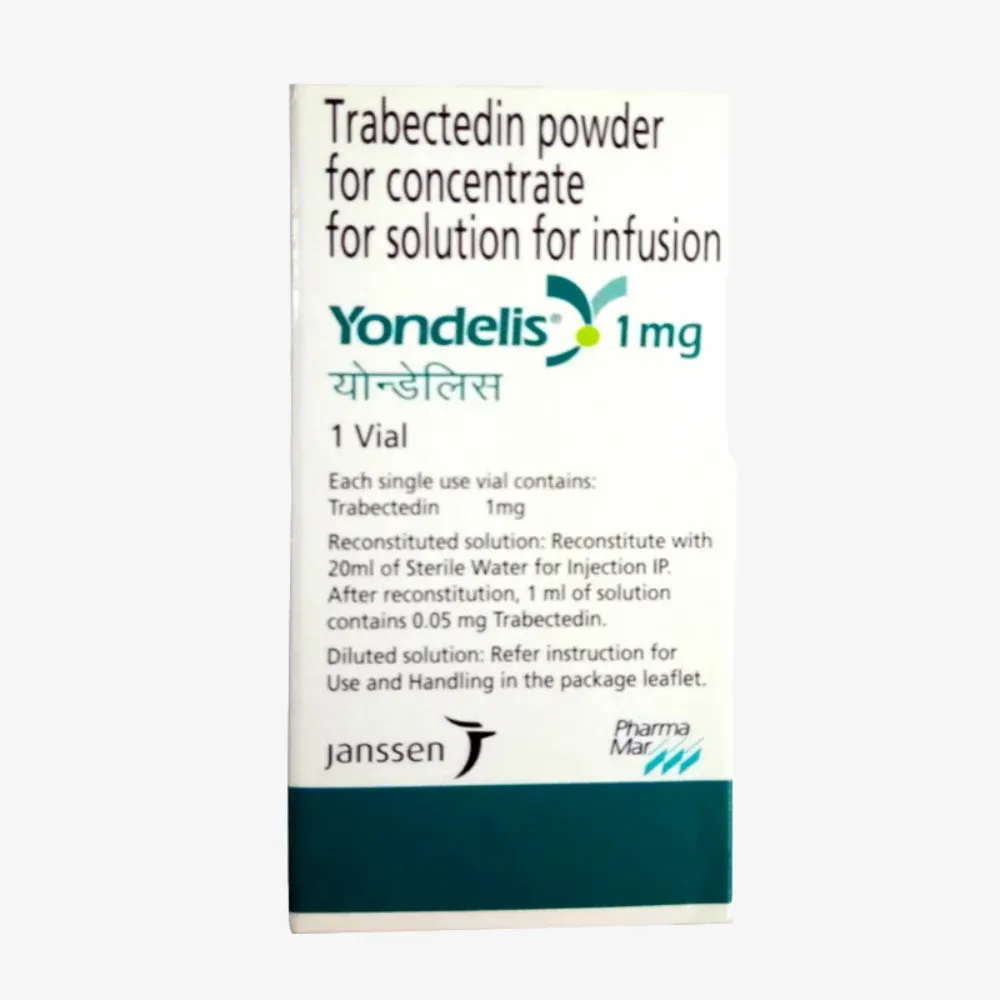
Table of Contents
- Package leaflet: Information for the patient
- Yondelis 0.25 mg powder for concentrate for solution for infusion, 1 mg powder for concentrate for solution for infusion.
- 1. What Yondelis is and what it is used for
- 2. What you need to know before using Yondelis
- 3. How to use Yondelis
- 4. Possible side effects
- 5. How to store Yondelis
- 6. Package contents and other information
- The following information is intended exclusively for healthcare professionals:
Package leaflet: Information for the patient
Yondelis 0.25 mg powder for concentrate for solution for infusion, 1 mg powder for concentrate for solution for infusion.
trabectedin
Please read this leaflet carefully before using this medicine because it contains important information for you.
- Keep this leaflet. You may need to read it again.
- If you have any questions, ask your doctor.
- If you experience any side effects, including those not listed in this leaflet, tell your doctor. See section 4.
Contents of this leaflet
- What Yondelis is and what it is used for
- What you need to know before using Yondelis
- How to use Yondelis
- Possible side effects
- How to store Yondelis
- Contents of the pack and other information
1. What Yondelis is and what it is used for
Yondelis contains the active substance trabectedin. Yondelis is an anticancer medicine that
prevents the multiplication of tumour cells.
Yondelis is used to treat patients with advanced soft tissue sarcoma who have not benefited from
other medicines or who cannot receive them. Soft tissue sarcoma is a malignant disease that arises
in any part of the soft tissues, such as muscles, fat or other tissues (e.g. cartilage or blood vessels).
Yondelis in combination with pegylated liposomal doxorubicin (PLD: another anticancer medicine)
is used to treat patients with recurrent (returned) ovarian cancer after at least one previous therapy,
and who are not resistant to platinum-containing anticancer medicines.
2. What you need to know before using Yondelis
Do not use Yondelis
- if you are allergic to trabectedin or to any of the other ingredients of this medicine (listed in section 6).
- if you have a severe infection.
- if you are breastfeeding.
- if you are scheduled to receive the yellow fever vaccine.
Warnings and precautions
Talk to your doctor before using Yondelis.
Yondelis, either alone or in combination with PLD, must not be used if you have severe liver, kidney, or heart damage.
Contact your doctor if you have or suspect any of the following conditions before starting treatment with Yondelis:
- Liver or kidney problems.
- Heart problems or a history of heart problems.
- Left ventricular ejection fraction (LVEF) below the lower limit of normal.
- If you have previously received treatment with high-dose anthracyclines.
Contact your doctor immediately if any of the following occur:
- If you develop fever, as Yondelis can cause adverse effects affecting blood and liver.
- If you experience general malaise, vomiting, or inability to drink fluids, accompanied by reduced urine output despite anti-nausea medication.
- If you experience severe muscle pain or weakness, which could be signs of muscle damage (rhabdomyolysis: see section 4).
- If the Yondelis solution leaks from the vein during infusion. This may cause tissue damage and destruction of cells around the injection site (tissue necrosis, see also section 4), which might require surgical removal of damaged tissue.
- If you experience an allergic reaction (hypersensitivity). In such a case, you may develop one or more of the following symptoms: fever, difficulty breathing, skin redness, flushing or rash, feeling unwell (nausea), or malaise (vomiting; see section 4).
- If you notice partial or generalized swelling (edema), possibly accompanied by dizziness, lightheadedness, or thirst (low blood pressure). This could be a sign of a condition (capillary leak syndrome) that causes excessive fluid accumulation in tissues and requires urgent medical evaluation.
Children and adolescents
Yondelis must not be used in children under 18 years of age with pediatric sarcomas.
Other medicines and Yondelis
Inform your doctor if you are taking, have recently taken, or might take any other medicines.
You must not use Yondelis if you are due to receive the yellow fever vaccine, and it is not recommended to use Yondelis if you are due to receive a vaccine containing live viral particles. The effect of medicines containing phenytoin (for epilepsy) may be reduced when taken together with Yondelis, and therefore this combination is not recommended.
If you are taking any of the following medicines during Yondelis treatment, close monitoring is required, as the effects of Yondelis may be:
- reduced (some examples include medicines containing rifampicin (for bacterial infections), phenobarbital (for epilepsy), or St John’s wort (Hypericum perforatum, a herbal remedy for depression)), or
- increased (some examples include medicines containing ketoconazole or fluconazole (for fungal infections), ritonavir (for human immunodeficiency virus, HIV, infections), clarithromycin (for bacterial infections), aprepitant (to prevent nausea and vomiting), cyclosporine (an immunosuppressant), or verapamil (for high blood pressure and heart conditions)).
Therefore, the use of any of these medicines with Yondelis should be avoided, if possible.
If you have been prescribed Yondelis or the combination Yondelis+PLD together with a medicine that may cause liver damage or muscle damage (rhabdomyolysis), close monitoring may be necessary, as there may be an increased risk of liver or muscle injury. Medicines containing statins (used to lower cholesterol levels and prevent cardiovascular disease) are an example of medicines that can cause muscle injury.
Yondelis and alcohol
Avoid drinking alcohol during treatment with Yondelis, as it may cause liver damage.
Pregnancy, breastfeeding and fertility
Pregnancy
Yondelis must not be used during pregnancy. If you are pregnant, suspect you may be pregnant, or are planning a pregnancy, consult your doctor before taking this medicine.
Women of childbearing potential must use effective contraception during treatment with Yondelis and for 8 months after treatment ends.
If you become pregnant, inform your doctor immediately. Genetic counselling is recommended, as Yondelis may cause genetic damage.
Breastfeeding
Yondelis must not be administered to patients who are breastfeeding. Therefore, you must stop breastfeeding before starting treatment and must not resume until your doctor confirms there is no risk.
Fertility
Men of reproductive potential must use effective contraception during treatment with Yondelis and for 5 months after treatment ends.
Patients are advised to consider possible preservation of oocytes and sperm before treatment due to the risk of irreversible infertility caused by Yondelis therapy.
Genetic counselling is also recommended for all patients wishing to have children after therapy.
Driving and using machines
During treatment with Yondelis, you may experience fatigue and loss of strength. Do not drive or operate tools or machinery if you experience these side effects.
Yondelis contains potassium
This medicine contains less than 1 mmol (39 mg) of potassium per vial, i.e., essentially ‘potassium-free’.
3. How to use Yondelis
Yondelis is administered under the supervision of a physician experienced in the use of chemotherapy.
Its use should be restricted to qualified oncologists or other healthcare professionals specialized in the administration of cytotoxic medicinal products.
For the treatment of soft tissue sarcoma, the usual dose is 1.5 mg/m² of body surface area. During the treatment period, your doctor will monitor you closely and determine the most appropriate dose of Yondelis for you. The recommended dose for Japanese patients is lower than the usual dose used in all other races and corresponds to 1.2 mg/m² of body surface area.
For the treatment of ovarian cancer, the usual dose is 1.1 mg/m² of body surface area, administered after PLD at a dose of 30 mg/m² of body surface area.
Before administration, Yondelis is reconstituted and diluted for intravenous infusion. Each time Yondelis is administered for the treatment of soft tissue sarcoma, it will take approximately 24 hours to complete the infusion into the bloodstream. For ovarian cancer treatment, the infusion will take 3 hours.
To avoid potential irritation at the injection site, administration of Yondelis through a central venous line is recommended.
You will be given certain medicinal products before treatment with Yondelis, and as needed, to protect the liver and reduce the risk of adverse effects such as nausea and vomiting.
The infusion is repeated every 3 weeks, although your doctor may occasionally recommend delaying administration to ensure you receive the appropriate dose of Yondelis.
The duration of the entire treatment period will depend on disease progression and your overall health status. Your doctor will decide how long the treatment should continue. If you have any doubts about how to use this medicine, consult your doctor.
4. Possible side effects
Like all medicines, this medicine, or its combination with PLD, may cause side effects, although not everybody experiences them.
If you have any doubts about the side effects listed below, please consult your doctor for a more detailed explanation.
Serious side effects caused by treatment with Yondelis:
Very common: may affect more than 1 in 10 people
- You may experience increased levels of the yellow pigment bilirubin in the blood, leading to jaundice (yellowing of the skin, mucous membranes, and eyes).
- Your doctor will prescribe regular blood tests to detect any blood abnormalities.
Common: may affect up to 1 in 10 people
- You may develop blood infections (sepsis) if your immune system is severely compromised. If you develop a fever, inform your doctor immediately.
- You may experience muscle pain (myalgia). Nerve damage may also occur, causing muscle pain, weakness, and tenderness. Generalized swelling, swelling of the limbs, and a sensation of chills on the skin may also occur.
- A reaction at the injection site may occur. The Yondelis infusion solution may leak from the vein during administration, causing damage and destruction of cells in the surrounding tissue (tissue necrosis; see also section 2 “Warnings and precautions”), which may require surgical intervention to remove the damaged tissue.
- You may have an allergic reaction. In this case, you may experience fever, difficulty breathing, skin redness, flushing or rash, feeling unwell (nausea), or vomiting.
- When Yondelis is used in combination with PLD, fainting (syncope) may occur. Additionally, you may feel that your heart is beating too hard or too fast (palpitations), weakness in the ventricles—the main heart chambers responsible for pumping (left ventricular dysfunction)—or a sudden blockage in a pulmonary artery (pulmonary embolism).
Uncommon: may affect up to 1 in 100 people
- Severe muscle pain, stiffness, and muscle weakness may occur. You may also notice dark-colored urine. All of the above effects may be signs of muscle damage (rhabdomyolysis).
- Your doctor may request blood tests in certain circumstances to prevent the development of muscle damage (rhabdomyolysis). In very severe cases, kidney failure may occur. If you experience severe muscle pain or weakness, contact your doctor immediately.
- You may experience difficulty breathing, irregular heartbeat, reduced urine output, sudden changes in mental status, skin patches, extremely low blood pressure associated with abnormal laboratory results (reduced platelet count). If you experience any of the symptoms or signs listed above, seek immediate medical attention.
- You may develop an abnormal accumulation of fluid in the lungs, causing swelling (pulmonary edema).
- You may notice partial or generalized swelling (edema) accompanied by possible dizziness, vertigo, or thirst (low blood pressure). This could be a sign of a condition (capillary leak syndrome) that causes excessive fluid buildup in tissues. If you experience any of the symptoms or signs listed above, seek immediate medical attention.
- Leakage of the Yondelis infusion solution from the vein (extravasation) may occur during infusion. In this case, you will notice redness, swelling, itching, and discomfort at the injection site. If you experience any of these symptoms or signs, inform your nurse or doctor immediately.
This situation may lead to damage or death of cells in the tissue surrounding the injection site (tissue necrosis), which may require surgical intervention.
Some symptoms or signs of extravasation may not be visible for several hours after they occur. The skin at the injection site may develop blisters, peeling, and dark discoloration. It may take several days before tissue damage becomes fully apparent. If you experience any of the symptoms or signs described above, seek immediate medical attention.
Rare: may affect up to 1 in 1,000 people
- You may experience yellowing of the skin and whites of the eyes (jaundice), pain in the upper right part of the abdomen, nausea, vomiting, general malaise, difficulty concentrating, disorientation or confusion, and drowsiness. These signs may indicate the liver’s inability to function properly. If you experience any of the symptoms or signs listed above, seek immediate medical attention.
Other less severe side effects
Very common: may affect more than 1 in 10 people
- You may:
- feel tired
- experience difficulty breathing and cough
- have back pain
- feel excess fluid in the body (edema)
- bruise very easily
- have nosebleeds
- be more prone to infections. An infection may also cause a rise in body temperature (fever). If you experience any of these symptoms, contact your doctor immediately.
- You may experience digestive symptoms such as loss of appetite, nausea or vomiting, abdominal pain, diarrhea, or constipation. If you continue to feel unwell, vomit, or are unable to drink fluids and produce less urine despite anti-nausea medication, contact your doctor immediately.
- Headache may occur.
- You may develop inflammation of mucous membranes, appearing as redness and swelling inside the mouth, leading to painful ulcers and inflammation of the mouth (stomatitis), or inflammation of the gastrointestinal tract when Yondelis is administered with PLD.
- Female patients receiving Yondelis together with PLD for ovarian cancer may also develop hand-foot syndrome. This may present as skin redness on the palms, fingers, and soles of the feet, which may later swell and turn purplish. The lesions may either dry out and peel or form blisters with ulcerations.
Common: may affect up to 1 in 10 people
- Fluid loss from the body, weight loss, digestive disturbances, and changes in taste may occur.
- You may lose your hair (alopecia).
- Dizziness, low blood pressure, flushing, or skin rash may occur.
- Female patients receiving Yondelis together with PLD for ovarian cancer may develop increased skin pigmentation.
- You may experience joint pain.
- Sleep disturbances may occur.
Reporting of side effects
If you experience any side effect, including those not listed in this leaflet, talk to your doctor. You can also report side effects directly via the national reporting system listed in Annex V. By reporting side effects, you can help provide more information on the safety of this medicine.
5. How to store Yondelis
Keep this medicine out of the sight and reach of children.
Do not use this medicine after the expiry date stated on the carton and on the label of the
vial. The expiry date refers to the last day of that month.
Store in a refrigerator (2 ºC – 8 ºC).
Information on the stability of reconstituted and diluted solutions is included in the section for
doctors and healthcare professionals.
Do not use this medicine if you notice visible particles after reconstitution or dilution.
Dispose of any unused product or waste material in accordance with local legal requirements.
6. Package contents and other information
What Yondelis contains
- The active substance is trabectidine. Yondelis 0.25 mg: Each vial of powder contains 0.25 mg of trabectedin. Yondelis 1 mg: Each vial of powder contains 1 mg of trabectedin.
- The other components are sucrose, potassium dihydrogen phosphate, phosphoric acid (for pH adjustment) and potassium hydroxide (for pH adjustment).
Description of the appearance of Yondelis and contents of the pack
Yondelis is a powder for concentrate for solution for infusion. The powder is white to off-white in colour and is contained in a glass vial.
Each carton contains 1 vial of either 0.25 mg or 1 mg of trabectedin.
Marketing Authorisation Holder and Manufacturer
Pharma Mar, S.A.
Avda. de los Reyes 1
Polígono Industrial La Mina
28770 Colmenar Viejo (Madrid)
Spain
Tel: +34 91 846 60 00
Fax: +34 91 846 60 01
For further information about this medicinal product, please contact the Marketing Authorisation Holder.
Other sources of information
More detailed information on this medicinal product is available on the website of the European Medicines Agency, https://www.ema.europa.eu.
__________________________________________________________________________________
The following information is intended exclusively for healthcare professionals:
Instructions for use, preparation, handling, and disposal
Appropriate procedures for the correct handling and disposal of cytotoxic medicinal products must be followed. Unused medicine and waste material derived from this medicine must be disposed of in accordance with local regulations for cytotoxic medicinal products.
Adequate training in the correct reconstitution and dilution techniques of Yondelis or its combination with PLD must be provided, and protective clothing including mask, gloves, and goggles must be worn during reconstitution and dilution. Any accidental contact with skin, eyes, or mucous membranes should be immediately treated with copious amounts of water. This medicine must not be handled during pregnancy.
Preparation for intravenous infusion
Yondelis must be reconstituted and then diluted prior to infusion (see also section 3).
Aseptic techniques must be strictly observed.
Yondelis must not be administered mixed in the same infusion with other medicinal products except its designated diluent. No incompatibilities have been observed between Yondelis and type I glass vials, polyvinyl chloride (PVC) and polyethylene (PE) bags and tubing, polysorbate reservoirs, or titanium implantable vascular access systems.
When Yondelis is used in combination with PLD, the intravenous line must be thoroughly flushed with 5% glucose infusion solution (50 mg/mL) after administration of PLD and before administration of Yondelis. The use of a diluent other than 5% glucose infusion solution (50 mg/mL) may cause precipitation of PLD. (For specific handling instructions, refer also to the Summary of Product Characteristics of PLD.)
Instructions for reconstitution
Yondelis 0.25 mg: Inject 5 mL of sterile water for injection into the vial.
Yondelis 1 mg: Inject 20 mL of sterile water for injection into the vial.
Use a syringe to inject the correct volume of sterile water for injection into the vial. Shake the vial until complete dissolution is achieved. The reconstituted solution is clear and colourless or slightly yellowish, essentially free from visible particles.
This reconstituted solution contains 0.05 mg/mL of trabectedin. It requires further dilution and is for single use only.
Instructions for dilution
Dilute the reconstituted solution with either 9 mg/mL (0.9%) sodium chloride solution or 50 mg/mL (5%) glucose solution for infusion. Calculate the required volume as follows:
Volume (mL) = BSA (m²) × dose (mg/m²)