Yimmugo
Italy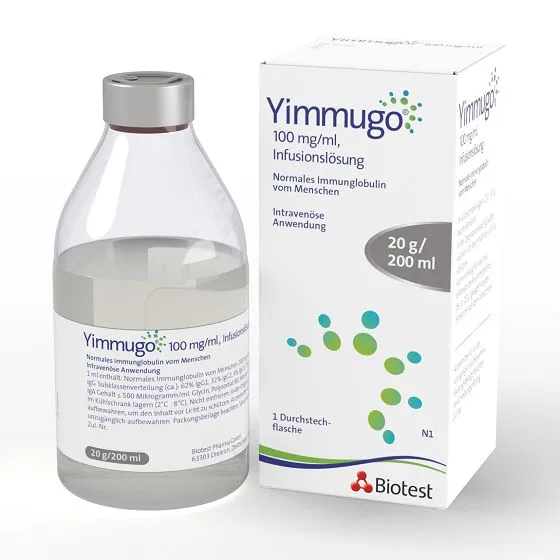
Table of Contents
- Package leaflet: Information for the user
- Yimmugo 100 mg/ml solution for infusion
- 1. What Yimmugo is and what it is used for
- 2. What you need to know before using Yimmugo
- 3. How to use Yimmugo
- 4. Possible side effects
- 5. How to store Yimmugo
- 6. Package contents and other information
- The following information is intended for healthcare professionals only:
Package leaflet: Information for the user
Yimmugo 100 mg/ml solution for infusion
Normal human immunoglobulin (IVIg)
This medicinal product is subject to additional monitoring. This will allow rapid identification of new safety information. You can help by reporting any side effects you experience while taking this medicine. See the end of section 4 for information on how to report side effects.
Please read all of this leaflet carefully before you start using this medicine because it contains important information for you.
- Keep this leaflet. You may need to read it again.
- If you have any questions, ask your doctor, pharmacist or nurse.
- If you get any side effects, including those not listed in this leaflet, talk to your doctor, pharmacist or nurse. See section 4.
Contents of this leaflet
- What Yimmugo is and what it is used for
- What you need to know before you use Yimmugo
- How to use Yimmugo
- Possible side effects
- How to store Yimmugo
- Contents of the pack and other information
1. What Yimmugo is and what it is used for
Yimmugo
- belongs to a class of medicines called "normal human immunoglobulins". These medicines contain human antibodies, which are also present in your blood. Antibodies can help the body prevent and fight infections.
Yimmugo is used to treat adults, children and adolescents (0–18 years of age) who do not have sufficient antibodies (replacement therapy):
- Patients born with an antibody deficiency (primary immunodeficiency syndromes, PID)
- Acquired antibody deficiency (secondary immunodeficiency syndrome, SID) in patients suffering from severe or recurrent infections and ineffective antimicrobial treatment, with documented deficiency of specific antibodies or low levels of immunoglobulin G (< 4 g/l)
Yimmugo is also used to treat adults, children and adolescents (0–18 years of age) with inflammatory diseases (immunomodulation), such as:
- Patients with low platelet count in the blood (primary immune thrombocytopenia, ITP) who will undergo surgery in the near future or who are at risk of bleeding
- Patients affected by a disease associated with multiple inflammations of the peripheral nerves (Guillain-Barré syndrome)
- Patients affected by a disease causing inflammation in various organs of the body, particularly blood vessels (Kawasaki disease)
- Patients affected by a chronic disease characterized by inflammation of the peripheral nerves. This disease causes muscle weakness and/or numbness, mainly in the legs and upper limbs (chronic inflammatory demyelinating polyneuropathy, CIDP)
- Patients affected by a motor nerve disease, characterized by slowly progressive weakness of the arms and legs (multifocal motor neuropathy, MMN)
2. What you need to know before using Yimmugo
Do not use Yimmugo
- if you are allergic to human immunoglobulins or to any of the other ingredients of this medicine (listed in section 6).
- if you have insufficient levels of immunoglobulin A (IgA), particularly if you have antibodies in your blood directed against IgA. This may lead to severe allergic reactions (anaphylaxis).
Warnings and precautions
Before using this medicine:
Talk to your doctor, pharmacist, or nurse before using Yimmugo:
- if you have an active infection or underlying chronic inflammation
- if you are allergic to immunoglobulins (see section "Do not use Yimmugo")
- if you have or have had kidney disease
- if you have been given medicines that may damage the kidneys
Very rarely, immunoglobulins may increase the risk of heart attack, stroke, pulmonary embolism, or deep vein thrombosis. Talk to your doctor, pharmacist, or nurse:
- if you are overweight, elderly, or diabetic
- if you have high blood pressure, reduced blood volume (hypovolemia), or thicker blood than normal (high blood viscosity)
- if you have been confined to bed for a long time, have blood vessel problems (vascular diseases), or other risk factors for thrombotic events (blood clots)
In all these cases, your doctor will monitor you particularly closely.
Monitoring will be required during and after the infusion:
- if you have never received this medicine before or if a long time has passed (e.g. several weeks) since your last dose (post-infusion monitoring: at least 1 hour by the doctor or nurse)
- if you have recently received Yimmugo (post-infusion monitoring: at least 20 minutes by the doctor or nurse)
It may be necessary to slow down or stop the infusion:
- if during the infusion you experience symptoms such as headache, flushing, chills, muscle pain, wheezing, rapid heartbeat, back pain, nausea, and low blood pressure. Rarely, these are signs of an allergic reaction. Another possibility is that the infusion rate is too high and needs to be reduced (in this case, it is referred to as an infusion-related reaction). Inform your doctor immediately of any symptoms occurring during the infusion.
- if you have severe difficulty breathing (respiratory distress), rapid breathing (tachypnea), abnormally low oxygen levels in the blood (hypoxia), and an increase in body temperature (fever). These are symptoms of transfusion-related acute lung injury (TRALI). TRALI occurs very rarely after administration of immunoglobulins. This condition causes fluid accumulation, not due to heart problems, in the air spaces of the lungs (non-cardiogenic pulmonary edema). Symptoms typically appear 1 to 6 hours after treatment. Inform your doctor immediately if you notice such reactions during Yimmugo infusions. The doctor will stop the infusion immediately.
- if you develop fever, neck pain, and headache. These are symptoms of aseptic meningitis syndrome (AMS, inflammation of the membrane covering the brain and spinal cord). AMS has been reported in association with immunoglobulin infusion. Discontinuation of immunoglobulin treatment has led to resolution of AMS within a few days, without further consequences. Your doctor can provide you with more information about this condition and its symptoms.
Depending on your condition, your doctor will determine the appropriate infusion rate and duration of treatment, and decide whether treatment with Yimmugo should be stopped and/or whether other medical measures should be taken.
Effects on red blood cells and blood tests
- This medicine may contain antibodies directed against blood groups. Rarely, these may increase the risk of red blood cell breakdown (hemolysis). Your doctor will monitor for clinical signs and symptoms of hemolysis and hemolytic anemia.
- Low levels of white blood cells (neutropenia) have been reported with immunoglobulins. This condition resolves spontaneously within 7–14 days. Your doctor can provide you with more information about the symptoms.
- For a certain period, Yimmugo may affect blood test results. Before undergoing any blood tests, inform your doctor that you are being treated with Yimmugo.
Safety information regarding infections
Yimmugo is produced from human plasma (the liquid part of blood). For medicines derived from human blood or plasma, all necessary measures are taken to prevent transmission of infectious agents to patients through administration of these medicines. All blood donors are tested for viruses and infections. In addition, the processing of blood or plasma includes steps for virus inactivation or removal.
Despite these precautionary measures, when medicines derived from human blood or plasma are administered, the risk of transmitting infections can never be completely ruled out.
The measures taken are considered effective against enveloped viruses, such as:
- human immunodeficiency virus (HIV)
- hepatitis B virus (HBV)
- hepatitis C virus (HCV)
- hepatitis A virus (HAV)
- parvovirus B19
Doctors are strongly recommended to record the name and batch number of the product each time a dose of Yimmugo is administered to you. The batch number provides information about the specific starting material used for the medicine. If necessary, this allows tracing back to the starting material used for you.
Children and adolescents
The warnings and special precautions listed for adults also apply to children and adolescents.
Other medicines and Yimmugo
Inform your doctor if you are taking, have recently taken, or might take any other medicines.
Yimmugo may reduce the effectiveness of certain vaccines, such as those for:
- measles
- rubella
- mumps
- chickenpox
It may be necessary to wait up to 3 months before receiving certain vaccines, and up to 1 year before receiving the measles vaccine.
Do not use loop diuretics (medicines that increase fluid excretion by the kidneys) together with Yimmugo.
Pregnancy, breastfeeding, and fertility
If you are pregnant, think you may be pregnant, are planning to become pregnant, or are breastfeeding, ask your doctor for advice before taking this medicine.
Your doctor will decide whether Yimmugo can be used during pregnancy and breastfeeding.
Driving and using machines
Yimmugo has a slight influence on the ability to drive and use machines. If you experience reactions such as nausea or dizziness, you should wait until these symptoms have disappeared before driving or operating machinery.
3. How to use Yimmugo
Posology and method of administration
Yimmugo is intended for intravenous use only (intravenous infusion) and will be administered to you by a doctor or nurse. The doctor will determine the dose, frequency, and infusion rate based on your condition and body weight. The product must be brought to room temperature or body temperature before use.
At the beginning of treatment, the infusion rate will be slow. Subsequently, if you tolerate it well, the doctor or nurse may gradually increase the infusion rate.
Use in children and adolescents
The use in children and adolescents (0–18 years of age) is the same as in adults.
If an infusion is not administered
Consult your doctor to determine how to proceed.
If you have been given more Yimmugo than you should have
Your blood may become too thick (hyperviscosity). This is particularly possible in children, elderly patients, or in case of heart or kidney problems. Remember to drink adequate amounts of fluids to avoid dehydration, and inform your doctor of any medical problems.
If you have any doubts about the use of this medicine, consult your doctor or nurse.
4. Possible side effects
Like all medicines, this medicine can cause side effects, although not everybody gets them.
Immediately inform your doctor if you notice any of the following effects:
- skin rash
- itching
- wheezing
- difficulty breathing
- swelling of the eyelids, face, lips, throat or tongue
- extremely low blood pressure with symptoms such as dizziness, confusion, fainting, rapid pulse
These may be signs of an allergic reaction or, in rare cases, a severe allergic reaction (anaphylactic shock) or a hypersensitivity reaction.
The following side effects were reported during controlled clinical studies with Yimmugo.
The frequencies listed below were calculated based on the number of treated patients.
Very common (may affect more than 1 in 10 people)
- headache
Common (may affect up to 1 in 10 people)
- dizziness
- fatigue (tiredness), chills, fever
- nausea, abdominal pain or mouth pain
- increased blood pressure, positive Coombs test
- skin reaction
- back pain, pain in arms and legs
- difficulty breathing (dyspnea), mouth and throat pain (oropharyngeal pain)
- reduction in white blood cells (neutropenia), reduction in red blood cells (haemolysis)
- difficulty maintaining balance (vertigo), ringing in the ears (tinnitus)
- allergic/anaphylactic reaction
- confusion
- hot flushes
Immunoglobulin-containing products in general may also cause the following side effects (in order of decreasing frequency):
- vomiting, joint pain and low blood pressure
- reduction in red blood cells due to their breakdown in blood vessels (haemolytic reactions (reversible)) and haemolytic anaemia requiring transfusion
- sudden drop in blood pressure and, in isolated cases, anaphylactic shock
- temporary skin reactions (including cutaneous lupus erythematosus)
- formation of blood clots that may enter the circulation (thromboembolic reactions) causing heart attack (myocardial infarction), stroke, clots in the lung vessels (pulmonary embolism), clots in a vein (deep vein thrombosis)
- cases of transient acute inflammation of the protective membranes covering the brain and spinal cord (reversible aseptic meningitis)
- blood test results indicating impaired kidney function and/or sudden kidney failure
- cases of transfusion-related acute lung injury (TRALI), see also section “Warnings and precautions”
Reporting of side effects
If you experience any side effect, including those not listed in this leaflet, talk to your doctor, pharmacist or nurse. You can also report side effects directly via the national reporting system.
By reporting side effects, you can help provide more information on the safety of this medicine.
5. How to store Yimmugo
Keep this medicine out of the sight and reach of children.
Do not use this medicine after the expiry date which is stated on the label and carton after
Exp.
Store in a refrigerator (2°C – 8°C). Do not freeze. Keep in the original packaging to protect the medicine from light.
Yimmugo may be stored at room temperature (up to 25°C) for a single period not exceeding 6 months. Record the date of starting storage of Yimmugo at room temperature on the product carton. Do not return Yimmugo to the refrigerator after it has been stored at room temperature.
After first opening, immediate use is recommended.
Do not use this medicine if the solution is cloudy or contains particles.
Do not dispose of any medicine via wastewater or household waste. Ask your pharmacist how to dispose of medicines no longer required. This will help protect the environment.
6. Package contents and other information
What Yimmugo contains
- The active substance is human normal immunoglobulin. 1 ml contains 100 mg of human normal immunoglobulin (purity: at least 96% IgG). The IgG subclass distribution is approximately 62% IgG1, 32% IgG2, 4% IgG3 and 1% IgG4. The maximum IgA content is 500 micrograms/ml.
- The other components are: glycine, polysorbate 80 and water for injections.
Description of the appearance of Yimmugo and contents of the container
Yimmugo is a solution for infusion. The solution should be clear or slightly opalescent and colourless to pale yellow.
50 ml, 100 ml or 200 ml of solution in a vial (Type II glass) with a stopper (bromobutyl) and a flip-off seal (plastic).
Pack: 1 vial containing 50 ml, 100 ml or 200 ml of solution.
Pack: 3 vials containing 100 ml or 200 ml of solution.
Not all pack sizes may be marketed.
Marketing Authorisation Holder and Manufacturer
Biotest Pharma GmbH
Landsteinerstrasse 5
63303 Dreieich
Germany
Tel.: +49 6103 801-0
Fax: +49 6103 801-150
E-mail: [email protected]
<------------------------------------------------------------------------------------------------------------------------>
The following information is intended for healthcare professionals only:
Dosage
The recommended dosages are summarized in the table below:
| Indication | Dose | Frequency of infusions |
| Replacement therapy: | ||
| Primary immunodeficiency syndromes | Initial dose: 0.4–0.8 g/kg Maintenance dose: 0.2–0.8 g/kg | every 3-4 weeks |
| Secondary immunodeficiencies (as defined in section 4.1) | 0.2–0.4 g/kg | every 3-4 weeks |
| Immunomodulation: | ||
| Primary immune thrombocytopenia | 0.8–1 g/kg or 0.4 g/kg/day | day 1, possibly repeated once within 3 days for 2–5 days |
| Guillain-Barré syndrome | 0.4 g/kg/day | for 5 days |
| Kawasaki disease | 2 g/kg | single dose in combination with acetylsalicylic acid |
| Chronic inflammatory demyelinating polyneuropathy (CIDP) | Initial dose: 2 g/kg Maintenance dose: 1 g/kg | divided over 2–5 days every 3 weeks; divided over 1–2 days |
| Multiple mononeuropathy (MMN) | Initial dose: 2 g/kg Maintenance dose: 1 g/kg or 2 g/kg | divided over 2–5 consecutive days every 2–4 weeks or every 4–8 weeks divided over 2–5 days |
Method of administration
Intravenous use.
Infuse Yimmugo intravenously at an initial rate not exceeding 0.3 ml/kg/h for 30 minutes. See section 2. In case of adverse reactions, reduce the infusion rate or interrupt the infusion. If well tolerated, the infusion rate may be gradually increased up to a maximum of 2 ml/kg/h during the first infusion. For subsequent infusions, if well tolerated, the infusion rate may be gradually increased up to a maximum of 6 ml/kg/h.
Replacement therapy:
In patients who have well tolerated an infusion rate of 6 ml/kg/h, this may be gradually increased up to a maximum of 8 ml/kg/h.
Incompatibilities
In the absence of compatibility studies, this medicinal product must not be mixed with other medicinal products or with other IVIg-based products.