Yellox
Italy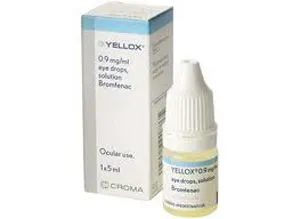
Table of Contents
Patient Information Leaflet: Instructions for the User
Yellox 0.9 mg/ml Eye Drops, Solution
Bromfenac
Please read this leaflet carefully before using this medicine, as it contains important information for you.
- Keep this leaflet. You may need to read it again.
- If you have any questions, consult your doctor or pharmacist.
- This medicine has been prescribed for you only. Do not give it to others, even if their symptoms are the same as yours, as it may be harmful.
- If you experience any side effects, including those not listed in this leaflet, contact your doctor or pharmacist. See section 4.
Contents of this leaflet:
- What Yellox is and what it is used for
- What you need to know before using Yellox
- How to use Yellox
- Possible side effects
- How to store Yellox
- Contents of the pack and other information
1. What Yellox is and what it is used for
Yellox contains bromfenac and belongs to a group of medicines called non-steroidal anti-inflammatory drugs (NSAIDs). Yellox works by blocking certain substances that cause inflammation.
Yellox is used to reduce eye inflammation following cataract surgery in adults.
2. What you need to know before using Yellox X
Do not use Yellox
- if you are allergic to bromfenac or to any of the other ingredients of this medicine (listed in section 6).
- if in the past you have experienced asthma, skin allergy, or severe nasal inflammation while taking other NSAIDs. Examples of NSAIDs include acetylsalicylic acid, ibuprofen, ketoprofen, and diclofenac.
Warnings and precautions
Talk to your doctor or pharmacist before using this medicine if:
- you are using topical steroids (e.g. cortisone), as this may cause unwanted side effects.
- you have bleeding disorders (e.g. haemophilia) or have had them in the past, or if you are taking other medicines that may prolong bleeding time (e.g. warfarin, clopidogrel, acetylsalicylic acid).
- you have eye problems (e.g. dry eye syndrome, corneal disorders).
- you have diabetes.
- you have rheumatoid arthritis.
- you have undergone repeated eye surgeries within a short period of time.
The use of contact lenses is not recommended after cataract surgery. Therefore, do not wear contact lenses while using Yellox.
Children and adolescents
Yellox must not be used in children and adolescents.
Other medicines and Yellox
Inform your doctor or pharmacist if you are currently taking, have recently taken, or might take any other medicines.
Pregnancy, breastfeeding and fertility
If you are pregnant, suspect you may be pregnant, are planning to become pregnant, or are breastfeeding, consult your doctor or pharmacist before using Yellox.
Yellox must not be used during the last three months of pregnancy. It should also not be used during the first six months of pregnancy unless strictly necessary and advised by your doctor. If treatment is required during this period, the lowest effective dose for the shortest possible duration should be used.
Oral forms (e.g. tablets) of similar medicines may cause adverse effects in the unborn baby. It is not known whether the same risk applies to Yellox when used in the eye.
Yellox may be prescribed during breastfeeding and is not expected to have a relevant effect on fertility.
Driving and use of machines
After using this eye drop, your vision may be blurred for a short time. If you experience blurred vision after using the drops, do not drive or operate machinery until your vision is clear again.
Yellox contains benzalkonium chloride
This medicine contains 0.00185 mg of benzalkonium chloride per single drop, equivalent to 0.05 mg/ml.
Benzalkonium chloride may be absorbed by soft contact lenses and may cause a change in their colour. Remove your contact lenses before using this medicine and wait 15 minutes before reinserting them.
Benzalkonium chloride may also cause eye irritation, especially if you have dry eye or corneal disorders (the transparent outer layer of the eye). If you experience any unusual sensation, burning, or pain in the eye after using this medicine, speak to your doctor.
3. How to use Yellox
Use this medicine exactly as instructed by your doctor. If you have any doubts, consult your doctor or pharmacist.
Dosage
The recommended dose is one drop of Yellox in the eye or eyes that have undergone cataract extraction, twice daily (morning and evening). Do not use more than one drop in the eye or eyes twice a day.
Begin using the drops the day after cataract surgery.
Method of administration
Yellox is for ophthalmic use only.
- Wash your hands before using the eye drops.
- Adopt a comfortable and stable position.
- Unscrew the closure cap of the bottle.
- Hold the bottle upside down between your thumb and other fingers.
- Tilt your head backward.
- Gently pull down the lower eyelid with a clean finger.
- Bring the tip of the bottle close to the eye.
- Do not touch the dropper tip to the eye, eyelid, surrounding areas, or any other surfaces.
- Gently press the bottle to release one drop of Yellox.
- Immediately after use, tightly replace the closure cap.
- Keep the bottle tightly closed when not in use.
If you are using any other eye drops, wait at least five minutes between applying Yellox and the other eye drops.
Duration of treatment
Continue using the eye drops during the first 2 weeks after surgery. Do not use Yellox for more than 2 weeks.
If you use more Yellox than you should
Rinse the eye with warm water. Do not apply further drops until the time of the next scheduled dose. In case of accidental ingestion of Yellox, drink a glass of water or another liquid to dilute the medicine.
If you forget to use Yellox
Apply a single dose as soon as you remember. If it is almost time for the next dose, skip the missed dose. Continue with the next dose at the regular time. Do not use a double dose to make up for a forgotten dose.
If you stop using Yellox
Do not stop using Yellox without consulting your doctor.
After discontinuation of Yellox, in rare cases a recurrence of the inflammatory response has been observed, for example as swelling of the retina, following cataract surgery.
If you have any doubts about how to use Yellox, consult your doctor or pharmacist.
4. Possible side effects
Like all medicines, this medicine can cause side effects, although not everyone experiences them.
If you notice a reduction or blurring of vision within the week following the end of treatment, contact your doctor immediately.
Contact your doctor immediately if you experience any of the following side effects while using the eye drops.
Uncommon side effects (may affect up to 1 in 100 people)
Sensation of a foreign body in the eye, redness and inflammation of the eye, damage and inflammation of the eye surface, eye discharge, itching, irritation or eye pain, swelling or bleeding of the eyelid, visual disturbances due to inflammation, floating or moving spots in front of the eyes or reduced vision, which may indicate bleeding or damage to the back of the eye (retina), eye discomfort, light sensitivity, reduced or blurred vision, facial swelling, cough, nosebleeds or runny nose.
Rare side effects (may affect up to 1 in 1,000 people)
Damage to the eye surface, redness of the eye, asthma.
Reporting of side effects
If you experience any side effect, contact your doctor or pharmacist.
This includes any possible side effect not listed in this leaflet. You can also report side effects directly via the national reporting system listed in Annex V.
By reporting side effects, you can help provide more information on the safety of this medicine.
5. How to store Yellox
Keep this medicine out of the sight and reach of children.
Do not use this medicine after the expiry date stated on the bottle and the outer carton after "EXP". The expiry date refers to the last day of that month.
Do not store above 25°C.
To avoid infections, discard the bottle 4 weeks after first opening, even if there is some solution remaining.
Write the date of opening on the carton label, in the designated space.
Do not dispose of medicines via wastewater or household waste. Ask your pharmacist how to dispose of medicines no longer required. This will help protect the environment.
6. Package contents and other information
What Yellox contains
- The active substance is bromfenac. One ml of solution contains 0.9 mg of bromfenac (as sesquihydrate sodium). One drop contains approximately 33 micrograms of bromfenac.
- The other excipients are: boric acid, borax, anhydrous sodium sulfite (E221), benzalkonium chloride (see section 2), tiloxapol, povidone (K30), edetate disodium, water for injections, sodium hydroxide (to adjust and maintain pH).
Description of the appearance of Yellox and contents of the pack
Yellox is a clear yellow liquid (solution) supplied in a pack containing one plastic bottle of 5 ml with a screw cap.
Marketing Authorisation Holder
Bausch + Lomb Ireland Limited
3013 Lake Drive
Citywest Business Campus
Dublin 24, D24PPT3
Ireland
Manufacturer
Dr. Gerhard Mann
Chem.-pharm. Fabrik GmbH
Brunsbütteler Damm 165/173
13581 Berlin
Germany
More detailed information on this medicinal product is available on the website of the European Medicines Agency: http://www.ema.europa.eu.
ANNEX IV
SCIENTIFIC CONCLUSIONS AND GROUNDS FOR THE VARIATION TO THE TERMS OF THE MARKETING AUTHORISATION
Scientific conclusions
Taking into account the assessment by the Pharmacovigilance and Risk Assessment Committee (PRAC) of the Periodic Safety Update Report (PSUR) for bromfenac, the PRAC's scientific conclusions are as follows:
In view of the available data on risks associated with use during pregnancy from literature and spontaneous reports within the same class, and considering a plausible mechanism of action, the PRAC considers that a causal relationship between bromfenac and risks associated with use during pregnancy is at least a reasonable possibility. The PRAC concluded that product information for medicinal products containing bromfenac should be amended accordingly.
Having reviewed the PRAC recommendation, the Committee for Human Medicinal Products (CHMP) agrees with the general conclusions and the rationale of the recommendation.
Grounds for the variation to the terms of the marketing authorisation
Based on the scientific conclusions on bromfenac, the CHMP considers that the benefit-risk balance of bromfenac remains favourable, subject to the proposed amendments to the product information.
The CHMP recommends a variation to the terms of the marketing authorisation.