Yasnal
Italy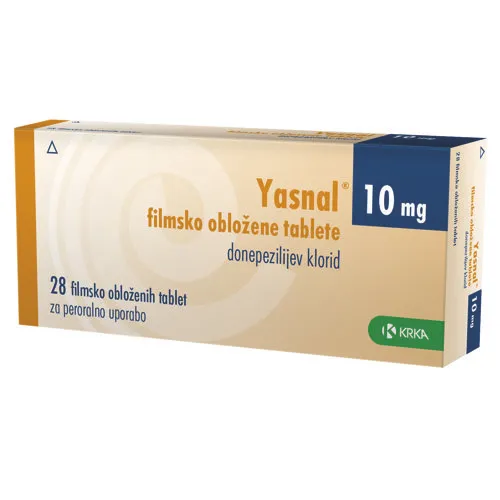
Table of Contents
- Package leaflet: Information for the user
- Yasnal 5 mg film-coated tablets, 10 mg film-coated tablets
- 1. What Yasnal is and what it is used for
- 2. What you need to know before taking Yasnal
- 3. How to take Yasnal
- 4. Possible side effects
- 5. How to store Yasnal
- 6. Package contents and other information
Package leaflet: Information for the user
Yasnal 5 mg film-coated tablets, 10 mg film-coated tablets
Donepezil hydrochloride
Generic medicine
Please read this leaflet carefully before taking this medicine because it contains
important information for you.
- Keep this leaflet. You may need to read it again.
- If you have any questions, ask your doctor or pharmacist.
- This medicine has been prescribed for you only. Do not give it to other people, even if their symptoms are the same as yours, as it may be harmful.
- If any adverse reaction occurs, including those not listed in this leaflet, contact your doctor or pharmacist. See section 4.
Contents of this leaflet:
- What Yasnal is and what it is used for
- What you need to know before taking Yasnal
- How to take Yasnal
- Possible side effects
- How to store Yasnal
- Contents of the pack and other information
1. What Yasnal is and what it is used for
Yasnal (donepezil hydrochloride) belongs to a group of medicines called acetylcholinesterase inhibitors. Donepezil increases the levels of a substance (acetylcholine) in the brain involved in memory function, by slowing its breakdown.
It is used for the treatment of dementia symptoms in patients with a diagnosis of mild to moderately severe Alzheimer's disease. Symptoms include increasing memory loss, confusion, and changes in behaviour. As a result, patients affected by Alzheimer's disease find it increasingly difficult to carry out their normal daily activities.
The use of Yasnal is restricted to adult patients.
2. What you need to know before taking Yasnal
Do not take Yasnal
- if you are allergic to donepezil hydrochloride, piperidine derivatives, or any of the excipients of this medicine (listed in section 6).
Warnings and precautions
Tell your doctor or pharmacist before taking Yasnal if you have or have had:
- stomach or duodenal ulcers,
- epileptic seizures or convulsions,
- heart disease (irregular or very slow heartbeat),
- asthma or other long-term lung diseases,
- liver problems or hepatitis,
- difficulty passing urine or mild kidney disease,
- any involuntary or abnormal movements of the tongue, face, or body (extrapyramidal symptoms). Yasnal may induce or worsen extrapyramidal symptoms.
If you are about to undergo surgery requiring general anaesthesia, you must inform your doctor and anaesthetist that you are taking Yasnal, as your medicine may affect the amount of anaesthetic required.
Yasnal can be used in patients with kidney disease or mild to moderate liver disease.
Inform your doctor beforehand if you have kidney or liver disease. Patients with severe liver disease must not take Yasnal.
In case of unexplained liver dysfunction, your doctor may consider discontinuing treatment with Yasnal.
Inform your doctor or pharmacist about the name of the person who cares for you. This person can help you take the medicine as prescribed by your doctor.
Other medicines and Yasnal
Tell your doctor or pharmacist if you are taking, have recently taken, or might take any other medicines, including those obtained without a prescription. This also applies to medicines you may take in the future while continuing Yasnal. These medicines may weaken or strengthen the effects of Yasnal.
In particular, inform your doctor if you are taking any of the following types of medicines:
- other medicines for Alzheimer's disease, e.g. galantamine or rivastigmine,
- painkillers or treatments for arthritis, e.g. aspirin, non-steroidal anti-inflammatory drugs (NSAIDs) such as ibuprofen or sodium diclofenac,
- anticholinergic medicines, e.g. tolterodine,
- antibiotics, e.g. erythromycin, rifampicin,
- antifungal medicines, e.g. ketoconazole or itraconazole,
- antidepressants, e.g. fluoxetine,
- anticonvulsants, e.g. phenytoin, carbamazepine,
- medicines for heart conditions, e.g. quinidine, beta-blockers (propranolol and atenolol),
- muscle relaxants, e.g. diazepam, succinylcholine,
- general anaesthetics,
- medicines obtained without prescription, e.g. herbal remedies.
Yasnal with food and drink and alcohol
Food does not affect the effects of Yasnal.
Yasnal must not be taken with alcohol, as alcohol may alter its effects.
Pregnancy, breastfeeding and fertility
If you are pregnant, think you might be pregnant, are planning to become pregnant, or are breastfeeding, consult your doctor or pharmacist before taking this medicine.
Yasnal must not be used during breastfeeding.
Driving and using machines
Alzheimer's disease may impair your ability to drive or operate machinery, so you should not engage in these activities unless your doctor tells you that it is safe to do so.
In addition, your medicine may cause fatigue, dizziness, and muscle cramps. If you experience any of these effects, you must not drive or operate machinery.
Yasnal contains lactose.
If your doctor has diagnosed you with an intolerance to certain sugars, contact him or her before taking this medicine.
3. How to take Yasnal
Take this medicine exactly as directed by your doctor or pharmacist. If
you have any doubts, consult your doctor or pharmacist.
How much Yasnal should you take?
You will usually start by taking 5 mg (one white tablet) each evening. After one month, your doctor may
instruct you to take 10 mg (one yellow tablet) each evening.
Swallow your Yasnal tablet with a glass of water before going to bed.
The tablet dosage may be adjusted depending on the duration of treatment and your doctor's
recommendations. The maximum recommended dose is 10 mg each evening.
If you have liver problems, your doctor may adjust your dose according to your needs (see section
2 "Warnings and precautions").
Always follow your doctor’s or pharmacist’s advice on how and when to take your medicine.
Do not change the dose on your own without consulting your doctor.
How long should you take Yasnal?
Your doctor or pharmacist will advise you on how long you should continue taking the tablets.
You will need to see your doctor from time to time to review your treatment and assess your symptoms.
If you take more Yasnal than you should
DO NOT take more than one tablet per day. Call your doctor immediately if you take more
tablets than prescribed. If you cannot contact your doctor, contact immediately the emergency department of your local hospital. Always bring the tablets and the pack with you to hospital so that the
doctors know what you have taken.
Symptoms of overdose include nausea and vomiting, salivation, sweating, slowed heartbeat, low
blood pressure (feeling of light-headedness or dizziness when standing), breathing difficulties, loss of
consciousness, and epileptic seizures or convulsions.
If you forget to take Yasnal
If you forget to take a tablet, take one tablet the following day at your usual time. Do
not take a double dose to make up for the forgotten dose.
If you forget to take the medicine for more than one week, call your doctor before taking it again.
If you stop taking Yasnal
Do not stop taking the tablets unless your doctor tells you to. If you stop taking Yasnal, the benefits of
your treatment will gradually disappear.
If you have any questions about the use of this medicine, consult your doctor or pharmacist.
4. Possible side effects
Like all medicines, this medicine can cause side effects, although not everyone gets them.
The following side effects have been reported in patients taking Yasnal.
Inform your doctor if you develop any of these side effects while taking Yasnal.
Serious side effects:
You must contact your doctor immediately if you notice any of the serious side effects listed below. You may require urgent medical treatment.
- Fever with muscle stiffness, sweating, or reduced level of consciousness (a condition called "Neuroleptic Malignant Syndrome") (may affect fewer than 1 in 10,000 people).
- Muscle weakness, tenderness, or pain, especially if you also feel unwell, have a high fever, or have dark urine. These may be caused by abnormal muscle breakdown, which can be life-threatening and lead to kidney problems (a condition called rhabdomyolysis) (may affect fewer than 1 in 10,000 people).
- Liver damage, e.g. hepatitis. Symptoms of hepatitis include nausea and vomiting, loss of appetite, general malaise, fever, itching, yellowing of the skin and eyes (jaundice), and dark-coloured urine (may affect up to 1 in 100 people).
- Gastric or duodenal ulcers. Symptoms of ulcer include stomach pain and discomfort (indigestion) between the navel and the breastbone (may affect up to 1 in 100 people).
- Bleeding in the stomach or intestines. This may cause passage of dark stools or visible blood from the rectum (may affect up to 1 in 100 people).
- Epileptic seizures or convulsions (may affect up to 1 in 100 people).
Very common side effects (may affect more than 1 in 10 people):
- Diarrhoea,
- feeling unwell (nausea),
- headache.
Common side effects (may affect up to 1 in 10 people):
- Muscle cramps,
- fatigue,
- difficulty sleeping (insomnia),
- common cold,
- loss of appetite,
- hallucinations (seeing or hearing things that are not real),
- unusual dreams including nightmares,
- agitation,
- aggressive behaviour,
- fainting,
- dizziness,
- being sick (vomiting),
- feeling of stomach discomfort,
- rash,
- itching,
- involuntary passage of urine,
- pain,
- accidents (patients may be more prone to falls or accidental injuries).
Uncommon side effects (may affect up to 1 in 100 people):
- Slow heart rate,
- mild increases in serum levels of a muscle enzyme (creatine kinase).
Rare side effects (may affect up to 1 in 1,000 people):
- Stiffness, tremor, or uncontrollable movements, particularly of the face and tongue, but also of the limbs,
- disturbances in the heart's electrical conduction system (sinoatrial block, atrioventricular block).
Reporting of side effects
If you get any side effects, including ones not listed in this leaflet, talk to your doctor or pharmacist.
You can also report side effects directly via the national reporting system at
www.agenziafarmaco.gov.it/content/come-segnalare-una-sospetta-reazione-avversa.
By reporting side effects, you can help provide more information on the safety of this medicine.
5. How to store Yasnal
Keep this medicine out of the sight and reach of children.
Do not use this medicine after the expiry date which is stated on the packaging after "EXP.". The expiry date refers to the last day of that month.
This medicine does not require any special storage conditions.
Do not dispose of any medicine via wastewater or household waste. Ask your pharmacist how to dispose of medicines you no longer use. This will help protect the environment.
6. Package contents and other information
What Yasnal contains
The active substance is donepezil hydrochloride.
- Each film-coated tablet contains 5 mg of donepezil hydrochloride (as monohydrate), equivalent to 4.56 mg of donepezil.
- Each film-coated tablet contains 10 mg of donepezil hydrochloride (as monohydrate), equivalent to 9.12 mg of donepezil.
The excipients are: - monohydrate lactose, microcrystalline cellulose, corn starch, hydroxypropylcellulose, magnesium stearate in the tablet core;
- titanium dioxide (E171), hypromellose 5cp, macrogol 400, yellow iron oxide (E172) – only in the 10 mg tablets, in the tablet coating.
Description of the appearance of Yasnal and pack contents
The 5 mg tablets are film-coated, white to almost white, round, approximately 7 mm in diameter, biconvex.
The 10 mg tablets are film-coated, yellowish-brown, round, approximately 9 mm in diameter, biconvex.
The tablets are available in blister packs containing 7, 10, 14, 20, 28, 30, 50, 56, 60, 84, 90, 98 and 100 film-coated tablets.
Not all pack sizes may be marketed.
Marketing Authorization Holder
KRKA, d.d., Novo mesto, Šmarješka cesta 6, 8501 Novo mesto, Slovenia
Local representative in Italy:
KRKA Farmaceutici Milano S.r.l. Viale Achille Papa 30, 20149 Milano, Italy
Responsible manufacturer for batch release
KRKA, d.d., Novo mesto, Šmarješka cesta 6, 8501 Novo mesto, Slovenia
TAD Pharma GmbH, Heinz-Lohmann-Str. 5, D-27472 Cuxhaven, Germany
This medicinal product is authorized in the European Economic Area countries under the following names:
| Member State Name | Medicinal Product Name |
| Germany, Bulgaria, Slovakia, Spain, Italy, Hungary, Czech Republic, Romania | Yasnal |
| Austria, Belgium, Cyprus, Denmark, France, Finland, Ireland, Sweden, Greece, Norway | Donepezil Krka |
| Portugal | Donepezilo Krka |
| United Kingdom | Donepezil hydrochloride |