Xospata
Italy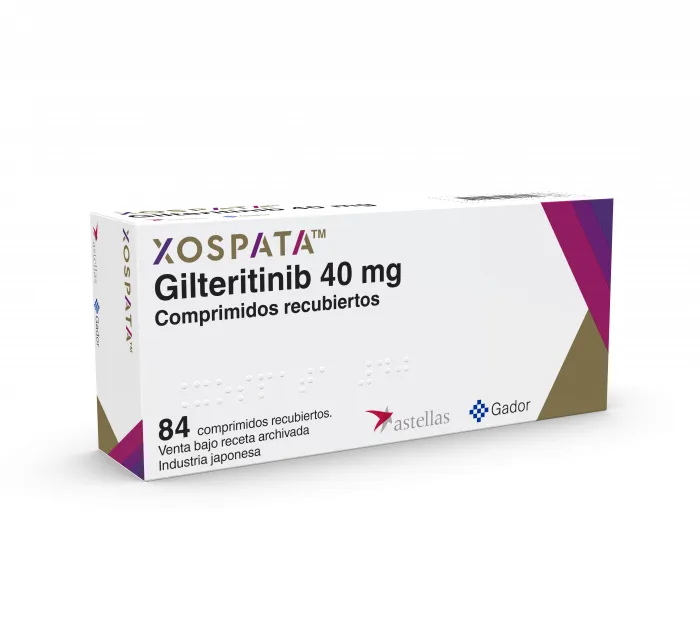
Table of Contents
P atient Information Leaflet
Xospata 40 mg film-coated tablets
gilteritinib
Please read this leaflet carefully before taking this medicine, as it contains
important information for you.
- Keep this leaflet. You may need to read it again.
- If you have any questions, ask your doctor, pharmacist, or nurse.
- This medicine has been prescribed for you only. Do not give it to others, even if they have the same symptoms as you, because it could be harmful.
- If you experience any side effects, including those not listed in this leaflet, tell your doctor, pharmacist, or nurse. See section 4.
Contents of this leaflet
- What Xospata is and what it is used for
- What you need to know before taking Xospata
- How to take Xospata
- Possible side effects
- How to store Xospata
- Contents of the pack and other information
1. What Xospata is and what it is used for
What Xospata is
Xospata belongs to a group of anticancer medicines called protein kinase inhibitors.
It contains the active substance gilteritinib.
What Xospata is used for
Xospata is used to treat adults with acute myeloid leukemia (AML), a cancer affecting a specific type of white blood cells. Xospata is used if the AML is associated with a genetic alteration in a gene called FLT3, and is prescribed for patients in whom the disease has relapsed or has not improved after prior treatment.
How Xospata works
In AML, patients develop a large number of abnormal white blood cells. Gilteritinib blocks the action of certain enzymes (kinases) required by abnormal cells to multiply and grow, thereby preventing cancer growth.
2. What you should know before taking Xospata
Do not take Xospata:
-
if you are allergic to gilteritinib or to any of the other ingredients of this medicine (listed in section 6). Warnings and precautions Immediately contact your doctor, pharmacist, or nurse:
-
if you experience any of the following symptoms: fever, difficulty breathing, skin rash, dizziness or feeling faint, rapid weight gain, swelling of the arms or legs. These signs may be associated with a condition called differentiation syndrome (see section 4. - Possible side effects). Differentiation syndrome can occur at any time during the first 3 months of treatment with
Xospata, starting as early as 1 day after beginning treatment. If this occurs, your
doctor will monitor you and may prescribe a medication to treat your condition. Your doctor
may also temporarily suspend treatment with Xospata until your symptoms have improved.
You will find this information also in the Patient Alert Card included in the
package. It is important that you carry this Alert Card with you and show it to every
healthcare professional you see. -
if you have seizures or symptoms that worsen rapidly, such as headache, reduced level of consciousness, confusion, blurred vision, or other vision problems. These could be signs of a condition called PRES (see section 4. - Possible side effects). Your doctor may perform tests to check whether you have developed PRES, and if confirmed, your doctor will stop treatment with Xospata.
Contact your doctor, pharmacist, or nurse before taking Xospata:
- if you have a heart rhythm disorder, for example irregular heartbeat, or a condition called QT interval prolongation (see section 4. - Possible side effects).
- if you have a history of low levels of potassium or magnesium in your blood, as this could increase the risk of abnormal heart rhythm.
- if you have severe pain in the upper abdomen and back, nausea, and vomiting. These could be signs of inflammation of the pancreas (pancreatitis).
Additional monitoring during treatment with Xospata
Your doctor will monitor you with periodic blood tests before and during treatment with Xospata.
Additionally, your doctor will monitor your heart function before and during treatment.
Children and adolescents
Xospata must not be given to children and adolescents under 18 years of age, as it is not known whether it is safe and effective in this age group.
Other medicines and Xospata
Inform your doctor, pharmacist, or nurse if you are taking, have recently taken, or might take any other medicines. Xospata may affect how these medicines work, or these medicines may affect how Xospata works.
In particular, inform your doctor, pharmacist, or nurse if you are taking any of the following
medicines:
- medicines used to treat certain types of cancer, for example mitoxantrone or methotrexate;
- medicines used to treat tuberculosis, for example rifampicin;
- medicines used to treat epilepsy, for example phenytoin;
- medicines used to treat fungal infections, for example voriconazole, posaconazole or itraconazole;
- medicines used to treat bacterial infections, for example erythromycin, clarithromycin or azithromycin;
- medicines used to treat high blood pressure (hypertension), for example captopril or carvedilol;
- medicines used to treat high blood sugar levels (hyperglycaemia), for example metformin;
- medicines used to lower cholesterol levels, for example rosuvastatin;
- medicines used to treat human immunodeficiency virus (HIV) infection, for example ritonavir;
- medicines used to treat depression, for example escitalopram, fluoxetine or sertraline;
- medicines used to treat heart problems, for example digoxin;
- medicines used to prevent blood clots, for example dabigatran etexilate;
- St John’s wort (also known as Hypericum perforatum), a herbal remedy used to treat depression.
If you regularly take any of these medicines, your doctor may switch you to a different medicine while you are being treated with Xospata.
Pregnancy and breastfeeding
Xospata may harm an unborn baby and must not be taken during pregnancy. Women of childbearing potential who take Xospata must use an effective method of contraception during treatment with Xospata and for at least 6 months after stopping Xospata. If you use hormonal contraception, you must also use a barrier method, such as a condom or diaphragm. Men taking Xospata who have a partner of childbearing potential must use an effective method of contraception during treatment with Xospata and for at least 4 months after stopping treatment.
It is not known whether Xospata passes into breast milk and could harm your baby. You must not breastfeed during treatment with Xospata and for at least 2 months after stopping treatment.
If you are pregnant, think you may be pregnant, or are planning a pregnancy, consult your doctor, pharmacist, or nurse before taking this medicine.
Driving and using machines
Dizziness may occur after taking Xospata. If this happens, do not drive or operate machinery.
3. How to take Xospata
Take this medicine exactly as your doctor or pharmacist has told you. If you
have any doubts, consult your doctor or pharmacist.
Xospata is taken orally as tablets.
Your doctor will tell you what dose of Xospata to take. The recommended dose is 120 mg (three tablets) once
daily. Your doctor may decide to increase or reduce your dose or to temporarily interrupt
treatment. Continue treatment at the dose prescribed by your doctor.
Taking Xospata
- You must take Xospata once daily, at the same time every day.
- Swallow the tablets whole with water.
- Do not break or crush the tablets.
- Xospata may be taken with or without food.
- You must continue taking Xospata for the entire duration prescribed by your doctor.
If you take more Xospata than you should
If you take more tablets than you should, stop taking Xospata and contact your doctor immediately.
If you forget to take Xospata
If you forget to take Xospata at your usual time, take your usual dose as soon as you remember, during the same day, and take your next dose at the usual time the following day.
Do not take a double dose to make up for a forgotten dose.
If you stop taking Xospata
Do not stop taking this medicine unless instructed by your doctor. Stopping treatment may delay your response;
therefore, you must continue taking Xospata for the entire duration prescribed by your doctor.
If you have any doubts about how to use this medicine, consult your doctor.
4. Possible side effects
Like all medicines, this medicine can cause side effects, although not everybody gets them.
Some side effects can be serious:
- Differentiation syndrome. Contact your doctor immediately if you experience any of the following symptoms: fever, difficulty breathing, rash, dizziness or feeling lightheaded, rapid weight gain, swelling of the arms or legs. These could be signs of a condition called differentiation syndrome (may affect up to 1 in 10 people).
- Posterior reversible encephalopathy syndrome (PRES). Contact your doctor immediately if you have seizures, worsening headache, confusion, or other visual problems. Cases of a condition called PRES affecting the brain have been reported in patients treated with Xospata, although these are not common (may affect up to 1 in 100 people).
- Heart rhythm problems (QT interval prolongation). Contact your doctor immediately if your heartbeat changes, or if you feel dizzy, lightheaded, or faint. Xospata can cause a heart problem called QT interval prolongation (may affect up to 1 in 10 people).
Other possible side effects
Very common (may affect more than 1 in 10 people):
- diarrhoea
- nausea
- constipation
- fatigue
- swelling due to fluid retention (oedema)
- loss of energy, weakness (asthenia)
- abnormal blood test results: elevated levels in the blood of creatine phosphokinase (related to muscle or heart function), alanine aminotransferase (ALT), aspartate aminotransferase (AST), and/or alkaline phosphatase in the blood (indicative of liver function)
- pain in the extremities
- joint pain (arthralgia)
- muscle pain (myalgia)
- cough
- shortness of breath (dyspnoea)
- dizziness
- low blood pressure (hypotension)
Common (may affect up to 1 in 10 people):
- fluid accumulation around the heart, which, if severe, can reduce the heart's ability to pump blood (pericardial effusion)
- a general feeling of discomfort or being unwell (malaise)
- a severe and potentially life-threatening allergic reaction, for example swelling of the mouth, tongue, face and throat, itching, hives (anaphylactic reaction)
- muscle stiffness
- reduced urine output, swelling in the legs (signs of sudden kidney damage)
- inflammation of the heart (pericarditis)
- heart failure
Reporting of side effects
If you get any side effects, including ones not listed in this leaflet, talk to your doctor or pharmacist. You can also report side effects directly via the national reporting system listed in Annex V. By reporting side effects, you can help provide more information on the safety of this medicine.
5. How to store Xospata
Keep this medicine out of the sight and reach of children.
Do not use this medicine after the expiry date stated on the carton and blister after
Exp. The expiry date refers to the last day of that month.
Store in the original packaging to protect from light.
Do not dispose of medicines via wastewater or household waste. Ask your pharmacist how to
dispose of medicines you no longer use. This will help protect the environment.
6. Package contents and other information
What Xospata contains
- The active substance is gilteritinib. Each film-coated tablet contains 40 mg of gilteritinib (as fumarate).
- The other components are: mannitol (E421), hydroxypropylcellulose, low-substituted hydroxypropylcellulose, magnesium stearate, hypromellose, talc, macrogol, titanium dioxide, yellow iron oxide (E172).
Description of the appearance of Xospata and contents of the pack
Xospata 40 mg film-coated tablets (tablets) are round, film-coated, light yellow tablets, with the company logo and '235' engraved on one side.
The tablets are supplied in blisters and are available in packs containing 84 film-coated tablets (4 blisters containing 21 film-coated tablets each).
Marketing Authorisation Holder
Astellas Pharma Europe B.V.
Sylviusweg 62
2333 BE Leiden
The Netherlands
Manufacturer
Delpharm Meppel B.V.
Hogemaat 2
7942 JG Meppel
The Netherlands
For further information about this medicinal product, please contact the local representative of the Marketing Authorisation Holder:
België/Belgique/Belgien Lietuva
Astellas Pharma B.V. Branch Astellas Pharma d.o.o.
Tél/Tel: +32 (0)2 5580710 Tel.: +370 37 408 681
България Luxembourg/Luxemburg
Астелас Фарма ЕООД Astellas Pharma B.V. Branch
Teл.: +359 2 862 53 72 Belgique/Belgien
Tél/Tel: +32 (0)2 5580710
Česká republika Magyarország
Astellas Pharma s.r.o. Astellas Pharma Kft.
Tel: +420 221 401 500 Tel.: +36 1 577 8200
Danmark Malta
Astellas Pharma a/s Astellas Pharmaceuticals AEBE
Tlf: +45 43 430355 Tel: +30 210 8189900
Deutschland Nederland
Astellas Pharma GmbH Astellas Pharma B.V.
Tel.: +49 (0)89 454401 Tel: +31 (0)71 5455745
Eesti Norge
Astellas Pharma d.o.o. Astellas Pharma
Tel: +372 6 056 014 Tlf: +47 66 76 46 00
Ελλάδα Österreich
Astellas Pharmaceuticals AEBE Astellas Pharma Ges.m.b.H.
Τηλ: +30 210 8189900 Tel.: +43 (0)1 8772668
España Polska
Astellas Pharma S.A. Astellas Pharma Sp.z.o.o.
Tel: +34 91 4952700 Tel.: +48 225451 111
France Portugal
Astellas Pharma S.A.S. Astellas Farma, Lda.
Tél: +33 (0)1 55917500 Tel: +351 21 4401300
Hrvatska România
Astellas d.o.o. S.C. Astellas Pharma SRL
Tel: +385 1670 0102 Tel: +40 (0)21 361 04 95
Ireland Slovenija
Astellas Pharma Co. Ltd. Astellas Pharma d.o.o.
Tel: +353 (0)1 4671555 Tel: +386 14011400
Ísland Slovenská republika
Vistor hf Astellas Pharma s.r.o.
Sími: +354 535 7000 Tel: +421 2 4444 2157
Italia Suomi/Finland
Astellas Pharma S.p.A. Astellas Pharma
Tel: +39 (0)2 921381 Puh/Tel: +358 (0)9 85606000
Κύπρος Sverige
Ελλάδα Astellas Pharma AB
Astellas Pharmaceuticals AEBE Tel: +46 (0)40-650 15 00
Τηλ: +30 210 8189900
Latvija United Kingdom (Northern Ireland)
Astellas Pharma d.o.o. Astellas Pharma Co., Limited
Tel: +371 67 619365 Tel: +353 (0)1 4671555
Free call from Northern Ireland: 0800 783 5018
More detailed information on this medicinal product is available on the website of the European Medicines Agency: http://www.ema.europa.eu