Xgeva
Italy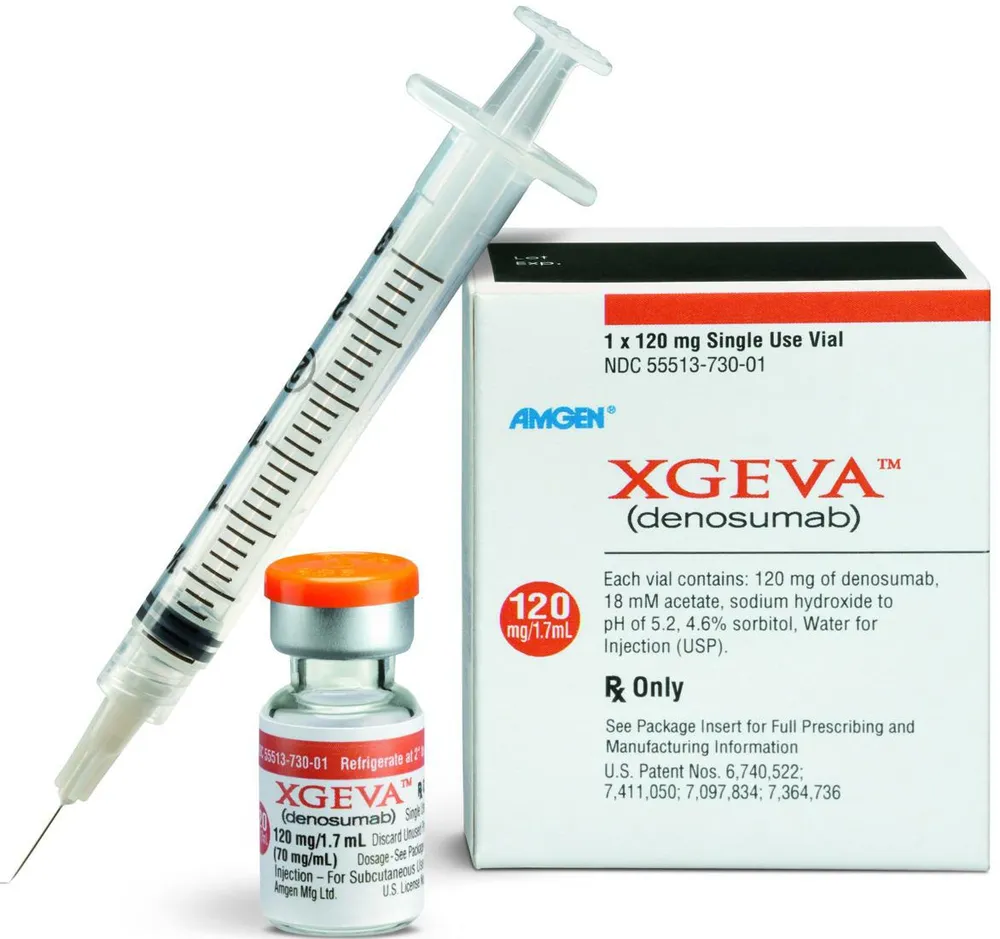
Table of Contents
- Package leaflet: Information for the patient
- XGEVA 120 mg solution for injection
- 1. What XGEVA is and what it is used for
- 2. What you should know before using XGEVA
- 3. How to use XGEVA
- 4. Possible side effects
- 5. How to store XGEVA
- 6. Package contents and other information
- The following information is intended exclusively for healthcare professionals:
Package leaflet: Information for the patient
XGEVA 120 mg solution for injection
denosumab
Please read this leaflet carefully before using this medicine because it contains
important information for you.
- Keep this leaflet. You may need to read it again.
- If you have any questions, ask your doctor, pharmacist, or nurse.
- This medicine has been prescribed for you only. Do not give it to other people, even if they have the same symptoms as yours, because it may be harmful.
- If you experience any side effects, including those not listed in this leaflet, inform your doctor, pharmacist, or nurse. See section 4.
- Your doctor will provide you with a patient reminder card containing important safety information that you need to know before and during treatment with XGEVA.
Contents of this leaflet
- What XGEVA is and what it is used for
- What you need to know before using XGEVA
- How to use XGEVA
- Possible side effects
- How to store XGEVA
- Contents of the pack and other information
1. What XGEVA is and what it is used for
XGEVA contains denosumab, a protein (monoclonal antibody) that works to reduce bone destruction caused by the spread of tumour to the bone (bone metastases) or by giant cell tumour of bone.
XGEVA is used in adults with advanced cancer to prevent serious complications caused by bone metastases (e.g. fracture, pressure on the spinal cord, or need for radiation therapy or surgery).
XGEVA is also used to treat giant cell tumour of bone that cannot be treated surgically or where surgery is not the best option, in adults and adolescents whose bones have stopped growing.
2. What you should know before using XGEVA
Do not use XGEVA
- if you are allergic to denosumab or to any of the other ingredients of this medicine (listed in section 6).
The healthcare provider will not administer XGEVA to you if you have severely low levels of calcium in your blood that have not been treated.
The healthcare provider will not administer XGEVA if you have unhealed wounds following dental or oral surgery.
Warnings and precautions
Talk to your doctor before using XGEVA.
Calcium and vitamin D supplementation
You must take calcium and vitamin D supplements while being treated with XGEVA, unless your blood calcium levels are high. Your doctor will discuss this with you. If your blood calcium level is low, your doctor may decide to give you calcium supplements before starting treatment with XGEVA.
Low blood calcium levels
Tell your doctor immediately if, during treatment with XGEVA, you experience muscle spasms, twitching or cramps, and/or numbness or tingling in your fingers, toes, or around your mouth, and/or seizures, confusion, or loss of consciousness. These may be signs of low blood calcium levels.
Kidney problems
Tell your doctor if you currently have, or have ever had, serious kidney problems, impaired kidney function, or if you are on dialysis, as these conditions may increase the risk of low blood calcium levels, especially if you are not taking calcium supplements.
Problems with mouth, teeth or jaw
A side effect called osteonecrosis of the jaw/mandible (a serious deterioration of the jaw/mandible bone tissue) has been commonly reported (may occur in up to 1 in 10 people) in patients receiving XGEVA injections for cancer-related conditions. Osteonecrosis of the jaw/mandible may also occur after stopping treatment.
It is important to try to prevent the development of osteonecrosis of the jaw/mandible, as it is a painful condition that may be difficult to treat. To reduce the risk of developing osteonecrosis of the jaw/mandible, you should take the following precautions:
- Before starting treatment, tell your doctor/nurse (healthcare provider) if you have any mouth or dental problems. Your doctor should delay starting treatment if you have unhealed mouth wounds following dental procedures or oral surgery. Your doctor may ask you to have a dental examination before starting treatment with XGEVA.
- During treatment, you must maintain good oral hygiene and have regular dental check-ups. If you wear dentures, make sure they fit properly.
- If you are currently undergoing dental treatment or are scheduled to have dental surgery (e.g., tooth extractions), inform your doctor about your dental treatment and inform your dentist that you are being treated with XGEVA.
- Contact your doctor and dentist immediately if you notice any new mouth or dental problems, such as loose teeth, pain or swelling, or failure of mouth sores to heal or presence of discharge, as these could be signs of osteonecrosis of the jaw/mandible.
Patients who are receiving chemotherapy and/or radiation therapy, taking steroids or anti-angiogenic medicines (used to treat cancer), undergoing dental surgery, not receiving routine dental care, suffering from gum problems, or who smoke may have a higher risk of developing osteonecrosis of the jaw/mandible.
Unusual fractures of the thigh bone (femur)
Some people have developed unusual femur fractures during treatment with XGEVA. Contact your doctor if you experience new or unusual pain in your hip, groin, or thigh.
High calcium levels in the blood after stopping XGEVA treatment
Some patients with giant cell tumor of bone have developed high calcium levels in the blood weeks to months after stopping treatment. Your doctor will monitor you for signs and symptoms of high calcium levels after you stop taking XGEVA.
Children and adolescents
XGEVA is not recommended for children and adolescents under 18 years of age, except for adolescents with giant cell tumor of bone whose bones have stopped growing. The use of XGEVA in children and adolescents with other cancers that have spread to the bones has not been studied.
Other medicines and XGEVA
Tell your doctor or pharmacist if you are taking, have recently taken, or might take any other medicines. This includes medicines obtained without a prescription. In particular, it is important that you tell your doctor if you are taking:
- another medicine containing denosumab
- a bisphosphonate
You must not take XGEVA together with other medicines containing denosumab or bisphosphonates.
Pregnancy and breastfeeding
XGEVA has not been studied in pregnant women. It is important that you inform your doctor if you are pregnant, suspect you may be pregnant, or are planning a pregnancy. The use of XGEVA is not recommended during pregnancy. Women of childbearing potential must use effective contraception while taking XGEVA and for at least 5 months after stopping treatment with XGEVA.
If you become pregnant during treatment with XGEVA or within 5 months after stopping XGEVA treatment, please inform your doctor.
It is not known whether XGEVA is excreted in human milk. It is important that you inform your doctor if you are breastfeeding or planning to breastfeed. Your doctor will help you decide whether to discontinue breastfeeding or discontinue XGEVA, taking into account the benefits of breastfeeding for the child and the benefits of XGEVA for the mother.
If you are breastfeeding during treatment with XGEVA, please inform your doctor.
Ask your doctor or pharmacist for advice before taking this medicine.
Driving and using machines
XGEVA has no or negligible influence on the ability to drive or use machines.
XGEVA contains sorbitol
This medicine contains 78 mg of sorbitol per vial.
XGEVA contains sodium
This medicine contains less than 1 mmol (23 mg) of sodium per 120 mg dose, i.e., essentially ‘sodium-free’.
3. How to use XGEVA
XGEVA must be administered under the supervision of a healthcare professional.
The recommended dose of XGEVA is 0.8 mL (120 mg) given once every 4 weeks as a single
subcutaneous injection. XGEVA will be injected into the thigh, abdomen, or upper arm. If you are
being treated for giant cell tumor of bone, you will receive an additional dose 1 week and 2 weeks
after the first dose.
Do not shake.
While receiving XGEVA treatment, you should also take calcium and vitamin D supplements unless
you have hypercalcemia (high blood calcium levels). Your doctor will discuss this with you.
If you have any questions about how to use this medicine, consult your doctor, pharmacist, or
nurse.
4. Possible side effects
Like all medicines, this medicine can cause side effects, although not everybody gets them.
Contact your doctor immediately if, during treatment with XGEVA, you notice any of the following symptoms (these may affect more than 1 in 10 people):
- muscle spasms, contractions, cramps, numbness or tingling in the fingers of the hands and feet or around the mouth, and/or seizures, confusion or loss of consciousness. These signs could indicate low levels of calcium in the blood. Low calcium levels may also lead to a change in heart rhythm called QT interval prolongation, which is detected by electrocardiogram (ECG).
Contact your doctor and dentist immediately if, during treatment with XGEVA or after stopping treatment with XGEVA, you notice any of the following symptoms (these may occur in up to 1 in 10 people):
- persistent pain in the mouth and/or jaw/mandible, and/or swelling or failure of mouth sores or lesions in the jaw/mandible to heal, presence of discharge, numbness or a feeling of heaviness in the jaw/mandible, or loose teeth, as these signs could indicate a serious deterioration of the jaw/mandible bone tissue (osteonecrosis).
Very common side effects (may occur in more than 1 in 10 people):
- bone, joint and/or muscle pain, sometimes severe,
- shortness of breath (dyspnoea),
- diarrhoea.
Common side effects (may occur in up to 1 in 10 people):
- low levels of phosphate in the blood (hypophosphataemia),
- tooth extraction,
- excessive sweating,
- in patients with advanced tumour: development of another type of tumour.
Uncommon side effects (may occur in up to 1 in 100 people):
- high levels of calcium in the blood (hypercalcaemia) after stopping treatment in patients with giant cell bone tumour,
- new or unusual pain in the hip, groin or thigh (this could be an early sign of a possible femur bone fracture),
- skin rash or mouth sores (drug-induced lichenoid eruptions).
Rare side effects (may occur in up to 1 in 1,000 people):
- allergic reactions (e.g. wheezing or difficulty breathing; swelling of the face, lips, tongue, throat or other body parts; skin rash, itching or hives). In rare cases, allergic reactions can be severe.
Not known (frequency cannot be estimated from the available data):
- inform your doctor if you experience ear pain, ear discharge, and/or ear infection. These could be signs of damage to the ear bone.
Reporting of side effects
If you experience any side effect, including those not listed in this leaflet, tell your doctor or nurse.
You can also report side effects directly via the national reporting system listed in Annex V. By reporting side effects, you can help provide more information on the safety of this medicine.
5. How to store XGEVA
Keep this medicine out of the sight and reach of children.
Do not use this medicine after the expiry date which is stated on the label and on the carton after
Exp. The expiry date refers to the last day of that month.
Store in a refrigerator (2°C – 8°C).
Do not freeze.
Keep the vial in the outer packaging to protect the medicine from light.
The vial may be removed from the refrigerator and allowed to reach room temperature (up to 25°C) prior to injection. This will make the injection more comfortable. Once the vial has reached room temperature (up to 25°C), it must be used within 30 days.
Do not dispose of any medicine via wastewater or household waste. Ask your pharmacist how to dispose of medicines no longer required. This will help protect the environment.
6. Package contents and other information
What XGEVA contains
- The active substance is denosumab. Each vial contains 120 mg in 1.7 mL of solution (equivalent to 70 mg/mL).
- The other components are glacial acetic acid, sodium hydroxide, sorbitol (E420), polysorbate 20 and water for injections.
Description of the appearance of XGEVA and contents of the pack
XGEVA is an injectable solution (injectable).
XGEVA is a clear, colourless to slightly yellow solution. It may contain traces of
transparent to white particles.
Each pack contains one, three or four single-use vials.
Not all pack sizes may be marketed.
Marketing Authorisation Holder and Manufacturer
Amgen Europe B.V.
Minervum 7061,
4817 ZK Breda,
The Netherlands
Marketing Authorisation Holder
Amgen Europe B.V.
Minervum 7061,
4817 ZK Breda,
The Netherlands
Manufacturer
Amgen Technology (Ireland) Unlimited Company
Pottery Road
Dun Laoghaire
Dublin
Ireland
Manufacturer
Amgen NV
Telecomlaan 5-7
1831 Diegem
Belgium
For further information on this medicine, please contact the local representative of the Marketing Authorisation Holder:
België/Belgique/Belgien Lietuva
s.a. Amgen n.v. Amgen Switzerland AG Vilniaus filialas
Tel/Tél: +32 (0)2 7752711 Tel: +370 5 219 7474
България Luxembourg/Luxemburg
Амджен България ЕООД s.a. Amgen
Тел.: +359 (0)2 424 7440 Belgique/Belgien
Tel/Tél: +32 (0)2 7752711
Česká republika Magyarország
Amgen s.r.o. Amgen Kft.
Tel: +420 221 773 500 Tel.: +36 1 35 44 700
Danmark Malta
Amgen, filial af Amgen AB, Sverige Amgen S.r.l.
Tlf: +45 39617500 Italy
Tel: +39 02 6241121
Deutschland Nederland
Amgen GmbH Amgen B.V.
Tel.: +49 89 1490960 Tel: +31 (0)76 5732500
Eesti Norge
Amgen Switzerland AG Vilniaus filialas Amgen AB
Tel: +372 586 09553 Tlf: +47 23308000
Ελλάδα Österreich
Amgen Ελλάς Φαρμακευτικά Ε.Π.Ε. Amgen GmbH
Τηλ.: +30 210 3447000 Tel: +43 (0)1 50 217
España Polska
Amgen S.A. Amgen Biotechnologia Sp. z o.o.
Tel: +34 93 600 18 60 Tel.: +48 22 581 3000
France Portugal
Amgen S.A.S. Amgen Biofarmacêutica, Lda.
Tél: +33 (0)9 69 363 363 Tel: +351 21 4220606
Hrvatska România
Amgen d.o.o. Amgen România SRL
Tel: +385 (0)1 562 57 20 Tel: +4021 527 3000
Ireland Slovenija
Amgen Ireland Limited AMGEN zdravila d.o.o.
Tel: +353 1 8527400 Tel: +386 (0)1 585 1767
Ísland Slovenská republika
Vistor hf. Amgen Slovakia s.r.o.
Sími: +354 535 7000 Tel: +421 2 321 114 49
Italia Suomi/Finland
Amgen S.r.l. Amgen AB, sivuliike Suomessa/Amgen AB, filial
Tel: +39 02 6241121 i Finland
Puh/Tel: +358 (0)9 54900500
Kύπρος Sverige
C.A. Papaellinas Ltd Amgen AB
Τηλ.: +357 22741 741 Tel: +46 (0)8 6951100
Latvija United Kingdom (Northern Ireland)
Amgen Switzerland AG Rīgas filiāle Amgen Limited
Tel: +371 257 25888 Tel: +44 (0)1223 420305
More detailed information on this medicine is available on the European Medicines Agency website: http://www.ema.europa.eu/ .
The following information is intended exclusively for healthcare professionals:
- Prior to administration, the XGEVA solution should be inspected visually. The solution may contain traces of translucent to white proteinaceous particles. Do not inject the solution if it is cloudy or shows discoloration.
- Do not shake.
- To minimize discomfort at the injection site, allow the vial to reach room temperature (up to 25°C) before injection, and inject slowly.
- The entire contents of the vial must be administered.
- A 27-gauge steel needle is recommended for denosumab administration.
- The vial must not be reused.
Any unused medicine and waste material derived from this medicine must be disposed of in accordance with
local regulations.