Xermelo
Italy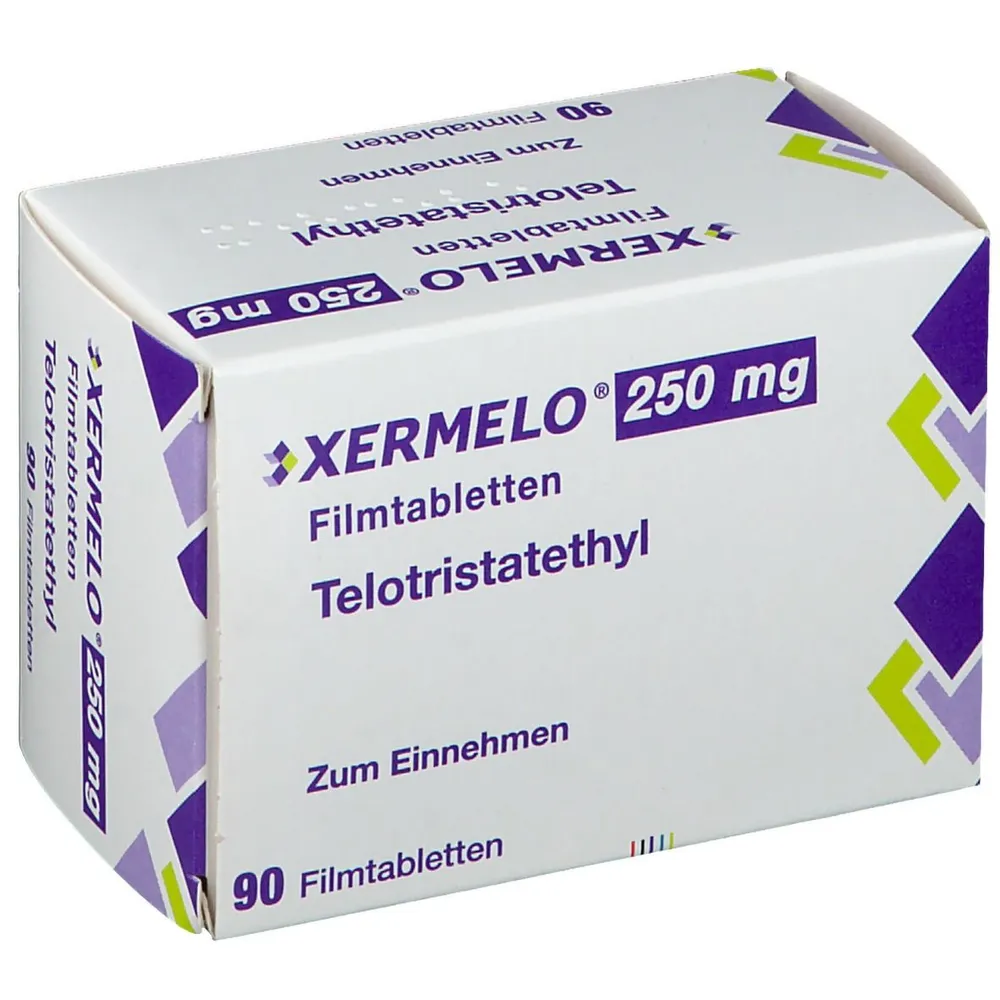
Table of Contents
Package leaflet: Information for the patient
Xermelo 250 mg film-coated tablets
telotristat ethyl
Read this leaflet carefully before taking this medicine because it contains important information for you.
- Keep this leaflet. You may need to read it again.
- If you have any questions, ask your doctor or pharmacist.
- This medicine has been prescribed for you only. Do not give it to other people, even if their symptoms are the same as yours, because it could be harmful.
- If you experience any side effects, including those not listed in this leaflet, talk to your doctor, pharmacist or nurse. See section 4.
Contents of this leaflet
- What Xermelo is and what it is used for
- What you need to know before taking Xermelo
- How to take Xermelo
- Possible side effects
- How to store Xermelo
- Contents of the pack and other information
1. What Xermelo is and what it is used for
What Xermelo is
This medicine contains the active substance telotristat ethyl.
What Xermelo is used for
This medicine is used in adults with a condition called 'carcinoid syndrome' that occurs when a tumour, known as a 'neuroendocrine tumour', releases a substance called serotonin into the bloodstream.
Your doctor will prescribe this medicine if diarrhoea is not well controlled with injections of other medicines called 'somatostatin analogues' (lanreotide or octreotide). You must continue receiving injections of these medicines while taking Xermelo.
How Xermelo works
When the tumour releases too much serotonin into the bloodstream, diarrhoea may develop.
This medicine works by reducing the amount of serotonin produced by the tumour, thereby decreasing diarrhoea.
2. What you need to know before taking Xermelo
Do not take Xermelo
- if you are allergic to telotristat or to any of the other ingredients of this medicine (listed in section 6).
Warnings and precautions
Talk to your doctor or pharmacist before taking Xermelo:
- if you have liver problems. This is because the medicine is not recommended for use in patients with severe liver impairment. Your doctor may decide to reduce the daily dose of Xermelo if your liver problems are considered mild or moderate. Your doctor will also monitor your liver function.
- if you have end-stage kidney disease or are on dialysis, consult your doctor. This is because the medicine has not been studied in patients with end-stage renal disease requiring dialysis.
Monitoring for adverse effects
Inform your doctor immediately if you notice any of the following signs and symptoms suggesting
that your liver may not be working properly:
- feeling unwell (unexplained nausea or vomiting), unusually dark urine, yellowing of the skin or whites of the eyes, pain in the upper right side of the stomach. Your doctor will perform blood tests to check your liver and will decide whether you should continue taking this medicine.
Talk to your doctor or pharmacist:
- if you feel down, depressed, or if you feel you have no interest or do not get pleasure from your usual activities while taking this medicine, since depression, depressed mood, and decreased interest have been reported in patients treated with telotristat;
- if you experience signs of constipation, because telotristat reduces the number of bowel movements.
Tests
- Your doctor may perform blood tests before you start taking this medicine and while you are taking it. This precaution is necessary to ensure that your liver is functioning normally.
Children and adolescents
This medicine is not recommended for patients under 18 years of age, as it has not been evaluated in this age group.
Other medicines and Xermelo
Inform your doctor or pharmacist if you are taking, have recently taken, or might take any other medicines, because Xermelo may affect the action of other medicines or other medicines may affect the action of Xermelo. This may mean that your doctor will need to adjust the dose or doses you are taking. You must inform your doctor of all medicines you are taking, including:
- medicines for diarrhoea. Xermelo and these medicines both reduce the number of bowel movements, and when taken together may cause severe constipation. Your doctor may need to adjust the dose of your medicines;
- medicines used to treat epilepsy, for example valproic acid;
- medicines used to treat neuroendocrine tumours, for example sunitinib or everolimus;
- medicines used to treat depression, for example bupropion or sertraline;
- medicines used to prevent transplant rejection, for example cyclosporine;
- medicines used to lower cholesterol levels, for example simvastatin;
- oral contraceptives, for example ethinylestradiol;
- medicines used to treat high blood pressure, for example amlodipine;
- medicines used to treat certain types of cancer, such as irinotecan, capecitabine, and flutamide;
- medicines used to reduce the risk of blood clots, such as prasugrel.
- octreotide. If you require treatment with subcutaneous octreotide injections, you should administer the injection at least 30 minutes after taking Xermelo.
Pregnancy and breastfeeding
If you are pregnant, think you may be pregnant, planning to become pregnant, or breastfeeding, ask your doctor or pharmacist for advice before taking this medicine.
Do not take this medicine if you are pregnant or if pregnancy could occur. The effects telotristat may have on the unborn baby are unknown.
Women must use effective contraception methods while taking this medicine.
You must not breastfeed while taking Xermelo, because this medicine may pass into breast milk and could be harmful to the baby.
Driving and using machines
Xermelo may have a minor influence on the ability to drive or use tools or machines. If you feel tired, wait until you feel better before driving or using tools or machines.
Xermelo contains lactose
Xermelo contains lactose (a type of sugar). If your doctor has told you that you have an intolerance to certain sugars, consult him or her before taking this medicine.
Xermelo contains sodium
This medicine contains less than 1 mmol of sodium (23 mg) per tablet, i.e. essentially ‘sodium-free’.
3. How to take Xermelo
Take this medicine exactly as directed by your doctor or pharmacist. If you have
any doubts, consult your doctor or pharmacist.
How much medicine to take
The recommended dose is one tablet (250 mg) three times a day. The maximum dose of Xermelo is
750 mg in 24 hours.
Your doctor will decide how long you should take Xermelo.
If you have liver problems, your doctor may decide to reduce your daily dose of Xermelo.
How to take this medicine
- Always take this medicine with meals or food.
- You must continue injections of somatostatin analogues (lanreotide or octreotide) while taking Xermelo.
If you take more Xermelo than you should
You may experience a feeling or state of malaise, diarrhea, or stomach ache. Contact a doctor.
Take the medicine package with you.
If you forget to take Xermelo
If you forget to take a dose, take the next dose at the scheduled time, skipping the missed
dose.
Do not take a double dose to make up for the missed dose.
If you stop taking Xermelo
Do not stop taking Xermelo without first talking to your doctor.
If you have any questions about the use of this medicine, consult your doctor or pharmacist.
4. Possible side effects
Like all medicines, this medicine can cause side effects, although not everybody gets them.
Immediately inform your doctor if you notice any of the following side effects:
- Feeling unwell or general malaise, abnormally dark urine, yellowing of the skin or eyes, pain in the upper right part of the stomach. These signs could indicate that the liver is not functioning properly. This may also be shown by changes in blood test results, such as increased liver enzymes: gamma-glutamyl transferase (very common, may affect more than 1 in 10 people), transaminases and alkaline phosphatase in the blood (common, may affect up to 1 in 10 people).
Other side effects
Inform your doctor, pharmacist or nurse if you notice any of the following side effects:
Very common side effects (may affect more than 1 in 10 people):
- Stomach ache (abdominal pain)
- Feeling tired or weak (fatigue)
- Feeling sick (nausea)
Common side effects (may affect up to 1 in 10 people):
- Flatulence
- Fever
- Headache
- Constipation
- Bloating of the stomach
- Loss of appetite
- Swelling (fluid retention in the body)
- Depression; you may experience reduced self-esteem, lack of motivation, sadness or low mood
Uncommon side effects (may affect up to 1 in 100 people):
- Hardened stools (intestinal obstruction, fecaloma), constipation, watery diarrhoea, pale skin (anaemia), nausea, vomiting, weight loss, back pain or stomach pains, particularly after eating, or reduced urine output (urination). Immediately inform your doctor if any of the following side effects occur:
- Breathing problems, rapid heartbeat, fever, incontinence (uncontrollable need to urinate), confusion, dizziness or agitation.
Inform your doctor, pharmacist or nurse if you notice any of the side effects listed above.
Reporting of side effects
If you get any side effects, including those not listed in this leaflet, talk to your doctor, pharmacist or nurse. You can also report side effects directly via the national reporting system referred to in Annex V. By reporting side effects, you can help provide more information on the safety of this medicine.
5. How to store Xermelo
Keep this medicine out of the sight and reach of children.
Do not use this medicine after the expiry date stated on the carton and blister after Exp.
The expiry date refers to the last day of that month.
Do not dispose of any medicine via wastewater or household waste. Ask your pharmacist how to
dispose of medicines you no longer use. This will help protect the environment.
This medicine requires no special storage conditions.
6. Package contents and other information
What Xermelo contains
- The active substance is telotristat ethyl. Each coated tablet contains telotristat etiprate, equivalent to 250 mg of telotristat ethyl.
- The other ingredients are: Tablet core: lactose (see section 2, "Xermelo contains lactose"), hydroxypropylcellulose, sodium croscarmellose, magnesium stearate and anhydrous colloidal silica. Film coating: poly(vinyl alcohol) (E1203), titanium dioxide (E171), macrogol 3350 (E1521) and talc (E553b).
Description of the appearance of Xermelo and contents of the pack
The tablets are white to off-white, film-coated, oval-shaped tablets. Each tablet is approximately 17 mm long and 7.5 mm wide, with 'T-E' engraved on one side and '250' on the other.
The tablets are packaged in PVC/PCTFE/PVC/Al blisters. The blisters are packed in a carton.
Pack sizes of 90 and 180 tablets. Not all pack sizes may be marketed.
Marketing Authorisation Holder
SERB SAS
40 Avenue George V
75008 Paris
France
Manufacturer
Tjoapack Netherlands B.V.
Nieuwe Donk 9
4879 AC Etten-Leur
The Netherlands
Other sources of information
More detailed information on this medicinal product is available on the website of the European Medicines Agency: http://www.ema.europa.eu. In addition, links to other websites on rare diseases and related therapeutic treatments are provided.