Xerava
Italy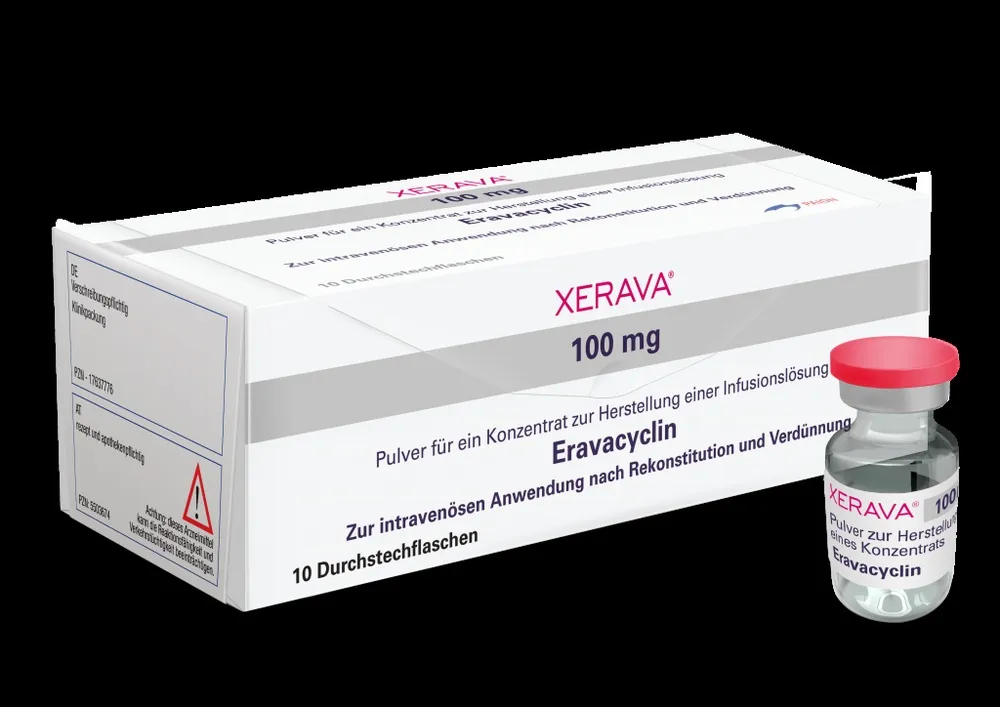
Table of Contents
- Package leaflet: Information for the patient
- Xerava 50 mg powder for concentrate for solution for infusion
- 1. What Xerava is and what it is used for
- 2. What you need to know before receiving Xerava
- 3. How Xerava will be administered to you
- 4. Possible side effects
- 5. How to store Xerava
- 6. Package contents and other information
- The following information is intended for healthcare professionals only:
- Patient information leaflet: information for the patient
- Xerava 100 mg powder for concentrate for solution for infusion
- 1. What Xerava is and what it is used for
- 2. What you need to know before receiving Xerava
- 3. How Xerava will be administered to you
- 4. Possible side effects
- 5. How to store Xerava
- 6. Package contents and other information
- The following information is intended exclusively for healthcare professionals:
Package leaflet: Information for the patient
Xerava 50 mg powder for concentrate for solution for infusion
eravacycline
Please read all of this leaflet carefully before you are given this medicine because it contains important information for you.
- Keep this leaflet. You may need to read it again.
- If you have any questions, ask your doctor or nurse.
- If you get any side effects, including any not listed in this leaflet, talk to your doctor or nurse. See section 4.
Contents of this leaflet
- What Xerava is and what it is used for
- What you need to know before you are given Xerava
- How Xerava will be given to you
- Possible side effects
- How to store Xerava
- Contents of the pack and other information
1. What Xerava is and what it is used for
What Xerava is
Xerava is an antibiotic medicine that contains the active substance eravacycline. It belongs to a
group of antibiotics called "tetracyclines" which work by inhibiting the growth of certain infectious
bacteria.
What Xerava is used for
Xerava is used to treat adolescents from 12 years of age weighing at least 50 kg and adults who have a complicated intra-abdominal infection.
2. What you need to know before receiving Xerava
Do not take Xerava
- if you are allergic to eravacycline or to any of the other ingredients of this medicine (listed in section 6);
- if you are allergic to any antibiotic belonging to the tetracycline class (for example, minocycline and doxycycline), as you may also be allergic to eravacycline.
Warnings and precautions
Talk to your doctor or nurse before receiving Xerava if you are concerned about the following:
Anaphylactic reactions
Anaphylactic (allergic) reactions have been reported with other antibiotics belonging to the tetracycline class, which may develop suddenly and could be life-threatening. Contact your doctor immediately if you suspect you are having an anaphylactic reaction during treatment with Xerava. Symptoms to watch for include rash, facial swelling, dizziness or fainting, chest tightness, difficulty breathing, rapid heartbeat, or loss of consciousness (see also section 4).
Diarrhoea
Talk to your doctor or nurse if you have diarrhoea before receiving Xerava. If diarrhoea develops during or after treatment, inform your doctor immediately. Do not take any medicine to treat diarrhoea without first consulting your doctor (see also section 4).
Infusion site reactions
Xerava is administered by intravenous infusion (drip). Inform your doctor or nurse if you notice any of the following signs at the infusion site during or after treatment: redness of the skin, rash, inflammation, pain, or increased sensitivity to pain.
New infection
Although Xerava fights certain bacteria, other bacteria and fungi may continue to grow. This is known as "overgrowth" or "superinfection". Your doctor will closely monitor you for signs of new infections and may stop treatment with Xerava and prescribe another treatment if necessary.
Pancreatitis
Severe abdominal and back pain accompanied by fever may be signs of inflammation of the pancreas. Inform your doctor or nurse if you experience any of these side effects during treatment with Xerava.
Liver problems
Talk to your doctor if you have liver problems or if you are overweight, especially if you are also taking itraconazole (a medicine used to treat fungal infections), ritonavir (a medicine used to treat viral infections), or clarithromycin (an antibiotic), as your doctor will monitor you closely for side effects.
Children and adolescents
This medicine must not be used in children under 12 years of age or in adolescents weighing less than 50 kg. Xerava must not be used in children under 8 years of age, as it may cause permanent effects on teeth, such as discoloration.
Other medicines and Xerava
Inform your doctor or nurse if you are taking, have recently taken, or might take any other medicines, including rifampicin and clarithromycin (antibiotics), phenobarbital, carbamazepine, and phenytoin (used to treat epilepsy), St. John’s wort (a herbal remedy used to treat depression and anxiety), itraconazole (a medicine used to treat fungal infections), ritonavir, atazanavir, lopinavir, and saquinavir (medicines used to treat viral infections), and cyclosporine (a medicine used to suppress the immune system).
Pregnancy and breastfeeding
If you are pregnant or breastfeeding, or if you suspect you may be pregnant or are planning a pregnancy, ask your doctor for advice before taking this medicine. Xerava is not recommended for use during pregnancy because it may:
- permanently stain the unborn baby’s teeth;
- delay normal bone formation in the unborn baby.
It is not known whether Xerava passes into breast milk. Long-term use of other similar antibiotic medicines by nursing mothers may permanently stain the infant’s teeth. Ask your doctor for advice before breastfeeding.
Driving and using machines
Xerava may affect your ability to drive or use machines safely. Do not drive or operate machinery if you feel dizzy, lightheaded, or unsteady after receiving this medicine.
3. How Xerava will be administered to you
Xerava will be administered to you by a doctor or nurse.
The recommended dose depends on body weight and is 1 mg/kg every 12 hours.
Your doctor may increase the dose (1.5 mg/kg every 12 hours) if you are taking other medicines such as
rifampicin, phenobarbital, carbamazepine, phenytoin, or St John's wort.
Xerava will be given to you through an intravenous infusion directly into a vein (intravenously) over
approximately 1 hour.
A treatment course usually lasts from 4 to 14 days. Your doctor will decide on the duration of treatment
in your case.
If you receive more Xerava than you should
Xerava will be administered to you in hospital by a doctor or nurse. Therefore, it is unlikely that you will
receive an excessive amount of the medicine. Immediately inform your doctor or nurse if you are concerned
that you have received too much Xerava.
If you miss a dose of Xerava
Xerava will be administered to you in hospital by a doctor or nurse. Therefore, it is unlikely that you will
miss a dose. Immediately inform your doctor or nurse if you are concerned that you have missed a dose.
4. Possible side effects
Like all medicines, this medicine can cause side effects, although not everybody gets them.
Consult your doctor immediately if you suspect you are having an anaphylactic reaction or if any of
the following symptoms occur during treatment with Xerava:
- rash;
- swelling of the face;
- feeling dizzy or faint;
- tightness in the chest;
- difficulty breathing;
- rapid heartbeat;
- loss of consciousness.
Tell your doctor or nurse immediately if diarrhoea occurs during or after treatment.
Do not take any medicine for diarrhoea without first consulting your doctor.
Other side effects may include:
Common (may affect up to 1 in 10 people):
- nausea;
- vomiting;
- inflammation and pain due to blood clots at the infusion site (thrombophlebitis);
- inflammation of a vein causing pain and swelling (phlebitis);
- redness or swelling at the infusion site;
- low levels of fibrinogen in the blood (a protein involved in blood clotting);
- laboratory tests indicating reduced ability to form blood clots.
Uncommon (may affect up to 1 in 100 people):
- diarrhoea;
- allergic reaction;
- inflammation of the pancreas causing severe abdominal and back pain (pancreatitis);
- rash;
- dizziness;
- headache;
- increased sweating;
- abnormal blood test results related to the liver.
Tell your doctor or nurse if you experience any of these side effects.
Other antibiotics of the tetracycline class
With other antibiotics of the tetracycline class, including minocycline and doxycycline, other side effects have been reported, including light sensitivity, headaches, visual disturbances, or abnormal blood tests. Inform your doctor or nurse if you notice any of these side effects during treatment with Xerava.
Reporting of side effects
If you get any side effects, including those not listed in this leaflet, talk to your doctor or nurse. You can also report side effects directly through the national reporting system listed in Annex V. Reporting side effects can help provide more information on the safety of this medicine.
5. How to store Xerava
Keep this medicine out of the sight and reach of children.
Do not use this medicine after the expiry date which is stated on the label of the vial and on the
carton after “Scad.” and “EXP”. The expiry date refers to the last day of that month.
Store in the refrigerator (2 °C–8 °C). Keep the vial in the carton to protect the medicine
from light.
Once the powder has been reconstituted into a solution and diluted for use, it should be
administered immediately. Otherwise, it may be stored at room temperature and used within 12 hours.
Reconstituted Xerava should be a clear solution, ranging in colour from pale yellow to orange.
The solution must not be used if it appears to contain particles or if it is cloudy.
Do not dispose of medicines via wastewater or household waste. Ask your pharmacist how to
dispose of medicines no longer required. This will help protect the environment.
6. Package contents and other information
What Xerava contains
- The active substance is eravacycline. Each vial contains 50 mg of eravacycline.
- The other components are mannitol (E421), hydrochloric acid (for pH adjustment) and sodium hydroxide (for pH adjustment).
Description of the appearance of Xerava and contents of the pack
Xerava is a compact powder ranging from pale yellow to dark yellow, contained in a 10 mL glass vial. The powder for concentrate for solution for infusion (powder for concentrate) will be reconstituted in the vial with 5 mL of water for injections. The reconstituted solution will be withdrawn from the vial and added to an intravenous infusion bag containing 9 mg/mL (0.9%) sodium chloride solution in hospital.
Xerava is available in packs containing 1 vial or in multiple packs comprising 12 boxes each containing 1 vial.
Not all pack sizes may be marketed.
Marketing Authorization Holder
PAION Pharma GmbH
Heussstraße 25
52078 Aachen
Germany
Manufacturer
Patheon Italia S.p.A.
2° Trav. SX. Via Morolense, 5
03013 Ferentino (FR)
Italy
For further information on this medicinal product, please contact the local representative of the Marketing Authorization Holder:
| Belgium/Belgium/Belgium ViatrisTél/Tel: + 32 (0)2 658 61 00 | Lithuania PAION Pharma GmbH Tel: + 800 4453 4453 |
| Bulgaria PAION Pharma GmbH Tel.: + 800 4453 4453 | Luxembourg/Luxembourg PAION Pharma GmbH Tél/Tel: + 800 4453 4453 |
| Czech Republic PAION Pharma GmbH Tel: + 800 4453 4453 | Hungary PAION Pharma GmbH Tel.: + 800 4453 4453 |
| Denmark PAION Pharma GmbH Tlf: + 800 4453 4453 | Malta PAION Pharma GmbH Tel: + 800 4453 4453 |
| Germany PAION Pharma GmbH Tel: + 800 4453 4453 | Netherlands PAION Pharma GmbH Tel: + 800 4453 4453 |
| Estonia PAION Pharma GmbH Tel: + 800 4453 4453 | Norway PAION Pharma GmbH Tlf: + 800 4453 4453 |
| Greece Viatris Hellas Ltd Tel: +30 210 0100002 | Austria PAION Pharma GmbH Tel: + 800 4453 4453 |
| Spain Viatris Pharmaceuticals, S.L. Tel: + 34 900 102 712 | Poland Viatris Healthcare Sp. z o.o. Tel.: + 48 22 546 64 00 |
| France Viatris Santé Tél: +33 4 37 25 75 00 | Portugal PAION Pharma GmbH Tel: + 800 4453 4453 |
| Croatia PAION Pharma GmbH Tel: + 800 4453 4453 | Romania BGP Products SRL Tel: +40 372 579 000 |
| Ireland PAION Pharma GmbH Tel: + 800 4453 4453 | Slovenia PAION Pharma GmbH Tel: + 800 4453 4453 |
| Iceland PAION Pharma GmbH Sími: + 800 4453 4453 | Slovakia PAION Pharma GmbH Tel: + 800 4453 4453 |
| Italy Viatris Italia S.r.l. Tel: + 39 02 612 46921 | Finland/Finland PAION Pharma GmbH Puh/Tel: + 800 4453 4453 |
| Cyprus PAION Pharma GmbH Tel: + 800 4453 4453 | Sweden PAION Pharma GmbH Tel: + 800 4453 4453 |
| Latvia PAION Pharma GmbH Tel: + 800 4453 4453 |
More detailed information on this medicinal product is available on the website of the European
Medicines Agency: http://www.ema.europa.eu .
The following information is intended for healthcare professionals only:
Important: refer to the product characteristics summary before prescribing.
Xerava must be reconstituted with water for injections and subsequently diluted using an intravenous infusion solution of 9 mg/mL (0.9%) sodium chloride.
Xerava must not be mixed with other medicinal products. If the same intravenous line is used for sequential infusion of different medicinal products, the line must be flushed before and after administration with an intravenous infusion solution of 9 mg/mL (0.9%) sodium chloride.
The dose must be calculated according to the patient's body weight; 1 mg/kg body weight.
Reconstitution instructions
Aseptic technique must be used during preparation of the infusion solution. Each vial must be reconstituted with 5 mL of water for injections and gently rotated until the powder is completely dissolved. Avoid shaking or rapid agitation of the vial, as this may cause foaming.
The reconstituted Xerava solution should be a clear liquid ranging from pale yellow to orange. The solution must not be used if particulate matter is present or if the solution is cloudy.
Preparation of the infusion solution
For administration, the reconstituted solution must be further diluted using an intravenous infusion solution of 9 mg/mL (0.9%) sodium chloride. The calculated volume of reconstituted solution should be added to the infusion bag to achieve a target concentration of 0.3 mg/mL, within a range of 0.2 to 0.6 mg/mL. See dosage calculation examples in Table 1 (adults) and Table 2 (adolescents aged 12–17 years weighing at least 50 kg).
Gently invert the infusion bag to mix the solution.
Table 1 Dosage calculation examples for adult patients weighing between 40 kg and 200 kg
| Patient weight (kg) | Total dose (mg) | Number of vials to reconstitute | Total volume to dilute (mL) | Recommended infusion bag size (mL) |
| 40 | 40 | 1 | 4 | 100 |
| 60 | 60 | 2 | 6 | 250 |
| 80 | 80 | 2 | 8 | 250 |
| 100 | 100 | 2 | 10 | 250 |
| 150 | 150 | 3 | 15 | 500 |
| 200 | 200 | 4 | 20 | 500 |
Table 2 Examples of calculation for adolescent patients (12-17 years) weighing between 50 kg and
90 kg
| Patient weight (kg) | Total dose (mg) | Number of vials to reconstitute | Total volume to dilute (mL) | Recommended infusion bag size (mL) |
| 50 | 50 | 1 | 5 | 250 |
| 60 | 60 | 2 | 6 | 250 |
| 70 | 70 | 2 | 7 | 250 |
| 80 | 80 | 2 | 8 | 250 |
| 90 | 90 | 2 | 9 | 250 |
For adolescent patients weighing 50 kg – 90 kg:
Calculate the required volume of the reconstituted solution based on the patient's weight and inject it
into a 250 mL infusion bag.
Infusion
The infusion solution should be inspected visually for the presence of particulate matter prior to administration.
Reconstituted and diluted solutions containing visible particles or appearing cloudy must be discarded.
After dilution, Xerava is administered intravenously over approximately 1 hour. The recommended dosage regimen of Xerava is 1 mg/kg every 12 hours for a duration of 4 to 14 days.
The reconstituted and diluted solution must be administered exclusively by intravenous infusion. It must not be administered as an intravenous bolus.
For single use only; any unused solution must be discarded.
Patient information leaflet: information for the patient
Xerava 100 mg powder for concentrate for solution for infusion
eravacycline
Please read this leaflet carefully before you are given this medicine because it contains important information for you.
- Keep this leaflet. You may need to read it again.
- If you have any questions, ask your doctor or nurse.
- If you get any side effects, including those not listed in this leaflet, tell your doctor or nurse. See section 4.
Contents of this leaflet
- What Xerava is and what it is used for
- What you need to know before receiving Xerava
- How Xerava will be administered to you
- Possible side effects
- How to store Xerava
- Contents of the pack and other information
1. What Xerava is and what it is used for
What Xerava is
Xerava is an antibiotic medicine that contains the active substance eravacycline. It belongs to a
group of antibiotics called "tetracyclines" that work by inhibiting the growth of certain infectious
bacteria.
What Xerava is used for
Xerava is used to treat adolescents aged 12 years and older with a body weight of at least 50 kg, and adults who have a complicated intra-abdominal infection.
2. What you need to know before receiving Xerava
Do not take Xerava
- if you are allergic to eravacycline or to any of the other ingredients of this medicine (listed in section 6);
- if you are allergic to any antibiotic belonging to the tetracycline class (for example, minocycline and doxycycline), as you may also be allergic to eravacycline.
Warnings and precautions
Talk to your doctor or nurse before receiving Xerava if you are concerned about the following:
Anaphylactic reactions
Anaphylactic (allergic) reactions have been reported with other antibiotics belonging to the tetracycline class, which may develop suddenly and could be fatal. Contact your doctor immediately if you suspect you are having an anaphylactic reaction during treatment with Xerava. Symptoms to watch for include rash, facial swelling, dizziness or feeling faint, chest tightness, difficulty breathing, rapid heartbeat, or loss of consciousness (see also section 4).
Diarrhoea
Talk to your doctor or nurse if you have diarrhoea before receiving Xerava. If diarrhoea occurs during or after treatment, inform your doctor immediately. Do not take any medicine for diarrhoea without first consulting your doctor (see also section 4).
Infusion site reactions
Xerava is administered by intravenous infusion (drip). Inform your doctor or nurse if you notice any of the following signs at the infusion site during or after treatment: redness of the skin, rash, inflammation, pain, or increased sensitivity to pain.
New infection
Although Xerava fights certain bacteria, other bacteria and fungi may continue to grow. This is known as "overgrowth" or "superinfection". Your doctor will closely monitor you for signs of new infections, or will stop treatment with Xerava and prescribe an alternative treatment if necessary.
Pancreatitis
Severe abdominal and back pain accompanied by fever may be signs of inflammation of the pancreas. Inform your doctor or nurse if you experience any of these side effects during treatment with Xerava.
Liver problems
Talk to your doctor if you have liver problems or if you are overweight, particularly if you are also taking itraconazole (a medicine used to treat fungal infections), ritonavir (a medicine used to treat viral infections), or clarithromycin (an antibiotic), as your doctor will monitor you closely for side effects.
Children and adolescents
This medicine must not be used in children under 12 years of age or in adolescents weighing less than 50 kg. Xerava must not be used in children under 8 years of age, as it may cause permanent effects on teeth, such as discoloration.
Other medicines and Xerava
Inform your doctor or nurse if you are taking, have recently taken, or might take any other medicines, including rifampicin and clarithromycin (antibiotics), phenobarbital, carbamazepine, and phenytoin (used in the treatment of epilepsy), St. John’s wort (a herbal remedy used for depression and anxiety), itraconazole (a medicine for fungal infections), ritonavir, atazanavir, lopinavir, and saquinavir (medicines used to treat viral infections), and cyclosporine (a medicine used to suppress the immune system).
Pregnancy and breastfeeding
If you are pregnant or breastfeeding, or if you suspect you may be pregnant or are planning to become pregnant, ask your doctor for advice before taking this medicine. Xerava is not recommended for use during pregnancy because it may:
- permanently stain the unborn baby's teeth;
- delay normal bone formation in the unborn baby.
It is not known whether Xerava passes into breast milk. Long-term use of other similar antibiotic medicines by nursing mothers during breastfeeding may permanently stain the baby's teeth. Ask your doctor for advice before breastfeeding.
Driving and using machines
Xerava may affect your ability to drive or operate machinery safely. Do not drive or operate machinery if you feel dizzy, lightheaded, or unsteady after receiving this medicine.
3. How Xerava will be administered to you
Xerava will be administered to you by a doctor or nurse.
The recommended dose depends on body weight and is 1 mg/kg every 12 hours.
Your doctor may increase the dose (1.5 mg/kg every 12 hours) if you are taking other medicines such as
rifampicin, phenobarbital, carbamazepine, phenytoin, or St John's wort.
Xerava will be given to you through an intravenous infusion (into a vein) over approximately 1 hour.
A treatment course usually lasts from 4 to 14 days. Your doctor will decide on the duration of treatment in your case.
If you receive more Xerava than you should
Xerava will be administered to you in hospital by a doctor or nurse. Therefore, it is unlikely that you will be given too much medicine. Inform your doctor or nurse immediately if you are concerned that you have received too much Xerava.
If you miss a dose of Xerava
Xerava will be administered to you in hospital by a doctor or nurse. Therefore, it is unlikely that you will miss a dose. Inform your doctor or nurse immediately if you are concerned that you have missed a dose.
4. Possible side effects
Like all medicines, this medicine can cause side effects, although not everyone gets them.
Consult your doctor immediately if you suspect you are having an anaphylactic reaction or if any of the
following symptoms occur during treatment with Xerava:
- rash;
- swelling of the face;
- feeling dizzy or faint;
- tightness in the chest;
- difficulty breathing;
- rapid heartbeat;
- loss of consciousness.
Tell your doctor or nurse immediately if you develop diarrhoea during or after treatment.
Do not take any medicine for diarrhoea without first consulting your doctor.
Other possible side effects include:
Common (may affect up to 1 in 10 people):
- nausea;
- vomiting;
- inflammation and pain due to blood clots at the infusion site (thrombophlebitis);
- inflammation of a vein causing pain and swelling (phlebitis);
- redness or swelling at the infusion site;
- low levels of fibrinogen in the blood (a protein involved in blood clotting);
- laboratory tests indicating reduced ability to form blood clots.
Uncommon (may affect up to 1 in 100 people):
- diarrhoea;
- allergic reaction;
- inflammation of the pancreas causing severe abdominal and back pain (pancreatitis);
- rash;
- dizziness;
- headache;
- increased sweating;
- abnormal blood test results relating to the liver.
Tell your doctor or nurse if you experience any of these side effects.
Other antibiotics of the tetracycline class
With other antibiotics of the tetracycline class, including minocycline and doxycycline, other side effects have been reported, including increased sensitivity to light, headaches, visual disturbances, or abnormal blood test results. Tell your doctor or nurse if you notice any of these side effects during treatment with Xerava.
Reporting of side effects
If you get any side effect, including those not listed in this leaflet, talk to your doctor or nurse. You can also report side effects directly via the national reporting system listed in Annex V. Reporting side effects can help provide more information on the safety of this medicine.
5. How to store Xerava
Keep this medicine out of the sight and reach of children.
Do not use this medicine after the expiry date stated on the vial label and on the carton after "Scad." and "EXP". The expiry date refers to the last day of that month.
Store in a refrigerator (2 °C–8 °C). Keep the vial in the carton to protect the medicine from light.
Once the powder has been reconstituted into a solution and diluted for use, it should be administered immediately. Otherwise, it may be stored at room temperature and used within 12 hours.
Reconstituted Xerava should be a clear solution ranging in colour from pale yellow to orange. The solution must not be used if it appears to contain particles or is cloudy.
Do not dispose of medicines via wastewater or household waste. Ask your pharmacist how to dispose of medicines no longer required. This will help protect the environment.
6. Package contents and other information
What Xerava contains
- The active substance is eravacycline. Each vial contains 100 mg of eravacycline.
- The other components are mannitol (E421), hydrochloric acid (for pH adjustment), and sodium hydroxide (for pH adjustment).
Description of the appearance of Xerava and contents of the pack
Xerava is a compact powder ranging from pale yellow to dark yellow, contained in a 10 mL glass vial.
The powder for concentrate for solution for infusion (powder for concentrate) will be reconstituted in the vial with 5 mL of water for injections or with 5 mL of 9 mg/mL (0.9%) sodium chloride injectable solution. The reconstituted solution will be withdrawn from the vial and added to an infusion bag containing 9 mg/mL (0.9%) sodium chloride intravenous infusion solution in hospital.
Xerava is available in packs containing 1 vial, 10 vials, or multiple packs comprising 12 boxes each containing 1 vial.
Not all pack sizes may be marketed.
Marketing Authorization Holder
PAION Pharma GmbH
Heussstraße 25
52078 Aachen
Germany
Manufacturer
PAION Pharma GmbH
Heussstraße 25
52078 Aachen
Germany
PAION Deutschland GmbH
Heussstraße 25
52078 Aachen
Germany
For further information about this medicinal product, please contact the local representative of the Marketing Authorization Holder:
| Belgium/Belgium/Belgium ViatrisTel/Tel: + 32 (0)2 658 61 00 | Lithuania PAION Pharma GmbH Tel: + 800 4453 4453 |
| Bulgaria PAION Pharma GmbH Tel: + 800 4453 4453 | Luxembourg/Luxembourg PAION Pharma GmbH Tel/Tel: + 800 4453 4453 |
| Czech Republic PAION Pharma GmbH Tel: + 800 4453 4453 | Hungary PAION Pharma GmbH Tel.: + 800 4453 4453 |
| Denmark PAION Pharma GmbH Tlf: + 800 4453 4453 | Malta PAION Pharma GmbH Tel: + 800 4453 4453 |
| Germany PAION Pharma GmbH Tel: + 800 4453 4453 | Netherlands PAION Pharma GmbH Tel: + 800 4453 4453 |
| Estonia PAION Pharma GmbH Tel: + 800 4453 4453 | Norway PAION Pharma GmbH Tlf: + 800 4453 4453 |
| Greece Viatris Hellas Ltd Tel: +30 210 0100002 | Austria PAION Pharma GmbH Tel: + 800 4453 4453 |
| Spain Viatris Pharmaceuticals, S.L. Tel: + 34 900 102 712 | Poland Viatris Healthcare Sp. z o.o. Tel.: + 48 22 546 64 00 |
| France Viatris Santé Tel: +33 4 37 25 75 00 | Portugal PAION Pharma GmbH Tel: + 800 4453 4453 |
| Croatia PAION Pharma GmbH Tel: + 800 4453 4453 | Romania BGP Products SRL Tel: +40 372 579 000 |
| Ireland PAION Pharma GmbH Tel: + 800 4453 4453 | Slovenia PAION Pharma GmbH Tel: + 800 4453 4453 |
| Iceland PAION Pharma GmbH Sími: + 800 4453 4453 | Slovakia PAION Pharma GmbH Tel: + 800 4453 4453 |
| Italy Viatris Italia S.r.l. Tel: + 39 02 612 46921 | Finland PAION Pharma GmbH Puh/Tel: + 800 4453 4453 |
| Cyprus PAION Pharma GmbH Tel: + 800 4453 4453 | Sweden PAION Pharma GmbH Tel: + 800 4453 4453 |
| Latvia PAION Pharma GmbH Tel: + 800 4453 4453 |
More detailed information on this medicinal product is available on the website of the European Medicines Agency: http://www.ema.europa.eu .
The following information is intended exclusively for healthcare professionals:
Important: refer to the product characteristics summary before prescribing.
Xerava must be reconstituted with Water for Injections or with 9 mg/mL (0.9%) sodium chloride solution for intravenous infusion, and subsequently diluted using 9 mg/mL (0.9%) sodium chloride solution for intravenous infusion.
Xerava must not be mixed with other medicinal products. If the same intravenous line is used for sequential infusion of different medicinal products, the line must be flushed before and after administration with 9 mg/mL (0.9%) sodium chloride solution for intravenous infusion.
The dose must be calculated according to the patient's body weight; 1 mg/kg body weight.
Instructions for Reconstitution
An aseptic technique must be used during preparation of the infusion solution. Each vial must be reconstituted with 5 mL of Water for Injections or with 5 mL of 9 mg/mL (0.9%) sodium chloride solution for intravenous infusion, and gently rotated until the powder is completely dissolved. Avoid shaking or rapid agitation of the vial, as this may cause foaming.
Reconstituted Xerava must appear as a clear solution, ranging from pale yellow to orange. The solution must not be used if particulate matter is present or if the solution is cloudy.
Preparation of the Infusion Solution
For administration, the reconstituted solution must be further diluted using 9 mg/mL (0.9%) sodium chloride solution for intravenous infusion. The calculated volume of reconstituted solution must be added to the infusion bag to achieve a target concentration of 0.3 mg/mL, within a range of 0.2 to 0.6 mg/mL. See calculation examples in Table 1 (adults) and Table 2 (adolescents aged 12–17 years weighing at least 50 kg).
Gently invert the infusion bag to mix the solution.
Table 1 Calculation examples for adult patients weighing between 40 kg and 200 kg
| Patient weight (kg) | Total dose (mg) | Number of vials to reconstitute | Total volume to dilute (mL) | Recommended infusion bag size (mL) |
|---|---|---|---|---|
| 40 | 40 | 1 | 2 | 100 |
| 60 | 60 | 1 | 3 | 250 |
| 80 | 80 | 1 | 4 | 250 |
| 100 | 100 | 1 | 5 | 250 |
| 150 | 150 | 2 | 7.5 | 500 |
| 200 | 200 | 2 | 10 | 500 |
Table 2 Examples of calculations for adolescent patients (12–17 years) weighing between 50 kg and
90 kg
| Patient weight (kg) | Total dose (mg) | Number of vials to reconstitute | Total volume to dilute (mL) | Recommended infusion bag size (mL) |
| 50 | 50 | 1 | 2.5 | 250 |
| 60 | 60 | 1 | 3 | 250 |
| 70 | 70 | 1 | 3.5 | 250 |
| 80 | 80 | 1 | 4 | 250 |
| 90 | 90 | 1 | 4.5 | 250 |
For adolescent patients weighing 50 kg – 90 kg:
Calculate the required volume of the reconstituted solution based on the patient's weight and transfer it into
a 250 mL infusion bag.
Infusion
The infusion solution should be inspected visually for particulate matter before administration.
Reconstituted and diluted solutions that contain visible particles or appear cloudy must be discarded.
After dilution, Xerava is administered intravenously over approximately 1 hour. The recommended dosage regimen of Xerava is 1 mg/kg every 12 hours for a duration of 4 to 14 days.
The reconstituted and diluted solution must be administered exclusively by intravenous infusion. It must not be given as an intravenous bolus.
For single use only; any unused solution must be discarded.