Xenazina
Italy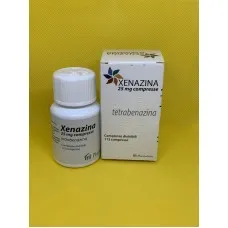
Table of Contents
Patient Information Leaflet
XENAZINA 25 mg tablets
tetrabenazine
Please read this leaflet carefully before taking this medicine because it contains important information for you.
- Keep this leaflet. You may need to read it again.
- If you have any questions, consult your doctor or pharmacist.
- This medicine has been prescribed for you only. Do not give it to others, even if their symptoms are the same as yours, as it may be harmful.
- If you experience any side effects, including those not listed in this leaflet, speak to your doctor or pharmacist. See section 4.
Contents of this leaflet:
- What XENAZINA is and what it is used for
- What you need to know before taking XENAZINA
- How to take XENAZINA
- Possible side effects
- How to store XENAZINA
- Contents of the pack and other information
1. What XENAZINA is and what it is used for
XENAZINA contains the active substance tetrabenazine, which belongs to a group of medicines that act on the nervous system.
XENAZINA is indicated in adult patients for the treatment of movement disorders associated with:
- Huntington's chorea, a disease causing movement and mental disorders;
- movement abnormalities (moderate to severe tardive dyskinesia) associated with taking medicines used to treat mental disorders. Movement disorders caused by medicines for mental disorders can be disabling or embarrassing, and may persist even after discontinuation, substitution, or dose reduction of the causative drug.
Talk to your doctor if you do not feel better or if you feel worse.
2. What you need to know before taking XENAZINA
Do not take XENAZINA
- If you are allergic to tetrabenazine or to any of the other ingredients of this medicine (listed in section 6).
- If you have thoughts of killing yourself (suicidal tendencies).
- If you are depressed and are not taking, or are not responding to, medicines for treating depression.
- If you are pregnant and/or breastfeeding (see pregnancy and breastfeeding).
- If you are taking or have taken within the last 2 weeks medicines for treating depression (MAOIs, monoamine oxidase inhibitors) (see Other medicines and XENAZINA).
- If you have liver disease.
- If you are taking reserpine, a medicine used to treat high blood pressure or mental disorders (see Other medicines and XENAZINA).
- If you have a central nervous system disorder that impairs movement control, manifesting, for example, with tremor, rigidity, slowed movements, or difficulty maintaining balance (Parkinson’s disease).
Warnings and precautions
Talk to your doctor or pharmacist before taking XENAZINA.
Inform your doctor:
- If you are or have been depressed, or if you have had thoughts of or attempted suicide during treatment with XENAZINA. Your doctor may reduce your dose or stop treatment with tetrabenazine and/or prescribe medicines for treating depression.
- If you develop anger and/or aggression during treatment.
- If you experience tremor, rigidity, slowed movements, difficulty maintaining balance, or if you have Parkinson’s disease (a central nervous system disorder impairing movement control) and notice worsening of symptoms.
- If you have previously had a condition called "Neuroleptic Malignant Syndrome." Your doctor will monitor you closely, as this syndrome could recur (see section 4 Possible side effects).
- If you have a heart condition (congenital long QT syndrome with a history of cardiac arrhythmias).
- If you experience inability to remain still and/or seated, restlessness, and agitation (akathisia); your doctor may decide to modify your treatment.
- If you experience drowsiness.
- If you experience a drop in blood pressure when moving from sitting to standing (orthostatic hypotension, which may present as dizziness or fainting).
- If you have elevated levels of prolactin, a hormone, in your blood.
- If your liver or kidneys do not function properly (hepatic and/or renal insufficiency).
- If you know you have reduced or intermediate activity of an enzyme called CYP2D6, as your doctor may prescribe a different dose.
Laboratory tests
If you need to have blood tests, inform laboratory staff that you are taking XENAZINA.
Children and adolescents
Adequately controlled clinical studies in children and adolescents are not available; therefore, specific recommendations for the use of XENAZINA in this population cannot be provided.
Other medicines and XENAZINA
Inform your doctor or pharmacist if you are taking, have recently taken, or might take any other medicines.
In particular, inform your doctor if you are taking:
- fluoxetine, paroxetine, duloxetine, or sertraline, medicines used to treat depression;
- quinidine or amiodarone, medicines used to treat heart rhythm disorders;
- terbinafine, a medicine used to treat fungal infections. Your doctor may adjust your tetrabenazine dose. Also inform your doctor:
- if you are taking levodopa, a medicine used to treat Parkinson’s disease;
- if you are taking MAOIs (monoamine oxidase inhibitors), medicines used to treat depression. Allow at least 14 days between stopping one of these medicines and starting tetrabenazine;
- if you are taking dopamine antagonists, medicines used to treat mental disorders;
- if you are taking antihypertensive agents and beta-blockers, medicines used to treat high blood pressure. You may experience a drop in blood pressure when moving from sitting to standing (orthostatic hypotension);
- if you are taking neuroleptics, hypnotics, or opioids, medicines used to treat mental disorders, insomnia, or pain;
- if you are taking antibiotics (e.g., gatifloxacin, moxifloxacin), used to treat infections;
- if you are taking class IA and III antiarrhythmic agents (e.g., quinidine, procainamide, amiodarone, sotalol), used to treat heart rhythm disorders;
- if you are taking reserpine, a medicine used to treat high blood pressure or mental disorders. Concomitant use of tetrabenazine and reserpine is contraindicated;
- if you are taking digoxin, a medicine used to treat heart conditions;
- if you are taking tricyclic antidepressants, medicines used to treat mental disorders such as depression;
- if you are taking phenytoin, a medicine used to treat epilepsy, as it may counteract the effects of tetrabenazine on movement.
XENAZINA with alcohol
If you take XENAZINA with alcohol, additional sedative effects may occur.
Pregnancy, breastfeeding, and fertility
If you are pregnant, suspect you may be pregnant, plan to become pregnant, or are breastfeeding, consult your doctor before taking this medicine.
Pregnancy
Tetrabenazine must not be used during pregnancy or in women of childbearing potential who are not using contraception (see Do not take XENAZINA).
Breastfeeding
Tetrabenazine must not be used during breastfeeding (see Do not take XENAZINA).
Fertility
Animal studies with tetrabenazine have not shown effects on pregnancy or intrauterine survival.
An increased length of the female cycle and delayed fertility have been observed.
Driving and using machines
XENAZINA may impair your ability to drive or operate machinery, as it may cause drowsiness.
XENAZINA contains lactose
If your doctor has diagnosed you with an intolerance to certain sugars, contact him before taking this medicine.
3. How to take XENAZINA
Take this medicine exactly as instructed by your doctor. If you have any doubts, consult your doctor.
At the beginning of treatment, your doctor will slowly increase the dose over several weeks in order to identify the dose best tolerated by you and effective in reducing your symptoms. Your doctor will adjust the dosage until the most suitable dose for you is reached.
If symptoms do not resolve or improve, your doctor may consider discontinuing therapy with tetrabenazine.
Once a dosage has been established, your doctor will periodically re-evaluate it, taking into account your overall condition.
Movement disorders associated with diseases of the central nervous system (Huntington's chorea)
Adults
The recommended dose is 25 mg, taken 1–3 times daily. Your doctor may increase the daily dose according to your individual needs.
Drug-induced movement disorders
The recommended starting dose is 12.5 mg daily. Your doctor may then gradually increase the dose depending on your response to the medicine. If you do not experience benefit or cannot tolerate the side effects, your doctor will discontinue treatment.
Elderly
If you are elderly, your doctor will prescribe reduced initial and maintenance doses. You may experience tremor, stiffness, slowed movements, or difficulty maintaining balance.
Children and adolescents
There are no adequately controlled clinical studies available in children and adolescents; therefore, specific dosage recommendations for the paediatric population cannot be provided.
Kidney disease (renal impairment)
If you have kidney disease, your doctor will start treatment with half the usual adult dose (12.5 mg daily, equivalent to half a tablet) and adjust the dose until the most appropriate dose for you is reached.
The tablet may be divided into equal parts.
If you take more XENAZINA than you should
In case of accidental overdose with XENAZINA, contact your doctor immediately or go to the nearest hospital.
If you experience any of the following overdose symptoms:
- movement problems caused by severe and uncontrollable muscle contractions (acute dystonia) affecting the eyes, head, neck, and body;
- uncontrolled eye rotation;
- excessive blinking;
- fixed eye position (oculogyric crisis);
- nausea, vomiting, diarrhoea;
- drowsiness;
- sweating;
- dizziness;
- low blood pressure (hypotension);
- confusion;
- hallucinations;
- feeling cold, lowered body temperature (hypothermia);
- sedation;
- flushing (redness/inflammation);
- tremor.
STOP taking tetrabenazine immediately and contact your doctor, who will monitor you closely and treat your symptoms.
If you forget to take XENAZINA
Do not take a double dose to make up for the missed tablet.
If you stop taking XENAZINA
If you have any questions about using this medicine, consult your doctor or pharmacist.
4. Possible side effects
Like all medicines, this medicine can cause side effects, although not everyone experiences them.
If you develop a condition called Neuroleptic Malignant Syndrome, characterized by fever, muscle rigidity, altered mental status, changes in heart rate or blood pressure, increased heart rate, sweating, heart rhythm problems, changes in blood tests (elevated levels of creatine phosphokinase), presence of a substance in the urine (myoglobinuria), muscle pain, and kidney disease, STOP treatment immediately and contact your doctor, who will start appropriate therapy.
The following side effects are listed by frequency:
Very common (may affect more than 1 in 10 people)
- Depression, which in some people may lead to suicidal thoughts. If you feel down or very sad, you may be becoming depressed and should inform your doctor of this change;
- drowsiness;
- muscle stiffness, slowed movements, balance problems (parkinsonism);
- tremors;
- excessive salivation.
Common (may affect up to 1 in 10 people)
- Agitation;
- anxiety;
- insomnia;
- confusion.
Very rare (may affect up to 1 in 10,000 people)
- Inflammation of the lungs (lobar pneumonia);
- decreased number of white blood cells, a type of blood cell (leukopenia);
- reduced appetite;
- loss of body water (dehydration);
- aggression, anger;
- suicide attempt;
- self-harm or beginning to think about intentionally harming yourself;
- increased body temperature (hyperthermia) associated with muscle rigidity, altered mental status, increased blood pressure and heart rate, heart rhythm disturbances, and sweating (neuroleptic malignant syndrome);
- repeated deviation of the eyes in one fixed direction (oculogyric crisis);
- sensitivity to light (photophobia);
- skin rash;
- itching;
- hives;
- weight loss;
- weight gain;
- falls.
Not known (frequency cannot be estimated from the available data)
- Disorientation;
- nervousness, restlessness;
- sleep disturbances;
- loss of coordination of movements (ataxia);
- inability to stay still (akathisia);
- movement problems caused by severe muscle contractions (dystonia);
- memory loss;
- dizziness;
- decreased heart rate (bradycardia);
- drop in blood pressure when standing up (orthostatic hypotension), sometimes leading to fainting (syncope);
- severe increase in blood pressure (hypertensive crisis);
- difficulty swallowing (dysphagia), nausea, vomiting;
- stomach pain, diarrhoea, constipation, dry mouth;
- increased sweating (hyperhidrosis);
- irregular menstrual cycle;
- fatigue, weakness (asthenia);
- lowering of body temperature (hypothermia);
- increased appetite.
Reporting of side effects
If you experience any side effect, including those not listed in this leaflet, contact your doctor. You may also report side effects directly via the national reporting system at https://www.aifa.gov.it/content/segnalazioni-reazioni-avverse. By reporting side effects, you can help provide more information on the safety of this medicine.
5. How to store XENAZINA
Keep this medicine out of the sight and reach of children.
Store below 25°C.
Do not use this medicine after the expiry date stated on the carton after EXP.
The expiry date refers to the last day of that month.
Do not dispose of any medicine via wastewater or household waste. Ask your pharmacist how to
dispose of medicines you no longer use. This will help protect the environment.
6. Package contents and other information
What XENAZINA contains
- The active substance is tetrabenazine 25 mg.
- The other ingredients are starch, lactose (see section 2 “XENAZINA contains lactose”), talc, magnesium stearate, yellow iron oxide E172.
Description of the appearance of XENAZINA and pack contents
XENAZINA is a yellow, scored tablet.
It is available in a plastic container containing 112 scored tablets of 25 mg.
Marketing Authorisation Holder and Manufacturer
Marketing Authorisation Holder
Bausch Health Ireland Limited
3013 Lake Drive
Citywest Business Campus
Dublin 24, D24 PPT3
Ireland
Manufacturer
Astrea Fontaine, Rue des Prés Potets – 21121 – Fontaine les Dijon – France