Vyxeos liposomal
Italy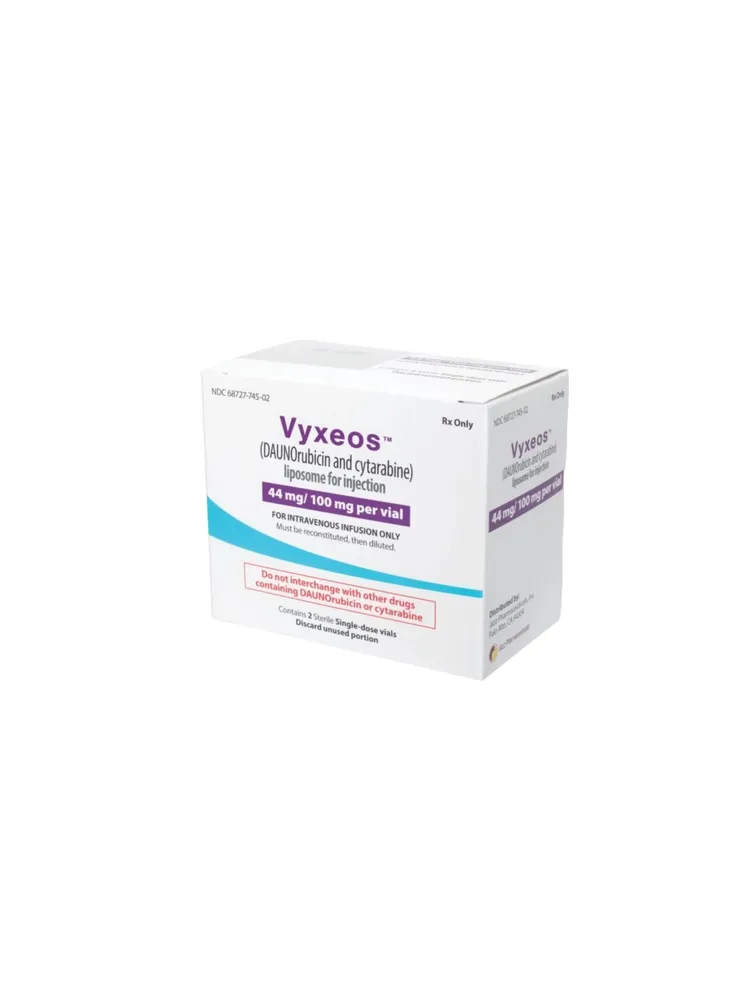
Table of Contents
- Package leaflet: Information for the patient
- Vyxeos liposomal 44 mg/100 mg powder for concentrate for solution for infusion
- 1. What Vyxeos liposomal is and what it is used for
- 2. What you need to know before receiving Vyxeos liposomal
- 3. How Vyxeos liposomal is administered
- 4. Possible side effects
- 5. How to store Vyxeos liposomal
- 6. Contents of the pack and other information
- The following information is intended for healthcare professionals only:
Package leaflet: Information for the patient
Vyxeos liposomal 44 mg/100 mg powder for concentrate for solution for infusion
daunorubicin and cytarabine
Please read this leaflet carefully before taking this medicine because it contains important information for you.
- Keep this leaflet. You may need to read it again.
- If you have any questions, ask your doctor or nurse.
- If you experience any side effects, including those not listed in this leaflet, tell your doctor or nurse. See section 4.
Contents of this leaflet
- What Vyxeos liposomal is and what it is used for
- What you need to know before being given Vyxeos liposomal
- How Vyxeos liposomal is given
- Possible side effects
- How to store Vyxeos liposomal
- Contents of the pack and other information
1. What Vyxeos liposomal is and what it is used for
What Vyxeos liposomal is
Vyxeos liposomal belongs to a group of medicines called "antineoplastic agents", which are used in the treatment of cancer. It contains two active substances, "daunorubicin" and "cytarabine", in the form of tiny particles called "liposomes". These active substances work in different ways to suppress cancer cells by preventing them from growing and dividing. By enclosing them in liposomes, their action in the body is prolonged and their penetration into cancer cells is enhanced, helping to destroy them.
What Vyxeos liposomal is used for
Vyxeos liposomal is used to treat patients with newly diagnosed acute myeloid leukaemia (a type of blood cancer affecting white blood cells). It is administered when the leukaemia is caused by previous treatments (known as therapy-related acute myeloid leukaemia) or when certain abnormalities are present in the bone marrow (known as acute myeloid leukaemia with "myelodysplasia-related changes").
2. What you need to know before receiving Vyxeos liposomal
Do not receive Vyxeos liposomal
- if you are allergic to the active substances (daunorubicin or cytarabine) or to any of the other ingredients of this medicine (listed in section 6).
Warnings and precautions
You will remain under medical supervision during treatment. Speak to your doctor or nurse
before starting treatment with Vyxeos liposomal:
- if you have low levels of platelets, red blood cells, or white blood cells in your blood (a blood test will be performed before you start treatment). If this applies to you:
- your doctor may give you a medicine to help prevent you from developing infections;
- your doctor will monitor you to help prevent infections during treatment.
- if you have previously had heart problems or a heart attack, or have previously received anticancer medicines of the “anthracycline” group. If this applies to you, your doctor may perform a heart examination before starting treatment and repeat it during treatment.
- if you suspect you are pregnant. During treatment and for 6 months after the last dose, you must use an effective method of contraception to avoid pregnancy (for yourself or your partner).
- if you experience allergic reactions (hypersensitivity). If signs of hypersensitivity occur, your doctor may suspend or permanently discontinue treatment, or reduce the infusion rate.
- if you have kidney or liver problems. Your doctor will monitor you during treatment.
- if you have previously suffered from Wilson’s disease or another copper accumulation disorder, as Vyxeos liposomal contains a component called “copper gluconate”.
- if you are due to receive a vaccine.
During treatment, your doctor will monitor your general health and may give you
additional supportive medicines before or together with Vyxeos liposomal. If any
of the conditions described above apply to you (or if you are unsure), speak to your doctor, pharmacist, or
nurse before starting treatment with Vyxeos liposomal.
Children and adolescents
The use of Vyxeos liposomal is not recommended in children and adolescents under 18 years
of age.
Other medicines and Vyxeos liposomal
Inform your doctor or nurse if you are taking, have recently taken, or might take
any other medicines, as Vyxeos liposomal may interfere with the way other
medicines work. In addition, other medicines may interfere with the way Vyxeos
liposomal works.
In particular, inform your doctor or nurse if you are taking any of the following medicines:
- anticancer medicines that may affect the heart, such as doxorubicin.
- medicines that may affect the liver.
Pregnancy and breastfeeding
You must not use Vyxeos liposomal during pregnancy, as it may harm the unborn child.
Use an effective method of contraception during treatment and for 6 months after treatment.
Inform your doctor immediately if you become pregnant during treatment. If you are pregnant, suspect you are pregnant, are planning a pregnancy, or are breastfeeding,
seek advice from your doctor before starting treatment with this medicine.
You must not breastfeed during treatment, as Vyxeos liposomal may harm the baby.
Contraception in men
Use an effective method of contraception during treatment and for 6 months after treatment with
Vyxeos liposomal.
Driving and using machines
You may experience drowsiness or dizziness after receiving Vyxeos liposomal. If this occurs, do not drive and do not operate tools or machinery.
3. How Vyxeos liposomal is administered
Vyxeos liposomal must be administered by a doctor or a nurse experienced in the treatment of acute myeloid leukemia.
- It is given as an intravenous infusion.
- The infusion will last one and a half hours (90 minutes).
The doctor or nurse will determine the dose of the medicine based on your weight and height.
The treatment will be given in "cycles". Each cycle consists of one infusion and may be administered weeks apart.
After the first treatment cycle, the doctor will decide whether you need further cycles, depending on your response to treatment and the occurrence of any side effects. Your doctor will assess your response to treatment after each cycle.
- During the first cycle, you will receive an infusion on days 1, 3 and 5.
- In subsequent cycles, you will receive an infusion on days 1 and 3. This schedule may be repeated if necessary.
During treatment with Vyxeos liposomal, your doctor will regularly perform blood tests to monitor your response to treatment and to ensure it is well tolerated. Your doctor may also perform a heart examination because Vyxeos liposomal may have an effect on heart function.
If you receive more Vyxeos liposomal than you should
This medicine will be administered to you in hospital by a doctor or nurse. It is unlikely that you will receive too high a dose. However, if you have any concerns, speak to your doctor or nurse.
If you miss an appointment
Contact your doctor or nurse as soon as possible.
If you have any questions about the use of this medicine, speak to your doctor or nurse.
4. Possible side effects
Like all medicines, this medicine can cause side effects, although not everyone gets them.
Serious side effects which may affect more than 1 in 10 people (very common)
Vyxeos liposomal may reduce the number of white blood cells, which fight infections, and the number of platelets (blood cells that help blood to clot), leading to bleeding disorders such as nosebleeds and bruising. Vyxeos liposomal may also cause heart problems.
Therefore, you must inform your doctor immediately if you experience:
- fever, chills, sore throat, cough, mouth sores, or any other sign of infection
- bleeding or bruising without injury
- chest or leg pain
- shortness of breath.
Inform your doctor immediately if you notice any of these side effects.
Other side effects
Very common side effects (may affect more than 1 in 10 people):
- reduced number of platelets (blood cells that help blood to clot), which may cause bruising or bleeding
- fever, often accompanied by other signs of infection, due to very low white blood cell count (febrile neutropenia)
- slow, fast, or irregular heartbeat, chest pain (which may be a sign of infection)
- vision problems, blurred vision
- pain or swelling of the tissue lining the digestive tract (mucositis) or abdominal pain, constipation, loss of appetite, diarrhoea, nausea, or vomiting
- skin redness, rash, muscle pain, headache, bone pain, joint pain, fatigue, generalised swelling, including swelling of arms and legs
- headache, dizziness, confusion, insomnia, anxiety
- kidney failure
- shortness of breath, cough, fluid in the lungs
- itching
- bleeding
- increased or decreased blood pressure
- chills, abnormally low or high body temperature
- increased sweating
Common side effects (may affect up to 1 in 10 people):
- anaemia (reduced number of red blood cells in the blood) causing tiredness and weakness
- kidney failure and blood test abnormalities due to massive death of tumour cells (tumour lysis syndrome)
- abdominal cramps or excessive flatulence
- excessive night sweats
- hair loss
Uncommon side effects (may affect up to 1 in 100 people):
- numbness and skin eruptions of the hands and feet (palmar-plantar erythrodysesthesia syndrome).
Reporting of side effects
If you get any side effects, including those not listed in this leaflet, talk to your doctor or nurse. You can also report side effects directly via the national reporting system listed in Annex V. By reporting side effects, you can help provide more information on the safety of this medicine.
5. How to store Vyxeos liposomal
- Keep this medicine out of the sight and reach of children.
- Do not use this medicine after the expiry date stated on the carton and vial after Exp./EXP. The expiry date refers to the last day of that month.
- Store in a refrigerator (2 °C-8 °C).
- Keep the vial in the outer packaging to protect the medicine from light.
- Store in an upright position.
- After reconstitution, reconstituted Vyxeos liposomal vials must be stored in the refrigerator (2 °C-8 °C) for up to 4 hours in an upright position.
- After dilution, the solution in infusion bags must be stored in the refrigerator (2 °C-8 °C) for up to 4 hours. The total combined storage time of the reconstituted product in the vial stored upright and the reconstituted product after dilution in an infusion bag must not exceed 4 hours. The 90-minute infusion time should be added to the 4-hour maximum storage time.
- Do not use this medicine if you notice the presence of particles in the diluted solution.
- Do not dispose of any medicine via wastewater. Ask your pharmacist how to dispose of medicines you no longer use. This will help protect the environment.
6. Contents of the pack and other information
What Vyxeos liposomal contains
- The active substances are daunorubicin and cytarabine. Each 50 mL vial contains 44 mg of daunorubicin and 100 mg of cytarabine.
- After reconstitution, the solution contains 2.2 mg/mL of daunorubicin and 5 mg/mL of cytarabine encapsulated in liposomes.
- The other components are distearoylphosphatidylcholine, distearoylphosphatidylglycerol, cholesterol, copper gluconate, tromethamine and sucrose.
Description of the appearance of Vyxeos liposomal and contents of the pack
Vyxeos liposomal is a purple powder for concentrate for solution for infusion in a glass vial.
Each pack contains 1, 2 or 5 vials. Not all pack sizes may be marketed.
Marketing Authorisation Holder and Manufacturer
Jazz Pharmaceuticals Ireland Ltd
5th Floor
Waterloo Exchange
Waterloo Road
Dublin
D04 E5W7
Ireland
Tel.: +353 1 968 1631
E-mail: [email protected]
Other sources of information
More detailed information on this medicinal product is available on the website of the European Medicines Agency: http://www.ema.europa.eu. Links to other websites on rare diseases and related therapeutic treatments are also provided.
This leaflet is available in all languages of the European Union/European Economic Area on the European Medicines Agency website.
The following information is intended for healthcare professionals only:
Vyxeos liposomal is a cytotoxic medicinal product. Special handling and disposal procedures must be observed. The product is for single use only and contains no preservatives. Any unused medicinal product must not be retained for subsequent administrations.
Instructions for Preparation
-
Determine the dose and number of Vyxeos liposomal vials based on the patient's body surface area (BSA), as described in section 4.2.
-
Remove the appropriate number of Vyxeos liposomal vials from the refrigerator and allow them to reach room temperature (15 °C–30 °C) for 30 minutes.
-
Using a 20 mL syringe, reconstitute each vial with 19 mL of sterile water for injections. Immediately start a timer for 5 minutes.
-
Gently mix the contents of the vial for 5 minutes by inverting the vial every 30 seconds.
-
Do not heat, vortex, or shake vigorously.
-
After reconstitution, allow the solution to stand for 15 minutes.
-
The reconstituted product should be a homogeneous, opaque, purple dispersion, practically free from visible particles.
-
If the reconstituted product is not to be diluted immediately into an infusion bag, store it in the refrigerator (2 °C–8 °C) for up to 4 hours.
-
After storage of the reconstituted product in the vial for up to 4 hours at 2 °C–8 °C in an upright position, the reconstituted product must be immediately diluted into an infusion solution and administered over a 90-minute infusion period.
-
The reconstituted product in the vial and the reconstituted product diluted in an infusion solution are stable for a combined storage period of up to 4 hours when stored at 2 °C–8 °C. The 4-hour stability period for the reconstituted product in the vial does not allow for an additional 4-hour stability period after the appropriate dose has been withdrawn from the reconstituted vial and diluted into the infusion solution.
-
The 4-hour stability period for the reconstituted product diluted in the infusion bag and stored at 2 °C–8 °C does not include the time required for reconstitution or the 90-minute infusion time.
-
The diluted infusion solution must be administered immediately over a 90-minute infusion period, within the maximum 4-hour stability period.
-
Calculate the required volume of reconstituted Vyxeos liposomal using the following formula:
[Required volume (mL) = daunorubicin dose (mg/m²) × patient’s BSA (m²) / 2.2 (mg/mL)].
The concentration of the reconstituted solution is 44 mg/20 mL (2.2 mg/mL) daunorubicin and 100 mg/20 mL (5 mg/mL) cytarabine. -
Gently invert each vial 5 times before withdrawing the concentrate for dilution.
-
Using aseptic technique, withdraw the calculated volume of reconstituted Vyxeos liposomal from the vial(s) using a sterile syringe and transfer it into an infusion bag containing 500 mL of 9 mg/mL (0.9%) sodium chloride injection or 5% glucose solution. Some residual product may remain in the vial. Discard any unused portion.
-
Gently invert the infusion bag to mix the solution. Dilution of the reconstituted product results in a homogeneous, translucent, dark purple dispersion.
-
If the diluted infusion solution is not used immediately, it must be stored in the refrigerator (2 °C–8 °C) for up to 4 hours.
-
If the solution has been refrigerated, gently invert the infusion bag to mix before administration.
Instructions for Administration
- Do not mix Vyxeos liposomal with other medicinal products, nor administer it simultaneously via the same intravenous line as other drugs.
- Administer Vyxeos liposomal as a constant intravenous infusion over 90 minutes using an infusion pump through a central venous catheter or a peripherally inserted central catheter (PICC). An in-line membrane filter may be used for the intravenous infusion of Vyxeos liposomal, provided the minimum pore size is ≥15 µm.
- After administration, flush the line with 9 mg/mL (0.9%) sodium chloride injection.
Disposal
This medicinal product may pose a potential risk to the environment due to its cytotoxic and antimitotic activity, which may have possible effects on reproduction. All materials used for dilution and administration must be disposed of in accordance with local procedures for the disposal of antineoplastic agents. Any unused medicinal product and waste derived from this medicinal product must be disposed of in accordance with local regulations for cytotoxic agents.