Vivotif
Italy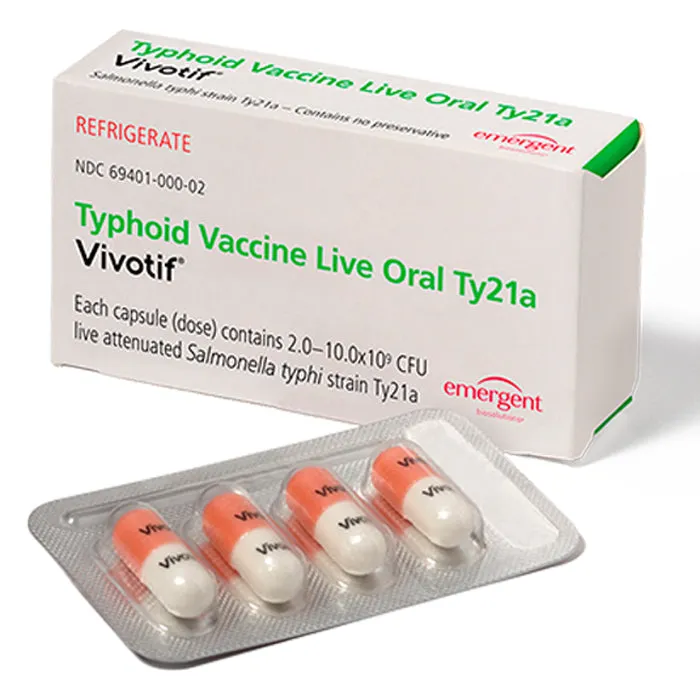
Table of Contents
Package leaflet: Information for the user
Vivotif
Salmonella Typhi Ty21a
Please read this leaflet carefully before taking this vaccine as it contains important information for you.
- Keep this leaflet. You may need to read it again.
- If you have any questions, ask your doctor, pharmacist or nurse.
- This vaccine has been prescribed for you only. Do not pass it on to other people.
- If you experience any adverse reactions, including those not listed in this leaflet, contact your doctor, pharmacist or nurse. See section 4.
Contents of this leaflet:
- What Vivotif is and what it is used for
- What you need to know before taking Vivotif
- How to take Vivotif
- Possible side effects
- How to store Vivotif
- Contents of the pack and other information
1. What Vivotif is and what it is used for
Vivotif is an oral vaccine that stimulates an immune response against a type of bacteria called
Salmonella Typhi, which causes typhoid fever. It is used to protect adults and children from the age of 5 years against typhoid fever.
How Vivotif works
The bacteria contained in the Vivotif vaccine have been modified so that they cannot cause typhoid fever, but can still stimulate the body's natural defence system (immune system) to fight the bacteria responsible for this disease.
Other diseases caused by Salmonella
There are many other types of bacteria belonging to the genus Salmonella, most of which cause illnesses associated with diarrhoea that are quite different from typhoid fever and are generally less severe.
Vivotif does not provide protection against infections caused by these other types of Salmonella bacteria.
2. What you need to know before taking Vivotif
Do not take Vivotif
- if you are allergic (hypersensitive) to Salmonella Typhi Ty21a or to any of the other ingredients of this vaccine (listed in section 6)
- if you have previously had allergic reactions after taking Vivotif
- if your immune system is weakened for any reason, for example, if you have had low immunity to infections since birth. Low immunity may also be due to certain infections or treatments that suppress the immune system, such as high-dose corticosteroids, anticancer drugs, or radiotherapy
- if you currently have a high fever (above 38.5°C) or a gastrointestinal illness (such as diarrhea)
- do not take Vivotif until you have fully recovered.
Warnings and precautions
Not everyone who completes a full course of Vivotif will be completely protected against typhoid fever. It is important to continue following hygiene advice and to be cautious regarding food and water consumption in areas affected by typhoid fever.
Children
This vaccine must not be administered to children under 5 years of age, as the capsule formulation is not suitable for this age group.
Other medicines and Vivotif
Tell your doctor, pharmacist, or nurse if you are taking, have recently taken, or might take any other medicines or vaccines, including over-the-counter drugs and herbal remedies, as Vivotif may interfere with the mechanism of action of other medicines and vaccines.
In particular, inform your doctor, pharmacist, or nurse if you are taking:
- antibiotics – Vivotif may not be effective if taken at the same time as antibiotics. Take Vivotif at least 3 days after the last dose of an antibiotic.
- medicines for malaria prevention – before starting treatment, wait 3 days after the last dose of Vivotif, unless otherwise advised by your doctor, pharmacist, or nurse.
If any of the conditions listed above apply to you, consult your doctor, pharmacist, or nurse before taking Vivotif.
Vivotif with food and drink
Vivotif should be taken on an empty stomach and at least one hour before the next meal.
Pregnancy, breastfeeding, and fertility
If you are pregnant, think you may be pregnant, are planning a pregnancy, or are breastfeeding, ask your doctor or pharmacist for advice before taking this medicine.
Driving and using machines
No effects of Vivotif on the ability to drive vehicles or operate machinery are known. However, if you do not feel well, do not drive or operate machinery.
Vivotif contains lactose and sucrose
If your doctor has diagnosed you with an intolerance to certain sugars, contact them before taking this medicine.
3. How to take Vivotif
Take this vaccine exactly as instructed by your doctor, pharmacist, or nurse. If you have any doubts, consult your doctor, pharmacist, or nurse.
The vaccine blister pack should be inspected to ensure the integrity of the foil and the capsules.
How much Vivotif to take and when
The recommended dose is three capsules, taken individually on alternate days.
- Take the first capsule on a day of your choice. This will be Day 1.
- Take the second capsule on Day 3.
- Take the third capsule on Day 5.
How to take the capsules
- Take the capsules on an empty stomach and at least one hour before your next meal.
- Do not crush or chew the capsules.
- Swallow the capsules with cold or lukewarm water (not exceeding 37°C).
- Swallow the capsules as quickly as possible after placing them in your mouth.
Protection against typhoid fever begins approximately seven to ten days after completing the three-capsule course. Your doctor, pharmacist, or nurse will advise you on how long before your travel you should complete the Vivotif course.
After three years, you may need to take Vivotif again if you continue to travel to areas where typhoid fever is present. In this case, consult your doctor, pharmacist, or nurse.
If you take more Vivotif than you should
If you accidentally take all three doses at once, inform your doctor, pharmacist, or nurse. It is unlikely to make you feel unwell, but you may not be adequately protected against typhoid fever.
If you forget to take Vivotif
If you forget to take a dose, take it as soon as you remember. Then take the next dose approximately 48 hours later.
If you have any doubts about the use of this product, consult your doctor, pharmacist, or nurse.
4. Possible side effects
Like all vaccines, this vaccine may cause side effects, although not everybody gets them.
Contact a doctor immediately if you experience the following serious side effects:
- serious allergic reactions causing swelling of the face or throat, shortness of breath, and/or drop in blood pressure and fainting.
Other side effects:
Common side effects (may affect up to 1 in 10 people)
- Stomach ache
- Nausea or vomiting
- Diarrhoea
- Fever
- Headache
- Skin redness
Other side effects (frequency cannot be determined from the available data):
- skin irritation, skin rashes, raised red or lumpy skin rashes, itching
- weakness
- general feeling of being unwell
- chills
- feeling of tiredness
- tingling
- dizziness
- joint or muscle pain
- back pain
- loss of appetite, flatulence, abdominal bloating
- flu-like illness.
Reporting of side effects
If you get any side effects, including ones not listed in this leaflet, talk to your doctor, pharmacist, or nurse.
You can also report side effects directly via the website:
https://www.aifa.gov.it/content/segnalazioni-reazioni-avverse .
By reporting side effects, you can help provide more information on the safety of this medicine.
5. How to store Vivotif
Keep this vaccine out of the sight and reach of children.
Do not use Vivotif after the expiry date stated on the label. The expiry date refers to the last day of that month.
Store in the refrigerator (2 °C – 8 °C).
Keep the blister pack in the outer packaging to protect the vaccine from light.
Do not use this vaccine if you notice that the blister pack or the capsules are damaged.
Do not dispose of any medicine via wastewater. Ask your pharmacist how to dispose of medicines you no longer use. This will help protect the environment.
6. Package contents and other information
What Vivotif contains
- Each capsule contains at least 2x10 viable cells of Salmonella Typhi Ty21a.
- The other ingredients are anhydrous lactose, sucrose, casein hydrolysate, ascorbic acid (E300), magnesium stearate (E470), non-viable cells of Salmonella Typhi Ty21a. Capsule shell: gelatin, titanium dioxide (E171), erythrosine (E127), yellow iron oxide (E172) and red iron oxide (E172). Capsule coating: hydroxypropylmethylcellulose phthalate, ethylene glycol and diethyl phthalate.
Description of the appearance of Vivotif and contents of the pack
The pack contains a blister with three enteric-coated capsules of Vivotif. The capsules are
bicolored, white and salmon.
Marketing Authorization Holder
Bavarian Nordic A/S
Philip Heymans Alle 3
2900 Hellerup
Denmark
Manufacturer
IL-CSM GmbH
Marie-Curie-Strasse 8
D-79539 Lörrach
Germany
This medicinal product is authorised in the European Economic Area and in the United Kingdom (Northern Ireland) under the following names:
Austria, Belgium, Czech Republic, Denmark, Finland, France, Luxembourg, Netherlands,
Norway, Poland, Portugal, Slovakia, Spain, Sweden, United Kingdom (Northern Ireland): Vivotif
Germany: Typhoral L
Further sources of information
More detailed information on this medicinal product is available on the website of the Italian Medicines Agency (http://www.agenziafarmaco.gov.it/)