Vividrin eyes
Italy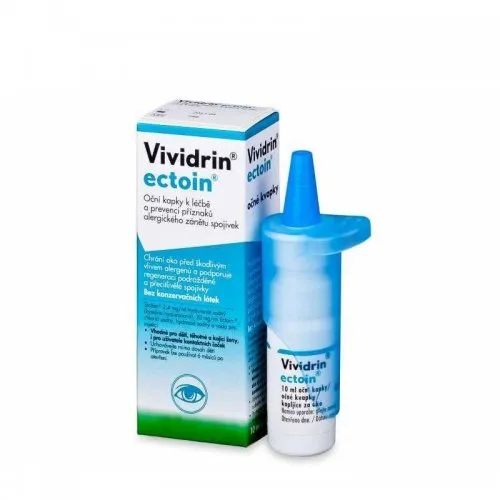
Table of Contents
Patient Information Leaflet
Vividrin Eyes 0.5 mg/ml eye drops, solution
Azelastine hydrochloride
Please read all of this leaflet carefully before using this medicine because it contains important information for you.
Use this medicine exactly as described in this leaflet or as your doctor or pharmacist has instructed you.
- Keep this leaflet. You may need to read it again.
- If you need more information or advice, contact your pharmacist.
- If you experience any side effects, including those not listed in this leaflet, contact your doctor or pharmacist. See section 4.
- Contact your doctor if you do not notice any improvement or if your symptoms worsen after 2 days.
Contents of this leaflet
- What Vividrin Eyes is and what it is used for
- What you need to know before using Vividrin Eyes
- How to use Vividrin Eyes
- Possible side effects
- How to store Vividrin Eyes
- Contents of the pack and other information
1. What Vividrin Eyes is and what it is used for
Vividrin Eyes contains the active substance azelastine hydrochloride, which belongs to a group of medicines called antiallergic agents (antihistamines). Antihistamines work by preventing the effects of substances such as histamine, which the body produces during an allergic reaction. It has been shown that azelastine reduces eye inflammation.
Vividrin Eyes can be used for the treatment and prevention of eye symptoms associated with hay fever (seasonal allergic conjunctivitis presenting with eye redness, itching or tearing) in adults and children from 4 years of age onwards.
Vividrin Eyes can be used for eye symptoms caused by allergies to substances such as house dust mites or pet hair (perennial allergic conjunctivitis) in adults and children from 12 years of age onwards.
Vividrin Eyes is a preservative-free solution.
2. What you need to know before using Vividrin Eyes
Do not use Vividrin Eyes:
- if you are allergic to azelastine hydrochloride or to any of the other ingredients of this medicine (listed in section 6).
Warnings and precautions
Talk to your doctor or pharmacist before using Vividrin Eyes:
- if you are unsure whether your eye symptoms are caused by an allergy. In particular, if only one eye is affected; if your vision is impaired; or if your eye burns but you have no nasal symptoms, you may have an infection rather than an allergy;
- if your symptoms worsen or last longer than 48 hours without significant improvement despite using Vividrin Eyes;
- if you wear contact lenses.
Vividrin Eyes is not indicated for the treatment of eye infections.
Children and adolescents
For the treatment of eye symptoms caused by hay fever (seasonal allergic conjunctivitis): do not administer this medicine to children under 4 years of age, as safety and efficacy have not been established.
For the treatment of eye symptoms caused by allergy (non-seasonal (perennial) allergic conjunctivitis): do not administer this medicine to children under 12 years of age, as safety and efficacy have not been established.
Other medicines and Vividrin Eyes
Although Vividrin Eyes is not known to interfere with other medicines, inform your doctor or pharmacist if you are using, have recently used, or might use any other medicines.
Pregnancy and breastfeeding
If you are pregnant, think you may be pregnant, planning to become pregnant, or are breastfeeding, consult your doctor or pharmacist before using this medicine.
Driving and using machines
Your vision may become temporarily blurred after using Vividrin Eyes. If this occurs, wait until your vision clears before driving or operating machinery.
Remove contact lenses before application and wait at least 15 minutes before reinserting them.
3. How to use Vividrin Eyes
Use this medicine exactly as described in this leaflet or as instructed by your doctor or pharmacist. If you have any doubts, consult your doctor or pharmacist.
Please remember:
Vividrin Eyes must be applied only into the eyes.
Recommended dose:
Eye disorders caused by hay fever (seasonal allergic conjunctivitis)
- For use in adults and children aged 4 years and older.
- The usual dose is one drop in each eye in the morning and evening. If exposure to pollen is expected, the usual dose of Vividrin Eyes can be administered as a preventive measure before going outdoors.
Eye disorders caused by allergy (non-seasonal (perennial) allergic conjunctivitis)
- For use in adults and children aged 12 years and older.
- The usual dose is one drop in each eye in the morning and evening.
If your symptoms are severe, your doctor may increase the dose to one drop in each eye up to four times a day.
You should notice relief from symptoms of allergic conjunctivitis within 15–30 minutes.
Instructions for applying Vividrin Eyes
To help you apply the eye drops correctly, it may be useful to sit in front of a mirror the first few times so you can see what you are doing.
If you wear contact lenses, you must remove them before applying Vividrin Eyes and wait 15 minutes before reinserting them.
When using this eye drop, you must wash your hands thoroughly before opening the bottle and follow the steps below:
A. Before first application into the eye
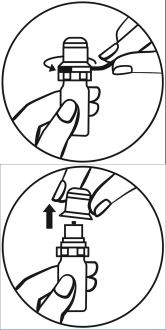
- Remove the security ring.
- Remove the protective cap.
B. To apply the eye drops
- Hold the bottle upside down. Press firmly in the center of the bottle to release one or two drops. If no drop appears, repeat steps A2 and B1.
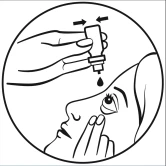
Gently pull down the lower eyelid while looking upward. Position the bottle over the eye and gradually press the center of the bottle until a drop appears.
Avoid contact between the eye or eyelids and the tip of the bottle.
- Blink once to help spread the drop over the entire surface of the eye.
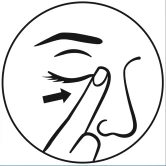
With the eye still closed, carefully wipe away any excess eye drop.
To reduce potential systemic absorption, it is recommended to press gently with a finger on the inner corner of the eye for 2 minutes after each application, keeping the eye closed.
C. After each application
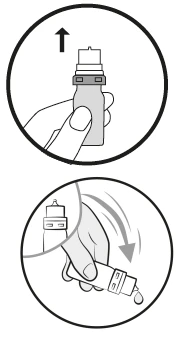
To remove residual drops:
- Hold the bottle upright in the center, with the opening facing upwards.
- Quickly rotate the bottle downward to expel the residual drop.
- Replace the protective cap after use.
Duration of treatment
If possible, Vividrin Eyes should be used regularly until symptoms disappear.
Do not use Vividrin Eyes for longer than 6 weeks without medical advice.
Consult your doctor if you do not feel better or if you feel worse after 2 days of treatment.
If you use more Vividrin Eyes than you should
If you apply too much Vividrin Eyes into your eyes, it is unlikely that problems will occur. If you are concerned, contact your doctor. In case of accidental ingestion of Vividrin Eyes, contact your doctor or the nearest hospital emergency department as soon as possible.
If you forget to use Vividrin Eyes
Use the eye drops as soon as possible, then take the next dose at your usual time. Do not use a double dose to make up for a forgotten dose.
If you have any questions about the use of this medicine, consult your doctor or pharmacist.
4. Possible side effects
Like all medicines, this medicine can cause side effects, although not everybody gets them.
These side effects include:
- Common (may affect up to 1 in 10 people): mild eye irritation (burning, itching, tearing) after application of Vividrin Eyes. This condition should not last long.
- Uncommon (may affect up to 1 in 100 people): bitter taste in the mouth. This condition disappears quickly, especially if you drink a non-alcoholic beverage.
- Very rare (may affect up to 1 in 10,000 people): an allergic reaction (such as skin rash and itching).
Reporting of side effects
If you experience any side effect, including those not listed in this leaflet, talk to your doctor or pharmacist.
You can also report side effects directly via the national reporting system at: https://www.aifa.gov.it/content/segnalazioni-reazioni-avverse .
By reporting side effects, you can help provide more information on the safety of this medicine.
5. How to store Vividrin Eyes
Keep this medicine out of the sight and reach of children.
Do not use this medicine after the expiry date stated on the bottle label and on the carton.
The expiry date refers to the last day of that month.
Do not store above 25°C.
Do not freeze.
After opening: do not use this medicine if the bottle has been open for more than 3 months. This medicine must not be stored at temperatures above 25°C.
Do not dispose of any medicine via wastewater or household waste. Ask your pharmacist how to dispose of medicines you no longer use. This will help protect the environment.
6. Package contents and other information
What Vividrin Occhi contains
Each ml of solution contains 0.5 mg/ml of azelastine hydrochloride. Each drop contains 0.0216 mg of
azelastine hydrochloride.
The other components are: sorbitol, hypromellose, disodium edetate, sodium hydroxide, purified water.
Description of the appearance of Vividrin Occhi and contents of the pack
Vividrin Occhi is a clear solution.
Vividrin Occhi is available in a plastic bottle with a dispensing system and a cap.
One bottle contains 10 ml of solution.
Marketing Authorisation Holder and Manufacturer
Marketing Authorisation Holder
Bausch + Lomb Ireland Limited
3013 Lake Drive - Citywest Business Campus
Dublin 24 – D24 PPT3
Ireland
Manufacturer
Laboratoire Chauvin
Zone Industrielle De Ripotier
50 Avenue Jean Monnet
07200 Aubenas, France
This medicinal product is authorised in the European Economic Area Member States under the following
names:
Austria: Vividrin Azelastin MDO 0.5 mg/ml Augentropfen, Lösung
Cyprus: Vivestin
Croatia: Vivialle 0.5 mg/ml kapi za oko, otopina
Germany: Vividrin Azelastin MDO 0.5 mg/ml Augentropfen, Lösung
Greece: Vivestin
Italy: Vividrin Occhi 0.5 mg/ml collirio, soluzione
Poland: Azel-Drop Free
Portugal: Vivilin, 0.5 mg/ml Colírio, Solução
Czech Republic: Ocuazel
Slovakia: Ocuazel
Spain: Vividrin 0.5 mg/ml colirio en solución
Hungary: Vivialle 0.5 mg/ml oldatos szemcsepp