Visucloben
Italy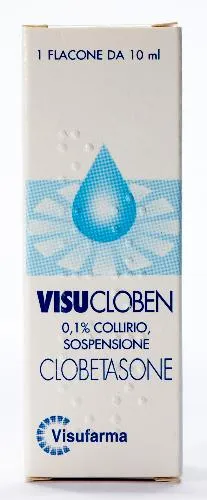
Table of Contents
Package leaflet: Information for the patient
VISUCLOBEN
1 mg/ml eye drops, suspension
Clobetasone butyrate
Please read this leaflet carefully before using this medicine because it contains important information for you.
Keep this leaflet. You may need to read it again.
- If you have any questions, ask your doctor or pharmacist.
- This medicine has been prescribed for you only. Do not give it to other people, even if their symptoms are the same as yours, because it could be harmful.
- If you experience any side effect, including those not listed in this leaflet, please inform your doctor or pharmacist. See section 4.
Contents of this leaflet:
1. What VISUCLOBEN is and what it is used for
2. What you need to know before using VISUCLOBEN
3. How to use VISUCLOBEN
4. Possible side effects
5. How to store VISUCLOBEN
6. Contents of the pack and other information
1. What VISUCLOBEN is and what it is used for
VISUCLOBEN is an ophthalmic (eye) medicine containing the active substance clobetasone butyrate, which belongs to a group of medicines called corticosteroids.
VISUCLOBEN is used in the treatment of:
- Inflammations of the eye caused by allergic diseases or inflammations of the eye not due to the presence of microorganisms (allergic conjunctivitis, vernal conjunctivitis, phlyctenular keratoconjunctivitis, keratitis due to rosacea, interstitial keratitis, iritis, cyclitis, etc.)
- Eye injuries (keratoconjunctival lesions caused by chemical or physical agents such as ultraviolet radiation, X-rays, heat, etc., or by the penetration of foreign bodies). Consult your doctor if you do not notice any improvement or if you observe a worsening of symptoms after the prescribed duration of treatment.
2. What you should know before using VISUCLOBEN
Do not use VISUCLOBEN
- if you are allergic to clobetasone butyrate or to any of the other ingredients of this medicine (listed in section 6).
- in case of
- acute herpes simplex infections and most viral diseases of the front part of the eye (cornea), active-phase chickenpox, eye inflammations with superficial corneal damage even in early stages (ulcerative keratitis); if your doctor has performed a fluorescein test and the result was positive.
- fungal infections (tuberculosis, mycoses)
- eye inflammations (such as acute ophthalmias and conjunctivitis) and eyelid margin inflammations (purulent and herpetic blepharitis)
- inflammations and infections of the eyelid (e.g. styes)
Warnings and precautions
Talk to your doctor or pharmacist before using Visucloben.
Use Visucloben under medical supervision.
Do not use eye products containing steroid-type anti-inflammatory agents (corticosteroids, to which clobetasone belongs) after removal of a superficial foreign body from the front part of the eye (cornea).
If you have been prescribed long-term or repeated treatment with this type of medicine, periodic eye examinations are required to:
- accurately assess the cornea and lens (the eye's internal lens).
- monitor intraocular pressure, although it has been shown that VISUCLOBEN has minimal undesirable effects on intraocular pressure during prolonged treatment. However, with some locally used anti-inflammatory agents belonging to the same class as VISUCLOBEN (corticosteroids), the following have been reported:
- cases of cataract and corneal perforation
- viral, bacterial, and fungal infections, which may be activated, worsened, or masked by the use of these products. Fungal infections are particularly prone to develop during prolonged local treatment with corticosteroids; if you have persistent corneal lesions (ulcerations), consider these infections. If you notice signs of hypersensitivity, discontinue use of VISUCLOBEN. Continuous use for longer than one month is not recommended. Always use the product under direct medical supervision. Proper use of Visucloben generally does not lead to the adverse effects that might occur if the medicine were taken orally; however, eye drops containing corticosteroids (such as clobetasone) may be absorbed in sufficient amounts to cause partial suppression of the activity of the gland located above the kidney (adrenal gland) in adults and a hormonal disorder in children (Cushing's syndrome). Hereditary and degenerative eye diseases do not respond to treatment with corticosteroid-type anti-inflammatory agents such as clobetasone. Contact your doctor if you experience blurred vision or other visual disturbances.
Children and adolescents
In very early infancy, this product should be administered only when strictly necessary and under direct medical supervision.
Other medicines and VISUCLOBEN
Inform your doctor or pharmacist if you are taking, have recently taken, or might take any other medicines.
No interactions with other medicines are known.
Pregnancy and breastfeeding
If you are pregnant, suspect you may be pregnant, planning a pregnancy, or are breastfeeding, consult your doctor or pharmacist before taking this medicine.
No studies have been conducted with VISUCLOBEN in pregnant or breastfeeding women.
Driving and using machines
VISUCLOBEN does not affect or affects negligibly the ability to drive vehicles or operate machinery.
VISUCLOBEN Eye Drops Suspension (10 ml bottle) contains benzalkonium chloride
The medicine contains benzalkonium chloride (1 mg per 10 ml, equivalent to 10 mg/100 ml), which may be absorbed by soft contact lenses and may cause discoloration.
Remove your contact lenses before using this medicine and wait 15 minutes before reinserting them.
Benzalkonium chloride may also cause eye irritation, especially if you have dry eye or corneal disorders (the transparent outermost layer of the eye). If you experience an abnormal sensation in the eye, such as burning or pain after using this medicine, speak with your doctor.
3. How to use VISUCLOBEN
Use this medicine exactly as directed by your doctor or pharmacist. If you have
any doubts, consult your doctor or pharmacist.
The recommended dose is:
Adults
Instill 1 drop of VISUCLOBEN into the conjunctival sac 2 - 4 times daily.
In particularly severe cases, instill 1 drop every 1 - 2 hours until significant
improvement is achieved; then reduce the frequency of instillations.
Children and adolescents
In the earliest infancy, the product should be administered only when clearly necessary and under
direct medical supervision.
If you use more VISUCLOBEN than you should
In case of accidental ingestion/uptake, i.e. unintentional overdose of
VISUCLOBEN, contact your doctor immediately or go to the nearest hospital.
If you forget to use VISUCLOBEN
Do not use a double dose to make up for the missed dose.
If you have any doubts about the use of this medicine, consult your doctor or pharmacist.
4. Possible side effects
Like all medicines, VISUCLOBEN may cause side effects, although not everyone experiences them.
Locally, the following may occur:
- hypersensitivity reactions such as hyperemia (increased blood flow in the eye causing redness and swelling), burning and itching, which require discontinuation of treatment. Increases in intraocular pressure have been reported in sensitive patients, but are generally milder and less frequent with Clobetasone compared to other anti-inflammatory drugs of the same class (corticosteroids) for ophthalmic use. Long-term treatments may cause:
- ocular hypertension and/or glaucoma (a serious eye disease)
- optic nerve damage, visual field alterations, cataract
- delayed healing of wounds
- infections
Rarely, patients receiving anti-inflammatory agents (corticosteroids) via other routes of administration or even locally in the eye for other conditions have reported:
- eye infections with the Herpes simplex virus. Perforation has been described in diseases causing thinning of the anterior part of the eye (cornea and sclera) following the use of local anti-inflammatory (steroid) agents.
Although not reported in patients treated with VISUCLOBEN, rare cases of small watery blisters (serous vesicles) have been reported with anti-inflammatory (corticosteroid) therapy following cataract surgery.
Blurred vision has been reported with unknown frequency.
Following the instructions provided in this leaflet reduces the risk of side effects.
Reporting of side effects
If you experience any side effect, including those not listed in this leaflet, talk to your doctor or pharmacist. You can also report side effects directly via the national reporting system at the website
https://www.aifa.gov.it/web/guest/content/segnalazioni-reazioni-avverse
. By reporting side effects, you can help provide more information on the safety of this medicine.
5. How to store VISUCLOBEN
Keep this medicine out of the sight and reach of children.
Do not use this medicine after the expiry date which is stated on the packaging after Exp.
The expiry date refers to the last day of that month.
The expiry date refers to the product in its original, undamaged packaging, correctly stored.
Store below 25°C.
The eye drops must be used within 30 days after first opening the bottle.
Do not dispose of any medicine via wastewater or household waste. Ask your pharmacist how to
dispose of medicines no longer required. This will help protect the environment.
6. Package contents and other information
What VISUCLOBEN contains
VISUCLOBEN Eye Drops (suspension) (10 ml bottle)
Active substance: clobetasone-17-butyrate
Each 100 ml of eye drop suspension contains: clobetasone-17-butyrate 100 mg;
Other components: macrogol 300, benzalkonium chloride, sodium citrate, citric acid monohydrate, polyvinyl alcohol, water for injections
Description of the appearance of VISUCLOBEN and contents of the pack
VISUCLOBEN Eye Drops are a suspension, supplied in packs containing:
1 bottle of 10 ml
Marketing Authorization Holder
VISUFARMA S.p.A.
Via Alberto Cadlolo, 21
00136 - Rome - Italy
Manufacturer
VISUCLOBEN Eye Drops in suspension, 10 ml bottle
TUBILUX PHARMA S.p.A.
Via Costarica, 20-22
Pomezia (Rome)