Vistabex
Italy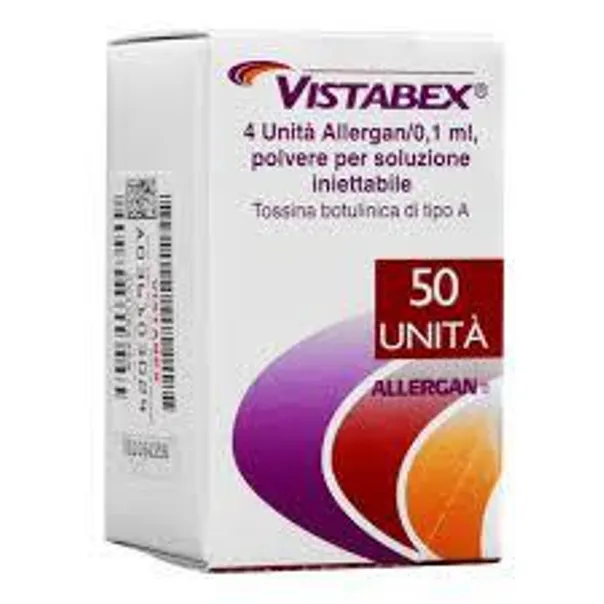
Table of Contents
- Package leaflet: Information for the user
- VISTABEX, 4 Allergan Units/0.1 ml, powder for injectable solution
- 1. What VISTABEX is and what it is used for
- 2. What you need to know before using VISTABEX
- 3. How to use VISTABEX
- 4. Possible side effects
- 5. How to store VISTABEX
- 6. Package contents and other information
Package leaflet: Information for the user
VISTABEX, 4 Allergan Units/0.1 ml, powder for injectable solution
botulinum toxin type A
Read this leaflet carefully before using this medicine because it contains
important information for you.
- Keep this leaflet. You may need to read it again. If you have any questions, ask your doctor or pharmacist.
- This medicine has been prescribed for you. Never give it to other people, even if their symptoms are the same as yours, because it could be dangerous.
- If you experience any side effects, including those not listed in this leaflet, contact your doctor or pharmacist. See section 4.
Contents of this leaflet
- What VISTABEX is and what it is used for
- What you need to know before using VISTABEX
- How to use VISTABEX
- Possible side effects
- How to store VISTABEX
- Contents of the pack and other information
1. What VISTABEX is and what it is used for
VISTABEX is a peripheral-acting muscle relaxant.
VISTABEX works by blocking nerve impulses to all muscles into which it has been injected.
This prevents muscle contraction, resulting in temporary and reversible paralysis.
VISTABEX is used for the temporary improvement in the appearance of:
- vertical lines between the eyebrows observed at maximum frowning, and/or,
- fan-shaped lines at the corner of the eyes observed at maximum smile, and/or,
- forehead lines observed at maximum eyebrow elevation,
when the severity of facial lines has a significant psychological impact in adult patients.
2. What you need to know before using VISTABEX
Do not use VISTABEX
- If you are allergic (hypersensitive) to botulinum toxin type A or to any of the other ingredients of this medicine (listed in section 6)
- If you have been diagnosed with myasthenia gravis or Eaton-Lambert syndrome (chronic diseases affecting the muscles)
- If you have an infection at the proposed injection sites.
Warnings and precautions
Talk to your doctor or pharmacist before using Vistabex.
Very rarely, adverse effects possibly related to the spread of the toxin away from the injection site have been reported with botulinum toxin (e.g. muscle weakness, difficulty swallowing, or accidental passage of food or liquids into the respiratory tract). Patients treated with therapeutic doses may experience excessive muscle weakness.
Consult your doctor immediately if you experience difficulty swallowing, speaking, or breathing after treatment.
- The use of VISTABEX is not recommended in patients with a history of dysphagia (difficulty swallowing) or impaired swallowing function.
- The use of VISTABEX is not recommended in patients under 18 years of age.
- There is limited experience with the use of VISTABEX in patients over 65 years of age.
- Excessive or too frequent dosing may increase the risk of antibody formation. The development of antibodies may lead to treatment failure with botulinum toxin type A, even in other indications. To minimize this risk, the interval between two treatments should not be less than three months.
- Very rarely, an allergic reaction may occur after administration of botulinum toxin.
- After treatment, drooping of the eyelid may occur.
Inform your doctor if
- you have previously experienced problems after botulinum toxin-based injections;
- you have not observed any significant improvement in wrinkles one month after your first treatment session;
- you suffer from certain neurological disorders (such as amyotrophic lateral sclerosis or motor neuropathy);
- you have inflammation in the area(s) to be treated;
- you have weakness or atrophy of the muscles to be treated;
- you have undergone surgery or sustained injuries to the head, neck, or chest;
- you are scheduled to undergo surgery in the near future.
Other medicines and VISTABEX
The use of botulinum toxin in combination with aminoglycoside antibiotics, spectinomycin, or other medicines that interfere with neuromuscular transmission is not recommended.
Inform your doctor if you have recently been injected with a medicine containing botulinum toxin (the active substance in VISTABEX), as this may excessively increase the effect of VISTABEX.
Inform your doctor or pharmacist if you are taking, have recently taken, or might take any other medicines.
Pregnancy and breastfeeding
The use of VISTABEX is not recommended during pregnancy and in women of childbearing potential who are not using contraception.
VISTABEX is not recommended for women who are breastfeeding.
Contact your doctor if you are pregnant, planning to become pregnant, or discover you are pregnant during treatment. Your doctor will decide whether you should continue treatment.
Ask your doctor or pharmacist for advice before taking any medicine.
Driving and using machines
Exercise caution when driving or operating machinery due to the risk of generalized and/or muscular weakness, dizziness, and vision disturbances associated with the use of this medicine, which may make these activities hazardous.
Do not drive vehicles or operate machinery until such symptoms have resolved.
VISTABEX contains sodium
This medicine contains less than 1 mmol of sodium (23 mg) per vial, which is essentially ‘sodium-free’.
3. How to use VISTABEX
Method and route of administration
VISTABEX must only be administered by appropriately qualified physicians with documented experience in treatment and equipped with the necessary equipment.
Glabellar lines observed at maximum frown
VISTABEX is injected into the muscles (intramuscularly), directly into the affected area between the eyebrows.
The usual dose is 20 Units. You will be treated with the recommended volume of 0.1 ml (4 Units) of VISTABEX at each of the 5 injection sites.
Improvement in the severity of glabellar lines observed at maximum frown is generally visible within one week after treatment, with maximum effect observed 5–6 weeks after injection. The effect has been demonstrated to last up to 4 months after injection.
Lateral periorbital lines (crow’s feet) observed at maximum smile
VISTABEX is injected directly into the affected area on each side of the eye.
The usual dose is 24 Units. You will be treated with the recommended volume of 0.1 ml (4 Units) of VISTABEX at each of the 6 injection sites (3 injection sites per side, one on each side of both eyes).
Improvement in the severity of lateral periorbital lines (crow’s feet) observed at maximum smile is generally visible within one week after treatment. The effect of treatment has been demonstrated to last on average for 4 months after injection.
Frontal lines observed at maximum eyebrow elevation
VISTABEX is injected directly into the muscle of the affected area of the forehead.
The usual dose is 20 Units. You will receive the recommended volume of 0.1 ml (4 Units) of VISTABEX at each of the 5 injection sites.
The total dose for treatment of frontal lines (20 Units) combined with glabellar lines (20 Units) is 40 Units.
Improvement in the severity of frontal lines observed at maximum eyebrow elevation is generally visible within one week after treatment. The effect of treatment has been demonstrated to last approximately 4 months after injection.
General information
If treatment for lateral periorbital lines (crow’s feet) observed at maximum smile is performed simultaneously with treatment for glabellar lines observed at maximum frown, you will receive a total dose of 44 Units.
If treatment is performed simultaneously for all three types of facial lines (lateral periorbital lines at maximum smile, glabellar lines at maximum frown, and frontal lines at maximum eyebrow elevation), you will receive a total dose of 64 Units.
The interval between two treatments must not be less than three months.
The efficacy and safety of repeated injections of VISTABEX beyond 12 months have not been evaluated.
If you have any doubts about the use of this medicine, consult your doctor or pharmacist.
4. Possible side effects
Like all medicines, this medicinal product can cause side effects, although not everyone experiences them.
In general, side effects occur within the first few days after injection and are temporary.
Most of the reported side effects have been mild to moderate in intensity.
Approximately 1 in 4 patients may experience side effects after injection of VISTABEX for vertical frown lines between the eyebrows observed at maximum frowning. About 8% of patients may experience side effects after injection of VISTABEX for lateral periorbital lines (crow’s feet) observed at maximum smile, whether treated alone or simultaneously with vertical frown lines between the eyebrows observed at maximum frowning. About 20% of patients may experience side effects after injection of VISTABEX for forehead lines observed at maximum eyebrow elevation, when treated simultaneously with vertical frown lines between the eyebrows observed at maximum frowning. Approximately 14% of patients may experience side effects if treatment of forehead lines and vertical frown lines is combined with treatment of lateral periorbital lines (crow’s feet) observed at maximum smile.
These side effects may be related to the treatment, the injection technique, or both. Ptosis (drooping) of the eyelid, which may be related to the injection technique, is consistent with the local muscle-relaxing action of VISTABEX.
Very rarely, side effects with botulinum toxin possibly related to the diffusion of the toxin away from the injection site have been reported (e.g., muscle weakness, difficulty swallowing, constipation, or aspiration pneumonia due to unintended entry of food or liquids into the airways, which may be fatal). VISTABEX injections are not recommended in patients with a history of dysphagia (difficulty swallowing) or impaired swallowing function.
If you experience any difficulty breathing, swallowing, or speaking after receiving VISTABEX, contact your doctor immediately.
In case of hives, swelling including facial or throat swelling, shortness of breath, feeling faint, or difficulty breathing, contact your doctor immediately.
Botulinum toxin may spread to nearby muscles, especially when high doses are administered, particularly in the neck area.
As expected with any injection procedure, pain, burning, stinging sensation, swelling, and/or bruising at the injection site may occur.
Talk to your doctor if this concerns you.
The frequency of side effects is classified into the following categories:
| Common | may affect up to 1 in 10 people. |
| Uncommon | may affect up to 1 in 100 people. |
Injections for the temporary improvement of vertical wrinkles between the eyebrows
| Common | Headache, numbness, drooping of the eyelids, nausea (feeling of sickness), skin flushing, skin tightness, localized muscle weakness, facial pain, swelling at injection site, bruising under the skin, pain at injection site, irritation at injection site |
| Uncommon | Infection, anxiety, dizziness, inflammation of the eyelids, eye pain, visual disturbances, blurred vision, dry mouth, swelling (face, eyelid, area around the eyes), light sensitivity, itching, dry skin, muscle contractions, influenza-like syndrome, lack of strength, fever, Mephistopheles sign (elevation of the outer part of the eyebrows) |
Injections for the temporary improvement of crow's feet lines at the corner of the eyes, when treated either simultaneously or separately from the vertical lines between the eyebrows observed at frowning
| Common | Injection site bruising*. |
| Uncommon | Eye swelling, bleeding at injection site*, pain at injection site*, tingling or numbness at injection site. |
*Some of these adverse reactions may also be related to the injection procedure.
Injections for the temporary improvement of forehead lines and vertical frown lines between the eyebrows observed upon glabellar contraction, when treated simultaneously or separately from crow’s feet lines at the corner of the eyes
| Common | Headache, eyelid ptosis1, skin tightness, eyebrow ptosis2, bruising at the injection site*, haematoma at the injection site*, Mephisto sign (elevation of the outer part of the eyebrows). |
| Uncommon | Pain at the injection site*. |
- The median time to onset of eyelid ptosis was 9 days after treatment
- The median time to onset of eyebrow ptosis was 5 days after treatment
*Some of these adverse reactions may also be related to the injection procedure.
The following list describes additional adverse reactions reported with VISTABEX since marketing for the treatment of glabellar lines, crow’s feet, and other clinical indications:
- severe allergic reaction (subcutaneous swelling, difficulty breathing)
- urticaria
- loss of appetite
- nerve damage
- difficulty moving the arm and shoulder
- voice and speech problems
- weakness of facial muscles
- decreased skin sensitivity
- muscle weakness
- chronic disease affecting the muscles (myasthenia gravis)
- numbness
- pain or weakness radiating from the spine
- fainting
- loss of muscle tone on one side of the face
- increased eye pressure
- eyelid ptosis
- difficulty completely closing the eye
- strabismus (crossed eyes)
- blurred vision, difficulty seeing clearly
- hearing loss
- ringing in the ear
- sensation of dizziness or spinning (vertigo)
- aspiration pneumonia (lung infection caused by accidental inhalation of food, drinks, saliva, or vomit)
- shortness of breath
- respiratory problems, respiratory depression and/or respiratory failure
- abdominal pain
- diarrhea
- dry mouth
- difficulty swallowing
- nausea
- vomiting
- hair loss
- eyebrow ptosis
- skin lesions resembling psoriasis (red, thick, dry, scaly)
- various types of red macular skin rashes
- excessive sweating
- loss of eyebrows
- itching
- rash
- muscle atrophy
- muscle pain
- loss of nerve stimulation to the injected muscle/loss of contraction in the injected muscle
- malaise
- feeling of general discomfort
- fever
- dry eye
- localized muscle contractions/involuntary muscle contractions
- eyelid swelling
Reporting of adverse reactions
If you experience any adverse reaction, including those not listed in this leaflet, consult your doctor or pharmacist. You may also report adverse reactions directly via the national reporting system at
https://www.aifa.gov.it/content/segnalazioni-reazioni-avverse . By reporting adverse reactions, you can help provide more information on the safety of this medicine.
5. How to store VISTABEX
Keep out of the sight and reach of children.
Do not use VISTABEX after the expiry date stated on the vial and carton
following Exp:. The expiry date refers to the last day of the month.
Store in a refrigerator (2°C - 8°C).
After reconstitution, immediate use of the injectable solution is recommended; however, the
product may be stored for up to 24 hours in a refrigerator (2°C - 8°C).
Do not dispose of any medicine via wastewater or household waste. This will help protect the environment.
6. Package contents and other information
What VISTABEX contains
The active substance is: botulinum toxin type A from Clostridium botulinum (0.1 ml of
reconstituted solution for injection contains 4 Allergan Units)
The excipients are human albumin and sodium chloride.
Description of the appearance of VISTABEX and contents of the pack
VISTABEX powder for injectable solution appears as a fine white powder for injectable solution, which may be difficult to see at the bottom of a clear glass vial.
Before injection, the product must be dissolved in sterile preservative-free normal saline (0.9% sodium chloride injectable solution).
Each vial contains 50 or 100 Allergan Units of botulinum toxin type A. Each package contains 1 or 2 vials.
Not all pack sizes may be marketed.
Marketing Authorization Holder
AbbVie S.r.l.
S.R. 148 Pontina km 52 snc
04011 Campoverde di Aprilia (LT)
Italy
Manufacturer
Allergan Pharmaceuticals Ireland
Castlebar Road
Westport County
Mayo, Ireland
or
AbbVie Deutschland GmbH & Co. KG
Knollstrasse
67061 Ludwigshafen
Germany
This medicinal product is authorized in the European Economic Area Member States under the following names:
| Austria, Belgium, Bulgaria, Croatia, Cyprus, Czechoslovakia, Denmark, Estonia, Finland, France, Germany, Greece, Hungary, Iceland, Ireland, Latvia, Lithuania, Luxembourg, Malta, Netherlands, Norway, Poland, Portugal, Romania, Slovakia, Slovenia, Spain, Sweden. | VISTABEL |
| Italy | VISTABEX |
The following information is intended for healthcare professionals only:
Botulinum toxin units are not interchangeable between products. The recommended doses in Allergan Units differ from those of other botulinum toxin-containing preparations.
VISTABEX is indicated for the temporary improvement in the appearance of:
- moderate to severe vertical glabellar lines observed at maximum frown, and/or
- moderate to severe lateral canthal lines (crow's feet) observed at maximum smile, and/or
- moderate to severe forehead lines observed at maximum eyebrow elevation, when the severity of facial lines has a significant psychological impact in adult patients.
Reconstitution must be performed in accordance with good practice standards, particularly regarding aseptic techniques. VISTABEX must be reconstituted with sterile preservative-free normal saline (0.9% sodium chloride injectable solution). When using a 50-unit vial, withdraw 1.25 ml of sterile preservative-free normal saline (0.9% sodium chloride injectable solution) with a syringe to obtain a reconstituted injectable solution at a concentration of 4 Units/0.1 ml. When using a 100-unit vial, withdraw 2.5 ml of sterile preservative-free normal saline (0.9% sodium chloride injectable solution) with a syringe to obtain a reconstituted injectable solution at a concentration of 4 Units/0.1 ml.
| Contents of the vial | Amount of diluent added (sterile normal saline solution without preservatives (injectable 0.9% sodium chloride solution)) | Resulting dose (Units per 0.1 ml) |
| 50 Units | 1.25 ml | 4.0 Units |
| 100 Units | 2.5 ml | 4.0 Units |
The central part of the rubber stopper must be cleaned with alcohol.
To avoid denaturing VISTABEX, slowly inject the diluent into the vial and gently rotate the vial to avoid bubble formation. The vial must be discarded if the vacuum force is insufficient to draw the diluent into the vial.
After reconstitution, the injectable solution should be visually inspected prior to use to ensure it is clear, colourless or slightly yellow, and free of particles.
VISTABEX must be used only for the treatment of a single patient in a single session.
Prior to injection for glabellar lines (moderate or severe vertical lines observed at maximum frown), the thumb or index finger should be firmly placed below the orbital rim to prevent diffusion below this rim. During injection, the needle should be oriented upward and medially.
To reduce the risk of eyelid ptosis, the maximum dose of 4 Units per injection site and the recommended number of injection sites must not be exceeded. In addition, injections near the levator palpebrae superior muscle should be avoided, particularly in patients with broader depressor supercilii complexes. Injections into the corrugator muscle should be administered at the central portion of the muscle, at least 1 cm above the eyebrow arch.
Injections for crow’s feet (moderate or severe lateral canthal lines observed at maximum smile) should be administered with the bevel of the needle pointing upward and directed away from the eye.
To reduce the risk of eyelid ptosis, the maximum dose of 4 Units per injection site and the recommended number of injection sites must not be exceeded. In addition, injections should be administered temporally to the orbital rim, thereby maintaining a safe distance from the levator palpebrae muscle.
The total dose for treatment of forehead lines (20 Units) together with glabellar lines (20 Units) is 40 Units/1.0 ml. To identify the appropriate injection sites in the frontalis muscle, assess the overall proportion between the subject's forehead size and the distribution of frontalis muscle activity.
Procedure for proper disposal of vials, syringes, and used materials
Immediately after use, any unused reconstituted injectable solution of VISTABEX remaining in the vial and/or syringe must be inactivated prior to disposal by adding 2 ml of diluted sodium hypochlorite solution (0.5% or 1%) and then disposed of according to local requirements.
Vials, syringes, and used materials must not be emptied and should be disposed of in designated containers and eliminated in accordance with local regulations.
Recommendations in case of an accident during handling of botulinum toxin
In the event of an accident during handling of the product, whether in lyophilized vacuum-dried form or reconstituted, the following measures must be taken immediately:
- Any spillage must be cleaned up: in the case of lyophilized powder, use absorbent material soaked in sodium hypochlorite solution (bleach), or for reconstituted product, use dry absorbent material.
- Contaminated surfaces must be cleaned with absorbent material soaked in sodium hypochlorite solution (bleach), then dried.
- In case of vial breakage, proceed as described above, carefully collect glass fragments, and clean up the product, taking care to avoid skin cuts.
- If the product comes into contact with the skin, wash with sodium hypochlorite solution (bleach) and rinse thoroughly with water.
- If the product comes into contact with the eyes, rinse thoroughly with water or with an ophthalmic irrigation solution.
- In case of injury (cut or puncture) to the operator, proceed as described above and take appropriate medical measures depending on the injected dose.
Product identification
To confirm that you are using the AbbVie product VISTABEX, check for anti-tampering features and the presence of a holographic film on the vial label. To view this film, examine the vial under a desk lamp or fluorescent light. Rotate the vial gently back and forth between your fingers and look on the label for rainbow-coloured horizontal lines, ensuring that the word “abbvie” appears within the rainbow lines.
Do not use the product and contact AbbVie for further information if the rainbow-coloured horizontal lines or the word “abbvie” are not present on the vial.
Additionally, VISTABEX vial labels contain removable stickers including the product’s batch number and expiration date. These stickers can be removed and affixed to the patient’s clinical record for traceability purposes. Please note that once the sticker is removed from the VISTABEX vial label, the word "USED" will appear, providing further assurance that you are using authentic VISTABEX product.