Visipaque
Italy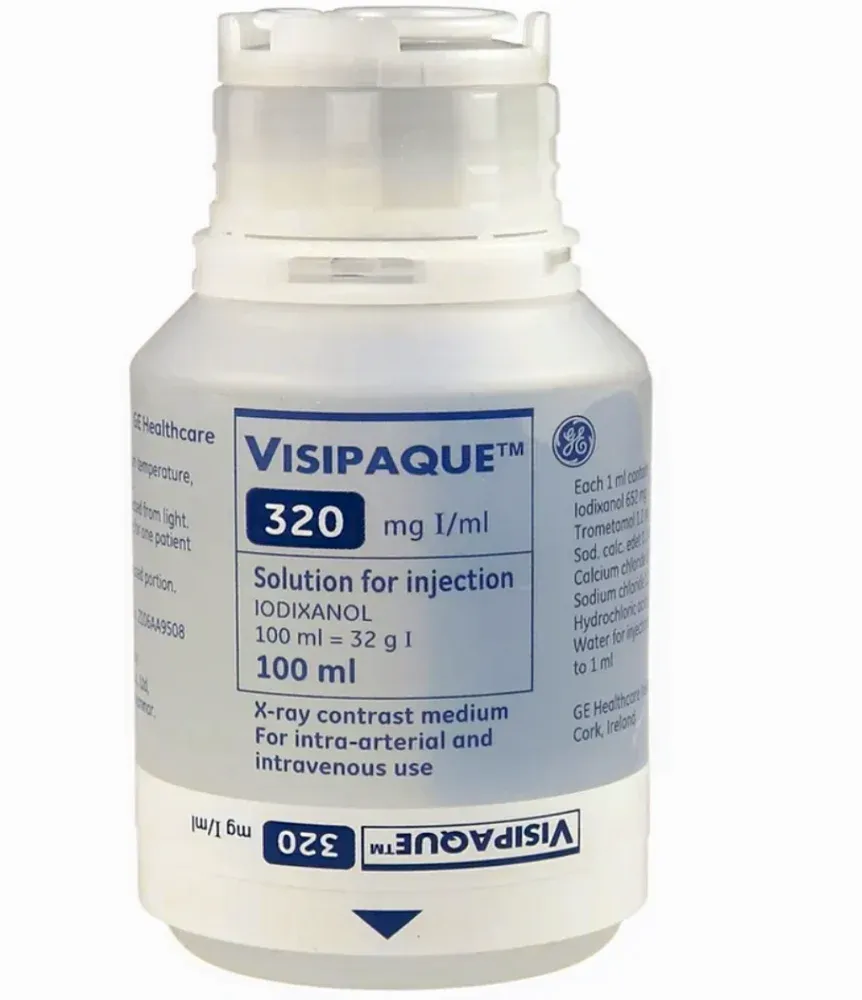
Table of Contents
- PACKAGE LEAFLET: INFORMATION FOR THE PATIENT
- Visipaque 270 mg I/ml solution for injection, 320 mg I/ml solution for injection
- 1. What Visipaque is and what it is used for
- 2. What you need to know before using Visipaque
- 3. How to use Visipaque
- 4. Possible side effects
- 5. How to store Visipaque
- 6. Package contents and other information
PACKAGE LEAFLET: INFORMATION FOR THE PATIENT
Visipaque 270 mg I/ml solution for injection, 320 mg I/ml solution for injection
Iodixanol
Please read this leaflet carefully before using this medicine because it contains important information for you.
- Keep this leaflet. You may need to read it again.
- If you have any questions, ask the doctor who will perform the procedure.
- If you experience any side effects, including those not listed in this leaflet, tell your doctor. See section 4.
Contents of this leaflet:
- What Visipaque is and what it is used for
- What you need to know before using Visipaque
- How to use Visipaque
- Possible side effects
- How to store Visipaque
- Contents of the pack and other information
1. What Visipaque is and what it is used for
- Visipaque is a “contrast medium” for diagnostic use only. It is used to help identify disease.
- It is administered before X-rays to provide the doctor with a clearer image.
- Visipaque can help your doctor distinguish between normal and abnormal appearance and structure of certain organs in your body.
- Visipaque is used for X-rays of your urinary system, spine, or blood vessels, including the blood vessels of your heart.
- Some people are given this medicine before or during a scan of their head or body using “Computed Tomography” (also known as CT scan).
- Visipaque is used to examine your throat (esophagus), stomach and intestines, or to examine body cavities such as your joints, uterus, or fallopian tubes.
Your doctor will explain which part of your body will be scanned.
2. What you need to know before using Visipaque
Do not use Visipaque
- if you have severe thyroid problems
- if you are allergic (hypersensitive) to iodixanol or to any of the other ingredients of this medicine (listed in section 6).
Warnings and precautions
Talk to your doctor before using Visipaque:
- if you have previously had an allergic reaction to a medicine similar to Visipaque, called a "contrast medium".
- if you have or have had thyroid problems.
- if you have had allergies.
- if you have asthma.
- if you have diabetes.
- if you have brain disorders or tumors.
- if you have severe heart or lung diseases.
- if you have kidney problems or combined liver and kidney problems.
- if you have a condition called "myasthenia gravis", a disease causing severe muscle weakness.
- if you have "pheochromocytoma" (persistent high blood pressure or episodes of high blood pressure due to a rare tumor of the adrenal glands).
- if you have homocystinuria (a condition associated with increased urinary excretion of the amino acid cysteine).
- if you have blood disorders or bone marrow problems.
- if you have suffered from alcohol or drug dependence.
- if you have epilepsy, blood clots in the brain, or stroke.
- if you are scheduled for thyroid function tests in the coming weeks.
- if blood or urine samples are to be collected on the same day.
Inform your doctor before using Visipaque if you are unsure whether any of the above conditions apply to you.
During or shortly after the imaging procedure, a short-term brain disorder called encephalopathy may occur. Inform your doctor immediately if any of the symptoms related to this condition described in section 4 appear.
Thyroid disorders may occur after administration of Visipaque in both children and adults. Children may also be exposed via their mother during pregnancy. Your doctor may need to perform thyroid function tests before and/or after administration of Visipaque.
Other medicines and Visipaque
Tell your doctor if you are taking, have recently taken, or might take any other medicines, including those not requiring a prescription. This is because some medicines may interact with Visipaque.
Inform your doctor:
- if you are taking metformin for the treatment of diabetes
- if you are taking or have recently taken (within the two weeks prior to the examination with an iodinated contrast medium such as Visipaque) interleukin-2, a medicine used to reduce immune defenses, as you may be at increased risk of delayed reactions (flu-like symptoms or skin reactions).
- if you are taking medicines to lower blood pressure, beta-blockers, since there is evidence that the use of beta-blockers is a risk factor for anaphylactoid reactions to radiodiagnostic contrast media such as Visipaque.
Pregnancy and breastfeeding
If you are pregnant, suspect you may be pregnant, planning pregnancy, or breastfeeding, consult your doctor before using this medicine. Your doctor will use this medicine only if the expected benefit outweighs the potential risk.
If you are pregnant, Visipaque must not be administered into body cavities such as the uterus and fallopian tubes.
If you receive this medicine during pregnancy, monitoring of the baby's thyroid function is recommended.
Breastfeeding
Breastfeeding can be continued normally after the examination with Visipaque.
Driving and using machines
Do not drive or operate machinery within 24 hours after the last administration of Visipaque into the spinal canal.
This is because you may experience dizziness or other signs of a delayed reaction.
Visipaque contains sodium
Visipaque 270 mg I/ml: 0.03 mmol (0.76 mg) of sodium per ml.
Visipaque 320 mg I/ml: 0.02 mmol (0.45 mg) of sodium per ml.
This should be taken into consideration in patients with impaired renal function or those on a low-sodium diet.
3. How to use Visipaque
Use this medicine exactly as your doctor has instructed you. If you have any doubts, consult your doctor.
Dose and administration
Visipaque will always be administered by a properly trained and qualified healthcare professional.
- Visipaque will always be used in a hospital or clinic setting.
- The medical staff will inform you of everything you need to know for the safe use of the medicine.
The usual dose is:
- A single injection, or you may be asked to drink it. In children, the dose may be administered rectally.
After administration of Visipaque
You will be asked to:
- drink plenty of fluids (to help eliminate the medicine from your body),
- remain in the area where the scan or X-ray was performed, or nearby, for at least 30 minutes,
- stay in the clinic or hospital for one hour. Inform your doctor immediately if you experience any adverse reactions during this period (see section 4 “Possible side effects”).
The above advice applies to all patients who have been administered Visipaque. If you are unsure about any of the above, please ask your doctor. Visipaque can be administered in many different ways; below is a description of the usual methods.
Injection into an artery or vein
Visipaque is usually injected into a vein in the arm or leg.
Sometimes it is administered through a thin plastic tube (catheter) inserted into an artery, usually in the arm or groin.
Injection into the spinal canal
Visipaque will be injected into the space around the spinal cord to visualize the spinal canal.
After administration of Visipaque, you must rest for 1 hour with your head and torso elevated at a 20° angle. After this, you may move cautiously, but you must avoid bending forward. If you are confined to bed, your head and torso must remain elevated for the first 6 hours.
You will be asked not to remain completely alone during the first 24 hours after administration of Visipaque, if you are an outpatient.
The above advice applies only if Visipaque has been administered into your spinal canal.
If you are unsure about any of the above, please ask your doctor.
Use in body cavities or joints
Body cavities may include joints, the uterus, and the fallopian tubes (see section "Pregnancy and Breast-feeding"). The method and site of administration of Visipaque may vary.
Oral use
Visipaque is usually given by mouth to examine the throat, stomach, and small intestine.
If you have been given more Visipaque than you should have
Since Visipaque is administered by a qualified healthcare professional, overdose is unlikely.
If necessary, haemodialysis can be used to remove excess iodixanol. There is no specific antidote. Treatment of overdose is symptomatic.
4. Possible side effects
Like all medicines, this medicine can cause side effects, although not everyone experiences them.
Serious or even fatal reactions occur only very rarely. These may affect kidney or heart function.
Cardiac reactions may be triggered by pre-existing disease or by the procedure itself.
Allergic reactions
If you have had an allergic reaction after receiving Visipaque in hospital or clinic, inform your doctor immediately. Symptoms may include:
- shortness of breath, difficulty breathing, tightness or pain in the chest
- skin rashes, swellings, itchy spots, blisters on the skin or in the mouth, or other allergic symptoms
- facial swelling
- vasculitis and Stevens-Johnson-like syndrome (SJS), if you have autoimmune disorders
- dizziness or fainting (caused by low blood pressure)
The side effects described above may also appear several hours or days after you have been administered Visipaque. If any of these side effects occur after you have left the hospital or clinic, go immediately to the nearest emergency department.
Other side effects may occur, depending on how and why Visipaque was administered to you. Ask your doctor if you are unsure about how Visipaque was given to you.
After injection into an artery or vein
Uncommon (affects fewer than 1 in 100 people)
- allergic reaction, also known as hypersensitivity reaction – see section "Allergic reactions" for symptoms
- headache
- nausea, vomiting
- kidney damage
- sensation of warmth, chest pain
- skin rash, itching, urticaria
- flushing
Rare (affects fewer than 1 in 1,000 people)
- sensation of dizziness
- altered sensations (including altered taste or smell, tingling, numbness, or burning sensation)
- irregular heartbeat
- low blood pressure
- heart attack
- acute kidney injury
- cough
- chills, fever
- feeling cold
- redness of the skin or mucous membranes
- pain and local reactions (at the injection site)
- malaise
Very rare (affects fewer than 1 in 10,000 people)
- visual disturbances
- cortical blindness (transient)
- tremor
- transient visual loss (including double vision, blurred vision)
- eyelid swelling
- reduced sense of touch
- high blood pressure and other vascular disorders
- difficulty breathing, feeling cold, and reduced muscle strength
- throat swelling
- irritated throat
- pain or discomfort in the abdominal area (abdominal pain)
- kidney problems
- cardiac arrest
- short-term memory loss
- extreme fatigue
- skin redness
- skin swelling
- agitation
- anxiety
- fainting
- stroke
- back pain
- facial swelling or other localized swelling
- muscle contraction
- diarrhoea
- excessive sweating (hyperhidrosis)
Not known (frequency cannot be estimated from the available data)
- allergic reaction, anaphylactic shock leading to shock and collapse – see "Allergic reactions" for other symptoms
- feeling confused, difficulty moving, seizures, altered consciousness, cramps
- temporary brain disorders (encephalopathy), including confusion, memory loss, hallucinations, visual disturbances, loss of vision, seizures, loss of coordination, loss of movement on one side of the body, speech problems, and loss of consciousness
- blood clots (thrombosis), pain and swelling of veins, arterial spasms
- severe breathing difficulties (caused by fluid in the lungs)
- joint pain, swelling and tenderness (pain) of the salivary glands
- iodine toxicity
- cardiac and pulmonary arrest
- coma
- formation of thrombi in the coronary arteries, coronary artery spasms
- chest pain (angina pectoris)
- reduced movement of ventricular walls, myocardial ischemia
- reduction in platelet count
- respiratory failure, cessation of breathing
- acute pancreatitis or worsening of existing pancreatitis (pancreatitis)
- enlargement of the salivary glands
- overactivity of the thyroid gland
- transient underactivity of the thyroid gland
- swelling
- increased creatinine levels (a sign that your kidneys are not functioning properly)
- palpitations
- skin and/or mucous membrane disorders such as various types of lesions and allergic inflammatory skin conditions (bullous dermatitis, erythema multiforme, toxic epidermal necrolysis, generalized acute exanthematous pustulosis, drug rash with eosinophilia and systemic symptoms, drug eruption, allergic dermatitis), acute allergic reactions (Stevens-Johnson syndrome), skin exfoliation
- shock
- Transient thyroid inactivity in newborns
- Bronchospasm
- Throat tightness
After injection into the spinal canal
Uncommon (affects fewer than 1 in 100 people)
- headache (may be severe and last for hours)
- vomiting
Not known (frequency cannot be estimated from the available data)
- sensation of dizziness, vertigo
- seizures
- tremor
- nausea
- pain (at the injection site)
- allergic reaction – see "Allergic reactions" for symptoms
- temporary brain disorders (encephalopathy), including confusion, memory loss, hallucinations, visual disturbances, loss of vision, seizures, loss of coordination, loss of movement on one side of the body, speech problems, and loss of consciousness
- muscle contraction
After use in body cavities (such as uterus and fallopian tubes)
Uncommon (affects fewer than 1 in 100 people)
- vomiting
Very common (affects more than 1 in 10 people)
- abdominal pain
- vaginal bleeding
Common (affects fewer than 1 in 10 people)
- headache, nausea, fever
Not known (frequency cannot be estimated from the available data)
- tremor
- allergic reaction – see "Allergic reactions" for symptoms
- local reactions (at the injection site)
After injection into joints
Common (affects fewer than 1 in 10 people)
- pain at the injection site
Not known (frequency cannot be estimated from the available data)
- allergic reactions – see "Allergic reactions" for symptoms
- tremor
After oral administration
Common (affects fewer than 1 in 10 people)
- diarrhoea, nausea
- abdominal pain
Uncommon (affects fewer than 1 in 100 people)
- vomiting
Not known (frequency cannot be estimated from the available data)
- allergic reaction – see "Allergic reactions" for symptoms
- tremor
Reporting of side effects
If you experience any side effect, including those not listed in this leaflet, please inform your doctor. You can also report side effects through the national reporting system. By reporting side effects, you can help provide more information on the safety of this medicine.
5. How to store Visipaque
Keep this medicine out of the sight and reach of children.
Do not use this medicine after the expiry date stated on the label.
Store in the carton to protect the medicine from light.
Store below 30°C.
The product may be stored for one month at 37°C.
6. Package contents and other information
What Visipaque contains
The active substance is iodixanol.
Visipaque 270 mg I/ml contains 550 mg of iodixanol per ml (equivalent to 270 mg of iodine per ml).
Visipaque 320 mg I/ml contains 652 mg of iodixanol per ml (equivalent to 320 mg of iodine per ml).
The other components are small amounts of trometamol, sodium chloride, calcium chloride dihydrate, sodium
calcium edetate, hydrochloric acid (for pH adjustment), and water. The product is isotonic and has a pH between
6.8 and 7.6.
Description of the appearance of Visipaque and contents of the pack
Visipaque is an injectable solution. The medicine is a clear, colourless to pale yellow, aqueous solution.
Visipaque is supplied in the following pack sizes:
270 mg I/ml 1 vial of 20 ml
1 vial of 50 ml
1 vial of 100 ml
1 vial of 200 ml
1 vial of 500 ml
1 polypropylene vial of 50 ml
1 polypropylene vial of 100 ml
1 polypropylene vial of 200 ml
1 polypropylene vial of 500 ml
10 polypropylene vials of 50 ml
10 polypropylene vials of 100 ml
10 polypropylene vials of 200 ml
6 polypropylene vials of 500 ml
320 mg I/ml 1 vial of 20 ml
1 vial of 50 ml
1 vial of 100 ml
1 vial of 200 ml
1 vial of 500 ml
1 polypropylene vial of 50 ml
1 polypropylene vial of 100 ml
1 polypropylene vial of 200 ml
1 polypropylene vial of 500 ml
10 polypropylene vials of 50 ml
10 polypropylene vials of 100 ml
10 polypropylene vials of 200 ml
6 polypropylene vials of 500 ml
Not all pack sizes may be marketed.
Marketing Authorisation Holder
GE Healthcare S.r.l.
Via Galeno 36,
20126 Milano - Italy
Manufacturers
GE Healthcare AS
Nycoveien 1,
0485 Oslo, Norway
GE Healthcare Ireland Limited
IDA Business Park
Carrigtohill
Cork, Ireland