Vimizim
Italy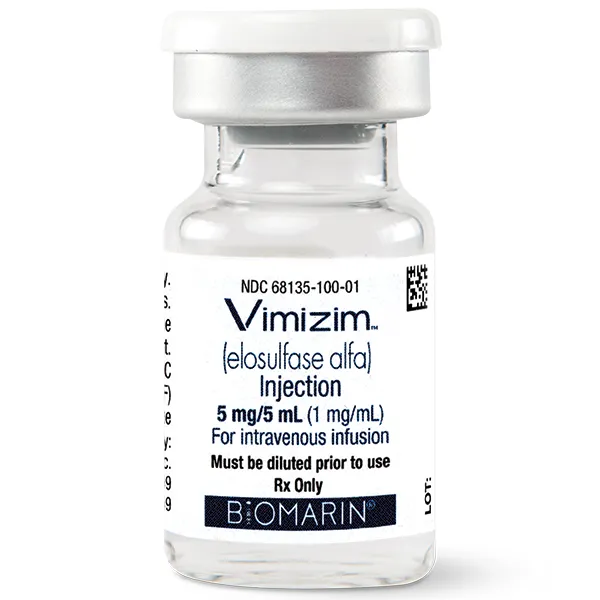
Table of Contents
- Package leaflet: Information for the user
- Vimizim 1 mg/ml concentrate for solution for infusion
- 1. What Vimizim is and what it is used for
- 2. What you need to know before using Vimizim
- 3. How to use Vimizim
- 4. Possible side effects
- 5. How to store Vimizim
- 6. Contents of the pack and other information
Package leaflet: Information for the user
Vimizim 1 mg/ml concentrate for solution for infusion
elosulfase alfa
▼ This medicinal product is subject to additional monitoring. This will allow rapid identification of new safety information. You can help by reporting any side effects you experience while taking this medicine. See the end of section 4 for information on how to report side effects.
Please read all of this leaflet carefully before you start using this medicine, as it contains important information for you.
- Keep this leaflet. You may need to read it again.
- If you have any questions, ask your doctor.
- If you get any side effects, including those not listed in this leaflet, tell your doctor or nurse. See section 4. Contents of this leaflet
- What Vimizim is and what it is used for
- What you need to know before using Vimizim
- How to use Vimizim
- Possible side effects
- How to store Vimizim
- Contents of the pack and other information
1. What Vimizim is and what it is used for
Vimizim contains an enzyme called elosulfase alfa, which belongs to a group of medicines known as enzyme replacement therapies. It is used to treat adults and children with mucopolysaccharidosis Type IVA (MPS IVA, also known as Morquio A syndrome).
People with MPS IVA are completely lacking or have insufficient levels of N-acetylgalactosamine 6-sulfatase, an enzyme that breaks down specific substances in the body, such as keratan sulfate, found in many tissues including cartilage and bone. As a result, these substances are not properly metabolized by the body. They accumulate in tissues, interfering with their normal function and causing the symptoms of MPS IVA, such as difficulty walking, breathing problems, short stature, and hearing loss.
How Vimizim works
This medicine replaces the missing natural enzyme, N-acetylgalactosamine 6-sulfatase, in patients with MPS IVA. Treatment has been shown to improve walking ability and reduce levels of keratan sulfate in the body. This medicine may improve the symptoms of MPS IVA.
2. What you need to know before using Vimizim
Do not use Vimizim
- if you have experienced potentially life-threatening allergic reactions to elosulfase alfa or to any of the other ingredients of this medicine (listed in section 6)
Warnings and precautions
- If you are being treated with Vimizim, you may experience infusion reactions. An infusion reaction is any adverse event, including allergic reaction, occurring during or within one day after the infusion (see section 4). If you experience such a reaction, contact your doctor immediately.
- If you have an allergic reaction during the infusion, your doctor may slow down or stop the infusion. Your doctor may also give you additional medicines to manage possible allergic reactions (e.g. antihistamines and/or corticosteroids).
- If you experience back pain, numbness in the arms or legs, or loss of bladder or bowel control, contact your doctor immediately. These symptoms may be part of the disease and could be caused by pressure on the spinal cord.
Other medicines and Vimizim
Inform your doctor if you are taking, have recently taken, or might take any other medicines.
Pregnancy, breast-feeding and fertility
You must not use Vimizim during pregnancy unless strictly necessary. It is not known whether Vimizim is excreted in human milk. Talk to your doctor to evaluate whether the benefits of taking Vimizim outweigh the potential risk to the newborn during breast-feeding. It is not known whether Vimizim affects human fertility. No effect on fertility was observed in animals.
Driving and using machines
Dizziness has been reported in some patients during Vimizim infusion. Inform your doctor if you experience dizziness after the infusion, especially before driving or operating machinery where dizziness could be dangerous.
Vimizim contains sodium and sorbitol (E420)
This medicine contains 8 mg of sodium (the main component of table salt) per 5 ml vial, equivalent to 0.4% of the maximum daily sodium intake for an adult. This medicine contains 100 mg of sorbitol per 5 ml vial, equivalent to 40 mg/kg. Sorbitol is a source of fructose. If you (or the child) have hereditary fructose intolerance, a rare genetic disorder, you (or the child) must not take this medicine unless you have discussed it with your doctor first. Patients with hereditary fructose intolerance are unable to metabolize fructose, which may cause serious adverse effects. Inform your doctor before taking this medicine if you (or the child) have hereditary fructose intolerance or if your child can no longer tolerate sweetened foods or drinks because they feel unwell, vomit, or experience adverse effects such as bloating, stomach cramps, or diarrhoea.
3. How to use Vimizim
Your doctor or nurse will administer Vimizim to you as an intravenous infusion.
The medicine must be diluted before administration. Your doctor or nurse will give you medicines before treatment to reduce allergic reactions, and you may also receive additional medicines to control fever.
Dosage
The dose received is based on body weight. The recommended dosage regimen for adults and children is 2 mg/kg body weight administered once weekly via intravenous infusion (IV infusion). Each infusion will be given over approximately 4 hours. Treatment with Vimizim may be started at a very early age and is intended for long-term use.
If you have further questions about the use of this medicine, please consult your doctor or nursing staff.
4. Possible side effects
Like all medicines, this medicine can cause side effects, although not everybody gets them.
Side effects have mainly been observed while patients were receiving the medicine or shortly afterwards ("infusion reactions"). The most serious side effects were severe allergic reactions (seen uncommonly – may affect up to 1 in 100 people) and mild to moderate vomiting (seen very commonly – may affect more than 1 in 10 people). Symptoms of an allergic reaction include skin rash, itching, or hives (seen commonly – may affect up to 1 in 10 people). If you experience difficulty swallowing or speaking, severe breathing problems or wheezing, swelling of the face or lips, dizziness, or weak pulse, these may be signs of a severe allergic reaction and you should seek immediate medical attention. Depending on the severity of the side effect, your doctor may slow down or temporarily stop the infusion and/or give you other medicines to reduce the effects of severe allergic reactions (e.g. antihistamines and/or corticosteroids) or to reduce fever (antipyretics).
Very common side effects include symptoms of infusion reactions such as headache, nausea, fever, chills, and stomach pain. Other very common adverse reactions have been diarrhea, mouth and throat pain, dizziness, and difficulty breathing.
Common side effects observed have included muscle pain.
Reporting of side effects
If you experience any side effect, including those not listed in this leaflet, talk to your doctor or nurse. You can also report side effects directly via the national reporting system listed in Annex V. By reporting side effects, you can help provide more information on the safety of this medicine.
5. How to store Vimizim
Keep this medicine out of the sight and reach of children.
Do not use this medicine after the expiry date stated on the carton and vial after
Exp. The expiry date refers to the last day of that month.
Unopened vials:
Store in a refrigerator (2°C–8°C).
Do not freeze.
Keep in the original packaging to protect the medicine from light.
Do not use Vimizim if the solution has changed colour or if it contains visible particles.
After dilution:
Use the product immediately once diluted. If not used immediately, the storage times and conditions
during use are the responsibility of the user and should generally not exceed 24 hours between 2°C and
8°C, followed by a maximum of 24 hours between 23°C and 27°C during administration.
Do not dispose of any medicine via wastewater or household waste. Ask your pharmacist how to
dispose of medicines no longer in use. This will help protect the environment.
6. Contents of the pack and other information
What Vimizim contains
- The active substance is elosulfase alfa. Each ml of concentrate contains 1 mg of elosulfase alfa. Each 5 ml vial contains 5 mg of elosulfase alfa.
- The other components are: sodium acetate trihydrate, monosodium phosphate monohydrate, arginine hydrochloride, sorbitol (E420), polysorbate 20, and water for injections (see section 2, “Vimizim contains sodium and sorbitol (E420)”). Description of the appearance of Vimizim and contents of the pack Vimizim is supplied as a concentrate for solution for infusion (sterile concentrate). The concentrate is from clear to slightly opalescent and from colourless to pale yellow and must be free from visible particles. Pack size: 1 vial of 5 ml. Marketing Authorisation Holder BioMarin International Limited Shanbally, Ringaskiddy County Cork, P43 R298 Ireland
Manufacturer
BioMarin International Limited
Shanbally, Ringaskiddy
County Cork, P43 R298
Ireland
More detailed information on this medicinal product is available on the European Medicines Agency website: http://www.ema.europa.eu. In addition, links to other websites on rare diseases and their therapeutic treatments are provided.
<------------------------------------------------------------------------------------------------------------------------>
The following information is intended for healthcare professionals only:
Vimizim must not be mixed with other medicinal products in the same infusion, except those
mentioned above.
Each vial of Vimizim is for single use only. Vimizim must be diluted with sodium chloride 9 mg/ml (0.9%) infusion solution using aseptic technique. The diluted solution of Vimizim should be administered to patients using an infusion set. An infusion set with an in-line 0.2 µm filter may be used.
Any unused medicinal product and waste materials derived from this medicinal product must be disposed of in accordance with local regulations.
Preparation of Vimizim infusion (use aseptic technique)
- Determine the number of vials to be diluted based on the patient's body weight and remove them from the refrigerator in advance to allow them to reach a temperature between 23°C and 27°C. Do not heat or place vials in a microwave. The recommended dosage regimen is 2 mg/kg body weight administered once weekly via intravenous infusion. Each infusion will take approximately 4 hours.
- Patient weight (kg) multiplied by 2 (mg/kg) = patient dose (mg)
- Patient dose (mg) divided by 1 (mg/ml Vimizim concentrate) = total number of ml of Vimizim
- Total (ml) of Vimizim divided by 5 ml per vial = total number of vials
- The total number of vials calculated should be rounded up to the next whole vial.
- Obtain an infusion bag containing 0.9% sodium chloride infusion solution suitable for intravenous administration. The total infusion volume is determined by the patient's body weight.
- Patients weighing less than 25 kg should receive a total volume of 100 ml.
- Patients weighing 25 kg or more should receive a total volume of 250 ml.
- Before dilution, visually inspect each vial for particulate matter and discoloration. The solution, which ranges from clear to slightly opalescent and from colourless to pale yellow, must be free from visible particles. Do not shake the vials.
- Remove and discard from a 100 ml or 250 ml infusion bag a volume of 0.9% sodium chloride infusion solution equal to the total volume of Vimizim to be added.
- Slowly withdraw the calculated volume of Vimizim from the appropriate number of vials, taking care not to agitate excessively.
- Slowly add the volume of Vimizim to the 0.9% sodium chloride infusion solution. When diluted in 100 ml of 0.9% sodium chloride infusion solution, the initial infusion rate will be 3 ml/hour. The infusion rate should be increased every 15 minutes as follows: first increase the infusion rate to 6 ml/hour, then progressively increase by increments of 6 ml/hour every 15 minutes until a maximum infusion rate of 36 ml/hour is reached. When diluted in 250 ml of 0.9% sodium chloride infusion solution, the initial infusion rate will be 6 ml/hour. The infusion rate should be increased every 15 minutes as follows: first increase the infusion rate to 12 ml/hour, then progressively increase by increments of 12 ml/hour every 15 minutes until a maximum infusion rate of 72 ml/hour is reached.
| Patient weight (kg) | Total infusion volume (ml) | Phase 1 Initial infusion rate 0-15 minutes (ml/hour) | Phase 2 15-30 minutes (ml/hour) | Phase 3 30-45 minutes (ml/hour) | Phase 4 45-60 minutes (ml/hour) | Phase 5 60-75 minutes (ml/hour) | Phase 6 75-90 minutes (ml/hour) | Phase 7 90 minutes and beyond (ml/hour) |
| < 25 | 100 | 3 | 6 | 12 | 18 | 24 | 30 | 36 |
| ≥ 25 | 250 | 6 | 12 | 24 | 36 | 48 | 60 | 72 |
The infusion rate may be increased according to patient tolerance.
- The diluted solution must be gently mixed before infusion.
- The diluted solution must be inspected visually for particulate matter before use. Do not use if the solution has changed colour or if particulate matter is present in the solution.
- The diluted solution should be used immediately. If not used immediately, the times and conditions of storage during use are the responsibility of the user and should generally not exceed 24 hours between 2°C and 8°C, followed by a maximum of 24 hours between 23°C and 27°C during administration.