Veyvondi
ItalyTable of Contents
- Package leaflet: Information for the patient
- VEYVONDI 650 IU powder and solvent for solution for injection, 1 300 IU powder and solvent for solution for injection
- 1. What VEYVONDI is and what it is used for
- 2. What you need to know before using VEYVONDI
- 3. How to use VEYVONDI
- 4. Possible side effects
- 5. How to store VEYVONDI
- 6. Package Contents and Other Information
- The following information is intended exclusively for healthcare professionals:
Package leaflet: Information for the patient
VEYVONDI 650 IU powder and solvent for solution for injection, 1 300 IU powder and solvent for solution for injection
vonicog alfa
Please read all of this leaflet carefully before you start using this medicine because it contains important information for you.
- Keep this leaflet. You may need to read it again.
- If you have any questions, ask your doctor.
- This medicine has been prescribed for you only. Do not pass it on to other people, even if their symptoms are the same as yours, as it may be harmful.
- If you experience any side effects, including those not listed in this leaflet, talk to your doctor, pharmacist, or nurse. See section 4.
Contents of this leaflet
- What VEYVONDI is and what it is used for
- What you need to know before using VEYVONDI
- How to use VEYVONDI
- Possible side effects
- How to store VEYVONDI
- Contents of the pack and other information
1. What VEYVONDI is and what it is used for
VEYVONDI contains the active substance vonicog alfa, which is a recombinant human von Willebrand factor (rVWF). It works in the same way as naturally occurring human von Willebrand factor (VWF) present in the body. VWF is a carrier molecule for coagulation factor VIII and plays a role in blood clotting by enabling platelets to adhere to sites of injury, thereby helping to form a blood clot. A deficiency in VWF increases the tendency to bleed.
VEYVONDI is used to prevent and treat bleeding episodes, including bleeding during surgical procedures, in adult patients (aged 18 years and older) with von Willebrand disease. It is used when treatment with another medicine, desmopressin, is not effective or cannot be administered.
VEYVONDI is used to treat bleeding episodes in children under 18 years of age with von Willebrand disease. It is used when treatment with another medicine, desmopressin, is not effective or cannot be administered.
Von Willebrand disease is an inherited bleeding disorder caused by a deficiency or insufficient amount of von Willebrand factor. In patients with this disease, blood does not clot properly, resulting in prolonged bleeding time. Administration of von Willebrand factor (VWF) corrects this deficiency.
2. What you need to know before using VEYVONDI
Do not use VEYVONDI
- if you are allergic to vonicog alfa or to any of the other ingredients of this medicine (listed in section 6)
- if you are allergic to mouse or hamster proteins
If you have any doubts, consult your doctor.
Warnings and precautions
Talk to your doctor, pharmacist, or nurse before using VEYVONDI.
There is a risk that you may develop a hypersensitivity reaction (a sudden and severe allergic reaction) to VEYVONDI. Your doctor is required to inform you about the initial signs of severe allergic reactions, such as increased heart rate, rash, hives, blisters, generalized itching, swelling of the lips and tongue, difficulty breathing, shortness of breath, chest tightness, rapid heartbeat, nasal congestion, red eyes, general malaise, and dizziness. These may be the first symptoms of a hypersensitivity reaction.
If you experience any of these symptoms, stop the infusion immediately and contact your doctor. Severe symptoms, including difficulty breathing and dizziness, require immediate emergency treatment.
Patients developing inhibitors
In some patients treated with this medicine, inhibitors (antibodies) against VWF may develop. These inhibitors, especially at high levels, may prevent the treatment from working properly. You will be closely monitored to check for the possible development of these inhibitors.
- If bleeding is not controlled by VEYVONDI, inform your doctor immediately.
If the levels of VWF or factor VIII in plasma do not reach the expected levels with VEYVONDI based on the test results your doctor refers to, or if bleeding is not adequately controlled, the cause could be the presence of VWF inhibitors or factor VIII antibodies. Your doctor will check for this condition. You may need a higher dose of VEYVONDI, a higher dose of factor VIII, or even a different medicine to control bleeding episodes. Do not increase the total dose of VEYVONDI to control bleeding without consulting your doctor.
If you have previously been treated with plasma-derived VWF concentrates, you may have a reduced response to VEYVONDI due to pre-existing antibodies. Your doctor may adjust the dose based on your laboratory results.
Thrombosis and embolism
There is a risk of thrombotic events occurring if you have known clinical or laboratory risk factors. Therefore, your doctor will monitor you for early signs of thrombosis.
FVIII-containing products may contain variable amounts of VWF. Therefore, any FVIII-containing product administered in combination with VEYVONDI must be a pure FVIII product.
If you have previously experienced blood clots or vessel blockages (thromboembolic complications), inform your doctor immediately.
Children and adolescents
The use of VEYVONDI is approved in children and adolescents under 18 years of age for the treatment of bleeding episodes; it is not approved for use in children under 18 years of age for the prevention of bleeding episodes or for the prevention and treatment of bleeding during surgical procedures.
Other medicines and VEYVONDI
Inform your doctor, pharmacist, or nurse if you are taking, have recently taken, or might take any other medicines.
Pregnancy and breastfeeding
If you are pregnant, suspect you may be pregnant, are planning a pregnancy, or are breastfeeding, ask your doctor, pharmacist, or nurse for advice before taking this medicine.
Driving and using machines
It is unlikely that VEYVONDI will affect your ability to drive or operate machinery.
VEYVONDI contains sodium
This medicine contains 5.2 mg of sodium (a main component of table salt) in each 650 IU vial or 10.4 mg of sodium in each 1,300 IU vial.
These amounts correspond to 2.2% of the maximum daily dietary intake recommended by the WHO for an adult, assuming a body weight of 70 kg and a dose of 80 IU/kg body weight.
This should be taken into account if you are on a low-sodium diet.
VEYVONDI contains polysorbate 80
This medicine contains 0.5 mg of polysorbate 80 per 650 IU vial or 1.0 mg of polysorbate 80 per 1,300 IU vial, equivalent to 0.1 mg/mL. Polysorbates may cause allergic reactions. Inform your doctor if you or your child have known allergies.
3. How to use VEYVONDI
Treatment with VEYVONDI must be supervised by a physician experienced in the management of
patients with von Willebrand disease.
Your doctor will calculate your dose of VEYVONDI (in International Units or IU). The dose depends on:
‐ body weight,
‐ site of bleeding,
‐ severity of bleeding,
‐ clinical condition,
‐ required surgical procedure,
‐ levels of VWF activity in the blood after surgery,
‐ severity of the disease.
Your doctor may monitor your blood to check whether your von Willebrand factor levels are adequate.
This is particularly important if you are about to undergo major surgery.
Treatment of bleeding episodes
Your doctor will determine the most appropriate dose for you or your child and will establish the frequency and duration of VEYVONDI administration.
For minor bleeding episodes (e.g., nosebleeds, oral bleeding, menorrhagia), the initial dose is usually 40 to 50 IU/kg; for major bleeding episodes (severe or refractory nosebleeds, menorrhagia, gastrointestinal bleeding, central nervous system trauma, hemarthrosis, or traumatic hemorrhage), the initial dose is 50 to 80 IU/kg. Subsequent doses (when clinically necessary) range from 40 to 50 IU/kg every 8–24 hours for minor bleeding, continued as long as clinically indicated, and from 4 to 60 IU/kg approximately every 2–3 days for major bleeding.
If you feel that VEYVONDI is not working adequately, consult your doctor. The doctor will perform tests to verify whether your von Willebrand factor levels are sufficient. If you use VEYVONDI at home, your doctor will ensure that you are properly trained in how to perform the infusion and how much to use.
Prevention of bleeding during elective surgery
To prevent excessive bleeding, your doctor will assess your FVIII:C levels within the 3 hours prior to surgery. If your FVIII level is not adequate, your doctor may administer a dose of 40–60 IU/kg of VEYVONDI 12–24 hours before the start of elective surgery (pre-operative dose) to increase FVIII levels to the target level (0.4 IU/mL for minor surgery and at least 0.8 IU/mL for major surgery). Within the hour before surgery, you will receive a dose of VEYVONDI based on the assessment performed 3 hours prior to surgery. The dose depends on the patient's VWF and FVIII levels, as well as the type and expected severity of bleeding.
Prophylactic treatment
The usual initial dose for long-term prophylaxis against bleeding episodes is 40 to 60 IU/kg twice weekly. The dose may be adjusted up to a maximum of 80 IU/kg one to three times weekly, depending on your clinical condition and the response to VEYVONDI. Your doctor will determine the most appropriate dose, dosing frequency, and duration of treatment.
How VEYVONDI is administered
VEYVONDI is generally administered by intravenous infusion (IV) by a physician or nurse. Detailed instructions for reconstitution and administration are provided at the end of this leaflet.
Use in children and adolescents
The use of VEYVONDI is approved in children and adolescents under 18 years of age for the treatment of bleeding episodes; it is not approved for use in children under 18 years of age for the prevention of bleeding episodes or for the prevention and treatment of bleeding during surgical procedures.
If you use more VEYVONDI than you should
Always use this medicine exactly as your doctor has instructed. If you have any doubts, consult your doctor. If you infuse more VEYVONDI than recommended, inform your doctor as soon as possible. There may be a risk of developing blood clots (thrombosis) if a high dose is accidentally administered.
If you forget to use VEYVONDI
‐ Do not infuse a double dose to make up for the missed dose.
‐ Proceed with the next scheduled infusion and continue according to your doctor’s instructions.
If you stop using VEYVONDI
Do not stop using VEYVONDI without consulting your doctor.
If you have any questions about the use of this medicine, consult your doctor or pharmacist.
4. Possible side effects
Like all medicines, this medicine can cause side effects, although not everybody gets them.
You may experience a severe allergic reaction to VEYVONDI.
You must stop the infusion and contact your doctor immediately if you or your child experience any of the following initial symptoms of severe allergic reactions:
- skin rash or hives, widespread itching,
- tightness in the throat, chest pain or tightness in the chest,
- difficulty breathing, confusion, rapid heartbeat,
- dizziness, nausea or fainting.
The following side effects have been reported with VEYVONDI:
Very common (may affect more than 1 in 10 people)
- headache
Common (may affect up to 1 in 10 people)
- nausea
- vomiting
- dizziness
- vertigo
- itching
- high blood pressure
Uncommon (may affect up to 1 in 100 people)
- tingling or burning sensation at the infusion site
- chest discomfort
- blood clots
- hot flushes
- muscle cramps
- altered taste
Reporting of side effects
If you experience any side effect, including those not listed in this leaflet, tell your doctor, pharmacist or nurse. You can also report side effects directly via the national reporting system detailed in Annex V. By reporting side effects, you can help provide more information on the safety of this medicine.
5. How to store VEYVONDI
- Keep this medicine out of the sight and reach of children.
- Do not use this medicine after the expiry date which is stated on the carton and on the label of the vial after "Exp." or "EXP". The expiry date refers to the last day of that month.
- Store below 30 °C.
- Do not freeze.
- Keep in the original packaging to protect the medicine from light.
- Do not refrigerate the solution after preparation.
- Use the reconstituted product within 3 hours to avoid the risk of microbial contamination, as the product does not contain preservatives.
- This product is for single use only. Properly dispose of any unused solution.
- Do not dispose of medicines via wastewater or household waste. Ask your pharmacist how to dispose of medicines you no longer use. This will help protect the environment.
6. Package Contents and Other Information
What VEYVONDI Contains
The active substance is vonicog alfa (recombinant human von Willebrand factor).
VEYVONDI 650 IU powder and solvent for solution for injection
Each vial of powder contains nominally 650 International Units (IU) of vonicog alfa.
After reconstitution with the 5 mL of solvent supplied, VEYVONDI contains approximately 130 IU/mL of
vonicog alfa.
VEYVONDI 1,300 IU powder and solvent for solution for injection
Each vial of powder contains nominally 1,300 International Units (IU) of vonicog alfa.
After reconstitution with the 10 mL of solvent supplied, VEYVONDI contains approximately 130 IU/mL of
vonicog alfa.
The other components are:
- Sodium citrate (E 331), glycine (E 640), trehalose dihydrate, mannitol (E 421), polysorbate 80 (E 433), and water for injections. See section 2, “VEYVONDI contains sodium” and “VEYVONDI contains polysorbate 80”.
Description of the Appearance of VEYVONDI and Contents of the Pack
VEYVONDI is a white to off-white powder. After reconstitution, when drawn into a syringe, the solution is clear, colourless, and free from flakes or other foreign particles.
Each pack of VEYVONDI 650 IU contains:
- powder in a glass vial with a rubber stopper
- 5 mL of solvent in a glass vial with a rubber stopper
- a reconstitution device (Mix2Vial)
Each pack of VEYVONDI 1,300 IU contains:
- powder in a glass vial with a rubber stopper
- 10 mL of solvent in a glass vial with a rubber stopper
- a reconstitution device (Mix2Vial)
Marketing Authorisation Holder
Baxalta Innovations GmbH
Industriestrasse 67
1221 Vienna
Austria
Manufacturer
Takeda Manufacturing Austria AG
Industriestrasse 67
1221 Vienna
Austria
For further information about this medicinal product, please contact the local representative of the marketing authorisation holder:
België/Belgique/Belgien Lietuva
Takeda Belgium NV Takeda, UAB
Tél/Tel: +32 2 464 06 11 Tel: +370 521 09 070
[email protected] [email protected]
България Luxembourg/Luxemburg
Такеда България ЕООД Takeda Belgium NV
Тел.: +359 2 958 27 36 Tél/Tel: +32 2 464 06 11
[email protected] [email protected]
Česká republika Magyarország
Takeda Pharmaceuticals Czech Republic s.r.o. Takeda Pharma Kft.
Tel: +420 234 722 722 Tel.: +36 1 270 7030
[email protected] [email protected]
Danmark Malta
Takeda Pharma A/S Τakeda HELLAS S.A.
Tlf.: +45 46 77 10 10 Tel: +30 210 6387800
[email protected] [email protected]
Deutschland Nederland
Takeda GmbH Takeda Nederland B.V.
Tel: +49 (0)800 825 3325 Tel: +31 20 203 5492
[email protected] [email protected]
Eesti Norge
Takeda Pharma OÜ Takeda AS
Tel: +372 6177 669 Tlf: +47 800 800 30
[email protected] [email protected]
Ελλάδα Österreich
Τakeda ΕΛΛΑΣ Α.Ε. Takeda Pharma Ges.m.b.H.
Tηλ: +30 210 6387800 Tel: +43 (0) 800-20 80 50
[email protected] [email protected]
España Polska
Takeda Farmacéutica España, S.A. Takeda Pharma Sp. z o.o.
Tel: +34 917 90 42 22 Tel.: +48223062447
[email protected] [email protected]
France Portugal
Takeda France SAS Takeda Farmacêuticos Portugal, Lda.
Tél: +33 1 40 67 33 00 Tel: +351 21 120 1457
[email protected] [email protected]
Hrvatska România
Takeda Pharmaceuticals Croatia d.o.o. Takeda Pharmaceuticals SRL
Tel: +385 1 377 88 96 Tel: +40 21 335 03 91
[email protected] [email protected]
Ireland Slovenija
Takeda Products Ireland Ltd Takeda Pharmaceuticals farmacevtska družba d.o.o.
Tel: 1800 937 970 Tel: +386 (0) 59 082 480
[email protected] [email protected]
Ísland Slovenská republika
Vistor ehf. Takeda Pharmaceuticals Slovakia s.r.o.
Sími: +354 535 7000 Tel: +421 (2) 20 602 600
[email protected] [email protected]
Italia Suomi/Finland
Takeda Italia S.p.A. Takeda Oy
Tel: +39 06 502601 Puh/Tel: 0800 774 051
[email protected] [email protected]
Κύπρος Sverige
Τakeda ΕΛΛΑΣ Α.Ε. Takeda Pharma AB
Τηλ: +30 210 6387800 Tel: 020 795 079
[email protected] [email protected]
Latvija
Takeda Latvia SIA
Tel: +371 67840082
[email protected]
More detailed information on this medicinal product is available on the website of the European Medicines Agency: https://www.ema.europa.eu.
Instructions for Preparation and Administration
General Instructions
Before preparation, check the expiry date and ensure that the VEYVONDI powder and water for injections (solvent) are at room temperature. Do not use after the expiry date stated on the labels and packaging.
During the reconstitution procedure, use an aseptic technique (clean, low-germ conditions) and work on a flat surface. Wash your hands and wear clean gloves (glove use is optional).
Use the reconstituted product (after mixing the powder with the supplied water) as soon as possible and within three hours. The reconstituted product may be stored at room temperature not exceeding 25 °C for up to three hours. Do not refrigerate the reconstituted product. After three hours, discard the product.
Before preparation, ensure that the VEYVONDI powder vial and the water for injections (solvent) are at room temperature.
Use plastic syringes with this product, as the proteins it contains tend to adhere to the surface of glass syringes.
Do not mix VEYVONDI with other medicinal products except with octocog alfa (ADVATE).
Instructions for Reconstitution
Steps Example Image
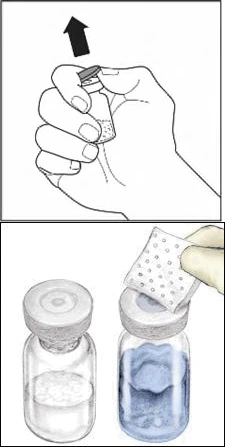
1 Remove the closure caps from the VEYVONDI powder and solvent vials to expose the centre of the rubber stoppers.
2 Before use, wipe each stopper for several seconds with a separate sterile alcohol swab (or other sterile solution suitable as recommended by the physician or haemophilia treatment centre) to disinfect. Allow the rubber stoppers to dry. Place the vials on a flat surface.
| 3 | Open the Mix2Vial device package by completely removing the lid, taking care not to touch the inside of the packaging. Do not remove the Mix2Vial device from the package. | N/A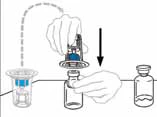 |
| 4 | Invert the Mix2Vial device package and place it over the top of the solvent vial. Firmly insert the blue plastic tip of the device into the center of the solvent vial stopper, pressing downward. Grasp the package by the edge and lift it off the Mix2Vial device. Be careful not to touch the transparent plastic tip. The solvent vial is now attached to the Mix2Vial device and is ready to be connected to the VEYVONDI vial. | |
| 5 | To connect the solvent vial to the VEYVONDI vial, invert the solvent vial and place it on top of the vial containing VEYVONDI powder. Fully insert the transparent plastic tip into the stopper of the VEYVONDI vial by pressing firmly downward. Perform this step immediately to prevent contamination. The solvent will flow into the VEYVONDI vial by vacuum action. Ensure that all the solvent has been transferred. Do not use if vacuum is lost or if the solvent does not flow into the VEYVONDI vial. | 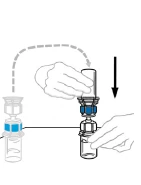 |
| 6 | Gently swirl the connected vials in a slow, continuous circular motion, or let the reconstituted product rest for 5 minutes, then gently swirl to ensure the powder has completely dissolved. Do not shake, as this may damage the product. Do not refrigerate after reconstitution. | 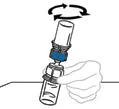 |
| 7 | Disconnect the two sides of the Mix2Vial device by holding the transparent plastic side of the Mix2Vial attached to the VEYVONDI vial in one hand and the blue plastic side of the Mix2Vial attached to the solvent vial in the other hand. Rotate the blue plastic side counterclockwise and gently separate the two vials. Do not touch the end of the plastic connector attached to the VEYVONDI vial containing the dissolved product. Place the VEYVONDI vial on a flat work surface. Discard the empty solvent vial. | 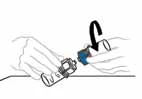 |
| 8 | Draw air into the sterile, empty, single-use plastic syringe by pulling back the plunger. The volume of air drawn should equal the volume of reconstituted VEYVONDI to be withdrawn from the vial. | 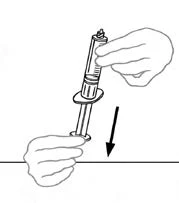 |
| 9 | Leaving the VEYVONDI vial (containing the reconstituted product) on the flat work surface, attach the syringe to the transparent plastic connector and rotate the syringe clockwise to secure it. | 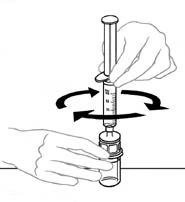 |
| 10 | Hold the vial with one hand and use the other hand to transfer all the air from the syringe into the vial. | 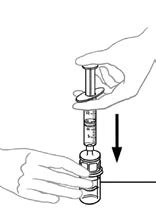 |
| 11 | Turn the attached syringe and VEYVONDI vial upside down so that the vial is above. Keep the plunger depressed. Slowly draw VEYVONDI into the syringe by pulling back the plunger gently. | 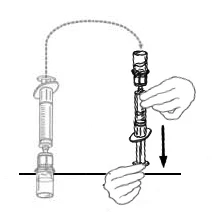 |
| 12 | Do not transfer the solution back and forth between the syringe and the vial, as this may damage the medicinal product. When ready for infusion, disconnect the syringe by rotating it counterclockwise. Visually inspect the syringe for particles; the solution should be clear and colorless. If flakes or particles are observed, do not use the solution and inform the doctor. | 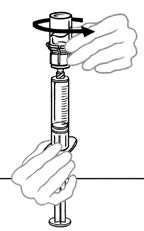 |
| 13 | If more than one VEYVONDI vial is required to prepare the dose: Leave the syringe attached to the vial until the additional vial is ready. Follow the reconstitution procedure described above (steps 2 to 8) to prepare the additional VEYVONDI vial, using a new Mix2Vial device for each vial. | |
| 14 | The contents of two vials can be drawn into the same syringe. NOTE: When transferring air into a second VEYVONDI vial and then drawing the solution into the syringe, position the vial and attached syringe so that the vial is above. |
Instructions for Administration
Before administration, inspect the prepared solution in the syringe for the presence of particles and discoloration (the solution should be clear, colourless, and free of particles). It is not uncommon for small flakes or particles to remain in the product vial after reconstitution. The filter included in the Mix2Vial device completely removes these particles. Filtration does not affect dose calculations. The solution in the syringe must not be used if it is cloudy or contains flakes or particles after filtration.
- Attach the infusion needle to a syringe containing the VEYVONDI solution. For convenience, it is preferable to use a winged infusion set (butterfly needle). Point the needle upwards and remove any air bubbles by gently tapping the syringe with a finger, then slowly and carefully expel the air from the syringe and needle.
- Apply a tourniquet and prepare the infusion site by thoroughly cleansing the skin with a sterile alcohol swab (or other suitable sterile solution as recommended by the physician or haemophilia treatment centre).
- Insert the needle into the vein and remove the tourniquet. Infuse VEYVONDI slowly at a rate not exceeding 4 mL per minute. Disconnect the empty syringe. If multiple syringes are required for the dose, connect and administer each additional VEYVONDI syringe one at a time. Note: Do not remove the butterfly needle until all syringes have been infused, and do not touch the Luer connection port of the syringe. If recombinant factor VIII has been prescribed, administer it within 10 minutes after completion of the VEYVONDI infusion.
- Remove the needle from the vein and apply a sterile gauze pad to the infusion site, applying pressure for several minutes.
If larger volumes are required, two VEYVONDI vials may be combined.
The contents of each reconstituted VEYVONDI vial may be drawn into a single syringe.
However, in such cases, the initially reconstituted VEYVONDI solution must not be further diluted.
Administer the solution slowly by intravenous infusion, not exceeding a rate of 4 mL/min.
Do not re-cap the needle. Place the needle, syringe, and empty VEYVONDI and diluent vials into a hard-walled sharps container for proper disposal.
Do not dispose of these items in unsorted household waste.
Any unused medicine and waste materials derived from this medicine must be disposed of in accordance with local regulations.
The following information is intended exclusively for healthcare professionals:
Treatment of bleeding episodes (on-demand treatment) in adults and children
The dose and frequency should be individualized according to clinical judgment, taking into account the severity of the bleeding episode, the site of bleeding, and the patient's clinical history, while monitoring appropriate clinical and laboratory parameters (levels of both VWF:RCo and FVIII:C).
Initiation of treatment
The initial dose of VEYVONDI should be between 40 and 80 IU/kg body weight. Replacement levels of VWF:RCo > 0.6 IU/mL (60%) and FVIII:C > 0.4 IU/mL (40%) should be achieved. Table 1 provides dosing guidelines for the treatment of mild and severe bleeding episodes.
To control bleeding, VEYVONDI must be administered with recombinant factor VIII if FVIII:C levels are < 40% or unknown. The dose of rFVIII should be calculated based on the difference between the patient's baseline plasma FVIII:C level and the desired peak FVIII:C level, aiming for an appropriate plasma FVIII:C level using an average approximate recovery of 0.02 (IU/mL)/(IU/kg). The full dose of VEYVONDI should be administered, followed by rFVIII within 10 minutes.
Dose calculation
VEYVONDI dose [IU] = dose [IU/kg] × body weight [kg]
Subsequent infusions
A subsequent dose of VEYVONDI between 40 IU and 60 IU/kg should be infused every 8–24 hours, according to the administration intervals indicated in Table 1 or until clinically appropriate. During severe bleeding episodes, maintain trough levels of VWF:RCo above 50% as long as deemed necessary.
Table 1. Dosing recommendations for the treatment of mild and severe bleeding episodes
| Bleeding | Initial dosea (IU of VWF:RCo/kg body weight) | Subsequent dose |
| Mild (e.g. epistaxis, oral bleeding, menorrhagia) | 40 to 50 IU/kg | 40 to 50 IU/kg every 8–24 hours (or as long as clinically necessary) |
| Severeb (e.g. severe or refractory epistaxis, menorrhagia, gastrointestinal bleeding, central nervous system trauma, hemarthrosis or traumatic bleeding) | 50 to 80 IU/kg | 40 to 60 IU/kg every 8–24 hours for approximately 2–3 days (or as long as clinically necessary) |
Prevention of bleeding/hemorrhage and treatment in case of elective surgery
in adults
Assess FVIII:C levels prior to the start of any surgical procedure. The recommended minimum target
levels are 0.4 IU/mL for minor and oral surgeries and 0.8 IU/mL for major surgeries.
To ensure preoperative endogenous FVIII levels of at least 0.4 IU/mL for minor and oral surgeries and 0.8 IU/mL for major surgeries, patients may receive a dose of 40–60 IU/kg of VEYVONDI 12–24 hours before the start of elective surgery (preoperative dose). Within the hour prior to surgery, patients should receive a dose of VEYVONDI based on assessment performed 3 hours before surgery. The dose depends on the patient's VWF and FVIII levels, as well as the type and severity of bleeding.
If FVIII:C levels meet the recommended target level, administer a dose of VEYVONDI alone within the hour before the procedure. If FVIII:C levels do not meet the recommended target levels, administer rFVIII in addition to vonicog alfa to increase VWF:RCo and FVIII:C. See Table 2 for recommended target levels of FVIII:C.
Table 2. Recommended peak plasma target levels of VWF:RCo and FVIII:C to be achieved before surgery to prevent excessive bleeding during and after surgery
| Type of surgical intervention | Target peak plasma level of VWF:RCo | Target peak plasma level of FVIII:C | Dose calculation of rVWF (to be administered within the hour before surgery) (required units of VWF:RCo) |
| Minor | 0.5–0.6 IU/mL | 0.4–0.5 IU/mL | ∆bVWF:RCo x body weight (kg)/IRc |
| Major | 1 IU/mL | 0.80–1 IU/mL | ∆bVWF:RCo x body weight (kg)/IRc |
During and after surgery
After the start of the surgical procedure, plasma levels of VWF:RCo and FVIII:C must be
monitored, and the intra- and post-operative replacement regimen should be individualized based on
pharmacokinetic (PK) results, the severity and duration of the hemostatic disorder, and according to the
treatment standards of the healthcare facility. In general, the frequency of VEYVONDI administration for
post-operative replacement should range from twice daily to every 48 hours; see Table 3 for
recommendations on subsequent maintenance dosing.
Table 3. Recommended target trough plasma levels of VWF:RCo and FVIII:C and minimum
duration of treatment for subsequent maintenance doses for prevention of excessive
bleeding after surgery
| Type of surgical procedure | Target trough plasma level of VWF:RCo | Target trough plasma level of FVIII:C | Minimum duration of treatment | Frequency of administration | ||
| Up to 72 hours after surgery | More than 72 hours after surgery | Up to 72 hours after surgery | More than 72 hours after surgery | |||
| Minor | ≥0.30 IU/mL | >0.40 IU/mL | 48 hours | Every 12–24 hours/alternate days | ||
| Major | >0.50 IU/mL | >0.30 IU/mL | >0.50 IU/mL | >0.40 IU/mL | 72 hours | Every 12–24 hours/alternate days |
Prophylactic treatment in adults
To initiate long-term prophylaxis against bleeding in patients with VWD, doses of 40 to 60 IU/kg of VEYVONDI administered twice weekly should be considered. Depending on the patient's condition and clinical response, including breakthrough bleeding episodes, higher doses (not exceeding 80 IU/kg) and/or increased frequency of administration (up to three times weekly) may be required.
Paediatric population
The safety and efficacy of VEYVONDI in children under 18 years of age have been established for the treatment of bleeding. The dosing regimen should follow the same guidelines used in adults and must be adjusted according to the patient's clinical condition and plasma levels of VWF:RCo and FVIII:C. In younger patients, shorter dosing intervals or higher doses may be required. The safety and efficacy of VEYVONDI for prophylactic treatment or for prevention or treatment of surgical bleeding have not yet been established in children under 18 years of age.
Name and batch number of the medicinal product
Every time VEYVONDI is administered to a patient, it is strongly recommended to record the name and batch number of the product in order to maintain a link between the patient and the product batch.