Verorab
Italy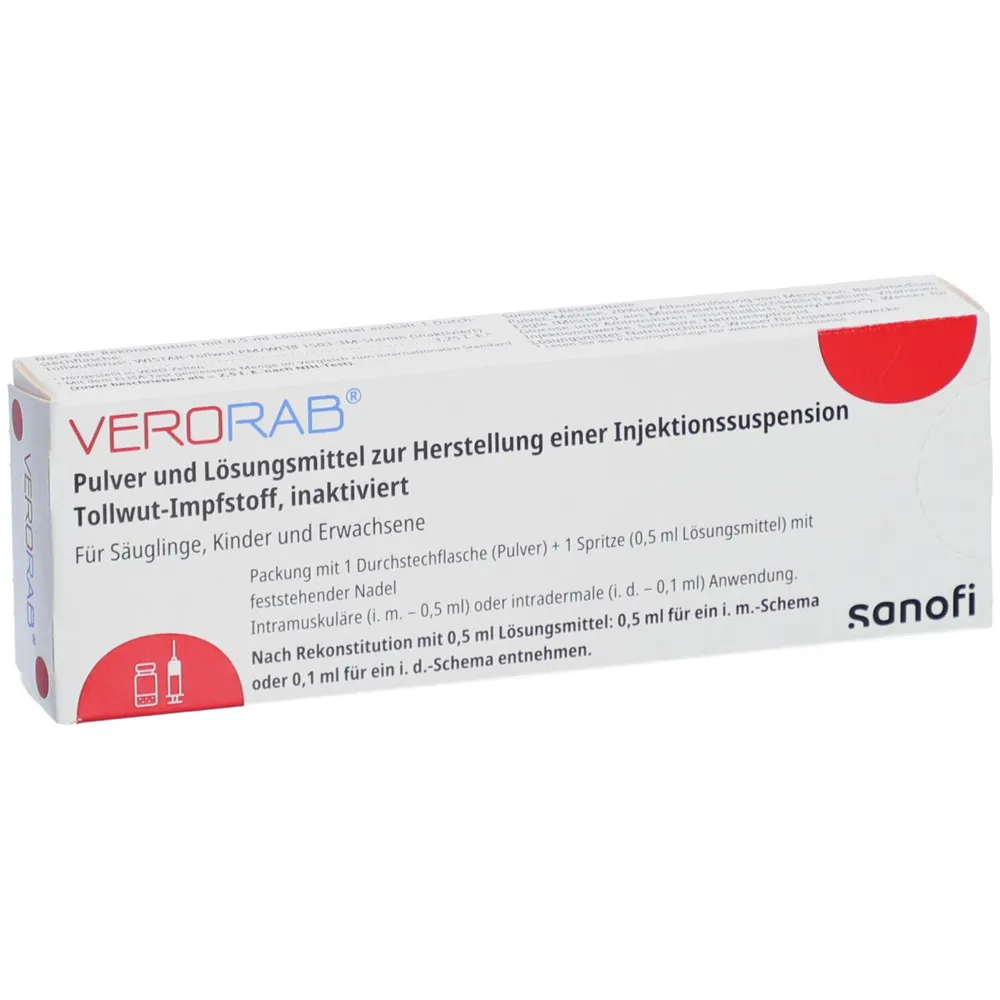
Table of Contents
- Package leaflet: Information for the user
- Verorab, powder and solvent for suspension for injection
- 1. What Verorab is and what it is used for
- 2. What you need to know before using Verorab
- 3. How to use Verorab
- 4. Possible side effects
- 5. How to store Verorab
- 6. Package contents and other information
- The following information is intended exclusively for healthcare professionals:
PACKAGE LEAFLET
Package leaflet: Information for the user
Verorab, powder and solvent for suspension for injection
Inactivated rabies vaccine
Please read this leaflet carefully before you or your child are vaccinated, as it contains important information for you.
- Keep this leaflet. You may need to read it again.
- If you have any questions, ask your doctor, pharmacist, or nurse.
- This medicine has been prescribed for you or your child only. Do not give it to others.
- If any adverse reaction occurs, including those not listed in this leaflet, contact your doctor, pharmacist, or nurse. See section 4.
Contents of this leaflet
- What Verorab is and what it is used for
- What you need to know before using Verorab
- How to use Verorab
- Possible side effects
- How to store Verorab
- Contents of the pack and other information
1. What Verorab is and what it is used for
Verorab is a rabies vaccine indicated for pre- and post-exposure prophylaxis of rabies in all age groups.
Verorab should be used in accordance with official recommendations.
2. What you need to know before using Verorab
Do not use Verorab
Pre-exposure prophylaxis:
- if you or your child are allergic to the active substance or to any of the other components of this medicine listed in section 6;
- if you or your child have developed an allergic reaction after a previous injection of this medicine or of any vaccine with the same composition;
- if you or your child have a fever or are suffering from an acute illness (in this case, vaccination should preferably be postponed).
Post-exposure prophylaxis:
- Given the fatal outcome of declared rabies infection, there are no contraindications to post-exposure vaccination.
Warnings and precautions
- As with all vaccines, Verorab may not protect 100% of vaccinated individuals.
- Verorab must not be administered intravascularly; ensure that the needle does not enter a blood vessel.
- Use with caution if you or your child are allergic to polymyxin B, streptomycin, or neomycin (present in trace amounts in the vaccine) or to any antibiotic of the same class.
- As with any injectable vaccine, appropriate medical treatment and supervision must be readily available in case of a rare anaphylactic reaction following administration of the vaccine.
- The need to perform serological tests (to assess seroconversion in individuals) should be determined according to official recommendations.
- When the vaccine is administered to individuals with known impaired immunity (immunodeficiency) due to an immunosuppressive disease or concomitant immunosuppressive therapy, blood tests should be performed 2 to 4 weeks after vaccination to ensure that a protective immune response has been achieved. In case of post-exposure vaccination, a complete vaccination schedule must be administered. For any category II or III exposure, rabies immunoglobulins should also be administered in addition to the vaccine; see “3. How to use Verorab”.
- Verorab should be administered with caution in individuals with low platelet levels (thrombocytopenia) or coagulation disorders, due to the risk of bleeding that may occur during intramuscular administration.
- Inform your doctor, pharmacist, or nurse before using Verorab if you or your child have ever had an allergic reaction to latex. The cap of the pre-filled syringe without needle contains a derivative of natural rubber latex which may cause a severe allergic reaction.
Talk to your doctor, pharmacist, or nurse before using Verorab.
Children and adolescents
Not applicable.
Other medicines and Verorab
Immunosuppressive treatments, including long-term systemic corticosteroid therapy, may interfere with antibody production and lead to vaccination failure. Therefore, a serological test is recommended 2 to 4 weeks after vaccination; see “Warnings and precautions”.
Verorab can be administered concomitantly with a Vi polysaccharide typhoid vaccine during the same vaccination session, using two different injection sites.
Rabies immunoglobulins or any other product and the rabies vaccine must never be mixed in the same syringe or injected at the same site.
Since rabies immunoglobulins interfere with the development of the immune response to the rabies vaccine, it is essential to strictly follow the recommendations for administration of rabies immunoglobulins.
Inform your doctor or pharmacist if you or your child are taking, have recently taken, or might take any other medicines.
Verorab with food and drink
Not applicable.
Pregnancy and breastfeeding
If you are pregnant, think you may be pregnant, are planning to become pregnant, or are breastfeeding, ask your doctor or pharmacist for advice before using this medicine.
Data on the use of Verorab in pregnant women are limited.
It is not known whether Verorab is excreted in breast milk, but no excretion has been identified and no risk is expected for infants receiving breast milk.
Due to the severity of the disease, Verorab may be administered during pregnancy or breastfeeding after a risk-benefit assessment by the doctor.
Driving and using machines
Dizziness has been frequently reported after vaccination. This may temporarily affect the ability to drive or use machinery.
Verorab contains phenylalanine, potassium, and sodium
Verorab contains 4.1 micrograms of phenylalanine in each 0.5 mL dose, equivalent to 0.068 micrograms/kg for a 60 kg person. Phenylalanine may be harmful if you have phenylketonuria (PKU), a rare genetic disorder causing accumulation of phenylalanine because the body cannot eliminate it properly.
Verorab contains less than 1 mmol of potassium (39 mg) and less than 1 mmol of sodium (23 mg) per dose, i.e., essentially “potassium-free” and “sodium-free”.
3. How to use Verorab
Use this medicine exactly as instructed by your doctor or pharmacist. If you have any doubts, consult your doctor or pharmacist.
The recommended dose is 0.5 mL of reconstituted vaccine administered intramuscularly (IM), or 0.1 mL of reconstituted vaccine administered intradermally (ID) at each injection site.
- Pre-exposure prophylaxis For pre-exposure primary immunization, individuals may be vaccinated according to one of the vaccination schedules shown in Table 1 and according to official local recommendations, if available:
Table 1: Pre-exposure vaccination schedules
Day 0 Day 7 Day 21 or Day 28
Intramuscular use (0.5 mL per dose)
Three-dose regimen 1 dose 1 dose 1 dose
IM use – 0.5 mL
One-week regimen 1 dose 1 dose
IM use – 0.5 mL
Intradermal use (0.1 mL per dose)
One-week regimen 2 doses 2 doses
ID use – 0.1 mL
Booster doses are determined based on the risk of exposure and serological testing for the presence of rabies virus neutralizing antibodies (≥ 0.5 IU/mL). A booster dose consists of a single dose of 0.5 mL administered intramuscularly or a single dose of 0.1 mL administered intradermically, according to WHO recommendations.
- Post-exposure prophylaxis Post-exposure prophylaxis should be initiated as soon as possible after a suspected exposure to rabies. In all cases, proper wound care (thorough washing of all bites and scratches with soap or detergent and copious amounts of water and/or virucidal agents) must be performed immediately or as soon as possible after exposure. This should be carried out prior to administration of rabies vaccine or rabies immunoglobulins, when indicated. Table 2: WHO guidelines for post-exposure prophylaxis according to level of exposure (adapt according to official local recommendations).
| Exposure Category | Type of exposure to a domestic or wild animal, suspected or confirmed rabid, or unavailable for testing | Recommended post-exposure prophylaxis |
| I | Touching or feeding animals Licking of intact skin (no exposure) | None, if a reliable history is available(a). |
| II | Nipping of bare skin Minor scratches or abrasions without bleeding (exposure) | Administer rabies vaccine immediately. Discontinue treatment if the animal remains healthy after the 10-day observation period(b) or if laboratory testing for rabies using appropriate methods is negative. Manage as Category III if exposure is due to bats. |
| III | Single or multiple transdermal bites(c) or scratches, licking of broken skin, or contamination of mucous membranes with saliva (licking), exposure to bats (severe exposure) | Administer rabies vaccine and rabies immunoglobulins immediately, preferably as soon as possible after initiation of post-exposure prophylaxis. Rabies immunoglobulins may be administered up to 7 days after the first dose of vaccine. Discontinue treatment if the animal remains healthy after the 10-day observation period(b) or if laboratory testing for rabies using appropriate methods is negative. |
Post-exposure prophylaxis in non-immunized individuals
Non-immunized individuals can be vaccinated using one of the vaccination regimens administered either
intramuscularly (IM) or intradermally (ID), as shown in Table 3.
Table 3: Post-exposure prophylaxis in non-immunized individuals
G0 G3 G7 G14 G21 G28
Intramuscular use (0.5 mL per dose)
Essen IM protocol 1 dose 1 dose 1 dose 1 dose - 1 dose
IM use – 0.5 mL/dose
Zagreb IM protocol 2 doses - 1 dose - 1 dose -
IM use – 0.5 mL/dose
Intradermal use (0.1 mL per dose)
New Red Cross ID regimen 2 doses 2 doses 2 doses - - 2 doses
Thai ( Thailand Red Cross, TRC)
ID use – 0.1 mL/dose
Pasteur Institute of Cambodia (IPC) ID regimen 2 doses 2 doses 2 doses - - -
ID use – 0.1 mL/dose
1-week 4-site ID regimen 4 doses 4 doses 4 doses - - -
ID use – 0.1 mL/dose
Regardless of the regimen used, vaccination should not be discontinued unless the animal is declared
non-rabid.
Rabies immunoglobulins must be administered in the case of any category III exposure (WHO classification, see Table 2). Whenever possible, each vaccine dose should be administered at a body site distant from the sites where immunoglobulins were administered.
Post-exposure prophylaxis in previously immunized individuals
According to official recommendations, this applies to individuals who have previously received pre-exposure prophylaxis, post-exposure prophylaxis, or who have interrupted post-exposure prophylaxis after having received at least two doses of a cell-culture-derived rabies vaccine.
Previously immunized individuals should receive 1 dose of vaccine (0.5 mL intramuscularly or 0.1 mL intradermally) on Day 0 (G0) and 1 dose on Day 3 (G3). Alternatively, 4 intradermal injections of 0.1 mL each can be administered at 4 separate sites on Day 0 (G0). Rabies immunoglobulins are not indicated in this case.
Individuals with reduced immunity
Pre-exposure prophylaxis
A 3-dose regimen (listed in the subsection "Pre-exposure prophylaxis") should be used, and a serological test for neutralizing antibodies should be performed 2 to 4 weeks after administration of the last vaccine dose to assess whether an additional vaccine dose is needed.
Post-exposure prophylaxis
A complete vaccination schedule must be administered following exposure. Rabies immunoglobulins should be administered in association with the vaccine in the case of any category II or III exposure (see Table 2).
Use in children
A child should receive the same dose as an adult.
Method of administration
- Intramuscular use (IM): The vaccine is administered into the anterolateral thigh muscle in infants and young children, and into the deltoid muscle in older children and adults. If the Zagreb regimen is used, one dose should be administered into each deltoid muscle (left and right) in adults on Day 0 (G0), followed by one dose on Day 7 (G7) and Day 21 (G21).
- Intradermal use (ID): The vaccine is preferably administered in the upper arm or forearm.
Verorab must not be injected into the gluteal region.
The vaccine must not be administered intravascularly.
If you or your child receive more Verorab than you should
Not applicable.
If you or your child forget to use Verorab
Not applicable.
If you or your child stop using Verorab
Not applicable.
If you have any further questions about the use of this medicine, consult your doctor, pharmacist, or nurse.
4. Possible side effects
Like all medicines, this medicine can cause side effects, although not everybody will get them.
Severe allergic reactions:
Severe allergic reactions (anaphylactic reactions) may always occur, even if very rare.
Contact your doctor or healthcare professional immediately or go immediately to the nearest hospital emergency department if you or your child experiences an anaphylactic reaction.
Signs or symptoms of an anaphylactic reaction usually occur very soon after the injection, if present, and may include rash, itching, difficulty breathing, shortness of breath, and swelling of the face, lips, throat or tongue.
Other side effects
Most side effects occur within 3 days after vaccination. Effects usually resolve spontaneously within 1–3 days of onset. The following frequencies have been reported:
Very common: may affect more than 1 in 10 people
- Feeling generally unwell,
- Headache,
- Muscle pain (myalgia),
- Pain at the injection site,
- Redness (erythema) at the injection site,
- Swelling at the injection site,
- In children only: irritability, inconsolable crying, and drowsiness.
Common: may affect up to 1 in 10 people
- Fever,
- Enlargement of lymph nodes (lymphadenopathy),
- Allergic reactions such as rash and itching,
- Influenza-like syndrome,
- Itching (pruritus) at the injection site,
- Hardening at the injection site,
- In children only: difficulty sleeping.
Uncommon: may affect up to 1 in 100 people
- Loss of appetite,
- Nausea,
- Stomach pain (abdominal pain),
- Diarrhoea,
- Vomiting,
- Chills,
- Tiredness, unusual weakness (asthenia),
- Dizziness,
- Joint pain (arthralgia),
- Bruising at the injection site (ecchymosis).
Rare: may affect up to 1 in 1,000 people
- Difficulty breathing.
Not known: frequency cannot be estimated from the available data
- Swelling of the face, lips, mouth, tongue or throat, which may cause difficulty in swallowing or breathing,
- Sudden loss/reduction in hearing.
Reporting of side effects
If you or your child experience any side effect, including those not listed in this leaflet, talk to your doctor, pharmacist or nurse. You can also report side effects directly via the national reporting system at the following address:
https://www.aifa.gov.it/content/segnalazioni-reazioni-avverse .
By reporting side effects, you can help provide more information on the safety of this medicine.
5. How to store Verorab
Keep this medicine out of the sight and reach of children.
Do not use this medicine after the expiry date stated on the carton after EXP. The expiry date refers to the last day of that month.
Store in a refrigerator (2°C–8°C). Do not freeze.
Store in the original outer packaging, protected from light.
Do not dispose of medicines via wastewater or household waste. Ask your pharmacist how to dispose of medicines you no longer use. This will help protect the environment.
6. Package contents and other information
What Verorab contains
- The active substance is: After reconstitution with 0.5 mL of solvent, 1 vial contains: Rabies virus, strain WISTAR Rabies PM/WI38 1503-3M (inactivated) ........................... 3.25 IU Produced on Vero cells Quantity measured by ELISA assay relative to the international standard
- Other components are: Powder: maltose, 20% human albumin solution, Basal Medium Eagle (BME) culture medium (a mixture of mineral salts including potassium, vitamins, dextrose and amino acids, including L-phenylalanine), water for injections, hydrochloric acid and sodium hydroxide.
Solvent: sodium chloride, water for injections.
May contain traces of polymyxin B, streptomycin and neomycin, used in the manufacturing process;
see “Warnings and precautions”.
Description of the appearance of Verorab and contents of the pack
Verorab is a powder and solvent for suspension for injection (powder in vial + 0.5 mL solvent in pre-filled syringe with or without needle – Pack of 1 or 10).
Marketing Authorisation Holder and Manufacturer
Marketing Authorisation Holder:
Sanofi Winthrop Industrie
82 avenue Raspail
94250 Gentilly
France
Representative in Italy
Sanofi S.r.l. - Viale L. Bodio, 37/B – 20158 Milano
Manufacturer:
Sanofi Winthrop Industrie
1541 avenue Marcel Mérieux
69280 Marcy l’Etoile
France
Sanofi Winthrop Industrie
Voie de l’Institut - Parc Industriel d’Incarville
B.P 101
27100 Val de Reuil
France
Sanofi-Aventis Zrt. Bdg. DC5 - Campona Utca 1. Budapest XXII - 1225 Budapest - Hungary
This medicinal product is authorised in the European Economic Area Member States and in the United Kingdom (Northern Ireland) under the following names:
- Austria, Belgium, Denmark, Finland, Germany, Ireland, Italy, Netherlands, Norway, Spain, Sweden, United Kingdom (Northern Ireland): Verorab.
- France: Vaccin Rabique Pasteur
Further sources of information
{<a href={link of the Member State}>}
The following information is intended exclusively for healthcare professionals:
Vaccination schedule recommendations must be strictly followed.
Instructions for handling:
- Remove the cap from the vial containing the lyophilized powder.
- Screw the plunger rod into the syringe, if provided separately.
- For the needle-free syringe: attach the reconstitution needle to the syringe.
- Inject the solvent into the vial containing the lyophilized powder.
- Gently shake the vial until a homogeneous suspension of the powder is obtained.
- The reconstituted vaccine must be clear, homogeneous, and free from particles.
o For syringes with a pre-attached needle:- Remove and dispose of the syringe used for vaccine reconstitution.
- Use a new syringe with a new needle to withdraw the reconstituted vaccine.
o For needle-free syringes: - Withdraw the suspension using a syringe.
- Replace the needle used to withdraw the vaccine with a new sterile needle suitable for intramuscular or intradermal injection.
- The needle length used for vaccine administration must be appropriate for the individual.
If Verorab is administered intramuscularly, the vaccine must be used immediately after reconstitution.
If Verorab is administered intradermally, the vaccine may be used up to 6 hours after reconstitution, provided it is stored at a temperature below 25°C and protected from light.
After reconstitution with the solvent, using aseptic techniques, a 0.1 mL dose should be withdrawn from the vial. The remaining volume may be used for another individual. Before each withdrawal, gently shake the vial to obtain a homogeneous suspension. For withdrawing and administering each dose of vaccine to each individual, a new sterile needle and a new sterile syringe must be used to prevent cross-contamination. Any unused reconstituted vaccine must be discarded after 6 hours.
Any unused medicine and waste material derived from this medicine must be disposed of in accordance with local regulations.
This medicinal product is subject to medical prescription.