Venofeer
Italy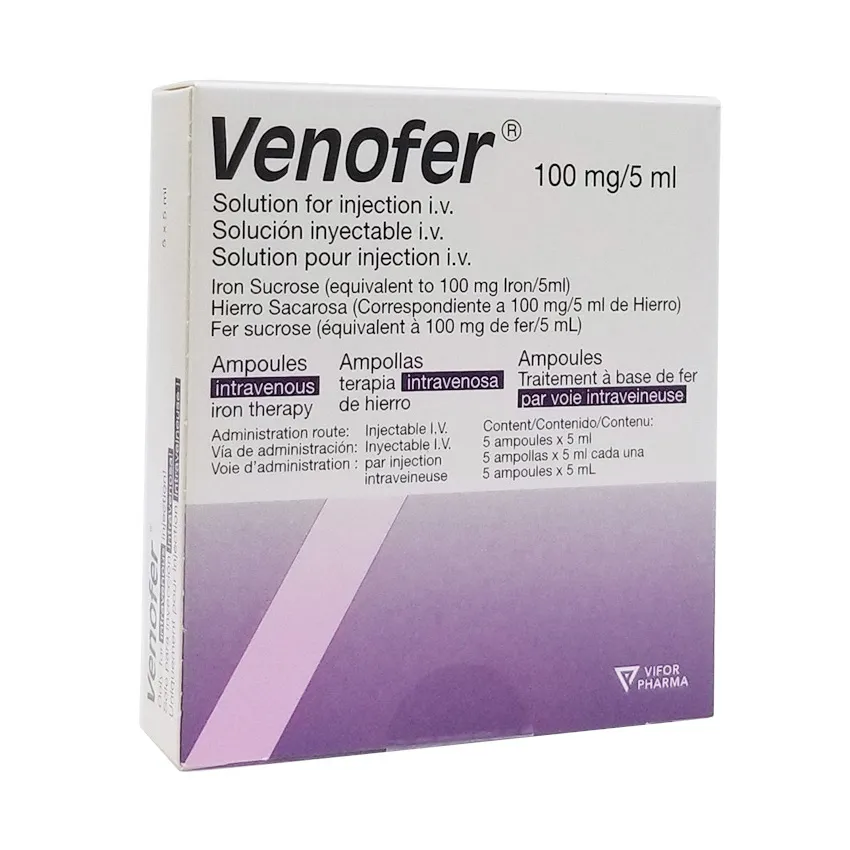
Table of Contents
- Package leaflet: Information for the user
- Venofer 20 mg of iron/mL
- 1. What Venofer is and what it is used for
- 2. What you need to know before you are given Venofer
- 3. How Venofer is administered
- 4. Possible side effects
- 5. How to store Venofer
- 6. Package contents and other information
- The following information is intended exclusively for healthcare professionals:
Package leaflet: Information for the user
Venofer 20 mg of iron/mL
Injectable solution or concentrate for solution for infusion
Iron Sucrose
Read this leaflet carefully before you are given this medicine because it
contains important information for you.
- Keep this leaflet. You may need to read it again.
- If you have any questions, ask your doctor.
- If you experience any side effects, including those not listed in this leaflet, tell your doctor. See section 4.
Contents of this leaflet:
- What Venofer is and what it is used for
- What you need to know before you are given Venofer
- How Venofer is given
- Possible side effects
- How to store Venofer
- Contents of the pack and other information
1. What Venofer is and what it is used for
Venofer is a medicine containing iron.
Medicines containing iron are used when you have too little iron in your body.
This condition is called "iron deficiency".
Venofer is given when:
- You cannot take iron by mouth, for example because iron tablets cause discomfort.
- You have already taken iron by mouth and it has had no effect.
2. What you need to know before you are given Venofer
Do not be given Venofer if:
- you are allergic (hypersensitive) to the product or to any of the other ingredients of this medicine (listed in section 6).
- you have previously experienced severe allergic reactions (hypersensitivity) to other injectable iron preparations.
- you have anemia that is not caused by iron deficiency;
- you have excess iron in your body or disorders affecting iron utilization in your body.
Do not be given Venofer if you fall into any of the categories listed above. If you have any doubts, consult your doctor before being administered Venofer.
Warnings and precautions
Talk to your doctor or nurse before receiving Venofer if:
- you have previously had allergies to medicines.
- you have systemic lupus erythematosus.
- you have rheumatoid arthritis.
- you have severe asthma, eczema, or other allergies.
- you have any infection.
- you have liver problems.
If you are unsure whether any of the above apply to you, consult your doctor or pharmacist before being administered Venofer.
Other medicines and Venofer
Inform your doctor or pharmacist if you are taking, have recently taken, or might take any other medicines, including those without a prescription and herbal medicines.
This is because Venofer may affect the action of other medicines. Likewise, other medicines may affect the action of Venofer.
In particular, inform your doctor or pharmacist if you are taking:
- Medicines containing iron taken orally. These medicines may not be effective if used concomitantly with Venofer.
Pregnancy and breastfeeding
Venofer has not been evaluated in women during the first trimester of pregnancy. It is important to inform your doctor if you are pregnant, suspect you may be pregnant, or are planning a pregnancy.
If you become pregnant during treatment, consult your doctor. Your doctor will decide whether or not you should be administered this medicine.
If you are breastfeeding, ask your doctor for advice before being administered Venofer.
Ask your doctor or pharmacist for advice before taking any medicine if you are pregnant or breastfeeding.
Driving and using machines
You may experience dizziness, mental confusion, or drowsiness after administration of Venofer. In such cases, you must not drive or operate tools or machinery. If in doubt, ask your doctor.
Venofer contains sodium
Venofer contains up to a maximum of 7 mg of sodium (the main component of table salt) per mL. This corresponds to 0.4% of the maximum daily recommended dietary intake for an adult.
3. How Venofer is administered
Your doctor will decide how much Venofer you should receive. Your doctor will also determine how often you need to receive it and how long your treatment should last. To establish the dose, your doctor will perform a blood test.
Your doctor or nurse will administer Venofer to you via one of the following routes:
- Slow intravenous injection – 1 to 3 times per week.
- As an intravenous infusion (drop by drop) – 1 to 3 times per week.
- During dialysis – injected into the venous line of the dialysis machine.
Venofer will be administered in a facility where immediate and appropriate treatment is available in case of immunological or allergic reactions. You will be monitored by a doctor or nurse for at least 30 minutes after each administration.
Venofer is a brown liquid; therefore, the injection or infusion will also be brown in color.
Use in children
The use of Venofer is not recommended in children.
4. Possible side effects
Like all medicines, this medicine can cause side effects, although not everyone gets them.
Allergic reactions (uncommon)
If you have an allergic reaction, tell your doctor or nurse immediately. Signs may include:
- Low blood pressure (feeling dizzy, lightheaded, or fainting).
- Swelling of the face.
- Difficulty breathing.
- Chest pain, which may be a sign of a potentially serious allergic reaction called Kounis syndrome. In some patients, such allergic reactions (rare) may become severe or potentially fatal (known as anaphylactoid/anaphylactic reactions). If you think you are having an allergic reaction, inform your doctor or nurse immediately.
Other side effects include:
Common (may affect up to 1 in 10 people)
2021-12-13 PIL-VEN/MRP/E12 T IT01 3 / 7
- Taste disturbances, such as a metallic taste. This is usually not a long-lasting effect.
- Low or high blood pressure.
- Feeling unwell (nausea).
- Reactions around the injection/infusion site such as pain, irritation, itching, bruising, or discolouration due to leakage of the injection into the skin.
Uncommon (may affect up to 1 in 100 people) - Headache or dizziness.
- Stomach ache or diarrhoea.
- Vomiting.
- Wheezing, difficulty breathing.
- Itching, rash.
- Muscle spasms, cramps, or pain.
- Tingling or "pins and needles".
- Reduced sense of touch.
- Inflammation of the veins.
- Flushing, burning sensation.
- Constipation.
- Joint pain.
- Limb pain.
- Back pain.
- Chills.
- Weakness, fatigue.
- Swelling of the hands and feet.
- Pain.
- Increased levels of liver enzymes (ALT, AST, GGT) in the blood.
- Increased serum ferritin levels.
Rare (may affect up to 1 in 1,000 people)
- Fainting.
- Drowsiness or somnolence.
- Pounding heartbeat (palpitations).
- Change in urine colour.
- Chest pain.
- Increased sweating.
- Fever.
- Increased blood levels of lactate dehydrogenase.
Other side effects with unknown frequency include: decreased alertness; confusion; loss of consciousness; anxiety; tremor or agitation; swelling of the face, mouth, tongue, or throat which may cause breathing difficulties; slowed pulse rate; increased pulse rate; circulatory collapse; inflammation of the veins causing blood clot formation; acute narrowing of the airways; itching, hives, skin rash, or redness of the skin; cold sweat, general feeling of malaise; pallor; sudden, life-threatening allergic reactions. A flu-like illness may occur several hours to several days after injection and is generally characterised by symptoms such as high temperature and muscle and joint pain.
2021-12-13 PIL-VEN/MRP/E12 T IT01 4 / 7
Reporting of side effects
If you experience any side effects, including those not listed in this leaflet, talk to your doctor or nurse. You can also report side effects directly via the national reporting system at
https://www.aifa.gov.it/content/segnalazioni-reazioni-avverse .
By reporting side effects, you can help provide more information on the safety of this medicine.
5. How to store Venofer
Keep this medicine out of the sight and reach of children.
Do not use this medicine after the expiry date stated on the label after "Exp".
Do not store above 25°C. Do not freeze. Keep the vials or ampoules
in the outer packaging.
Once opened, Venofer vials or Venofer bottles must be used
immediately. After dilution with sodium chloride solution, the diluted solution must
be used immediately.
Venofer is normally stored by the doctor or hospital.
6. Package contents and other information
What Venofer contains
- The active substance is iron (as iron sucrose). Each millilitre contains 20 mg of iron.
- The other components are water for injections and sodium hydroxide.
Description of the appearance of Venofer and contents of the pack
Venofer is a dark brown, non-transparent aqueous solution.
Venofer is available in the following pack sizes:
- 5 glass vials of 5 mL. Each 5 mL vial contains 100 mg of iron.
- 5 glass ampoules of 5 mL. Each 5 mL ampoule contains 100 mg of iron. Not all pack sizes may be marketed.
Marketing Authorisation Holder and Manufacturer
Vifor France
100-101 Terrasse Boieldieu
Tour Franklin La Défense 8
92042 Paris La Défense Cedex
France
Tel. +33 (0)1 41 06 58 90
Fax +33 (0)1 41 06 58 99
2021-12-13 PIL-VEN/MRP/E12 T IT01 5 / 7
SALES LICENSING HOLDER:
Vifor Pharma Italia Srl
Via Paolo di Dono, 73
00142 Rome
Italy
For any information regarding this medicinal product, please contact the local representative of the Marketing Authorisation Holder.
The following information is intended exclusively for healthcare professionals:
Administration
Carefully monitor patients for the onset of signs and symptoms of hypersensitivity reactions during and after each administration of Venofer.
Venofer must be administered only if trained personnel capable of assessing and managing anaphylactic reactions are immediately available, and in a facility equipped with full resuscitation equipment. The patient must remain under observation for at least 30 minutes after each administration of Venofer to monitor for possible adverse reactions.
Route of administration:
Venofer must be administered exclusively by intravenous route, which may consist of a drip infusion, a slow intravenous injection, or a direct injection into the venous line of the dialysis machine.
Extravasation must be avoided, as leakage of Venofer at the injection site may cause pain, inflammation, and brown discoloration of the skin.
Intravenous drip infusion:
Venofer must be diluted only in sterile 0.9% m/V sodium chloride (NaCl) solution.
Dilution must be performed immediately before infusion, and the solution should be administered as follows:
| Dose of Venofer (mg of iron) | Dose of Venofer (mL of Venofer) | Maximum volume of dilution with sterile 0.9% m/V NaCl solution | Minimum infusion time |
|---|---|---|---|
| 50 mg | 2.5 mL | 50 mL | 8 minutes |
| 100 mg | 5 mL | 100 mL | 15 minutes |
| 200 mg | 10 mL | 200 mL | 30 minutes |
For reasons of stability, dilutions at lower concentrations than Venofer are not acceptable.
2021-12-13 PIL-VEN/MRP/E12 T IT01 6 / 7
Intravenous injection:
Venofer may be administered by slow intravenous injection at a rate of 1 mL of undiluted solution per minute, with no more than 10 mL of Venofer (200 mg of iron) given per injection.
Injection into the venous line of the dialysis machine:
Venofer may be administered during a hemodialysis session directly into the venous line of the dialysis machine, under the same conditions described for intravenous injection.
Incompatibilities
Venofer must not be mixed with medicinal products other than sterile sodium chloride solution 0.9% m/V. Mixing with other solutions or medicinal products may result in precipitation and/or interaction. Compatibility with containers other than glass, polyethylene, and PVC is unknown.
Shelf life and storage
Do not use this medicinal product after the expiry date stated on the packaging after "Exp". Do not store above 25°C. Do not freeze. Store in the original packaging.
Shelf life after first opening of the container
From a microbiological standpoint, the diluted product should be used immediately.
Shelf life after dilution with sterile sodium chloride solution (NaCl) 0.9% m/V
From a microbiological standpoint, the diluted product should be used immediately after dilution.
Instructions for use and handling
Before use, vials or ampoules should be inspected visually for the presence of any sediment or damage. Use only those vials or ampoules that show no sediment and in which the solution is homogeneous. The diluted solution should be brown and clear.
Any unused medicinal product and waste material derived from this medicinal product must be disposed of in accordance with current local regulations.
2021-12-13 PIL-VEN/MRP/E12 T IT01 7 / 7