Velbe
Italy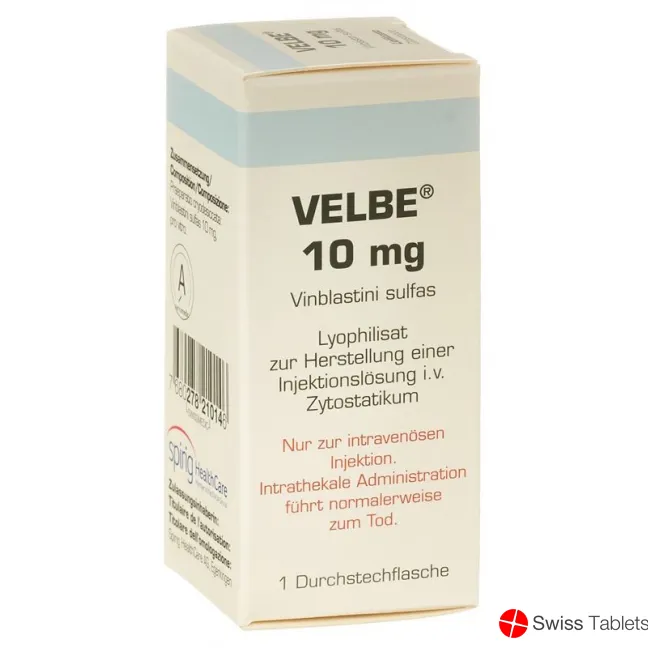
Table of Contents
Package leaflet: Information for the patient
VELBE 10 mg Powder for solution for infusion
Vinblastine sulfate
Please read all of this leaflet carefully before this medicine is administered to you because it contains important information for you.
- Keep this leaflet. You may need to read it again.
- If you have any questions, ask your doctor, pharmacist or nurse.
- If you get any side effects, including those not listed in this leaflet, tell your doctor, pharmacist or nurse. See section 4.
Contents of this leaflet:
- What VELBE is and what it is used for
- What you need to know before you are given VELBE
- How VELBE is administered to you
- Possible side effects
- How to store VELBE
- Contents of the pack and other information
1. What VELBE is and what it is used for
VELBE contains the active substance vinblastine, which belongs to a group of medicines known as
antineoplastic agents (anticancer drugs that work by inhibiting the growth of tumour cells) and is usually
administered in combination with other anticancer drugs.
VELBE is used in adults and children to treat:
- Hodgkin's disease (a cancer of the lymphatic system)
- Lymphocytic lymphoma (a tumour characterised by the proliferation of B lymphocytes)
- Histiocytic lymphoma (a malignant tumour arising from histiocytic cells)
- Advanced mycosis fungoides (a fungal infection)
- Advanced testicular carcinoma
- Kaposi's sarcoma (a malignant tumour of endothelial cells lining blood and lymphatic vessels)
- Letterer-Siwe disease (Langerhans cell histiocytosis or histiocytosis X)
- Choriocarcinoma (a tumour of the uterus) resistant to other chemotherapeutic agents
- Breast carcinoma resistant to other therapeutic measures.
- What you need to know before being given VELBE
Do not receive VELBE
- if you are allergic to the active substance or to any other vinca alkaloid; if you suffer from abnormally low white blood cell count (leucopenia) not caused by a tumour;
- if you have a severe infection. In this case, your doctor will treat your infection before administering vinblastine.
Warnings and precautions
Since VELBE is an anticancer medicine, it will be administered only in a specialised unit and under the supervision of a doctor experienced in the use of such medicines. The medical staff will explain to you the special precautions you must take before, during, and after treatment. This patient information leaflet will help you remember them.
VELBE must be administered only intravenously (directly into a vein), not by any other route. Administration by other routes may result in patient death, as occurs with intrathecal administration.
Before each administration, blood tests will be performed to check whether you have enough blood cells to receive VELBE. Your doctor may decide to adjust the dose or delay treatment depending on your general condition and if blood test results are inadequate (e.g. very low white blood cell count).
Before receiving VELBE, inform your doctor
- if you have or have had liver or heart problems;
- if you have recently undergone or are scheduled to undergo radiotherapy;
- if you have recently been vaccinated.
Inform your doctor immediately if, after injection of VELBE,
- you experience breathing difficulties;
- sore throat, fever, chills, or mouth disorders occur.
You should know that treatment with VELBE may cause side effects such as
- constipation (manageable with usual remedies such as enemas and laxatives). If high doses of VELBE are to be administered, your doctor may also recommend preventive treatment for constipation;
- hair loss;
- jaw pain and pain in organs affected by the tumour (the latter are believed to be caused by swelling of tumour tissue during response to treatment);
- nausea and vomiting;
- sudden drop in blood pressure when standing up after prolonged rest (orthostatic hypotension);
- photosensitisation (increased sensitivity to light causing sunburn-like reactions). Prolonged exposure to sunlight or artificial ultraviolet light (e.g. sunlamps, tanning beds) should be avoided to prevent photosensitisation.
Other medicines and VELBE
Inform your doctor if you are taking, have recently taken, or might take any other medicines.
The following medicines may affect and/or increase the toxicity of VELBE, and vice versa:
- medicines known as CYP3A4 inhibitors;
- digitoxin (used to treat certain heart conditions);
- certain antibiotics (e.g. erythromycin, bleomycin, mitomycin C);
- medicines used to treat epilepsy (e.g. phenytoin);
- itraconazole (used to treat fungal infections);
- other medicines used to treat cancer (e.g. methotrexate, cisplatin, interferon);
- vaccines;
- radiotherapy.
Pregnancy, breastfeeding and fertility
Pregnancy
Vinblastine should be used only if strictly necessary during pregnancy. Your doctor will assess the benefits of treatment for the mother against the potential risks to the foetus.
Women of childbearing age must avoid becoming pregnant during treatment with VELBE.
Male and female patients of reproductive age must use an effective method of contraception during treatment and for at least three months (preferably six months) after discontinuation of therapy with VELBE.
If you become pregnant during this period, inform your doctor immediately.
Breastfeeding
Breastfeeding must be discontinued for the entire duration of therapy with VELBE.
Fertility
Vinblastine may reduce fertility in both men and women.
Since VELBE may cause permanent infertility, prior to starting treatment, your doctor will inform male patients about the possibility of sperm preservation.
Driving and use of machines
Due to possible adverse effects on the nervous system, such as reduced reflexes, muscle weakness, and visual disturbances, this medicine may affect your ability to drive vehicles or operate machinery.
- How VELBE is administered to you
FOR INTRAVENOUS USE ONLY. FATAL IF ADMINISTERED BY OTHER ROUTES.
VELBE will be administered exclusively into a vein (intravenously) and only by personnel experienced in the administration of vinblastine.
VELBE will be administered once a week. The injection will take approximately 1 minute.
The amount of medicine to be administered will depend on your age, body size, and general medical condition. It will also depend on any other cancer treatments you have received.
Your height and weight will be measured to calculate your body surface area. Your doctor will use this body surface area in square metres (m²) to determine the correct dose for you.
The recommended initial dose is:
Adults: a single dose of 3.7 mg/m².
Children and adolescents: a single dose of 2.5 mg/m².
The dose may be increased weekly until a suitable maintenance dose for you is reached.
Patients with impaired liver function If your liver function is poor, your doctor will halve the recommended dose. In severe cases, your doctor may decide not to administer VELBE.
Patients with renal impairment
No dose adjustment is necessary.
If you receive more VELBE than you should or if a dose of VELBE is missed
Since VELBE is administered by a doctor or nurse, it is unlikely that too much will be given or that a dose will be missed.
If you suspect you have received an excessive dose of VELBE, contact your doctor or nurse immediately.
If you have any doubts about the use of this medicine, consult your doctor or nurse.
4. Possible side effects
Like all medicines, this medicine can cause side effects, although not everyone gets them.
Your doctor will explain these side effects to you and will discuss the risks and benefits associated with the use of this medicine. Most side effects resolve within 24 hours.
Very common: may affect more than 1 in 10 people:
- abnormal decrease in white blood cells in the blood (leucopenia);
- nausea, vomiting;
- hair loss (usually partial, and in some cases regrowth occurs during maintenance therapy);
- formation of blisters in the mouth and on the skin.
Common: may affect up to 1 in 10 people:
- anaemia, reduction in platelets (thrombocytopenia), and suppression of bone marrow function (myelosuppression);
- tingling, loss of some reflexes;
- constipation, intestinal obstruction (ileus), bleeding from pre-existing ulcer, intestinal inflammation with rectal bleeding (haemorrhage), loss of appetite, and diarrhoea.
Uncommon: may affect up to 1 in 100 people:
- depression;
- severe decrease or increase in blood pressure;
- Raynaud's phenomenon (mainly affects fingers and toes and is characterised by pain, burning sensation, numbness, or tingling; the affected area may turn from pale to cyanotic and then red);
- sudden drop in blood pressure when standing up;
- sore throat (pharyngitis);
- pain at the tumour site;
- discomfort.
Rare: may affect up to 1 in 1,000 people:
- severe reduction in sodium levels in the blood (syndrome of inappropriate ADH secretion);
- malaise;
- numbness, inflammation of peripheral nerves (peripheral neuritis), headache, seizures, dizziness;
- stroke;
- ear problems (including partial or complete, temporary or permanent hearing loss, and balance disorders with vertigo, involuntary rhythmic repetitive eye movements, and dizziness).
Frequency not known: frequency cannot be estimated from the available data:
- haemolytic anaemia;
- psychosis;
- facial and jaw pain (neuralgia), peripheral nerve disorders (peripheral neuropathy), vocal cord paralysis;
- ringing in the ears (tinnitus);
- inflammation of the mouth (stomatitis), stomach pain, abdominal pain, painful salivary glands (parotitis);
- dermatitis, increased skin sensitivity to sunlight (photosensitivity);
- fatigue, fever;
- pain at the injection site;
- extravasation during intravenous injection, i.e. leakage of the drug into surrounding tissues, has caused inflammation (cellulitis) and tissue damage (necrosis), as well as inflammation of the veins (phlebitis).
Other side effects
The following have also been reported:
- severe tissue erosions with involuntary eyelid movements (blepharospasm), swelling of the eyelid and preauricular lymph nodes after contact with the cornea (the transparent membrane covering the front of the eye);
- increased heart rate (tachycardia), chest pain (angina pectoris), heart rhythm disorders;
- myocardial infarction in patients treated with bleomycin, cisplatin, and vinblastine in combination;
- accumulation of tissue in the liver (hepatic fibrosis);
- reduction in muscle mass (muscle atrophy);
- urinary retention, formation of clots within small blood vessels (thrombotic microangiopathy) associated with renal failure;
- reduced fertility, absence of sperm (aspermia);
- acute shortness of breath (bronchospasm).
In patients previously treated or concurrently treated with mitomycin-C (a chemotherapeutic agent belonging to the class of antibiotics), breathing difficulties, rales, and lung problems may occur several hours after administration of vinblastine. With appropriate treatment, these symptoms usually resolve completely, although some patients have developed progressive breathing difficulties requiring chronic treatment.
Reporting of side effects
If you experience any side effect, including those not listed in this leaflet, talk to your doctor or pharmacist. You can also report side effects directly via the national reporting system at www.agenziafarmaco.gov.it/it/responsabili.
By reporting side effects, you can help provide more information on the safety of this medicine.
5. How to store VELBE
Keep this medicine out of the sight and reach of children.
Do not use this medicine after the expiry date which is stated on the carton and vial after "Exp".
The expiry date refers to the last day of that month.
This medicine must be stored in a refrigerator (between +2°C and +8°C).
After dilution with the recommended diluent, the medicine can be stored in the refrigerator for up to 28 days.
If the medicine is dissolved in physiological saline or sterile water for injection, it must be stored in the refrigerator for a maximum of 24 hours.
Do not dispose of any medicine via wastewater or household waste. Ask your pharmacist how to dispose of medicines you no longer use. This will help protect the environment.
6. Package contents and other information
What VELBE contains
- The active substance is vinblastine (as vinblastine sulfate). One vial contains 10 mg of vinblastine.
Description of the appearance of VELBE and contents of the pack
Powder.
VELBE is available in packs containing 10 mg in 1 glass vial.
Marketing Authorization Holder
EG S.P.A. - Via Pavia, 6 – 20136 Milan, Italy
Manufacturer
Cell Parm GmbH D- 30625 Hannover, Feodor – Lynen Str. 35 (Germany)
The following information is intended exclusively for healthcare professionals:
Syringes containing this product must be labeled with the statement: “FATAL IF ADMINISTERED BY OTHER ROUTES. FOR INTRAVENOUS USE ONLY.”
Syringes prepared by a pharmacist must be packaged in an outer wrapper labeled with the statement: “DO NOT REMOVE THE WRAPPER UNTIL TIME OF INJECTION. FATAL IF ADMINISTERED BY OTHER ROUTES. FOR INTRAVENOUS USE ONLY.”
As with all antineoplastic agents, VELBE must be handled with care. Dilution of the medicinal product must be performed under aseptic conditions in a designated area by trained personnel. All necessary precautions must be taken to avoid contact with skin and mucous membranes.
Precautions for preparation and administration:
Standard safety precautions for cytotoxic agents must be observed when preparing and disposing of the infusion solution. The handling of the infusion solution must be carried out in a safe environment, and protective clothing and gloves must be worn. If a safe environment is not available, protective mask and eye protection must be added to the equipment. If the solution comes into contact with the eyes, it may cause severe irritation. The eyes must be immediately and thoroughly rinsed with water. If irritation persists, a physician must be consulted. If the solution contacts the skin, wash thoroughly with water.
To prepare a 1 mg/ml solution of VELBE, add 10 ml of 0.9% sodium chloride solution (containing benzyl alcohol as a preservative) to the 10 mg of VELBE contained in the sterile vial.
The drug dissolves immediately, yielding a clear solution.
Prior to administration, parenterally administered drugs should be visually inspected for particulate matter and discoloration whenever solution and container permit.
After preparing the solution and withdrawing the required dose, any remaining content may be stored at a temperature between +2°C and +8°C for up to 28 days without significant loss of activity.
Due to the presence of benzyl alcohol as a preservative in the diluent, the VELBE solution thus prepared must not be administered to children under two years of age. In such cases, the product may be dissolved in physiological saline or water for injections in identical quantities; solutions prepared in this manner must be stored in the refrigerator and used within 24 hours of preparation.
VELBE must not be diluted with solvents that increase or decrease the pH of the resulting solution outside the range of 3.5 to 5. Solutions must be prepared with physiological saline or 5% glucose in water (in both cases with or without preservative), and must not be mixed in the same container with any other chemical substance.
DO NOT USE OTHER DILUENT SOLUTIONS.
The dose of VELBE may be injected into the tubing of a continuous intravenous infusion line or directly into a vein. The latter method is more suitable for outpatient therapy. It is extremely important that the needle is correctly positioned within the vein before injecting the product.
The dose should be injected over approximately one minute, taking all necessary precautions to ensure proper intravenous needle placement and to prevent leakage of the solution, which could cause subcutaneous tissue irritation and phlebitis.
To further minimize the risk of extravasation, it is recommended to repeatedly flush the syringe with venous blood before removing the needle.
Injection into extremities with already impaired circulation or potentially damaged by compression or neoplastic invasion, phlebitis, or varicosities is discouraged in order to avoid thrombophlebitis.
WARNING: Accidental extravasation of VELBE solution may cause severe irritation. The injection must be immediately stopped, and the remaining portion of the solution must be administered into another vein. Extravasated drug dispersion can be facilitated by applying warm compresses or hyaluronidase. These measures help reduce pain and the risk of local tissue reactions.
Disposal
All devices used in the preparation, administration, or otherwise coming into contact with VELBE must be disposed of in accordance with local guidelines for handling cytotoxic compounds.