Vanflyta
Italy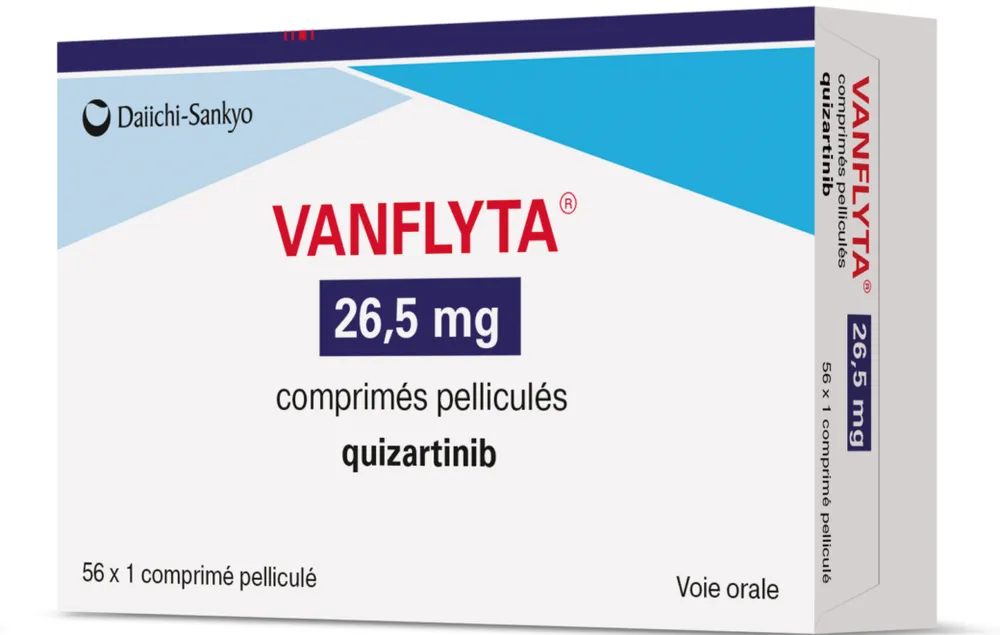
Instructions for Use
Patient Information Leaflet
VANFLYTA 17.7 mg film-coated tablets, 26.5 mg film-coated tablets
quizartinib
This medicinal product is subject to additional monitoring. This will allow any new safety information to be identified quickly. You can help by reporting any side effects you experience while taking this medicine. See the end of section 4 for information on how to report side effects.
Please read this leaflet carefully before taking this medicine, as it contains important information for you.
- Keep this leaflet. You may need to read it again.
- If you have any questions, ask your doctor, pharmacist, or nurse.
- This medicine has been prescribed for you only. Do not give it to other people, even if their symptoms are the same as yours, as it may be harmful.
- If you experience any side effect, including those not listed in this leaflet, talk to your doctor, pharmacist, or nurse. See section 4.
Contents of this leaflet
- What VANFLYTA is and what it is used for
- What you need to know before taking VANFLYTA
- How to take VANFLYTA
- Possible side effects
- How to store VANFLYTA
- Contents of the pack and other information
1. What VANFLYTA is and what it is used for
What VANFLYTA is
VANFLYTA contains the active substance quizartinib. It is a type of anticancer medicine called a
"protein kinase inhibitor". It is used in combination with chemotherapy for the treatment of adults
with acute myeloid leukaemia (AML), a type of blood cancer, who have a mutation (alteration) in the
FLT3 gene known as "FLT3-ITD". Treatment with VANFLYTA may be continued after a bone marrow
transplant, once patients have sufficiently recovered.
Your doctor will perform tests on your cancer cells to detect changes in the FLT3 gene, in order to
identify FLT3-ITD mutations early and ensure that VANFLYTA is appropriate for you.
How VANFLYTA works
In acute myeloid leukaemia, the body produces a large number of abnormal white blood cells that
do not mature into healthy cells. VANFLYTA works by blocking the action of proteins called
"tyrosine kinases" in these abnormal cells. This slows down or stops the uncontrolled division and
growth of the abnormal cells and helps immature cells to develop into normal cells.
2. What you should know before taking VANFLYTA
Do not take VANFLYTA
- if you are allergic to quizartinib or to any of the other ingredients of this medicine (listed in section 6). If you think you may be allergic, consult your doctor;
- if you have from birth a heart condition called "long QT syndrome" (abnormal electrical activity of the heart that alters its rhythm);
- if you are breastfeeding (see "Pregnancy, breastfeeding and fertility").
Warnings and precautions
Talk to your doctor, pharmacist or nurse before taking VANFLYTA:
- if you have or have previously had heart problems, including arrhythmia (abnormal heart rhythm), myocardial infarction (heart attack) within the previous 6 months, congestive heart failure (insufficient pumping ability of the heart), uncontrolled angina pectoris (chest pain), or uncontrolled hypertension (blood pressure too high);
- if you have been diagnosed with low levels of potassium or magnesium in your blood;
- if you are taking medicines that can prolong the QT interval (irregular heart rhythm; see "Other medicines and VANFLYTA");
- if you are taking strong CYP3A inhibitors (see "Other medicines and VANFLYTA");
- if you have or have previously had fever, cough, chest pain, shortness of breath, fatigue, or pain when urinating.
Monitoring during treatment with VANFLYTA
Blood tests
Your doctor will perform regular blood tests during treatment with VANFLYTA to monitor
your blood cells (white blood cells, red blood cells and platelets) and electrolytes (salts such as sodium,
potassium, magnesium, calcium, chloride and bicarbonate in the blood). Your doctor will monitor your electrolytes more frequently if you experience diarrhea or vomiting.
Electrocardiogram
Before and during treatment, your doctor will perform heart checks using an electrocardiogram (ECG) to ensure that your heart is beating normally. ECGs will initially be performed once a week and later less frequently, according to your doctor’s decision. Your doctor will monitor your heart more frequently if you are taking other medicines that prolong the QT interval (see "Other medicines and VANFLYTA").
Infections in patients over 65 years of age
Elderly patients are at higher risk of developing very serious infections compared to younger patients, especially during the initial treatment period. If you are over 65 years old, you will be closely monitored for the development of severe infections during the induction phase.
Children and adolescents
Do not give this medicine to children or adolescents under 18 years of age, as there is insufficient information on its use in this age group.
Other medicines and VANFLYTA
Tell your doctor or pharmacist if you are taking, have recently taken or might take any other medicines, including those without a prescription, vitamins, antacids (medicines for heartburn and stomach acidity), and herbal supplements. This is because some medicines may affect how VANFLYTA works.
In particular, the following medicines may increase the risk of side effects with VANFLYTA by increasing its levels in the blood:
- certain medicines used to treat fungal infections – such as itraconazole, posaconazole or voriconazole;
- certain antibiotics – such as clarithromycin or telithromycin;
- nefazodone, a medicine used to treat major depression.
The following medicines may reduce the effectiveness of VANFLYTA:
- certain medicines used to treat tuberculosis – such as rifampicin;
- certain medicines used to treat epileptic seizures or epilepsy – such as carbamazepine, primidone, phenobarbital or phenytoin;
- certain medicines used to treat prostate cancer – such as apalutamide and enzalutamide;
- mitotane – a medicine used to treat symptoms of adrenal gland tumors;
- bosentan – a medicine used to treat high blood pressure in the lungs (pulmonary arterial hypertension);
- St. John’s wort (hypericum or Hypericum perforatum) – a herbal product used for anxiety and mild depression.
Some medicines used to treat HIV may increase the risk of side effects (e.g., ritonavir) or reduce the effectiveness (e.g., efavirenz or etravirine) of VANFLYTA.
Medicines that prolong the QT interval
Concomitant administration of VANFLYTA and other medicines that prolong the QT interval may further increase the risk of QT prolongation. Examples of medicines that prolong the QT interval include, among others, azole antifungals, ondansetron, granisetron, azithromycin, pentamidine, doxycycline, moxifloxacin, atovaquone, prochlorperazine and tacrolimus.
Pregnancy, breastfeeding and fertility
Pregnancy
You must not take VANFLYTA during pregnancy, as it could be harmful to the unborn child. Women of childbearing potential must undergo a pregnancy test within 7 days before starting this medicine.
Women must use effective contraception during treatment with VANFLYTA and for at least 7 months after stopping treatment. Men must use effective contraception during treatment with VANFLYTA and for at least 4 months after stopping treatment.
If you are pregnant, suspect you may be pregnant, or are planning a pregnancy, consult your doctor, pharmacist or nurse before taking this medicine.
Breastfeeding
Do not breastfeed during treatment with VANFLYTA and for at least 5 weeks after stopping treatment, as it is not known whether VANFLYTA passes into breast milk (see "Do not take VANFLYTA").
If you are breastfeeding, consult your doctor, pharmacist or nurse before taking this medicine.
Fertility
VANFLYTA may reduce fertility in women and men. Talk to your doctor before starting treatment.
Driving and using machines
It is unlikely that VANFLYTA will affect your ability to drive or use machinery.
3. How to take VANFLYTA
Take this medicine exactly as your doctor or pharmacist has told you. If
you have any doubts, consult your doctor or pharmacist.
Dose of VANFLYTA to take
Your doctor or pharmacist will tell you the exact dose of VANFLYTA you should take. Do not change the dose and
do not stop taking VANFLYTA without first consulting your doctor.
Usually, you will start by taking one 35.4 mg tablet (two 17.7 mg tablets) once daily for 2 weeks, during each chemotherapy cycle. The maximum recommended dose is
53 mg once daily.
Your doctor may prescribe a lower starting dose of one 17.7 mg tablet once daily
if you are taking certain other medicines.
After completion of chemotherapy, your doctor may adjust the dose to one 26.5 mg tablet
once daily for 2 weeks, and then increase the dose to 53 mg (two 26.5 mg tablets)
once daily thereafter, depending on your response to treatment with VANFLYTA.
Your doctor may temporarily suspend treatment or adjust the dose based on blood tests, side effects, or other medicines you may be taking.
Your doctor will stop treatment if you need to undergo a stem cell transplant. Your
doctor will tell you when to stop taking the medicine and when to restart it.
Taking the medicine
- Take VANFLYTA by mouth, with or without food.
- Take VANFLYTA every day at approximately the same time: this will help you remember to take the medicine.
- If you vomit after taking the medicine, do not take another tablet until your next scheduled dose.
How long to take VANFLYTA
Continue taking VANFLYTA for the entire period indicated by your doctor. Your doctor will monitor
your condition regularly to check that the treatment remains effective.
If you have any doubts about how long you should continue treatment with VANFLYTA, consult your doctor or pharmacist.
If you take more VANFLYTA than you should
If you accidentally take more tablets than you should, or if someone else accidentally takes
this medicine, consult your doctor immediately or go to hospital, taking this leaflet with you.
Medical treatment may be necessary.
If you forget to take VANFLYTA
If you forget to take VANFLYTA, take it as soon as possible on the same day. Take the
next dose at the usual time the following day.
Do not take an extra dose (two doses on the same day) to make up for a missed dose.
If you stop taking VANFLYTA
Stopping treatment with VANFLYTA may cause your condition to worsen. Do not stop taking the medicine
unless instructed by your doctor.
If you have any questions about how to use this medicine, ask your doctor or pharmacist.
4. Possible side effects
Like all medicines, this medicine can cause side effects, although not everybody gets them.
Serious side effects
Tell your doctor, pharmacist, or nurse immediately if you notice any of the following side effects:
- Dizziness, feeling of emptiness in the head, or fainting. These could be signs of a heart problem called "QT interval prolongation" (an abnormal electrical activity of the heart that alters its rhythm);
- Fever, cough, chest pain, shortness of breath, fatigue, or pain when urinating. These could be signs of an infection or febrile neutropenia (low number of white blood cells accompanied by fever).
Very common side effects
(may affect more than 1 in 10 people)
- Increased alanine aminotransferase (abnormal liver enzyme test results)
- Thrombocytopenia (low levels of platelets in the blood)
- Anaemia (low levels of red blood cells)
- Neutropenia (low levels of neutrophils, a type of white blood cell)
- Diarrhoea
- Nausea (feeling unwell)
- Abdominal pain (stomach ache)
- Headache
- Vomiting
- Oedema (swelling of the face, arms, and legs)
- Upper respiratory tract infections (infections of the nose and throat)
- Reduced appetite
- Epistaxis (severe nosebleed)
- Fungal infections
- Herpes virus infections
- Dyspepsia (indigestion)
- Bacteraemia (presence of bacteria in the blood)
Common side effects
(may affect up to 1 in 10 people)
- Pancytopenia (low levels of all types of blood cells)
Uncommon side effects
(may affect up to 1 in 100 people)
- Cardiac arrest (cessation of heartbeat)
- Ventricular fibrillation (dangerous, irregular, and uncoordinated contractions of the lower chambers of the heart)
Reporting of side effects
If you get any side effect, including ones not listed in this leaflet, talk to your doctor, pharmacist, or nurse. You can also report side effects directly through the national reporting system listed in Annex V. By reporting side effects, you can help provide more information on the safety of this medicine.
5. How to store VANFLYTA
Keep this medicine out of the sight and reach of children.
Do not use this medicine after the expiry date stated on the carton and blister after "Exp./EXP". The expiry date refers to the last day of that month.
This medicine does not require any special storage conditions.
Do not use this medicine if you notice that the packaging is damaged or shows any signs of tampering.
Do not dispose of medicines via wastewater or household waste. Ask your pharmacist how to dispose of medicines you no longer use. This will help protect the environment.
6. Package contents and other information
What VANFLYTA contains
- The active substance is quizartinib.
VANFLYTA 17.7 mg: each film-coated tablet contains 17.7 mg of quizartinib (as dihydrochloride).
VANFLYTA 26.5 mg: each film-coated tablet contains 26.5 mg of quizartinib (as dihydrochloride). - The other components are:
VANFLYTA 17.7 mg:
Tablet core: hydroxypropylbetadex, microcrystalline cellulose, magnesium stearate
Film coating: hypromellose, talc, triacetin, titanium dioxide
VANFLYTA 26.5 mg:
Tablet core: hydroxypropylbetadex, microcrystalline cellulose, magnesium stearate
Film coating: hypromellose, talc, triacetin, titanium dioxide, yellow iron oxide
Description of the appearance of VANFLYTA and contents of the pack
VANFLYTA 17.7 mg film-coated tablets (tablets) are white, round tablets with "DSC 511" imprinted on one side, available in packs containing 14 × 1 or 28 × 1 film-coated tablets in unit-dose divisible blisters made of aluminium/aluminium.
VANFLYTA 26.5 mg film-coated tablets (tablets) are yellow, round tablets with "DSC 512" imprinted on one side, available in packs containing 14 × 1, 28 × 1 or 56 × 1 film-coated tablets in unit-dose divisible blisters made of aluminium/aluminium.
Not all pack sizes may be marketed.
Marketing Authorisation Holder
Daiichi Sankyo Europe GmbH
Zielstattstrasse 48
81379 Munich
Germany
Manufacturer
Daiichi Sankyo Europe GmbH
Luitpoldstrasse 1
85276 Pfaffenhofen
Germany
For further information about this medicinal product, please contact the local representative of the Marketing Authorisation Holder:
België/Belgique/Belgien
This page has been machine-translated and may contain inaccuracies. The original data is available in the manufacturing country's language.
Last data check: May 11, 2026 · Data source: Agenzia Italiana del Farmaco (AIFA)