Vancomycin Mylan
Italy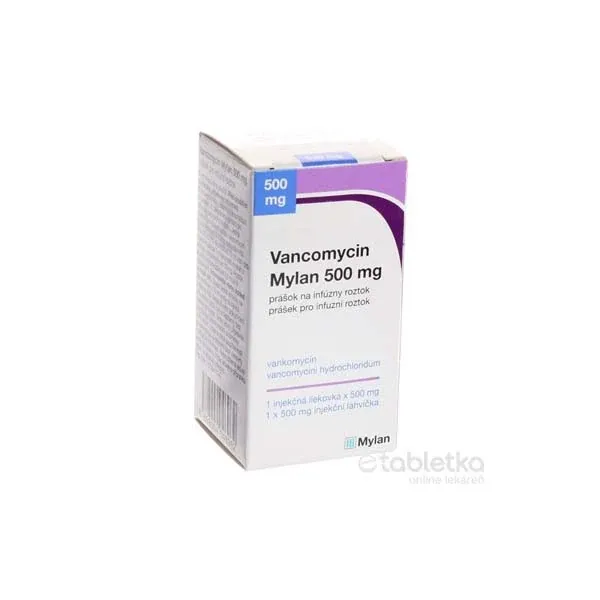
Table of Contents
- Package leaflet: Information for the user
- Vancomycin Mylan 500 mg powder for solution for infusion, 1000 mg powder for solution for infusion
- 1. What Vancomycin Mylan is and what it is used for
- 2. What you need to know before using Vancomycin Mylan
- 3. How to use Vancomycin Mylan
- 4. Possible side effects
- 5. How to store Vancomycin Mylan
- 6. Contents of the pack and other information
Package leaflet: Information for the user
Vancomycin Mylan 500 mg powder for solution for infusion, 1000 mg powder for solution for infusion
vancomycin
Generic medicine
Read this leaflet carefully before using this medicine because it contains
important information for you.
- Keep this leaflet. You may need to read it again.
- If you have any questions, ask your doctor or pharmacist.
- This medicine has been prescribed for you only. Do not give it to other people, even if their symptoms are the same as yours, as it may be harmful.
- If you experience any side effects, including those not listed in this leaflet, tell your doctor or pharmacist. See section 4.
Contents of this leaflet:
- What Vancomycin Mylan is and what it is used for
- What you need to know before using Vancomycin Mylan
- How to use Vancomycin Mylan
- Possible side effects
- How to store Vancomycin Mylan
- Contents of the pack and other information
1. What Vancomycin Mylan is and what it is used for
Vancomycin is an antibiotic belonging to a group of antibiotics known as "glycopeptides".
Vancomycin works by killing certain bacteria that cause infections.
Vancomycin powder is reconstituted to form a solution for infusion or an oral solution.
Vancomycin is used in all age groups by infusion for the treatment of the following serious infections:
- Infections of the skin and underlying tissue.
- Infections of the bones and joints.
- Lung infection known as "pneumonia".
- Infection of the inner lining of the heart (endocarditis), and to prevent endocarditis in at-risk patients undergoing major surgical procedures.
- Blood infection associated with the above-mentioned infections.
Vancomycin is used in adults and children for the treatment of mucosal infections of the small and large intestine with mucosal damage (pseudomembranous colitis) caused by the bacterium Clostridium difficile.
2. What you need to know before using Vancomycin Mylan
Do not use Vancomycin Mylan
- if you are allergic to vancomycin or to any of the other ingredients of this medicine (listed in section 6).
Warnings and precautions
Serious adverse effects, potentially leading to vision loss, have been reported following ocular injection of vancomycin.
Talk to your doctor, pharmacist, or nurse before using vancomycin if:
- you have previously had an allergic reaction to the medicine teicoplanin, as this may mean you are also allergic to vancomycin.
- you have a hearing disorder, especially if you are elderly (you may require hearing tests during treatment).
- you have kidney disease (you will need blood and kidney function tests during treatment).
- you are receiving vancomycin by infusion for the treatment of Clostridium difficile-associated diarrhea rather than orally.
- you have ever developed a severe skin rash or skin peeling, blisters, and/or mouth ulcers after taking vancomycin.
Serious skin reactions have been reported during treatment with vancomycin, including Stevens-Johnson syndrome, toxic epidermal necrolysis, drug reaction with eosinophilia and systemic symptoms (DRESS), and acute generalized exanthematous pustulosis (AGEP).
Discontinue use of vancomycin and seek immediate medical attention if you experience any of the symptoms described in section 4.
Cases of allergic reactions to this medicine, including breathing difficulties and chest pain, have been reported with Vancomycin Mylan. Stop taking Vancomycin Mylan immediately and contact your doctor or emergency services if you notice any of these symptoms.
Talk to your doctor, hospital pharmacist, or nurse during treatment with vancomycin if:
- you have received vancomycin for a prolonged period (you may need liver and kidney blood tests during treatment).
- you develop any skin reaction during treatment.
- you develop severe and persistent diarrhea during or after vancomycin use; contact your doctor immediately. This may be a sign of intestinal inflammation (pseudomembranous colitis), which can occur following antibiotic treatment.
Children
Vancomycin will be used with particular caution in premature infants and newborns, as their kidneys are not fully developed and may lead to accumulation of vancomycin in the blood.
This age group requires blood tests to monitor vancomycin levels in the blood.
Concomitant administration of vancomycin and anesthetic agents has been associated with skin flushing (erythema) and allergic reactions in children. Similarly, concomitant use with other medicines such as aminoglycoside antibiotics, non-steroidal anti-inflammatory drugs (NSAIDs, e.g. ibuprofen), or amphotericin B (a medicine for fungal infections) may increase the risk of kidney damage, and therefore more frequent blood and kidney function tests may be required.
Other medicines and Vancomycin Mylan
Inform your doctor or hospital pharmacist if you are taking, have recently taken, or might take any other medicines, including those without a prescription.
The following medicines may interact with vancomycin when taken simultaneously:
- medicines for bacterial infections (streptomycin, neomycin, gentamicin, kanamycin, amikacin, bacitracin, tobramycin, colistin B, colistin, piperacillin/tazobactam),
- tuberculosis (viomycin),
- fungal infections (amphotericin B),
- cancer (cisplatin), and
- muscle relaxants used during anesthesia,
- anesthetics (if you are undergoing general anesthesia).
Your doctor may prescribe blood tests and adjust the dosage if vancomycin is administered concomitantly with other medicines.
Pregnancy and breastfeeding
You must inform your doctor if you are pregnant or planning to become pregnant. Vancomycin should only be administered during pregnancy if clearly necessary.
Inform your doctor if you are breastfeeding, as vancomycin passes into breast milk in small amounts and may cause diarrhea in infants. Your child should be closely monitored for diarrhea.
Ask your doctor or pharmacist for advice before taking this medicine.
Driving and using machines
No adverse effects on the ability to drive or operate machinery are known.
3. How to use Vancomycin Mylan
Vancomycin will be administered to you by medical personnel while you are in hospital.
Your doctor will decide the daily dosage and duration of treatment.
Dosing
The dose administered will depend on:
- age,
- body weight,
- the type of infection you have,
- your kidney function,
- your hearing ability,
- any other medicines you are taking.
Intravenous administration
Adults and adolescents (from 12 years of age)
The dose will be calculated based on your body weight. The usual infusion dose is 15–20 mg
per kg of body weight. It is generally administered every 8–12 hours. In some cases,
your doctor may decide to administer an initial dose of up to 30 mg per kg of body weight. The maximum daily dose must not exceed 2 g.
Use in children
Children from one month up to less than 12 years of age
The dose will be calculated based on body weight. The usual infusion dose is 10–15 mg
per kg of body weight. It is generally administered every 6 hours.
Premature infants and newborns (from 0 to 27 days)
Dosing will be calculated based on postmenstrual age (time elapsed from the first day of the
last menstrual period to birth (gestational age) plus the time elapsed after birth (postnatal age)).
Elderly patients, pregnant women, and patients with renal disease, including those on dialysis, may require a different dose.
Oral administration
For adults and adolescents (from 12 to 18 years of age)
The recommended dose is 125 mg every 6 hours. In some cases, your doctor may decide to prescribe a higher daily dose, up to 500 mg every 6 hours. The maximum daily dose must not exceed 2 g. If you have previously experienced other episodes (mucosal infection), you may require a different dose and duration of therapy.
Use in children
Newborns, infants, and children under 12 years of age
The recommended dose is 10 mg per kg of body weight. It is generally administered every 6 hours. The maximum daily dose must not exceed 2 g.
Method of administration
Intravenous infusion means that the medicine contained in a vial or infusion bag is administered through a tube inserted into one of your blood vessels. The doctor or nurse will always administer vancomycin intravenously and never intramuscularly.
Vancomycin will be administered intravenously over at least 60 minutes.
If administered for the treatment of gastrointestinal disorders (so-called pseudomembranous colitis), the medicine must be given as an oral solution (you will take the medicine by mouth).
Duration of treatment
The duration of treatment depends on the type of infection and may last for several weeks.
The length of therapy may vary for each patient depending on individual response to treatment.
During treatment, you may need to undergo blood tests; you may be asked to provide urine samples and also have hearing tests to monitor for possible adverse effects.
If you take more Vancomycin Mylan than you should
Since this medicine will be administered to you while you are in hospital, it is unlikely that you will receive more than the prescribed amount. However, inform your doctor or nurse immediately if you have any concerns in this regard.
If you have any doubts about how to use this medicine, consult your doctor or pharmacist.
4. Possible side effects
Like all medicines, this medicine can cause side effects, although not everybody will experience them.
Vancomycin may cause allergic reactions, although severe allergic reactions (anaphylactic shock) are rare. Inform your doctor immediately if you experience sudden wheezing, difficulty breathing, redness of the upper part of the body, rash or itching.
Absorption of vancomycin from the gastrointestinal tract is negligible. However, if you have an inflammatory disease of the digestive tract, especially if you also have kidney disease, side effects may occur that are typically seen when vancomycin is administered by infusion.
Stop using vancomycin and consult a doctor immediately if you notice any of the following symptoms:
- Flat, red, target-like or circular spots on the trunk, often with central blisters, skin peeling, mouth ulcers, and ulcers of the throat, nose, genitals, and eyes. These serious skin rashes may be preceded by fever and flu-like symptoms (Stevens-Johnson syndrome and toxic epidermal necrolysis).
- Widespread rash, high body temperature, and swollen lymph nodes (DRESS syndrome or drug hypersensitivity syndrome).
- Widespread, red, scaly rash with subcutaneous bumps and blisters accompanied by fever at the beginning of treatment (acute generalized exanthematous pustulosis). Chest pain, which may be a sign of a potentially severe allergic reaction called Kounis syndrome.
Side effects caused by vancomycin include:
Common side effects (may affect up to 1 in 10 people)
- Decreased blood pressure
- Shortness of breath, noisy breathing (a high-pitched sound caused by obstruction of airflow in the upper airways)
- Rash and inflammation inside the mouth, itching, itchy rash, hives
- Kidney problems, which may mainly be detected in blood tests
- Redness of the upper body and face, inflammation of a vein
- Increased liver enzymes
Uncommon side effects (may affect up to 1 in 100 people)
- Temporary or permanent hearing loss
Rare side effects (may affect up to 1 in 1,000 people)
- Decrease in white blood cells, red blood cells, and platelets (blood cells responsible for clotting); increase in certain white blood cells in the blood
- Loss of balance, ringing in the ears, dizziness
- Inflammation of blood vessels
- Nausea (feeling of disgust)
- Inflammation of the kidneys and kidney failure
- Chest and back muscle pain
- Fever, chills
Very rare side effects (may affect up to 1 in 10,000 people)
- Sudden onset of severe skin allergic reaction with blistering or skin peeling. This may be associated with high fever and joint pain
- Cardiac arrest
- Inflammation of the intestine causing abdominal pain and diarrhoea, which may contain blood
Frequency not known (frequency cannot be estimated from the available data)
- Vomiting, diarrhoea
- Confusion, dizziness, loss of energy, swelling, fluid retention, reduced urine output
- Rash with swelling or pain behind the ears, neck, groin, under the chin, and armpits (swollen lymph nodes), abnormal liver function and blood tests
- Rash with blisters and fever
- Excessive destruction of red blood cells causing fatigue and pale skin (haemolytic anaemia)
Reporting of side effects
If you experience any side effect, including those not listed in this leaflet, talk to your doctor or pharmacist. You can also report side effects directly via the national reporting system at:
https://www.aifa.gov.it/content/segnalazioni-reazioni-avverse. By reporting side effects, you can help provide more information on the safety of this medicine.
5. How to store Vancomycin Mylan
Keep this medicine out of the sight and reach of children.
Do not use this medicine after the expiry date (Exp.) stated on the vial label and outer carton. The expiry date refers to the last day of that month.
Powder: this medicine requires no special storage conditions.
The stability of the reconstituted solution and of the further diluted product is described in the information for healthcare professionals.
Do not dispose of medicines via wastewater or household waste. Ask your pharmacist how to dispose of medicines you no longer use. This will help protect the environment.
6. Contents of the pack and other information
What Vancomycin Mylan contains
The active substance is vancomycin.
Vancomycin 500 mg powder for solution
Each vial contains 500 mg of vancomycin (as hydrochloride), equivalent to 500,000 IU.
Vancomycin 1000 mg powder for solution
Each vial contains 1000 mg of vancomycin (as hydrochloride), equivalent to 1,000,000 IU.
The other component is hydrochloric acid for pH adjustment.
Description of the appearance of Vancomycin Mylan and contents of the pack
This medicine is a lyophilized powder, white to almost white or slightly pinkish to yellow, for infusion solution.
500 mg vial of powder. Packs containing 1, 5, 10 or 20 vials.
1000 mg vial of powder. Packs containing 1, 5, 10 or 20 vials.
Not all pack sizes may be marketed.
Marketing Authorisation Holder and Manufacturer
Marketing Authorisation Holder
Mylan S.p.A., Via Vittor Pisani 20, 20124 Milano, Italy
Manufacturers
Biologici Italia Laboratories S.r.l. (Italy), Via Filippo Serpero, 20060 Masate (MI), Italy
Mylan S.A.S. (FR), 117 Allee des Parcs, 69800 Saint-Priest, France
Vianex S.A. Plant C, 16th km Marathonos Ave., Pallini Attiki, 15351, Greece
This medicine is authorised in the European Economic Area Member States under the following names:
Austria: Vancomycin Arcana 500 mg and 1000 mg - Powder for the preparation of an infusion solution
Belgium: Vancomycine Viatris 500 mg & 1000 mg powder for solution for infusion
Cyprus: Vancomycin Viatris 500 mg and 1000 mg
Czech Republic: Vancomycin Viatris 500 mg & 1000 mg, powder for the preparation of an infusion solution
Greece: Vancomycin / Generics 500 mg & 1000 mg powder for solution for infusion
Ireland: Vancomycin Viatris 500 mg, 1000 mg, powder for solution for infusion
Italy: Vancomicina Mylan
Poland and Slovakia: Vancomycin Mylan
Slovenia: Vankomycin Viatris 1000 mg powder for infusion solution
Medical advice/information
Antibiotics are used to treat bacterial infections. They are ineffective against viral infections. If your doctor has prescribed antibiotics, they are specifically intended for your current illness. Despite antibiotic treatment, some bacteria may survive or grow. This phenomenon is known as resistance: some antibiotic treatments become ineffective.
The misuse of antibiotics increases resistance. It may also help bacteria become resistant, thereby delaying treatment or reducing antibiotic effectiveness if you do not follow the appropriate:
- dosage
- regimen
- duration of treatment
Therefore, to maintain the effectiveness of this medicine:
1 - Use antibiotics only when prescribed.
2 - Follow instructions strictly.
3 - Do not reuse an antibiotic without a medical prescription, even if you wish to treat a similar illness.
The following information is intended exclusively for physicians or healthcare professionals:
Below is an extract from the Summary of Product Characteristics to support the administration of vancomycin. In determining the appropriateness of use for a particular patient, the prescriber must refer to the full Summary of Product Characteristics of the medicine.
METHOD OF ADMINISTRATION
Administration by intravenous route
Administration only by intravenous infusion, not by intramuscular route.
Vancomycin for intravenous use is generally administered as an intermittent infusion.
Vancomycin must be administered only as a slow intravenous infusion lasting at least one hour or at a maximum rate of 10 mg/min (whichever is longer), and must be sufficiently diluted (at least 100 ml for 500 mg or at least 200 ml for 1000 mg) (see section 4.4).
Patients whose fluid intake must be limited may also receive a solution of 500 mg/50 ml or 1000 mg/100 ml, although the risk of infusion-related adverse effects may be increased with these higher concentrations.
Continuous infusion of vancomycin may be considered, e.g., in patients with unstable vancomycin clearance.
The pH of the reconstituted solution ranges between 2.8 and 4.5.
Oral administration
The reconstituted and diluted solution may also be used for oral administration.
It may be administered to the patient by mouth after dilution, or the diluted solution may be administered via a nasogastric tube.
The therapeutic indications for intravenous and oral administration differ.
The two routes of administration are not interchangeable.
MEDICINAL PRODUCT HANDLING
Preparation of infusion solution
For vancomycin 500 mg: dissolve the contents of one vial in 10 ml of water for injections.
For vancomycin 1000 mg: dissolve the contents of one vial in 20 ml of water for injections.
One ml of reconstituted solution contains 50 mg of vancomycin.
After reconstitution, the solution must be further diluted. Suitable diluents for further dilution are water for injections, 5% glucose solution, or 0.9% sodium chloride solution.
Further dilution is required depending on the mode of administration:
- Intermittent infusion: Reconstituted solutions containing 500 mg of vancomycin (50 mg/ml) must be diluted with at least 100 ml of diluent (5 mg/ml). Reconstituted solutions containing 1000 mg of vancomycin (50 mg/ml) must be diluted with at least 200 ml of diluent (5 mg/ml). The required dose must be administered as an intravenous infusion at a rate not exceeding 10 mg/min over at least 60 minutes.
- Continuous infusion: Add 1 g or 2 g of vancomycin, corresponding to 2–4 vials of reconstituted solution, to the volume of diluent indicated above, sufficient to allow slow intravenous infusion of the desired daily dose over 24 hours.
Stability of the diluted solution:
Chemical and physical stability of the ready-to-use solution (with the diluents mentioned above) has been demonstrated for 48 hours at 25 °C or up to 96 hours at 2–8 °C.
From a microbiological standpoint, the prepared infusion solution should be used immediately. If not used immediately, the conditions and duration of storage during use are the responsibility of the user. Normally, the storage period should not exceed 24 hours at 2–8 °C, unless the infusion solution has been prepared under controlled and validated aseptic conditions.
Before administration, reconstituted and diluted solutions must be visually inspected for particles and discoloration. Only clear, colourless solutions free from visible suspended particles should be used.
Preparation of oral solution
After initial reconstitution of the solution in the vial, the required amount of solution is withdrawn from the vial using a graduated syringe with a needle, transferred into a glass or bottle, and diluted with 30 ml of water immediately before administration.
Disposal
Vials are for single use only. Unused medicines must be discarded.
Unused medicine and waste derived from this medicine must be disposed of in accordance with local regulations.