Valganciclovir Accord
Italy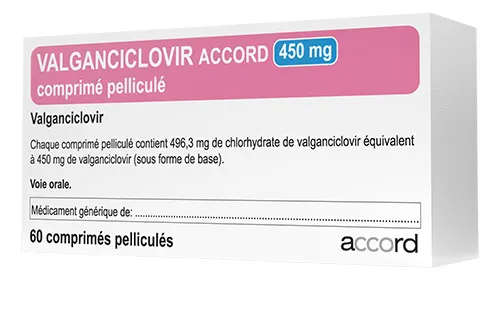
Table of Contents
- Package leaflet: Information for the user
- Valganciclovir Accord 450 mg film-coated tablets
- 1. What Valganciclovir Accord is and what it is used for
- 2. What you need to know before taking Valganciclovir Accord
- 3. How to take Valganciclovir Accord
- 4. Possible side effects
- 5. How to store Valganciclovir Accord
- 6. Package contents and other information
Package leaflet: Information for the user
Valganciclovir Accord 450 mg film-coated tablets
Generic medicine
Please read all of this leaflet carefully before taking this medicine because it contains important information for you.
- Keep this leaflet. You may need to read it again.
- If you have any questions, ask your doctor or pharmacist.
- This medicine has been prescribed for you only. Do not give it to others, even if their symptoms are the same as yours, as it could be harmful.
- If you experience any side effects, including those not listed in this leaflet, talk to your doctor or pharmacist. See section 4.
Contents of this leaflet:
- What Valganciclovir Accord is and what it is used for
- What you need to know before taking Valganciclovir Accord
- How to take Valganciclovir Accord
- Possible side effects
- How to store Valganciclovir Accord
- Contents of the pack and other information
1. What Valganciclovir Accord is and what it is used for
Valganciclovir Accord belongs to a group of medicines that act directly by preventing viral growth.
Inside the body, the active substance in the tablets, valganciclovir, is converted into ganciclovir. Ganciclovir prevents a virus called cytomegalovirus (CMV) from multiplying and invading healthy cells. In patients with a weakened immune system, CMV can cause organ infections that may be life-threatening.
Valganciclovir Accord is used:
- for the treatment of CMV retinitis in patients with acquired immunodeficiency syndrome (AIDS). CMV infection of the eye's retina can lead to visual problems and even blindness.
- to prevent CMV infections in adults and children who are not infected with CMV but who have received an organ transplant from a donor infected with CMV.
2. What you need to know before taking Valganciclovir Accord
Do not take Valganciclovir Accord
- if you are allergic to valganciclovir or to any of the other ingredients of this medicine (listed in section 6).
- if you are allergic to ganciclovir, aciclovir, or valaciclovir, which are medicines used to treat other viral infections.
- if you are breastfeeding.
Warnings and precautions
Talk to your doctor or pharmacist before taking Valganciclovir Accord.
Be especially careful with Valganciclovir Accord:
- if you have low levels of white blood cells, red blood cells, or platelets (small cells involved in blood clotting). Your doctor will perform blood tests before starting treatment with Valganciclovir Accord tablets and additional tests during the time you are taking the tablets.
- if you are undergoing radiation therapy or hemodialysis.
- if you have kidney problems. Your doctor may prescribe a reduced dose and may require frequent blood tests during treatment.
- if you are taking ganciclovir capsules and your doctor wants to switch your treatment to Valganciclovir Accord tablets. It is important that you do not take more tablets than prescribed by your doctor, as this could lead to overdose.
Other medicines and Valganciclovir Accord
Tell your doctor or pharmacist if you are taking, have recently taken, or might take any other medicines, including those without a prescription.
If you take other medicines together with Valganciclovir Accord, the combination may alter the amount of drug entering the bloodstream or may cause harmful effects.
Inform your doctor if you are already taking medicines containing any of the following:
- imipenem-cilastatin (an antibiotic). Concomitant use with Valganciclovir Accord may cause seizures (epileptic fits)
- zidovudine, didanosine, lamivudine, tenofovir, abacavir, emtricitabine, or similar medicines used to treat AIDS
- ribavirin, pegylated interferons, adefovir, and entecavir used to treat hepatitis B/C
- probenecid (a medicine for gout). Concomitant use of probenecid and Valganciclovir Accord may increase the amount of ganciclovir in the blood
- mycophenolate mofetil (used after transplants)
- vincristine, vinblastine, adriamycin, hydroxyurea, or similar medicines for treating cancer
- cidofovir or foscarnet, used to treat viral infections
- trimethoprim, trimethoprim/sulfamethoxazole combinations, and dapsone (antibiotics)
- pentamidine (a medicine to treat parasitic or lung infections)
- flucytosine or amphotericin B (antifungal agents)
Valganciclovir Accord with food and drink
Valganciclovir Accord should be taken with food. If you are unable to eat for any reason, you should still take your dose of Valganciclovir Accord as usual.
Pregnancy, breastfeeding, and fertility
Do not take Valganciclovir Accord if you are pregnant unless recommended by your doctor.
If you are pregnant, suspect you may be pregnant, plan to become pregnant, or are breastfeeding, consult your doctor or pharmacist before taking this medicine.
Taking Valganciclovir Accord during pregnancy may be harmful to the unborn baby.
You must not take Valganciclovir Accord if you are breastfeeding. If your doctor decides to start your treatment with Valganciclovir Accord, you must stop breastfeeding before taking the tablets.
Women of childbearing potential
Women of childbearing potential must use an effective method of contraception during treatment with Valganciclovir Accord.
Men
Men whose partner may become pregnant must use a condom during treatment with Valganciclovir Accord and for 90 days after the end of treatment.
Driving and using machines
Do not drive or operate tools or machinery if you experience dizziness, fatigue, tremor, or confusion while taking this medicine.
Consult your doctor or pharmacist before taking any medicine.
3. How to take Valganciclovir Accord
Take this medicine exactly as directed by your doctor or pharmacist. If you are unsure, consult your doctor or pharmacist.
Be careful when handling the tablets. Do not break or crush the tablets. The tablets must be swallowed whole and, if possible, taken with food. If you accidentally touch crushed or damaged tablets, wash your hands thoroughly with soap and water. If tablet powder comes into contact with your eyes, rinse the eyes with sterile water or, if unavailable, with clean water.
To avoid overdose, you must strictly follow the number of tablets prescribed by your doctor.
Valganciclovir Accord tablets should be taken with food, whenever possible – see section 2.
Adults:
Prevention of CMV disease in transplant patients
You should start taking this medicine within 10 days after transplantation. The recommended dose is two tablets taken ONCE daily. Continue this dose up to 100 days after transplantation. If you have received a kidney transplant, your doctor may advise you to continue taking the tablets for 200 days.
Treatment of active CMV retinitis in patients with AIDS (called induction treatment)
The recommended dose of Valganciclovir Accord is two tablets TWICE daily for 21 days (three weeks). Do not take this dose for longer than 21 days unless your doctor tells you to do so, as this may increase the risk of side effects.
Long-term treatment to prevent recurrence of active inflammation in AIDS patients with CMV retinitis (called maintenance treatment)
The recommended dose is two tablets ONCE daily. Try to take the tablets at the same time each day. Your doctor will advise you on how long to continue taking Valganciclovir Accord. If your retinitis worsens while taking this dose, your doctor may recommend repeating the induction treatment (as above) or may decide to prescribe another medicine to treat the CMV infection.
Elderly patients
Valganciclovir Accord has not been studied in elderly patients.
Patients with renal impairment
If your kidneys are not functioning properly, your doctor may prescribe a lower number of tablets per day or advise you to take the tablets only on certain days of the week. It is very important that you take only the number of tablets prescribed by your doctor.
Patients with hepatic impairment
There are no studies with valganciclovir in patients with liver problems.
Use in children and adolescents
Prevention of CMV disease in transplant patients
Children should start taking this medicine within 10 days after transplantation. The dose administered will depend on the child's size and must be taken ONCE daily. Your doctor will determine the most appropriate dose based on your child’s height, weight, and kidney function. This dose should be continued for up to 100 days. If your child has received a kidney transplant, your doctor may recommend continuing the dose for 200 days.
For children unable to swallow Valganciclovir Accord film-coated tablets, valganciclovir oral powder for oral solution may be used.
If you take more Valganciclovir Accord than you should
If you have taken or think you have taken more tablets than prescribed, contact your doctor or go to the hospital immediately. Taking too many tablets may cause serious side effects, especially affecting the blood or kidneys. You may require hospital treatment.
If you forget to take Valganciclovir Accord
If you forget to take your tablets, take the missed dose as soon as you remember, and then take the next dose at your usual time. Do not take a double dose to make up for the forgotten tablet.
If you stop taking Valganciclovir Accord
Do not stop treatment with this medicine unless your doctor tells you to do so.
If you have any questions about the use of this medicine, consult your doctor or pharmacist.
4. Possible side effects
Like all medicines, this medicine can cause side effects, although not everyone gets them.
Allergic reactions
Up to 1 in 100 patients may experience a sudden and severe allergic reaction to valganciclovir (anaphylactic shock). STOP taking Valganciclovir Accord and go immediately to the nearest hospital emergency department if you experience any of the following reactions:
- Raised, itchy skin rash (urticaria)
- Sudden swelling of the throat, face, lips, and mouth causing difficulty swallowing or breathing
- Sudden swelling of the hands, feet, or ankles.
The side effects observed during treatment with valganciclovir or ganciclovir are listed below.
Very common (may affect more than 1 in 10 people):
- Effects on blood: reduced number of white blood cells in the blood (neutropenia), making you more susceptible to infections; reduced number of blood particles carrying oxygen (anaemia), which may cause tiredness and shortness of breath during physical activity
- Effects on breathing: feeling short of breath or difficulty breathing (dyspnoea)
- Effects on stomach and digestion: diarrhoea
Common (may affect from 1 to 10 in 100 people):
- Effects on blood: reduced number of white blood cells (cells that fight infections) in the blood (leucopenia); reduced number of platelets in the blood (thrombocytopenia), which may cause bruising and bleeding; and reduced numbers of several types of blood cells simultaneously (pancytopenia)
- Effects on the nervous system: headache, difficulty sleeping (insomnia), altered taste (dysgeusia), reduced sensitivity to touch (hypoesthesia), sensation of pins and needles or tingling of the skin (paraesthesia), loss of sensation in hands or feet (peripheral neuropathy), dizziness, and epileptic seizures (convulsions)
- Effects on the eyes: eye pain, swelling inside the eyes (oedema), separation of the inner lining layer of the eye (retinal detachment), and seeing floaters
- Effects on the ears: earache
- Effects on breathing: cough
- Effects on the stomach and digestion: nausea and vomiting, stomach ache, constipation, flatulence, indigestion (dyspepsia), and difficulty swallowing (dysphagia)
- Effects on the skin: inflamed skin (dermatitis), itching, and night sweats
- Effects on muscles, joints, or bones: back pain, muscle pain (myalgia) or joint pain (arthralgia), muscle stiffness (rigidity), and muscle cramps
- Infections: fungal infections of the mouth (oral candidiasis), bacterial or viral infections in the blood, inflammation of connective tissue (cellulitis), inflammation or infection of the kidneys or bladder
- Effects on the liver: increased levels of certain liver enzymes, detectable only through blood tests
- Effects on the kidneys: changes in normal kidney function
- Effects on eating: loss of appetite (anorexia), weight loss
- General effects: fatigue, fever, pain, chest pain, loss of energy (asthenia), and general feeling of being unwell
- Effects on mood or behaviour: depression, feeling anxious, confusion, and unusual thoughts
Uncommon (may affect from 1 to 10 in 1,000 people):
- Effects on the heart: changes in normal heart rhythm (arrhythmia)
- Effects on circulation: reduced blood pressure (hypotension), which may cause fainting and dizziness
- Effects on blood: reduced production of blood cells in the bone marrow
- Effects on the nervous system: shivering or trembling (tremor)
- Effects on the eyes: red, swollen eyes (conjunctivitis), abnormal vision
- Effects on the ears: deafness
- Effects on the stomach and digestion: bloated abdomen, mouth ulcers, inflammation of the pancreas (pancreatitis), which may cause severe stomach and back pain
- Effects on the skin: hair loss (alopecia), itchy rash or swelling (urticaria), dry skin
- Effects on the kidneys: presence of blood in the urine (haematuria), kidney failure
- Effects on the liver: increased levels of a liver enzyme called alanine aminotransferase (detectable only through blood tests)
- Effects on fertility: infertility in men
- Effects on mood or behaviour: unusual changes in mood and behaviour, loss of contact with reality such as hearing voices or seeing things that are not there, feeling agitated.
Rare (may affect from 1 to 10 in 10,000 people):
- Effects on blood: failure in the production of all types of blood cells (red blood cells, white blood cells, and platelets) in the bone marrow.
Retinal detachment has occurred only in patients with AIDS who were treated with valganciclovir for CMV infection.
Additional side effects in children and adolescents
The side effects reported in children and adolescents are similar to those reported in adults.
Reporting of side effects
If you experience any side effects, including those not listed in this leaflet, please inform your doctor or pharmacist. You may also report side effects directly via the national reporting system at www.agenziafarmaco.gov.it/it/responsabili.
By reporting side effects, you can help provide more information on the safety of this medicine.
5. How to store Valganciclovir Accord
Keep this medicine out of the sight and reach of children.
Do not use this medicine after the expiry date which is stated on the label or carton, after "Exp".
The expiry date refers to the last day of that month.
This medicine does not require any special storage conditions.
Do not dispose of medicines via wastewater or household waste. Ask your pharmacist how to dispose of medicines you no longer use. This will help protect the environment.
6. Package contents and other information
What Valganciclovir Accord contains
The active substance is valganciclovir 450 mg, equivalent to 496.3 mg of valganciclovir hydrochloride.
The other components are:
Tablet core: microcrystalline cellulose, crospovidone type A, povidone (K-30) and stearic acid (50).
Tablet coating: hypromellose 3 cP, hypromellose 6 cP, titanium dioxide (E171), macrogol 400,
iron oxide red (E172) and polysorbate 80.
Description of the appearance of Valganciclovir Accord and package contents
Valganciclovir Accord are 450 mg film-coated tablets. The tablets are described below.
Film-coated tablets of approximately 16.7 x 7.8 mm, pink in colour, oval-shaped, biconvex, with the letter “J” imprinted on one side and “156” on the other side.
Valganciclovir Accord is available in:
- OPA-Aluminum-PVC/Aluminum blister packs in carton: 30, 60, 90 or 120 tablets
- HDPE bottle filled with purified cotton, with a child-resistant screw cap made of polypropylene and a sealing paste (composed of a wax-based support, foil, PET and hot melt adhesive): 60 tablets.
Not all pack sizes may be marketed.
Marketing Authorization Holder
Accord Healthcare S.L.U.
World Trade Center,
Moll de Barcelona,
s/n, Edifici Est 6ª planta,
08039 Barcelona,
Spain
Responsible Pharmacist for Batch Release
Pharmadox Healthcare, Ltd.
KW20A Kordin Industrial Park, Paola, PLA 3000
Malta
Accord Healthcare Limited
Sage House, 319 Pinner Road, Harrow, Middlesex
HA1 4HF
United Kingdom
WESSLING Hungary Kft.
Budapest, 1047,
Fóti út 56
Hungary
This medicinal product is authorized in the Member States of the European Economic Area under the following names:
| Country | Proposed Name |
| Netherlands | Valganciclovir Accord 450 mg filmomhulde tabletten |
| Austria | Valganciclovir Accord 450 mg filmtabletten |
| Cyprus | Valganciclovir Accord 450 mg film coated tablets |
| Czech Republic | Valhit |
| Denmark | Valganciclovir Accord 450 mg filmovertrukne tabletter |
| Estonia | Valganciclovir Accord |
| Finland | Valganciclovir Accord 450 mg tabletti, kalvopäällysteinen |
| Ireland | Valganciclovir 450 mg film-coated tablets |
| Italy | Valganciclovir Accord |
| Lithuania | Valganciclovir Accord 450 mg plėvele dengtos tabletės |
| Latvia | Valganciclovir Accord 450 mg apvalkotās tabletes |
| Malta | Valganciclovir 450 mg film-coated tablets |
| Norway | Valganciclovir Accord |
| Poland | Valhit |
| Portugal | Valganciclovir Accord |
| Sweden | Valganciclovir Accord 450 mg filmdragerade tabletter |
| United Kingdom | Valganciclovir 450 mg film-coated tablets |
| Spain | Valganciclovir Accord 450 mg comprimidos recubiertos con película |
| France | Valganciclovir Accord 450 mg comprimé pelliculé |