Urivesc
Italy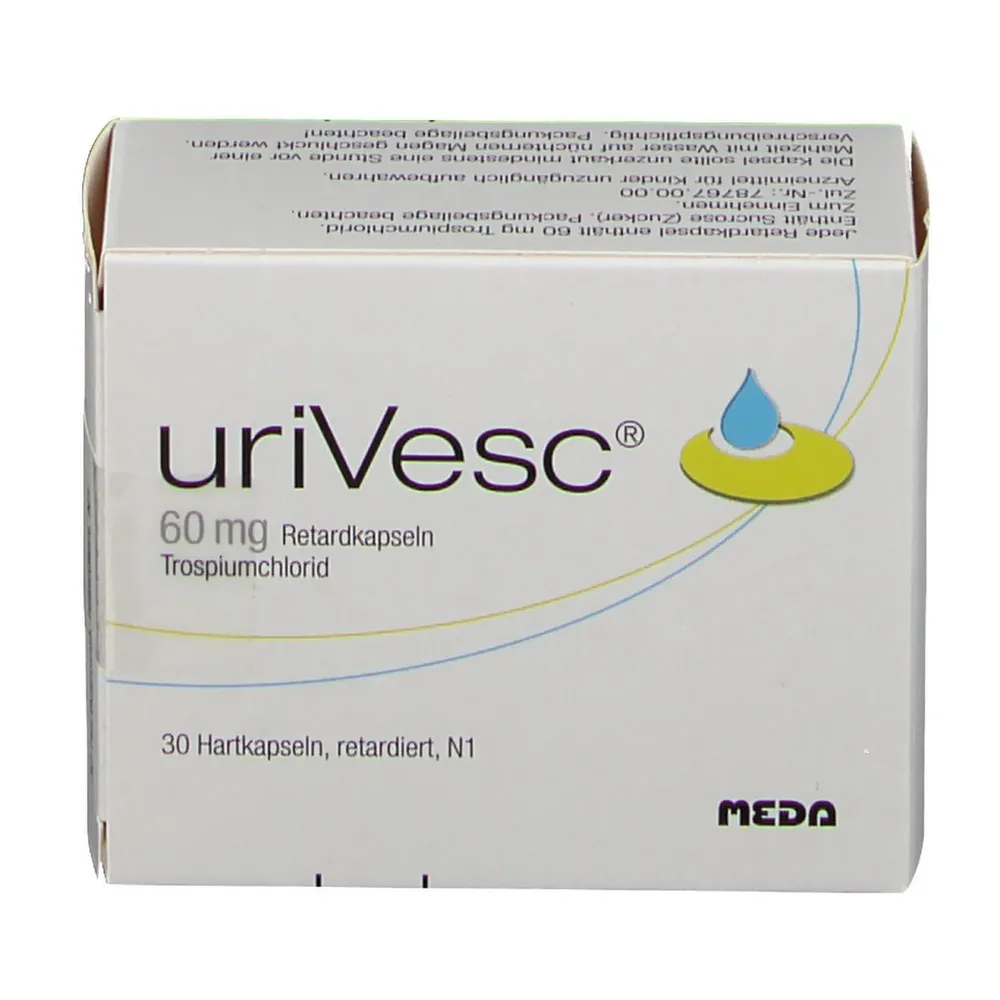
Table of Contents
- Patient Information Leaflet: Information for the User
- Urivesc 20 mg Film-coated Tablets
- PACKAGE LEAFLET: INFORMATION FOR THE USER
- Urivesc 60 mg prolonged-release hard capsules
- 1. WHAT URIVESC 60 MG IS AND WHAT IT IS USED FOR
- 2. WHAT YOU SHOULD KNOW BEFORE TAKING URIVESC 60 MG
- 3. HOW TO TAKE URIVESC 60 MG
- 4. POSSIBLE ADVERSE REACTIONS
- 5. HOW TO STORE URIVESC 60 MG
- 6. Package contents and other information
Patient Information Leaflet: Information for the User
Urivesc 20 mg Film-coated Tablets
Trospium Chloride
contains
important information for you.
www.aifa.gov.it/content/adverse-reaction-reporting
PACKAGE LEAFLET: INFORMATION FOR THE USER
Urivesc 60 mg prolonged-release hard capsules
Trospium chloride
Please read this entire leaflet carefully before taking this medicine, as it contains
important information for you.
- Keep this leaflet. You may need to read it again.
- If you have any questions, consult your doctor or pharmacist.
- This medicine has been prescribed for you. Do not give it to others, even if their symptoms are the same as yours, as it could be harmful.
- If you experience any side effects, including those not listed in this leaflet, contact your doctor or pharmacist. See section 4.
Contents of this leaflet:
- What Urivesc 60 mg is and what it is used for
- What you need to know before taking Urivesc 60 mg
- How to take Urivesc 60 mg
- Possible side effects
- How to store Urivesc 60 mg
- Contents of the pack and other information
1. WHAT URIVESC 60 MG IS AND WHAT IT IS USED FOR
Urivesc 60 mg is a medicine used to relax the bladder muscle.
The medicine is used for the treatment of symptoms associated with involuntary loss of urine
and/or increased frequency of urination and/or urgency to urinate in patients with
overactive bladder.
2. WHAT YOU SHOULD KNOW BEFORE TAKING URIVESC 60 MG
Do not take Urivesc 60 mg
- if you have ever had an allergic reaction to trospium chloride or to any of the excipients in Urivesc 60 mg (listed in section 6). (An allergic reaction may include skin rash, itching, or shortness of breath).
- if you have any of the following conditions:
- urinary retention, i.e. blockage of the urinary tract,
- the eye condition known as narrow-angle glaucoma,
- abnormal or faster than normal heartbeat,
- myasthenia gravis (a disease causing muscle weakness),
- a severe gastrointestinal disorder, such as toxic megacolon,
- kidney problems,
- severe liver problems.
Warnings and precautions
Talk to your doctor or pharmacist before taking Urivesc 60 mg if you have any of the following conditions:
- any type of obstruction in the stomach or intestines,
- impaired urinary flow (e.g., due to benign prostatic hyperplasia),
- neuropathy, for example nerve damage,
- hiatal hernia associated with reflux esophagitis. The latter is generally associated with heartburn that worsens when bending forward or lying down,
- overactive thyroid,
- any heart condition, such as coronary artery disease or congestive heart failure,
- any liver problems.
Patients with liver disorders
If you have liver disease, consult your doctor. Patients with severe liver disease must not take this medicine.
Patients with kidney disorders
If you have kidney disease, consult your doctor. Patients with kidney disease must not take this medicine.
Children and adolescents under 18 years of age
DO NOT administer Urivesc 60 mg to children or adolescents under 18 years of age.
Other medicines and Urivesc 60 mg
Inform your doctor or pharmacist if you are taking, have recently taken, or might take any other medicines.
In particular, inform your doctor if you are taking any of the following medicines:
- certain antidepressants, such as amitriptyline or imipramine,
- some medicines for asthma treatment that may increase heart rate (e.g. salbutamol),
- other anticholinergic medicines (e.g. amantadine – used in the treatment of Parkinson's disease),
- metoclopramide – a medicine used for nausea and vomiting,
- medicines containing guar gum, colestipol or cholestyramine.
Please note that this information may also apply to medicines you have recently taken.
Pregnancy, breastfeeding and fertility
Since there is no experience with trospium chloride during pregnancy and breastfeeding, Urivesc 60 mg should be taken during pregnancy and breastfeeding only if your doctor considers it absolutely necessary.
Driving and using machines
Even when used as directed, this medicine may affect vision and consequently impair your ability to drive in road traffic, use machinery, or perform other potentially dangerous activities. Therefore, if you experience blurred vision, do not drive motor vehicles, operate machinery, or engage in other hazardous activities.
Urivesc 60 mg contains sucrose and sodium
If your doctor has diagnosed you with an intolerance to certain sugars, such as sucrose, contact him/her before taking this medicine.
This medicine contains less than 1 mmol (23 mg) of sodium per capsule, i.e. essentially “sodium-free”.
3. HOW TO TAKE URIVESC 60 MG
Take Urivesc 60 mg exactly as directed by your doctor. If you have any doubts, consult your doctor or pharmacist.
Usual dose, if the doctor has not prescribed otherwise
If the doctor has not prescribed otherwise, the usual daily dose is one prolonged-release capsule of Urivesc 60 mg.
Method of administration
Swallow one prolonged-release capsule whole with a glass of water. Take the capsule at least one hour before a meal, on an empty stomach.
Duration of treatment
Your doctor will determine how long you should take this medicine.
The need for continued treatment should be reviewed regularly every 3 to 6 months.
Patients with kidney disease must consult their doctor and must not take this medicine.
Patients with liver disease must consult their doctor before taking this medicine.
If you take more Urivesc 60 mg than you should
To date, no symptoms or signs of intoxication have been reported in humans.
If you have taken more capsules than you should, inform your doctor or pharmacist immediately; they will decide what measures are necessary.
If you forget to take Urivesc 60 mg
Do not take a double dose to make up for the missed dose. Continue taking the medicine as directed in the dosage instructions.
If you stop taking Urivesc 60 mg
If you stop taking Urivesc 60 mg before the time recommended by your doctor, your symptoms may return. Therefore, take Urivesc 60 mg for the duration prescribed by your doctor. If you wish to stop treatment, consult your doctor.
If you have any questions about the use of this medicine, consult your doctor or pharmacist.
4. POSSIBLE ADVERSE REACTIONS
Like all medicines, Urivesc 60 mg may cause adverse reactions, although not everyone experiences them.
The following adverse reactions have been reported following the use of Urivesc 60 mg prolonged-release hard capsules in clinical studies:
Very common adverse reactions: may affect more than 1 in 10 people
- Dry mouth
Common adverse reactions: may affect from 1 to 10 in 100 people
- Constipation, nausea, abdominal pain, indigestion,
- dry eyes, nasal dryness.
Uncommon adverse reactions: may affect from 1 to 10 in 1,000 people
- Flatulence.
Rare adverse reactions: may affect from 1 to 10 in 10,000 people
- Difficulty emptying the bladder, urinary retention,
- increased heart rate, palpitations,
- difficulty seeing objects up close,
- skin rashes,
- general feeling of weakness.
Very rare adverse reactions: may affect less than 1 in 10,000 people
- Urinary tract infections,
- headache.
Other possible adverse reactions, for which frequency is unknown
- Isolated cases of hallucinations, confusion, and agitation have occurred, particularly in elderly patients, and may be favored by neurological disorders and/or concomitant use of other medicines with a similar mechanism of action.
The following adverse reactions have also been reported with trospium (trospium is the active substance in Urivesc 60 mg; it is not known whether these adverse reactions will also occur with the capsules prescribed to you):
Breathing difficulties, diarrhoea, chest pain, mild to moderate increase in certain liver values (serum transaminases), irregular and rapid heartbeat, joint or muscle pain, dizziness.
The following "very rare" adverse reactions listed below are important and will require immediate medical intervention if they occur. Stop taking Urivesc 60 mg and contact your doctor immediately if you experience any of the following symptoms:
- Swelling of the face, tongue, and trachea, which may cause severe breathing difficulties
- Sudden allergic reaction, with shortness of breath, skin rash, wheezing, and drop in blood pressure.
Reporting of adverse reactions
If you experience any adverse reaction, including those not listed in this leaflet, talk to your doctor or pharmacist. You can also report adverse reactions directly via the national reporting system at
www.aifa.gov.it/content/segnalazioni-reazioni-avverse. By reporting adverse reactions, you can help provide more information on the safety of this medicine.
5. HOW TO STORE URIVESC 60 MG
Keep this medicine out of the sight and reach of children.
Do not use Urivesc 60 mg after the expiry date stated on the blister and container,
after EXP.
The expiry date refers to the last day of the month.
This medicine does not require any special storage conditions.
Do not use Urivesc 60 mg if you notice that the packaging is damaged or shows signs of tampering.
Do not dispose of medicines via wastewater or household waste. Ask your pharmacist how to dispose of medicines you no longer use. This will help protect the environment.
6. Package contents and other information
What Urivesc 60 mg contains
The active substance is: trospium chloride.
Each prolonged-release capsule contains 60 mg of trospium chloride.
The excipients are:
Capsule contents: sucrose, maize starch, methylacrylate-methylmethacrylate-methacrylic acid copolymer, sodium dodecyl sulfate, ammonium hydroxide, medium-chain triglycerides, oleic acid, ethylcellulose, titanium dioxide (E 171), hypromellose, macrogol 400, polysorbate 80, triethyl citrate, talc
Capsule shell: gelatin, titanium dioxide (E 171), yellow iron oxide (E 172), red iron oxide (E 172), printing ink (gelatin, shellac, black iron oxide (E 172), propylene glycol)
See section 2 "Urivesc 60 mg contains sucrose and sodium".
Description of the appearance of Urivesc 60 mg and contents of the pack
Urivesc 60 mg prolonged-release, hard capsules consist of a white part and an orange part marked with the inscription SAN 60, and contain white or whitish microspheres.
Urivesc 60 mg is available in packs containing 4 (sample), 7, 10, 14, 28, 30, 56, 60, 84, 90, and 10x28 prolonged-release capsules. Not all pack sizes may be marketed.
Marketing Authorization Holder
Viatris Healthcare Limited,
Damastown Industrial Park,
Mulhuddart, Dublin 15,
DUBLIN, Ireland
Manufacturer
Madaus GmbH
51101 Cologne
Germany
This medicinal product is authorized in the European Economic Area Member States under the following names:
Denmark Spasmo-lyt Depot 60 mg
Germany Urivesc
Finland Spasmo-lyt Depot 60 mg
United Kingdom Regurin XL 60 mg prolonged-release capsule, hard
Italy Urivesc 60 mg prolonged-release capsule, hard
Luxembourg Urivesc
Austria Urivesc 60 mg-Retardkapseln
Portugal Urivesc
Spain Urivesc 60 mg cápsulas duras de liberación prolongada
This Patient Information Leaflet was last approved on