Typhim Vi
Italy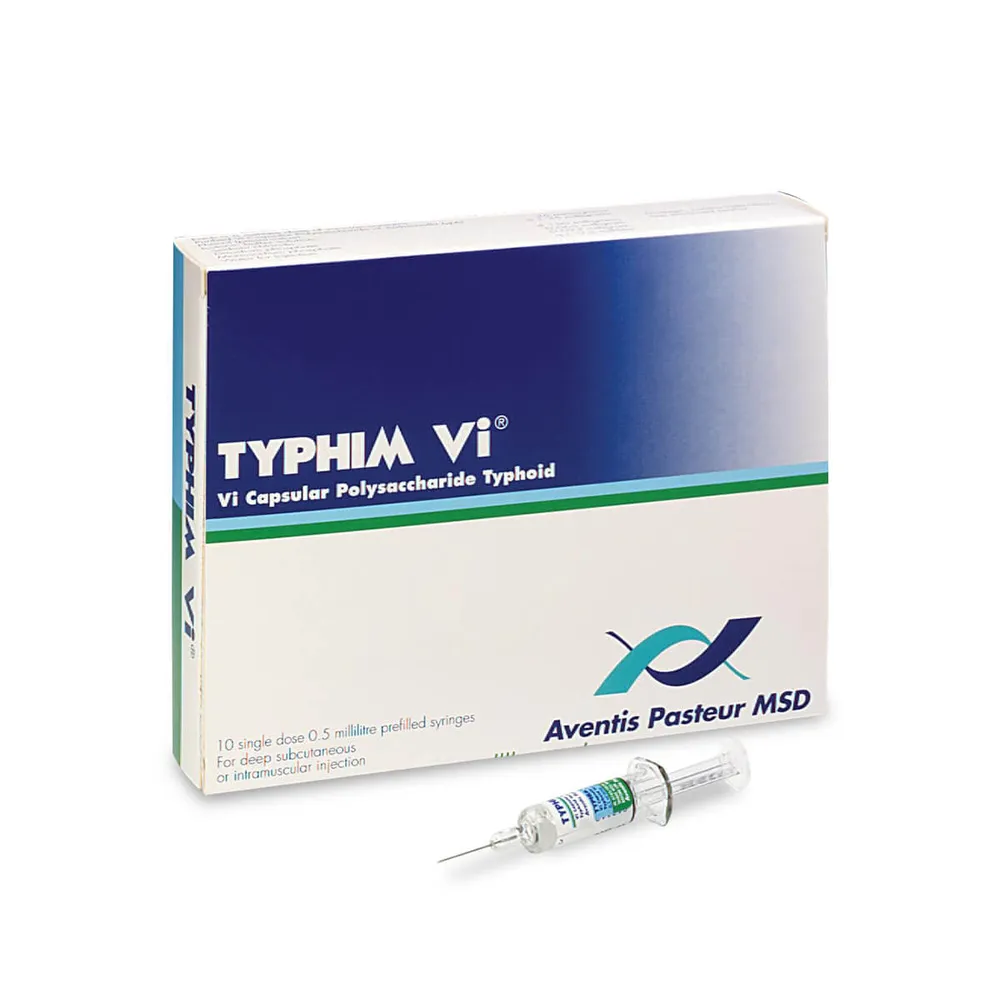
Table of Contents
PATIENT LEAFLET: INFORMATION FOR THE USER
TYPHIM Vi
Injectable solution
Vi capsular polysaccharide typhoid vaccine
Please read this leaflet carefully before you or your child are vaccinated, as it contains important information for you.
- Keep this leaflet. You may need to read it again.
- If you have any questions, ask your doctor, pharmacist or nurse.
- This vaccine has been prescribed for you only. Do not give it to others.
- If you experience any side effects, including those not listed in this leaflet, contact your doctor, pharmacist or nurse. See section 4.
Contents of this leaflet:
- What TYPHIM Vi is and what it is used for
- What you need to know before using TYPHIM Vi
- How to use TYPHIM Vi
- Possible side effects
- How to store TYPHIM Vi
- Package contents and other information
1. What TYPHIM Vi is and what it is used for
TYPHIM Vi is a typhoid polysaccharide vaccine.
Vaccines are used to protect you or your child against infectious diseases. They work by stimulating the body to produce its own protection against the disease for which the vaccine is specific.
TYPHIM Vi is indicated for active immunization against typhoid fever caused by Salmonella enterica Serovar Typhi, in adults or children aged 2 years and older.
2. What you should know before using TYPHIM Vi
As with all polysaccharide vaccines, TYPHIM Vi is indicated only for use in individuals aged 2 years and older, since in children under 2 years of age the antibody response may be inadequate.
Do not take TYPHIM Vi
- if you are hypersensitive to any of its components, or to other vaccines containing the same substances;
- if you have febrile illnesses or acute-phase diseases.
Warnings and precautions
Inform your doctor before vaccination if you or your child:
- are allergic to formaldehyde or casein, as the vaccine may contain traces of residual formaldehyde or casein from the manufacturing process.
- have thrombocytopenia or a coagulation disorder, as bleeding at the injection site may occur.
- have immune system problems or are receiving immunosuppressive treatment. In such cases, the immune response to the vaccine may be inadequate. Therefore, antibody titer monitoring is recommended to confirm that an immune response has occurred. If necessary, additional vaccine doses should be administered.
As with other vaccines, vaccination with TYPHIM Vi may not provide complete protection in all vaccinated individuals. The duration of immunity is approximately 3 years; however, the possibility of antibody levels decreasing below protective thresholds during this period cannot be completely ruled out. Vaccination should be performed at least two weeks before potential exposure to Salmonella Typhi infection. The vaccine provides protection against infection caused by Salmonella Typhi, but does not protect against Salmonella paratyphi A or B, or against non-typhoidal Salmonellae.
Fainting (especially in adolescents) may occur following, or even before, any needle injection. Therefore, inform your doctor or nurse if you or your child has previously fainted after an injection.
Use with other medicines or vaccines
TYPHIM Vi may be administered simultaneously with vaccines against Hepatitis B, Hepatitis A, Tetanus, Diphtheria, Polio, Rabies, Meningococcal Meningitis (A+C), and Yellow Fever. When administered concomitantly, different injection sites must be used.
Pregnancy and breastfeeding
If you are pregnant, suspect you may be pregnant, planning a pregnancy, or are breastfeeding, consult your doctor or pharmacist before using this medicine. The use of this vaccine during pregnancy is not recommended. TYPHIM Vi should be administered to pregnant women only if strictly necessary and after careful assessment of risks and benefits.
It is not known whether the vaccine is excreted in breast milk. The vaccine should be administered with caution to breastfeeding women.
Driving and using machines
No studies have been conducted regarding the effects on the ability to drive vehicles or operate machinery.
TYPHIM Vi contains sodium
TYPHIM Vi contains less than 1 mmol of sodium (23 mg) per dose, i.e., essentially "sodium-free".
3. How to use TYPHIM Vi
Use this vaccine exactly as instructed by your doctor or pharmacist. If you have any doubts, consult your doctor or pharmacist.
The recommended dose is a single 0.5 ml injection. Revaccination, if the individual remains at risk, should be performed at intervals not exceeding 3 years.
If using the pre-filled syringe presentation without needle, supplied with 2 separate needles in the blister pack (either one may be used), the needle must be firmly attached to the end of the syringe by rotating it 90°.
The preferred route of administration is intramuscular; however, the vaccine may also be administered subcutaneously.
4. Possible side effects
Like all medicines, this vaccine can cause side effects, although not everybody will experience them.
Serious allergic reactions:
Anaphylactic and anaphylactoid reactions, including shock, which may include one or more of the following symptoms:
- Rash, skin rash;
- Swelling of the face and/or neck;
- Difficulty breathing, bluish colour of the tongue or lips;
- Low blood pressure, rapid heartbeat and weak pulse, cold skin, dizziness and possible fainting.
These symptoms or signs usually occur immediately after the injection, while the person is still at the place where the vaccine was administered.
If any of these symptoms occur after you or your child have left the place where the vaccine was administered, you must consult a doctor IMMEDIATELY.
Other adverse events
The following adverse events have been reported with the following frequencies:
Other adverse events reported in adults
Very common: may affect more than 1 in 10 people:
- Pain at the injection site;
- Muscle pain (myalgia);
- Feeling generally unwell;
- Fatigue (feeling of weakness).
Common: may affect up to 1 in 10 people:
- Redness at the injection site (erythema);
- Hardness (induration) at the injection site;
- Swelling/edema at the injection site;
- Headache.
Uncommon: may affect up to 1 in 100 people:
- Itching at the injection site.
Other adverse events reported in children and adolescents (aged 2 to 7 years)
Very common: may affect more than 1 in 10 people:
- Pain, redness (erythema), swelling/edema, and hardness (induration) at the injection site;
- Headache;
- Muscle pain (myalgia).
Common: may affect up to 1 in 10 people:
- Feeling generally unwell;
- Fatigue, unusual feeling of weakness (asthenia);
- Fever.
Most of the adverse reactions reported in adults and in children/adolescents occurred within 3 days after vaccination. Most reactions resolved spontaneously within 1–3 days after onset.
Not known: frequency cannot be estimated from the available data in adults and children/adolescents:
- Serum sickness: joint pain, rash, swollen lymph nodes, and feeling generally unwell; these symptoms generally appear 2–4 weeks after vaccination;
- Fainting in response to injection (vasovagal syncope);
- Cough, shortness of breath, difficulty breathing (asthma);
- Nausea, vomiting, diarrhoea, stomach ache (abdominal pain);
- Rash, sometimes associated with swelling and itching (skin rash, urticaria);
- Joint pain (arthralgia).
Data collected from clinical studies and post-marketing surveillance show that there is no significant difference in safety profile between adults, adolescents and children.
Reporting of side effects
If you experience any side effect, including those not listed in this leaflet, talk to your doctor, pharmacist or nurse. You can also report side effects directly via the relevant national reporting system.
By reporting side effects, you can help provide more information on the safety of this medicine.
5. How to store TYPHIM Vi
Keep this vaccine out of the sight and reach of children.
Do not use this vaccine after the expiry date stated on the packaging. The expiry date refers to the last day of the month indicated and to the product kept in its original, undamaged packaging, correctly stored.
Typhim Vi must be stored in a refrigerator at a temperature between +2°C and +8°C. Do not freeze. Protect from light.
It is important to always keep the information about the medicine available; therefore, keep both the carton and the package leaflet.
Do not dispose of any medicines via wastewater or household waste. Ask your pharmacist how to dispose of medicines you no longer use. This will help protect the environment.
6. Package contents and other information
What TYPHIM Vi contains
The active substance is:
1 dose (0.5 ml) contains:
Purified Vi capsular polysaccharide derived from Salmonella Typhi (strain Ty2)…………0.025 mg
The excipients are:
Phenol, sodium chloride, disodium phosphate dihydrate, sodium dihydrogen phosphate dihydrate, water for
injections.
Description of the appearance of TYPHIM Vi and package contents
The vaccine is a clear, colourless liquid.
TYPHIM Vi is an injectable solution for intramuscular use supplied in a pre-filled syringe of 0.5 ml with a
permanently attached needle or without a permanently attached needle, with 1 or 2 separate needles included
in the blister pack.
Marketing Authorization Holder and Manufacturer
Sanofi Winthrop Industrie
82 avenue Raspail
94250 Gentilly
France
Representative in Italy
Sanofi S.r.l. - Viale L. Bodio, 37/B – 20158 Milano
Manufacturer:
Sanofi Pasteur - 1541 avenue Marcel Mérieux - 69280 Marcy l'Etoile - France
Sanofi Pasteur - Parc Industriel d'Incarville - 27100 Val de Reuil - France
Sanofi-Aventis Zrt. Bdg. DC5 - Campona Utca 1. Budapest XXII - 1225 Budapest - Hungary
This summary of product characteristics was last approved on .
The following information is intended exclusively for physicians or healthcare professionals:
As with all injectable vaccines, appropriate medical treatment and medical supervision must always be readily available in case of rare anaphylactic reactions following vaccine administration.
In the absence of compatibility studies, this medicinal product must not be mixed with other medicinal products.
The vaccine must be used as supplied; no reconstitution is required.
Shake well before use. Adequate shaking is necessary to maintain the vaccine in suspension.
The vaccine should be administered by intramuscular or subcutaneous route. Do not administer intravenously: therefore, ensure before injection that the syringe needle has not entered a blood vessel.
It is important to use separate sterile syringes and needles for each patient to avoid transmission of infectious agents from one individual to another.
Any unused medicine or waste material derived from this medicine must be disposed of in accordance with local regulations.
See also section 3. How to use TYPHIM Vi