Trosyd gynecological
Italy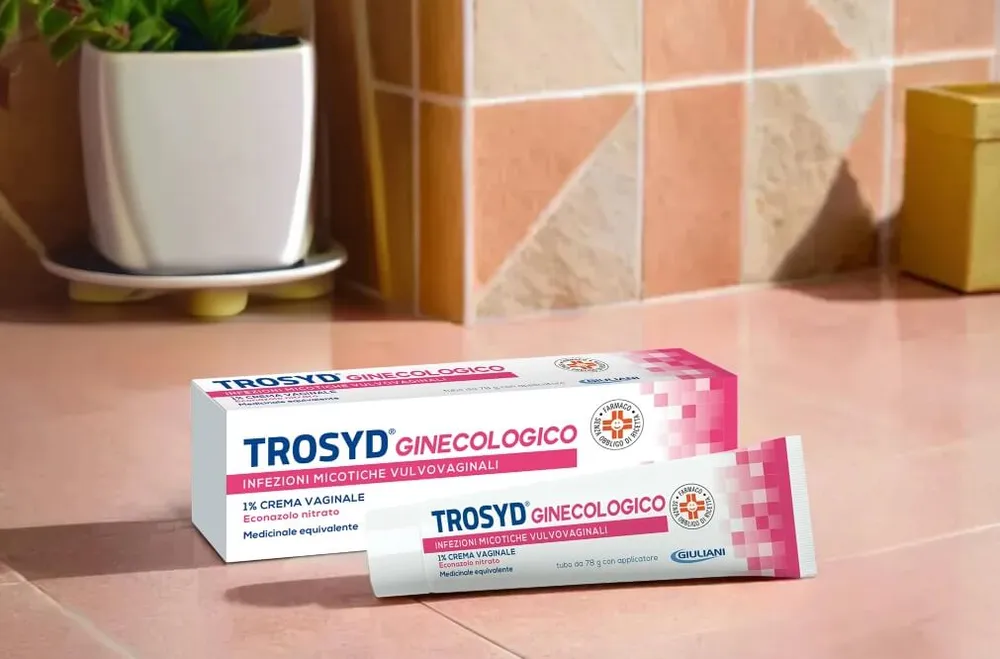
TROSYD GINECOLOGICO 1% cream
TROSYD GINECOLOGICO 1% cutaneous solution
Generic medicine
THERAPEUTIC PHARMACOLOGICAL CATEGORY
Topical antifungal agents.
THERAPEUTIC INDICATIONS
Cutaneous fungal infections caused by dermatophytes, yeasts, and molds, even when associated with infections caused by gram-positive bacteria.
CONTRAINDICATIONS
TROSYD GINECOLOGICO is contraindicated in patients who have shown hypersensitivity to the active substance or to any of the excipients.
PRECAUTIONS FOR USE
For external use only. TROSYD GINECOLOGICO is not for ophthalmic or oral use.
If a sensitization reaction or irritation occurs, use of the product must be discontinued.
INTERACTIONS
Inform your doctor or pharmacist if you have recently taken any other medicines, including those without a prescription.
Econazole is a known inhibitor of cytochrome CYP3A4 and CYP2C9. Despite low systemic availability following cutaneous application, clinically relevant interactions may occur, as reported in patients receiving oral anticoagulants such as warfarin and acenocoumarol. In these patients, caution is advised and INR should be monitored more frequently. Adjustment of the oral anticoagulant dosage may be necessary during treatment with econazole and after its discontinuation.
SPECIAL WARNINGS
Pregnancy and lactation
Consult your doctor or pharmacist before taking any medicine.
Use during pregnancy
In animal studies, econazole nitrate did not show teratogenic effects but was fetotoxic in rodents at maternal subcutaneous doses of 20 mg/kg/day and at maternal oral doses of 10 mg/kg/day. The relevance of this effect in humans is unknown.
In humans, systemic absorption of econazole is low (< 10%) after topical application on intact skin. There are no adequate and well-controlled studies on adverse effects resulting from the use of TROSYD GINECOLOGICO in pregnancy, and no other relevant epidemiological data are available. From the limited number of post-marketing data, no adverse effects of TROSYD GINECOLOGICO on pregnancy or on fetal and neonatal health have been identified.
Due to systemic absorption, TROSYD GINECOLOGICO should not be used during the first trimester of pregnancy unless considered necessary by the physician for the patient's health.
TROSYD GINECOLOGICO may be used during the second and third trimesters of pregnancy if the potential benefits to the mother outweigh the possible risks to the fetus.
Use during lactation
After oral administration of econazole nitrate in lactating rats, econazole and/or its metabolites were excreted in milk and detected in suckling pups.
It is not known whether topical administration of TROSYD GINECOLOGICO may result in systemic absorption of econazole sufficient to produce detectable levels in human breast milk.
Caution should be exercised when TROSYD GINECOLOGICO is administered to women who are breastfeeding.
Effects on ability to drive vehicles and use machinery
None known.
DOSAGE, ADMINISTRATION METHOD, AND DURATION OF TREATMENT
Apply once in the morning and once in the evening to infected skin areas with gentle massage.
For moist intertriginous areas (interdigital spaces of the feet, gluteal folds), it is advisable to clean with gauze or bandages before applying TROSYD GINECOLOGICO.
For the treatment of onychomycosis, an occlusive dressing is recommended.
OVERDOSE
TROSYD GINECOLOGICO is intended for cutaneous application only. In case of accidental ingestion, nausea, vomiting, and diarrhea may occur; treat with symptomatic therapy. Given the pharmaceutical forms available, intended for topical use, acute overdose due to ingestion is extremely unlikely and has never been reported to date.
If the product comes into accidental contact with the eyes, rinse thoroughly with clean water or physiological saline solution and consult a doctor if symptoms persist.
In case of accidental ingestion/overdose of TROSYD GINECOLOGICO, contact a doctor immediately or go to the nearest hospital.
IF YOU HAVE ANY DOUBTS ABOUT THE USE OF TROSYD GINECOLOGICO, CONSULT YOUR DOCTOR OR PHARMACIST.
UNDESIRABLE EFFECTS
Like all medicines, TROSYD GINECOLOGICO can cause adverse effects, although not everyone experiences them.
Data from clinical trials
The safety of econazole nitrate cream (1%) and econazole nitrate emulsion (1%) was evaluated in 470 subjects participating in 12 clinical trials who received at least one of the formulations. Based on safety data collected from these clinical trials, the most commonly reported adverse drug reactions (ADRs) (incidence ≥ 1%) were (with incidence in %): pruritus (1.3%), burning sensation of the skin (1.3%), and pain (1.1%).
The table below lists ADRs reported with the use of dermatological formulations of econazole in clinical trials or in post-marketing experience. Frequency classes are reported according to the following convention: very common (≥ 1/10); common (≥ 1/100 to < 1/10); uncommon (≥ 1/1,000 to < 1/100); rare (≥ 1/10,000 to < 1/1,000); very rare (< 1/10,000); and not known (frequency cannot be estimated from the available data from clinical trials).
In the table below, all ADRs with known frequency (common or uncommon) come from clinical trial data, and all ADRs with frequency not known come from post-marketing data.
Table 1: Adverse Drug Reactions (ADRs)
| System organ classes | Adverse Drug Reactions | ||
| Frequency category | |||
| Common (from ≥ 1/100 to < 1/10) | Uncommon (from ≥ 1/1,000 to < 1/100) | Not known | |
| Skin and subcutaneous tissue disorders | Pruritus Burning sensation of the skin | Erythema | Angioedema Contact dermatitis Rash Urticaria Vesicle Skin exfoliation |
| General disorders and administration site conditions | Pain | Discomfort Swelling | |
The use of the product, especially if prolonged, may lead to sensitization phenomena. In the event of hypersensitivity reactions, treatment must be discontinued and appropriate therapy initiated; similarly, if non-sensitive microorganisms develop, the same course of action should be taken.
Following the instructions contained in the package leaflet reduces the risk of undesirable effects.
Reporting of Adverse Effects
If you experience any adverse effect, including those not listed in this leaflet, consult your doctor or pharmacist. Adverse effects can also be reported directly via the national reporting system at the following website:
https://www.aifa.gov.it/content/segnalazioni-reazioni-avverse .
Reporting adverse effects contributes to providing more information on the safety of this medicinal product.
EXPIRY AND STORAGE
Expiry date: see the date stated on the packaging.
This date refers to the product in unopened packaging stored correctly.
WARNING: do not use the medicinal product after the expiry date stated on the packaging.
No special storage precautions are required.
Medicines must not be disposed of via wastewater or household waste. Ask your pharmacist how to dispose of medicines no longer in use. This will help protect the environment.
KEEP THIS MEDICINAL PRODUCT OUT OF THE SIGHT AND REACH OF CHILDREN.
COMPOSITION
TROSYD GYNECOLOGICAL 1% cream:
100 g of cream contain:
Active substance: Econazole nitrate 1.00 g
Excipients: polyglycolic ester of fatty acids, propylene glycol, methyl parahydroxybenzoate, propyl parahydroxybenzoate, deionized water.
TROSYD GYNECOLOGICAL 1% cutaneous solution:
100 ml of solution contain:
Active substance: Econazole nitrate 1.00 g
Excipients: ethyl alcohol, propylene glycol, methyl parahydroxybenzoate, propyl parahydroxybenzoate.
PHARMACEUTICAL FORM AND CONTENT
1% Cream – 30 g tube
1% Cutaneous solution – 1 bottle of 30 ml
MARKETING AUTHORISATION HOLDER
Giuliani S.p.A. - Via Palagi, 2 - 20129 Milan
MANUFACTURER AND FINAL CONTROLLER
TROSYD GYNECOLOGICAL 1% cream:
Special Product’s Line S.p.A. - Via Fratta Rotonda Vado Largo, 1 – 03012 ANAGNI (FR)
TROSYD GYNECOLOGICAL 1% cutaneous solution:
Special Product’s Line S.p.A. - Via Campobello, 15 - 00040 POMEZIA (Rome)
REVISION OF THE PACKAGE LEAFLET BY THE ITALIAN MEDICINES AGENCY (AIFA):
TROSYD GYNECOLOGICAL 1% vaginal cream
TROSYD GYNECOLOGICAL 50 mg ovules
Equivalent medicine
THERAPEUTIC PHARMACOLOGICAL CATEGORY
Gynecological antiseptics and anti-infectives.
THERAPEUTIC INDICATIONS
Vulvovaginal mycoses (Trichophyton mentagrophytes, Epidermophyton, Malassezia furfur, Candida albicans, Nocardia minutissima).
CONTRAINDICATIONS
Hypersensitivity to the active substance or to any of the excipients.
PRECAUTIONS FOR USE
Concomitant use of latex-containing condoms or diaphragms with anti-infective vaginal preparations may reduce the effectiveness of latex contraceptives. Therefore, products such as TROSYD GYNECOLOGICAL cream must not be used concurrently with diaphragms or latex-containing condoms. Patients using spermicidal contraceptives should consult their doctor, as local vaginal treatments may inactivate the efficacy of spermicidal contraceptives (see section "Interactions").
TROSYD GYNECOLOGICAL must not be used in combination with other products for internal or external treatment of the genital area. If marked irritation or sensitization occurs, treatment must be discontinued.
Patients with known sensitivity to imidazoles have also reported sensitivity to econazole nitrate.
TROSYD GYNECOLOGICAL is not intended for ophthalmic or oral use.
INTERACTIONS
Inform your doctor or pharmacist if you have recently taken any other medicinal product, including those without a prescription.
Econazole is a known inhibitor of cytochromes CYP3A4 and CYP2C9. Despite limited systemic availability following vaginal application, clinically relevant interactions may occur, as reported in patients receiving oral anticoagulants such as warfarin and acenocoumarol. In such patients, caution is required and INR should be monitored more frequently. Adjustment of the oral anticoagulant dosage may be necessary during and after treatment with econazole.
Contact between latex-containing products (such as diaphragms and condoms) and TROSYD GYNECOLOGICAL cream must be avoided, as components of TROSYD GYNECOLOGICAL may damage latex. Patients using spermicidal contraceptives should consult their doctor, as any local vaginal treatment may inactivate the spermicidal contraceptive (see section "Precautions for use").
SPECIAL WARNINGS
Pregnancy and breastfeeding
Consult your doctor or pharmacist before taking any medicinal product.
Pregnancy
In animal studies, econazole nitrate did not show teratogenic effects but was fetotoxic at high doses. The relevance of this effect in humans is unknown.
Due to vaginal absorption, TROSYD GYNECOLOGICAL must not be used during the first trimester of pregnancy unless considered necessary by the physician for the patient's health.
TROSYD GYNECOLOGICAL may be used during the second and third trimesters if the potential benefits outweigh the possible risks to the fetus.
Breastfeeding
After oral administration of econazole nitrate to lactating rats, econazole and/or its metabolites were excreted in milk and detected in suckling pups.
It is not known whether econazole nitrate is excreted in human breast milk.
Caution should be exercised when administering TROSYD GYNECOLOGICAL to women who are breastfeeding.
Effects on ability to drive and use machines
None known.
DOSAGE, METHOD AND DURATION OF ADMINISTRATION
Vaginal cream:
one applicator filled with cream every evening for two weeks.
Vaginal ovules:
one ovule every evening for two weeks.
Pregnant women should thoroughly wash their hands before self-administering TROSYD GYNECOLOGICAL vaginal ovules (for further information, see section "Special Warnings"). Furthermore, regarding TROSYD GYNECOLOGICAL cream, administration is recommended without using the applicator, or alternatively, should be performed by a physician.
OVERDOSE
Overdose with econazole nitrate has not been reported to date.
Given the available pharmaceutical forms intended for vaginal application, acute overdose due to ingestion is extremely unlikely and has never been reported. In case of accidental ingestion, nausea, vomiting, and diarrhea may occur. If necessary, treat with symptomatic therapy.
In case of accidental ingestion/overdose of an excessive amount of TROSYD GYNECOLOGICAL, contact your doctor immediately or go to the nearest hospital.
IF YOU HAVE ANY DOUBTS ABOUT THE USE OF TROSYD GYNECOLOGICAL, CONSULT YOUR DOCTOR OR PHARMACIST.
UNDESIRABLE EFFECTS
Like all medicines, TROSYD GYNECOLOGICAL can cause adverse effects, although not everybody experiences them.
The most frequently reported adverse reactions in clinical studies were local application site reactions such as burning sensation, stinging pain, pruritus, and erythema.
The use of the product, especially if prolonged, may lead to sensitization phenomena. In case of hypersensitivity reactions, treatment must be discontinued and appropriate therapy initiated; similarly, if non-sensitive microorganisms develop, the same course of action should be taken.
The table below lists the ADRs (Adverse Drug Reactions) reported with the gynecological formulation in clinical studies or post-marketing experience, including the adverse reactions mentioned above.
Frequency classes are reported according to the following convention:
very common (≥ 1/10); common (≥ 1/100 to < 1/10); uncommon (≥ 1/1,000 to < 1/100); rare (≥ 1/10,000 to < 1/1,000); very rare (< 1/10,000); not known (frequency cannot be determined from available clinical study data).
All ADRs with known incidence (common or uncommon) originate from clinical study data, while all ADRs with unknown frequency originate from post-marketing data.
Table 1: Adverse Drug Reactions (ADRs)
| System organ classification | Adverse drug reactions | ||
| Frequency class | |||
| Not known | |||
| Skin and subcutaneous tissue disorders | Angioedema Rash Urticaria Erythema Pruritus | ||
| Burning sensation Hypersensitivity | |||
Following the instructions in this leaflet reduces the risk of adverse reactions.
Reporting of adverse reactions
If you experience any adverse reaction, including those not listed in this leaflet, contact your doctor or pharmacist. Adverse reactions can also be reported directly through the national reporting system at the following website:
https://www.aifa.gov.it/content/segnalazioni-reazioni-avverse
Reporting adverse reactions helps provide more information on the safety of this medicinal product.
EXPIRY DATE AND STORAGE
Expiry: see the expiry date stated on the packaging.
The expiry date refers to the product in its original packaging, correctly stored.
WARNING: do not use the medicinal product after the expiry date stated on the packaging.
No special storage precautions required.
Medicinal products must not be disposed of via wastewater or household waste. Ask your pharmacist how to dispose of medicines no longer required. This will help protect the environment.
KEEP THIS MEDICINAL PRODUCT OUT OF THE SIGHT AND REACH OF CHILDREN.
COMPOSITION
TROSYD GYNECOLOGICAL 1% vaginal cream:
100 g of cream contain:
Active substance: Econazole nitrate 1.00 g
Excipients: Polyglycolic ester of saturated fatty acids, Propylene glycol, Methyl para-hydroxybenzoate, Propyl para-hydroxybenzoate, Deionized water.
TROSYD GYNECOLOGICAL 50 mg ovules:
One ovule contains:
Active substance: Econazole nitrate 0.05 g
Excipients: Semisynthetic glycerides.
PHARMACEUTICAL FORM AND CONTENT
1% Vaginal cream – 1 tube of 78 g with applicator
50 mg Ovules – 15 ovules
MARKETING AUTHORISATION HOLDER
Giuliani S.p.A. - Via Palagi, 2 - 20129 Milan
MANUFACTURER AND FINAL CONTROLLER
Special Product’s Line S.p.A. - Via Campobello, 15 - 00040 POMEZIA (Rome)
REVISION OF THE LEAFLET BY THE ITALIAN MEDICINES AGENCY: