Trodelvy
Italy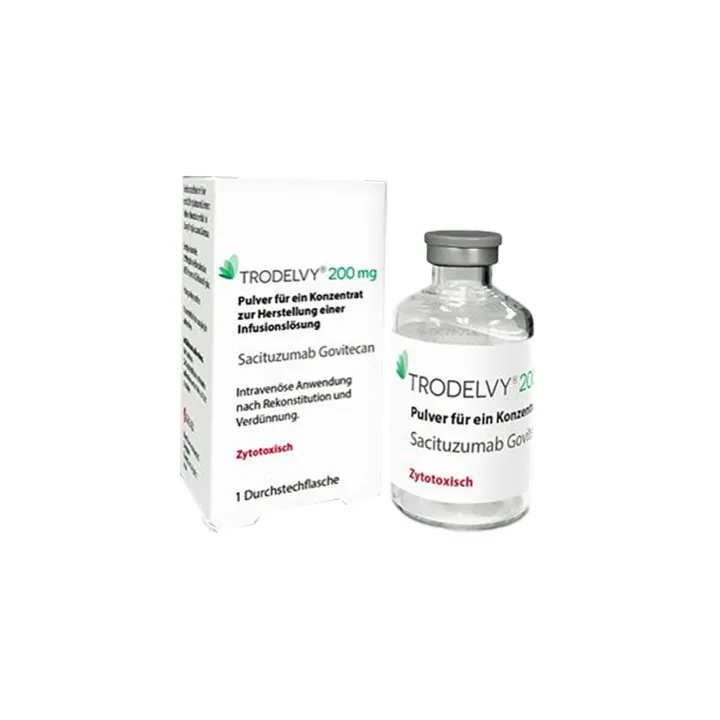
Table of Contents
- Patient Information Leaflet
- Trodelvy 200 mg powder for concentrate for solution for infusion
- 1. What Trodelvy is and what it is used for
- 2. What you need to know before you are given Trodelvy
- 3. How Trodelvy will be administered to you
- 4. Possible side effects
- 5. How to store Trodelvy
- 6. Package contents and other information
- The following information is intended exclusively for healthcare professionals:
Patient Information Leaflet
Trodelvy 200 mg powder for concentrate for solution for infusion
sacituzumab govitecan
This medicinal product is under additional monitoring. This will allow for rapid identification of
new safety information. You can help by reporting any side effects you experience while taking
this medicine. See the end of section 4 for information on how to report side effects.
Please read this leaflet carefully before you are given this medicine as it contains important
information for you.
- Keep this leaflet. You may need to read it again.
- If you have any questions, ask your doctor or nurse.
- If you get any side effects, including those not listed in this leaflet, tell your doctor or nurse. See section 4.
Contents of this leaflet
- What Trodelvy is and what it is used for
- What you need to know before you are given Trodelvy
- How Trodelvy will be given to you
- Possible side effects
- How to store Trodelvy
- Contents of the pack and other information
1. What Trodelvy is and what it is used for
Trodelvy is an anticancer medicine that contains the active substance sacituzumab govitecan. One of the active substances in the medicine is a monoclonal antibody that specifically binds to a protein found on the surface of breast cancer cells called Trop-2. The other active substance in Trodelvy is SN-38, a compound capable of killing cancer cells. Once the medicine has bound to the cancer cells, SN-38 penetrates into the cancer cells and kills them, thereby helping to fight the cancer.
Trodelvy is used in adults to treat a type of breast cancer called triple-negative breast cancer (TNBC). Trodelvy should only be used after patients have already tried at least two other treatments for their cancer, including at least one treatment for locally advanced or metastatic cancer.
Trodelvy is used in adults to treat a type of breast cancer called hormone receptor-positive (HR+) and human epidermal growth factor receptor 2-negative (HER2–) breast cancer. Trodelvy should only be used after patients have received prior hormonal anticancer therapy and at least two other treatments for locally advanced or metastatic cancer.
The medicine is used when the tumour cannot be surgically removed because it has spread to areas outside the breast (locally advanced) or to other organs of the body (metastatic).
If you have any questions about how Trodelvy works or why it has been prescribed for you, consult your doctor or nurse.
2. What you need to know before you are given Trodelvy
Do not receive Trodelvy if you are allergic to sacituzumab govitecan or to any of the
other components of this medicine (listed in section 6). If you think you may be allergic, consult
your doctor.
Warnings and precautions
Infusion-related reactions
Trodelvy is administered by intravenous infusion. Some people may develop infusion-related reactions,
which can be severe or life-threatening. Contact your doctor immediately if you experience any of
the following signs and symptoms of infusion-related reactions:
- itching
- sudden appearance of swollen, pale red patches or plaques (wheals) on the skin
- fever
- sudden severe chills accompanied by a feeling of cold
- excessive sweating
- difficulty breathing and wheezing
- chest pain, rapid heartbeat
Before the Trodelvy infusion, your doctor may give you medicines to help prevent these symptoms.
During each infusion and for 30 minutes afterwards, you will be closely monitored for signs and
symptoms of infusion-related reactions. Your doctor may slow down or stop the infusion if you develop
a severe infusion-related reaction.
Neutropenia
This medicine can cause neutropenia, a condition in which there are too few neutrophils in the blood,
increasing the risk of infections. These infections can be serious, life-threatening, and potentially fatal,
particularly during the early stages of treatment. Contact your doctor immediately if you experience
any of the following signs and symptoms of neutropenia or infection:
- fever (temperature of 38.5 °C or higher)
- chills or sweating
- sore throat, mouth ulcers, or toothache
- stomach pain
- pain near the anus
- pain or burning during urination, or more frequent urination
- diarrhoea or ulcers around the anus
- cough or shortness of breath
Your doctor will take blood samples to monitor your neutrophil levels and may give you a medicine to
help prevent low neutrophil counts during treatment with Trodelvy. Trodelvy will not be administered
if your neutrophil count is below a certain level on day 1 or day 8 of each treatment cycle.
If your neutrophil count is too low, your doctor may need to reduce the dose of Trodelvy, give you a
medicine to treat low neutrophil count, or, in some cases, stop treatment with Trodelvy.
Diarrhoea
Contact your doctor immediately if you have severe diarrhoea during treatment with Trodelvy.
Treatment with Trodelvy will be delayed until the diarrhoea improves. Loperamide will be given to treat
the diarrhoea, unless an infection is present. If appropriate, fluids will also be administered.
Before the next infusion, your doctor may give you medicines such as atropine to relieve stomach
cramps, diarrhoea, and excessive salivation.
Diarrhoea may lead to dehydration and sudden kidney damage. Contact your doctor if you notice dark-
coloured urine or reduced urine output.
Nausea and vomiting
This medicine may cause nausea and vomiting. Contact your doctor immediately if you have
severe nausea and vomiting during treatment with Trodelvy.
Your doctor will give you medicines before anticancer therapy and between infusions to help relieve
nausea and vomiting. Trodelvy will not be administered if you have severe nausea and vomiting,
and will only be given once symptoms have resolved.
Patients with the UGT1A1*28 gene
Some patients are more likely to develop certain side effects of the medicine due to their genetic
background. If you have the UGT1A1*28 gene, your body breaks down the medicine more slowly. This
means you are more likely to develop certain side effects (such as neutropenia, with or without fever,
and low red blood cell levels (anaemia)) compared to those who do not have this gene. These patients
will be closely monitored by the doctor.
Contact your doctor or nurse before receiving Trodelvy if:
- you have liver problems
- you have kidney problems
- you are a woman of childbearing age (see “Pregnancy”, “Male and female contraception”, and “Breast-feeding”)
- you are taking other medicines for other conditions (see “Other medicines and Trodelvy”)
- you have had problems after receiving an infusion in the past.
During treatment with Trodelvy, your doctor will closely monitor you for any side effects. If severe
side effects occur, your doctor may give you additional medicines to manage them, adjust the dose of
Trodelvy, or permanently discontinue treatment with Trodelvy.
See section 4 for a list of possible side effects associated with Trodelvy.
Children and adolescents
Trodelvy must not be given to children and adolescents under 18 years of age, as there is no available
information on its mechanism of action in this age group.
Other medicines and Trodelvy
Tell your doctor if you are taking, have recently taken, or might take any other medicine.
Some medicines may affect how Trodelvy works and may increase the levels of the active substance in
your blood, increasing the risk of side effects. These include:
- propofol, an anaesthetic used during surgery;
- ketoconazole, used to treat fungal infections;
- tyrosine kinase inhibitors, used to treat cancer (drugs whose names end in “nib”);
Some medicines may reduce the level of the active substance of Trodelvy in the blood, reducing its
effectiveness:
- carbamazepine or phenytoin, used to treat epilepsy;
- rifampicin, used to treat tuberculosis; ritonavir or tipranavir, used to treat HIV.
Pregnancy
Trodelvy must not be used during pregnancy as it may harm the unborn baby. Inform your doctor
immediately if you are pregnant, suspect you may be pregnant, or are planning to become pregnant.
Male and female contraception
Women of childbearing potential must use effective contraception during treatment with Trodelvy and
for 6 months after the last dose of Trodelvy.
Men with female partners of childbearing potential must use effective contraception during treatment
and for 3 months after the last dose of Trodelvy.
Breast-feeding
Do not breast-feed during treatment with Trodelvy and for 1 month after the last dose. It is not known
whether this medicine is excreted in breast milk and could harm the baby.
Driving and using machines
Trodelvy may affect your ability to drive or operate machinery, for example by causing dizziness or
fatigue. Therefore, you should exercise caution when driving, using tools, or operating machinery after
receiving Trodelvy.
3. How Trodelvy will be administered to you
Trodelvy will only be administered to you by a doctor or nurse experienced in the use of anticancer therapies.
It is important that your treating doctor or nurse confirms that you can take this medicine by performing blood tests before treatment begins.
Medicines given before treatment with Trodelvy
Before receiving Trodelvy, you will be given certain medicines to help prevent infusion-related reactions and, if necessary, nausea and vomiting. Your doctor will decide which medicines you need and the appropriate doses.
How much Trodelvy you will receive
Treatment for your cancer is repeated in cycles of 21 days (3 weeks). The recommended dose of Trodelvy is 10 mg per kg of body weight at the beginning of each cycle (day 1 of each cycle) and again one week later (day 8 of each cycle).
How the medicine will be administered to you
A doctor or nurse will administer the medicine to you as an intravenous infusion (an intravenous drip into a vein).
First infusion: The first infusion will be given over a period of 3 hours.
Second and subsequent infusions: If no complications occurred during the first infusion, the following infusions will be administered over 1 to 2 hours.
During each infusion and for 30 minutes afterwards, your doctor or nurse will monitor you for any signs or symptoms of infusion-related reactions.
Infusion-related reactions
Your doctor will reduce the infusion rate if you develop an infusion-related reaction. Treatment will be discontinued if the infusion-related reaction is life-threatening. See section 2.
Administration of the medicine in case of adverse effects
Your doctor may adjust the dose or interrupt administration if you experience certain adverse effects. See section 4.
If you are given more Trodelvy than you should
Since the infusion is administered by a doctor or other appropriately trained personnel, overdose is unlikely. If you accidentally receive too much medicine, your doctor will monitor you and provide further treatment as needed.
If a dose of Trodelvy is missed
If you miss or skip an appointment, contact your doctor or treatment center as soon as possible to reschedule. Do not wait until your next scheduled visit. It is very important not to miss a dose for the treatment to be fully effective.
If you stop treatment with Trodelvy
You must not stop treatment early without first discussing it with your doctor.
Treatment with Trodelvy for breast cancer generally requires several infusions. The number of infusions you receive will depend on your response to treatment. Therefore, you should continue receiving Trodelvy even if you notice that your symptoms improve, until your doctor decides that treatment should be stopped. If treatment is stopped too early, symptoms may return.
If you have any questions about the use of this medicine, consult your doctor or nurse.
4. Possible side effects
Like all medicines, this medicine can cause side effects, although not everybody gets them.
Serious side effects
Contact your doctor immediately if you experience any of the following serious, very common side effects
(may affect more than 1 in 10 people):
- Decrease in the number of white blood cells (neutropenia), which may cause the following signs and symptoms:
- fever, with a body temperature of 38.5 °C or higher: this condition is called febrile neutropenia
- chills or sweating
- sore throat, mouth ulcers or toothache
- stomach pain
- pain near the anus or ulcers around the anus
- pain or burning during urination or frequent urination
- diarrhoea
- cough or shortness of breath
- Diarrhoea (even without other signs)
- Hypersensitivity reactions (including infusion-related reactions), which may cause the following signs and symptoms:
- swollen lips, tongue, eyes, throat or face
- swelling or skin rash with red, itchy raised areas on the skin
- sudden appearance of patches (wheals) or swollen pale red bruises on the skin
- fever
- sudden attack of severe chills accompanied by a feeling of coldness
- excessive sweating
- wheezing, tightness in the throat or chest, shortness of breath, dizziness, feeling faint, difficulty breathing
- chest pain, palpitations
- Nausea, vomiting
Other possible side effects
The following side effects are also possible. Inform your doctor immediately if any of these become severe or serious.
Very common
(may affect more than 1 in 10 people)
- burning sensation during urination and frequent, urgent urination
- cough, sore throat, runny nose, sore throat and sneezing
- insufficient number of red blood cells (anaemia)
- low levels of white blood cells (lymphocytes or leucocytes)
- loss of appetite
- low levels of potassium or magnesium in the blood
- difficulty sleeping
- dizziness
- shortness of breath
- constipation, stomach pain
- hair loss, skin rash, general itching sensation
- back pain, joint pain
- fatigue
Common
(may affect up to 1 in 10 people)
- tremors, fever, general discomfort, pallor or change in skin colour, shortness of breath due to presence of bacteria in the bloodstream (sepsis)
- lung infection (pneumonia)
- stuffy nose, facial pain, wheezing
- dry cough that may produce clear, yellowish-grey or greenish mucus
- flu-like symptoms; herpes infection in the mouth
- reduced number of platelets, which could cause bleeding and bruising (thrombocytopenia)
- high blood glucose levels
- reduction in the body's water content
- low levels of phosphate, calcium or sodium in the blood
- anxiety
- altered sense of taste
- low blood pressure
- nosebleeds; cough reflex triggered by mucus dripping down the back of the throat
- inflammation of the large intestine (colitis)
- inflamed mouth and mouth ulcers; pain in the stomach area; reflux; bloated abdomen
- darker skin; skin problems similar to acne; dry skin
- chest muscle pain; muscle spasms
- blood in the urine; excess protein in the urine
- chills
- weight loss
- increased levels of enzymes called alkaline phosphatase and lactate dehydrogenase, abnormal blood clotting tests.
Uncommon
(may affect up to 1 in 100 people)
- inflammation of the small intestine (enteritis)
Reporting of side effects
If you experience any side effect, including those not listed in this leaflet, talk to your doctor or pharmacist. You can also report side effects directly via the national reporting system listed in Annex V. By reporting side effects, you can help provide more information on the safety of this medicine.
5. How to store Trodelvy
Trodelvy will be stored by healthcare professionals at the hospital or clinic where you will receive your treatment. Below are the storage instructions:
- Keep this medicine out of the sight and reach of children.
- Do not use this medicine after the expiry date stated on the vial label and the carton after “Exp.”. The expiry date refers to the last day of that month.
- Store in a refrigerator (2 °C - 8 °C). Do not freeze.
- Keep the vial in the outer packaging to protect the medicine from light.
- After reconstitution and dilution, if not used immediately, the infusion bag containing the diluted solution can be stored in a refrigerator (2 °C - 8 °C) for up to 24 hours protected from light.
- Do not use the medicine if the reconstituted solution is cloudy or shows any change in colour.
Trodelvy is a cytotoxic medicine. Special procedures for handling and disposal must be followed.
6. Package contents and other information
What Trodelvy contains
- The active substance is sacituzumab govitecan. One vial contains 200 mg of sacituzumab govitecan. After reconstitution, one mL of solution contains 10 mg of sacituzumab govitecan.
- The other components are 2-(N-morpholino)ethanesulfonic acid (MES), polysorbate 80 and trehalose dihydrate.
Description of the appearance of Trodelvy and package contents
The medicine is a nearly white to yellowish powder for concentrate for solution for infusion and is supplied in a glass vial. Each pack contains 1 vial.
Marketing Authorisation Holder
Gilead Sciences Ireland UC
Carrigtohill
County Cork, T45 DP77
Ireland
Manufacturer
Gilead Sciences Ireland UC
IDA Business and Technology Park
Carrigtohill
County Cork, T45 DP77
Ireland
For further information on this medicine, contact the local representative of the Marketing Authorisation Holder:
België/Belgique/Belgien Lietuva
Gilead Sciences Belgium SRL-BV Gilead Sciences Ireland UC
Tél/Tel: + 32 (0) 24 01 35 50 Tel: + 353 (0) 1 686 1888
България Luxembourg/Luxemburg
Gilead Sciences Ireland UC Gilead Sciences Belgium SRL-BV
Тел.: + 353 (0) 1 686 1888 Tél/Tel: + 32 (0) 24 01 35 50
Česká republika Magyarország
Gilead Sciences s.r.o. Gilead Sciences Ireland UC
Tel: + 420 910 871 986 Tel.: + 353 (0) 1 686 1888
Danmark Malta
Gilead Sciences Sweden AB Gilead Sciences Ireland UC
Tlf: + 46 (0) 8 5057 1849 Tel: + 353 (0) 1 686 1888
Deutschland Nederland
Gilead Sciences GmbH Gilead Sciences Netherlands B.V.
Tel: + 49 (0) 89 899890-0 Tel: + 31 (0) 20 718 36 98
Eesti Norge
Gilead Sciences Ireland UC Gilead Sciences Sweden AB
Tel: + 353 (0) 1 686 1888 Tlf: + 46 (0) 8 5057 1849
Ελλάδα Österreich
Gilead Sciences Ελλάς Μ.Ε.Ρ.Ε. Gilead Sciences GesmbH
Τηλ: + 30 210 8930 100 Tel: + 43 1 260 830
España Polska
Gilead Sciences, S.L. Gilead Sciences Poland Sp. z o.o.
Tel: + 34 91 378 98 30 Tel.: + 48 22 262 8702
France Portugal
Gilead Sciences Gilead Sciences, Lda.
Tél: + 33 (0) 1 46 09 41 00 Tel: + 351 21 7928790
Hrvatska România
Gilead Sciences Ireland UC Gilead Sciences (GSR) S.R.L.
Tel: + 353 (0) 1 686 1888 Tel: + 40 31 631 18 00
Ireland Slovenija
Gilead Sciences Ireland UC Gilead Sciences Ireland UC
Tel: + 353 (0) 214 825 999 Tel: + 353 (0) 1 686 1888
Ísland Slovenská republika
Gilead Sciences Sweden AB Gilead Sciences Slovakia s.r.o.
Sími: + 46 (0) 8 5057 1849 Tel: + 421 232 121 210
Italia Suomi/Finland
Gilead Sciences S.r.l. Gilead Sciences Sweden AB
Tel: + 39 02 439201 Puh/Tel: + 46 (0) 8 5057 1849
Κύπρος Sverige
Gilead Sciences Ελλάς Μ.Ε.Ρ.Ε. Gilead Sciences Sweden AB
Τηλ: + 30 210 8930 100 Tel: + 46 (0) 8 5057 1849
Latvija United Kingdom (Northern Ireland)
Gilead Sciences Ireland UC Gilead Sciences Ireland UC
Tel: + 353 (0) 1 686 1888 Tel: + 44 (0) 8000 113 700
More detailed information on this medicine is available on the website of the European Medicines Agency, http://www.ema.europa.eu.
The following information is intended exclusively for healthcare professionals:
Trodelvy is a cytotoxic medicinal product. Follow special procedures for handling and disposal.
This medicinal product must not be mixed with other medicinal products except those mentioned below.
Reconstitution
- Calculate the required dose (mg) of Trodelvy according to the patient's body weight.
- Slowly inject 20 mL of sodium chloride 9 mg/mL (0.9%) injection solution into each vial using a sterile syringe. The resulting concentration is 10 mg/mL.
- Gently swirl the vials and wait 15 minutes for complete dissolution. Do not shake. The medicinal product should be visually inspected for the presence of particles or discoloration prior to administration. The solution should be particle-free, clear, and yellow in color. Do not use the reconstituted solution if it is cloudy or shows discoloration.
- Use immediately to prepare a diluted infusion solution.
Dilution
- Calculate the volume of reconstituted solution required to achieve the appropriate dose based on the patient's body weight.
- Determine the final volume of the infusion solution to administer the appropriate dose of sacituzumab govitecan at a concentration between 1.1 mg/mL and 3.4 mg/mL.
- Remove and discard an equivalent volume of sodium chloride 9 mg/mL (0.9%) injection solution from the final infusion bag to accommodate the required volume of reconstituted solution.
- Withdraw the calculated amount of reconstituted solution from the vial(s) using a syringe. Discard any remaining solution in the vial(s).
- To minimize foaming, slowly inject the required volume of reconstituted solution into an infusion bag made of polyvinyl chloride, polyolefin (polypropylene and/or polyethylene), or ethylene vinyl acetate. Do not shake the contents.
- If necessary, adjust the volume in the infusion bag with sodium chloride 9 mg/mL (0.9%) injection solution to achieve a final concentration between 1.1 mg/mL and 3.4 mg/mL. Use only sodium chloride 9 mg/mL (0.9%) injection solution, as the stability of the reconstituted medicinal product has not been established with other infusion solutions.
- If not used immediately, the infusion bag containing the diluted solution may be stored refrigerated (2 °C - 8 °C) for up to 24 hours protected from light. Do not freeze. After refrigeration, administer the diluted solution at a maximum room temperature of 25 °C within 8 hours (including infusion time).
Administration
- Administer Trodelvy as an intravenous infusion. Protect the infusion bag from light.
- The infusion bag must be covered during infusion until administration is complete. It is not necessary to cover the infusion tubing or use light-protective tubing during infusion.
- An infusion pump may be used.
- Do not mix or co-administer Trodelvy with other medicinal products in the same infusion line.
- At the end of the infusion, flush the intravenous line with 20 mL of sodium chloride 9 mg/mL (0.9%) injection solution.
Disposal
Any unused medicinal product and waste materials derived from this medicinal product must be disposed of in accordance with local regulations.