Trecondi
Italy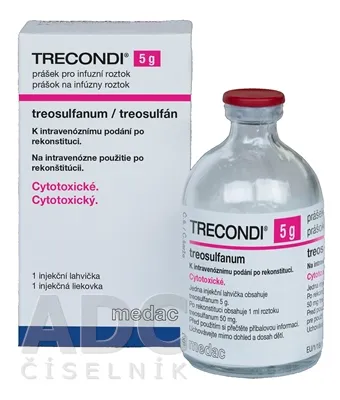
Table of Contents
- Package leaflet: Information for the user
- Trecondi 1 g powder for solution for infusion, 5 g powder for solution for infusion
- 1. What Trecondi is and what it is used for
- 2. What you need to know before receiving Trecondi
- 3. How to use Trecondi
- 4. Possible side effects
- 5. How to store Trecondi
- 6. Package contents and other information
- The following information is intended exclusively for healthcare professionals:
Package leaflet: Information for the user
Trecondi 1 g powder for solution for infusion, 5 g powder for solution for infusion
treosulfan
Please read all of this leaflet carefully before you are given this medicine because it contains important information for you.
- Keep this leaflet. You may need to read it again.
- If you have any questions, ask your doctor, pharmacist or nurse.
- If you get any side effects, talk to your doctor, pharmacist or nurse. This includes any possible side effects not listed in this leaflet. See section 4.
Contents of this leaflet
- What Trecondi is and what it is used for
- What you need to know before you are given Trecondi
- How Trecondi is given
- Possible side effects
- How to store Trecondi
- Contents of the pack and other information
1. What Trecondi is and what it is used for
Trecondi contains the active substance treosulfan, which belongs to a group of medicines called
alkylating agents. Treosulfan is used to prepare patients for bone marrow transplantation (hematopoietic stem cell transplantation). Treosulfan destroys bone marrow cells and allows transplantation of new bone marrow cells, leading to the production of healthy blood cells.
Trecondi is used as treatment prior to blood stem cell transplantation in adults, adolescents, and children over one month of age affected by malignant and non-malignant diseases.
2. What you need to know before receiving Trecondi
Do not receive Trecondi if:
- you are allergic to treosulfan,
- you have an active, uncontrolled infection,
- you have a severe heart, lung, liver, or kidney disease,
- you have an inherited disorder of DNA repair, a condition that reduces the ability to repair DNA (which carries genetic information),
- you are or suspect you may be pregnant.
Warnings and precautions
Trecondi is a medicine that kills cells (cytotoxic), used to reduce the number of blood cells. At the recommended dose, this is the intended effect. You will undergo periodic blood tests during treatment to monitor that your blood cell count does not decrease excessively.
To prevent and treat infections, you will be given medicines such as antimycotics, antifungals, or antivirals.
Trecondi may increase the risk of developing another tumour in the future.
Since inflammation of the oral mucosa is a common side effect of this medicine, attention should be paid to maintaining adequate oral hygiene. Preventive measures are recommended, such as using mouthwashes (e.g. with barrier-protective, antimicrobial agents) or applying ice inside the oral cavity (this reduces blood flow to the oral mucosa and decreases the amount of treosulfan reaching the cells).
You must not receive live vaccines during treatment with treosulfan.
Trecondi may cause menopausal symptoms (absence of menstruation).
Children and adolescents
Seizures (convulsive episodes) may very rarely occur in infants under 4 months of age. Children under 1 year of age may experience more severe respiratory side effects compared to older children. The child will be closely monitored for signs of nervous system side effects and breathing problems.
Diaper rash with ulceration in the area around the anus (perianal area) may occur in infants and children wearing diapers, because treosulfan excreted in urine can damage the skin. Therefore, diapers should be changed frequently within the 6–8 hours following each dose of this medicine.
There is insufficient information on the use of treosulfan in children under 1 month of age.
Other medicines and Trecondi
Tell your doctor if you are taking, have recently taken, or might take any other medicines, including those without a prescription.
Pregnancy, breastfeeding, and fertility
You must not become pregnant during treatment with this medicine and for up to 6 months after treatment. Use an effective method of contraception while you or your partner are being treated with this medicine.
If you are pregnant, suspect you may be pregnant, plan to become pregnant, or are breastfeeding with breast milk, consult your doctor before receiving this medicine.
You must stop breastfeeding before starting treatment with this medicine.
If you are a man being treated with this medicine, you must not father a child during treatment and for up to 6 months afterwards.
This medicine may cause infertility, and it may no longer be possible to become pregnant after treatment. If you wish to have children, discuss this with your doctor before starting treatment. Men should seek advice about the possibility of sperm preservation before starting therapy.
Driving and using machines
This medicine may cause nausea, vomiting, and dizziness, which could impair your ability to drive vehicles or operate machinery. If you experience these symptoms, do not drive or operate machinery.
3. How to use Trecondi
Use in adults
This medicine is used in combination with fludarabine.
The recommended dose is 10-14 g/m² of body surface area (calculated using height and weight).
Use in children and adolescents
This medicine is used in combination with fludarabine and, in most cases, also with thiotepa.
The recommended dose is 10-14 g/m² of body surface area.
How Trecondi is administered
This medicine will be administered to you by a doctor. It is given as an intravenous infusion over 2 hours for 3 days prior to the infusion of blood stem cells.
4. Possible side effects
Like all medicines, this medicine can cause side effects, although not everybody gets them.
Serious side effects
The most serious side effects of treosulfan therapy or of the transplant procedure include:
- reduction in the number of blood cells, which is the intended effect of the medicine to prepare you for the transplant infusion (all patients: very common)
- infections caused by bacteria, viruses, and fungi (adults: common; children and adolescents: very common)
- blockage of a vein in the liver (adults: uncommon; children and adolescents: frequency not known)
- inflammation of the lungs (pneumonia) (adults: uncommon)
Your doctor will regularly monitor your blood cell counts and liver enzymes to detect and manage these events.
Adults
A list of all other side effects is provided below, classified according to their frequency.
Very common (may affect more than 1 in 10 people)
- reduction in the number of white blood cells with fever (febrile neutropenia)
- inflammation of the lining of various parts of the body, especially inside the mouth (which may cause ulcers), diarrhoea, nausea, vomiting
- fatigue
- increased level of bilirubin (a liver pigment, often indicating liver problems) in the blood
Common (may affect up to 1 in 10 people)
- infection of the bloodstream (sepsis)
- allergic reactions
- decreased appetite
- difficulty sleeping (insomnia)
- headache, dizziness
- changes and abnormalities in heart rhythm (the heartbeat is irregular, too fast, or too slow)
- high or low blood pressure, flushing
- difficulty breathing, nosebleeds
- mouth pain, inflammation of the stomach, stomach discomfort, abdominal pain, constipation, difficulty swallowing, pain in the oesophagus or stomach
- skin rash with flat reddish spots or raised reddish bumps (maculopapular rash), red spots on the skin (purpura), skin redness (erythema), hand-foot syndrome (tingling, numbness, painful swelling or redness of the palms of the hands or soles of the feet), itching sensation, hair loss
- pain in arms or legs, back pain, bone pain, joint pain
- sudden reduction in kidney function, blood in the urine
- fluid retention in the body causing swelling (oedema), fever, chills
Uncommon (may affect up to 1 in 100 people)
- abnormal control of blood sugar levels, including high or low blood sugar
- confusion
- bleeding in the brain, nerve problems in arms or legs, with symptoms such as numbness, reduced or increased sensitivity, tingling, burning (peripheral sensory neuropathy)
- sensation of dizziness (vertigo)
- bruising
- fluid around the lungs (pleural effusion), throat inflammation, inflammation or pain in the larynx, hiccups
- bleeding in the mouth, sensation of swelling, dry mouth
- type of skin rash with red spots and sometimes purple areas or blisters in the center (erythema multiforme), acne, skin rash, dry skin
- muscle pain
- pain in the urinary tract
- chest pain not due to heart problems, pain
- increased levels of alkaline phosphatase in the blood (this will be monitored by your doctor)
Not known (frequency cannot be estimated from the available data)
- potentially life-threatening illness following bloodstream infection (septic shock)
- development of a different tumour caused by chemotherapy treatment (secondary malignant tumour)
- increased blood acidity
- abnormal brain function (encephalopathy), restless, repetitive or involuntary movements and rapid speech (extrapyramidal disorder), fainting, sensation of tingling, prickling or numbness (paraesthesia)
- dry eye
- inability of the heart to pump enough blood to meet the body's needs (heart failure), heart attack, fluid in the sac surrounding the heart (pericardial effusion)
- blockage of a blood vessel (embolism)
- sore throat, hoarseness, cough
- gastrointestinal bleeding, inflammation of the colon, inflammation of the oesophagus, inflammation of the anus
- liver damage caused by medicines, enlarged liver
- skin inflammation (dermatitis), skin tissue death, skin ulcer, bronze pigmentation of the skin
- kidney function impairment, inflammation of the urinary bladder with bleeding (haemorrhagic cystitis), pain during urination (dysuria)
- increased level of lactate dehydrogenase (a substance indicating tissue or cell damage) in the blood
Children and adolescents
A list of all other side effects is provided below, classified according to their frequency.
Very common (may affect more than 1 in 10 people)
- inflammation of the mucosa, especially inside the mouth (with ulcers), diarrhoea, nausea, vomiting, abdominal pain
- liver damage
- itching sensation, hair loss
- fever
- increased level of a liver enzyme (ALT) in the blood
Common (may affect up to 1 in 10 people)
- headache
- sore throat, nosebleeds
- difficulty swallowing, inflammation of the anus, mouth pain
- redness and peeling of most of the body's skin (exfoliative dermatitis), type of skin rash with flat reddish spots or raised reddish bumps (maculopapular rash), skin rash, skin redness (erythema), hives, skin pain, bronze pigmentation of the skin
- chills
- increased levels of a liver enzyme (AST) and bilirubin (a liver pigment, often indicating liver problems) in the blood, increased C-reactive protein (a marker of inflammation in the body)
Not known (frequency cannot be estimated from the available data)
- development of a different tumour caused by chemotherapy treatment (secondary malignant tumour)
- reduction in the number of white blood cells with fever (febrile neutropenia)
- blood pH higher than normal (alkalosis), abnormal levels of electrolytes in the blood, decreased level of magnesium in the blood, decreased appetite
- seizure, sensation of tingling, prickling or numbness (paraesthesia)
- bleeding in the eye, dry eye
- fluid leakage from capillaries (small blood vessels), high blood pressure, low blood pressure
- reduced oxygen supply to parts of the body (hypoxia), cough
- inflammation of the colon, stomach discomfort, inflammation of the rectal lining, gum pain, oesophageal pain, constipation
- enlarged liver
- skin ulcer, type of skin rash with red spots and sometimes purple areas or blisters in the center (erythema multiforme), blistering skin disease (bullous dermatitis), acne, hand-foot syndrome (tingling, numbness, painful swelling or redness of the palms of the hands or soles of the feet), diaper rash with ulceration in the area around the anus
- pain in arms or legs
- reduced kidney function, kidney function impairment, inflammation of the urinary bladder (cystitis), blood in the urine
- redness of the scrotal skin, penile pain
- fluid accumulation in tissues causing facial swelling, fatigue, pain
- increased level of a liver enzyme in the blood (gamma-glutamyl transferase)
Reporting of side effects
If you experience any side effect, including those not listed in this leaflet, talk to your doctor, pharmacist, or nurse. You can also report side effects directly via the national reporting system listed in Annex V. By reporting side effects, you can help provide more information on the safety of this medicine.
5. How to store Trecondi
Keep this medicine out of the sight and reach of children.
Do not use this medicine after the expiry date stated on the blister and carton after Exp. The expiry date refers to the last day of that month.
This medicine requires no special storage conditions.
For storage conditions after reconstitution, see the information below intended for healthcare professionals.
Do not dispose of any medicine via wastewater or household waste. Ask your pharmacist how to dispose of medicines you no longer use. This will help protect the environment.
6. Package contents and other information
What Trecondi contains
The active substance is treosulfan. The medicine contains no other components.
Trecondi 1 g powder for solution for infusion
One vial contains 1 g of treosulfan.
Trecondi 5 g powder for solution for infusion
One vial contains 5 g of treosulfan.
After reconstitution, 1 mL of solution contains 50 mg of treosulfan.
Description of the appearance of Trecondi and contents of the pack
White crystalline powder in a glass vial with a rubber stopper and an aluminium overseal.
Trecondi is available in packs containing 1 or 5 vials (Type I glass).
Not all pack sizes may be marketed.
Marketing Authorisation Holder and Manufacturer
medac
Gesellschaft für klinische Spezialpräparate mbH
Theaterstr. 6
22880 Wedel
Germany
Tel.: +49 4103 8006-0
Fax: +49 4103 8006-100
E-mail: [email protected]
Other sources of information
More detailed information on this medicine is available on the website of the European Medicines Agency, http://www.ema.europa.eu. In addition, links to other websites on rare diseases and related therapeutic treatments are provided.
The following information is intended exclusively for healthcare professionals:
As with all cytotoxic substances, appropriate precautions must be taken during the handling of treosulfan.
The medicinal product must be prepared by personnel with adequate training. Inhalation, skin contact, and contact with mucous membranes must be avoided when handling treosulfan (it is recommended to use disposable gloves, eye protection, protective gown, and appropriate face mask). Any contaminated parts of the body must be thoroughly rinsed with water and soap; eyes must be rinsed with sodium chloride solution 9 mg/mL (0.9%). If possible, handling should be performed on a dedicated safety workbench equipped with laminar airflow and a liquid-proof, disposable absorbent protective covering. Disposal of materials (syringes, needles, etc.) used to reconstitute cytotoxic medicinal products requires caution and appropriate precautions.
Use Luer-lock connectors on all syringes and infusion sets. The use of large-bore needles is recommended to minimize pressure and the potential for aerosol formation. Aerosol formation may be reduced by using a vented needle.
Pregnant personnel must be excluded from handling cytotoxic agents.
Instructions for reconstitution of treosulfan:
- Treosulfan should be reconstituted in its original glass container. Reconstituted treosulfan solutions may be transferred into a larger glass vial, a PVC bag, or a PE bag.
- To avoid solubility issues, warm the solvent, sodium chloride solution 4.5 mg/mL (0.45%), to 25 °C–30 °C (not exceeding this range), for example by using a water bath.
- Carefully remove treosulfan powder adhering to the inner surface of the vial by swirling. This step is very important, as moisture on powder adhering to the surface may cause clumping. If clumping occurs, shake the vial vigorously to dissolve the clumps.
- Reconstitute each Trecondi vial containing 1 g of treosulfan with 20 mL of pre-warmed sodium chloride solution 4.5 mg/mL (0.45%) (maximum 30 °C), by swirling. Reconstitute each Trecondi vial containing 5 g of treosulfan with 100 mL of pre-warmed sodium chloride solution 4.5 mg/mL (0.45%) (maximum 30 °C), by swirling.
To prepare the sodium chloride solution 4.5 mg/mL (0.45%), equal volumes of sodium chloride solution 9 mg/mL (0.9%) and water for injections may be mixed.
Reconstituted infusion solution
The reconstituted solution contains 50 mg of treosulfan per mL and appears as a clear, colourless solution.
Solutions showing signs of precipitation must not be used.
After reconstitution with sodium chloride solution 4.5 mg/mL (0.45%), chemical and physical stability has been demonstrated for 3 days at a temperature of 25 °C.
From a microbiological standpoint, unless the reconstitution process excludes the risk of microbial contamination, the medicinal product should be used immediately. If not used immediately, the duration and conditions of storage during use are the responsibility of the user.
Do not store the reconstituted solution in the refrigerator (2 °C–8 °C), as this may cause precipitation.
Treosulfan has mutagenic and carcinogenic potential. Residual medicinal product and all materials used for reconstitution and administration must be disposed of in accordance with standard procedures applicable to antineoplastic agents, in compliance with current regulations on hazardous waste disposal.