Toradiur
Italy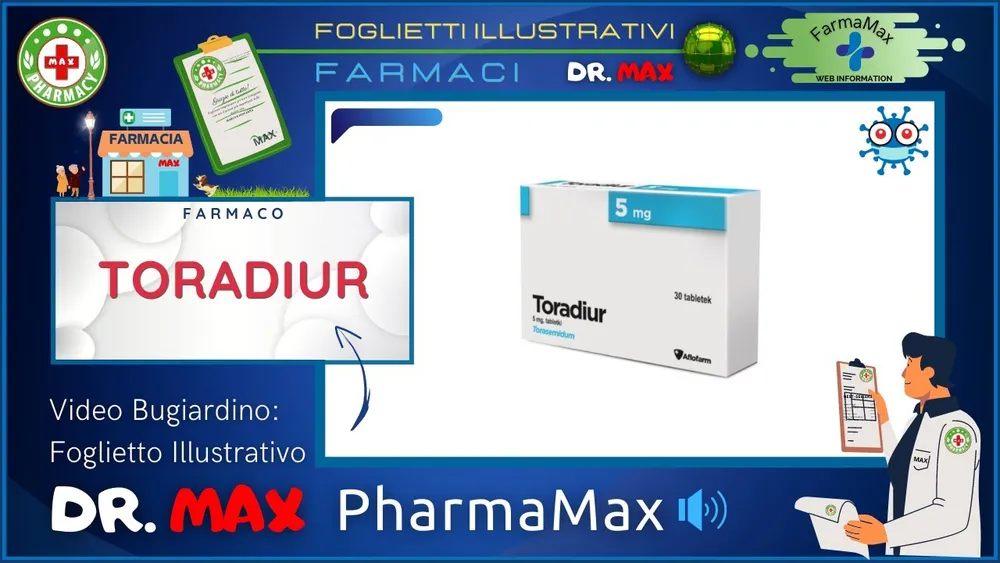
Table of Contents
Patient Information Leaflet
Toradiur 10 mg tablets
torasemide
Please read this leaflet carefully before taking this medicine because it contains important information for you.
- Keep this leaflet. You may need to read it again.
- If you have any questions, ask your doctor or pharmacist.
- This medicine has been prescribed for you only. Do not give it to others, even if their symptoms are the same as yours, as it could be harmful.
- If you experience any adverse reactions, including those not listed in this leaflet, contact your doctor or pharmacist. See section 4.
Contents of this leaflet:
- What Toradiur is and what it is used for
- What you need to know before taking Toradiur
- How to take Toradiur
- Possible side effects
- How to store Toradiur
- Contents of the pack and other information
1. What Toradiur is and what it is used for
Toradiur contains the active substance torasemide, which belongs to the class of "diuretics", medicines that increase the production and elimination of urine.
Toradiur is used in adults and adolescents over 12 years of age for the treatment of:
- oedema (fluid accumulation) originating in the heart, liver, and kidneys;
- acute pulmonary oedema (fluid accumulation in the lungs);
- ascites (fluid accumulation in the abdomen);
- congestive heart failure (the heart’s inability to supply an adequate amount of blood to meet the body’s normal needs);
- acute renal failure (oliguria, i.e. reduced volume of urine excreted);
- chronic renal failure (long-term kidney dysfunction);
- nephrotic syndrome (a kidney disorder causing loss of proteins in the urine).
Talk to your doctor if you do not feel better or if you feel worse.
2. What you need to know before taking Toradiur
Do not take Toradiur
- if you are allergic to torasemide or to any of the other ingredients of this medicine (listed in section 6);
- if you are allergic to sulphonamides (medicines used to treat diabetes);
- if you have anuria (marked reduction in urine production);
- if you are in a coma caused by liver problems (hepatic coma);
- if you have hypotension (low blood pressure);
- if you have hypovolemia (reduced blood volume);
- if you have hyponatremia (low sodium levels in the blood) and hypokalemia (low potassium levels in the blood);
- if you have severe urinary disorders, such as, for example, prostatic hypertrophy (enlarged prostate);
- if you suffer from gout (a disease causing inflammation and joint pain);
- if you have sinoatrial block or second- or third-degree atrioventricular block (if your heart has rhythm disturbances);
- if you are being treated with aminoglycosides or cephalosporins (antibiotics);
- if you have kidney problems due to drugs that may cause kidney damage (nephrotoxic drugs);
- if the child to be treated is under 12 years of age.
Warnings and precautions
Talk to your doctor or pharmacist before taking Toradiur.
In particular, consult your doctor or pharmacist if you think any of the following conditions apply to you:
- if you have kidney problems (nephrotic syndrome);
- if you have liver problems (e.g. hepatic cirrhosis, ascites, and hepatic encephalopathy);
- if you have urinary retention;
- if you have hypotension.
During prolonged treatment with Toradiur, your doctor will carry out periodic blood tests to monitor: - your body's water and salt balance (electrolyte balance), especially potassium levels (high potassium levels may cause cardiac and atrial rhythm disturbances);
- blood levels of glucose, uric acid, creatinine, and lipids.
For athletes
Using this medicine without therapeutic need constitutes doping and may lead to a positive anti-doping test.
Children
The safety and efficacy of Toradiur in children under 12 years of age have not been established.
Other medicines and Toradiur
Tell your doctor or pharmacist if you are taking, have recently taken, or might take any other medicine.
In particular, inform your doctor or pharmacist if you are taking any of the following medicines:
- cardiac glycosides (used to stimulate heart activity);
- mineralocorticoids (used to regulate blood pressure and urine excretion);
- glucocorticoids (used to treat inflammation);
- laxatives (used to facilitate bowel movements);
- NSAIDs such as salicylates and indomethacin (anti-inflammatory drugs);
- kanamycin, gentamicin, tobramycin, and cephalosporins (antibiotics used to treat bacterial infections);
- platinum derivatives (used to treat certain tumours);
- lithium (used for certain mental disorders);
- probenecid (used to treat gout);
- coumarin derivatives (used to delay blood coagulation);
- ACE inhibitors and AT2 antagonists (used to treat high blood pressure);
- cholestyramine (used to lower blood cholesterol levels);
- antidiabetic medicines (used to treat diabetes);
- noradrenaline and adrenaline (medicines that increase blood pressure);
- muscle relaxants (used to reduce muscle contraction);
- theophylline (used for asthma and certain breathing disorders)
Pregnancy, breastfeeding, and fertility
If you are pregnant, think you may be pregnant, planning to become pregnant, or breastfeeding, consult your doctor or pharmacist before taking this medicine.
Pregnancy
There are no clinical data available on the risk of using Toradiur during pregnancy.
Your doctor will prescribe Toradiur only if strictly necessary.
Breastfeeding
There is insufficient information on the excretion of Toradiur in human milk.
A risk to the breastfed infant cannot be excluded.
If you are breastfeeding, your doctor will prescribe Toradiur only if strictly necessary.
Driving and using machines
This medicine may impair your ability to drive or operate machinery. Therefore, if you are taking this medicine, you should exercise caution when driving or operating machinery, especially during the first days of treatment or if you are also consuming alcohol.
Toradiur contains lactose
If your doctor has diagnosed you with an intolerance to certain sugars, contact them before taking this medicine.
3. How to take Toradiur
Take this medicine exactly as directed by your doctor or pharmacist. If you have
any doubts, consult your doctor or pharmacist.
The recommended dose is from ½ to 2 tablets daily, depending on the severity of the disease.
The tablet may be divided into equal parts.
Take the tablets orally.
Swallow without chewing, with some liquid, during meals.
If you take more Toradiur than you should
In case of accidental ingestion/overdose of Toradiur, contact your doctor immediately or go to the nearest hospital.
Symptoms that may occur following accidental overdose of Toradiur include:
- drowsiness;
- confusion;
- hypotension (low blood pressure);
- cardiocirculatory collapse (sudden drop in arterial pressure);
- gastrointestinal symptoms (such as abdominal pain, nausea, vomiting, diarrhoea, constipation);
- dehydration (loss of fluids);
- hypovolemia (reduced blood volume);
- decreased levels of sodium, potassium and chlorides in the blood (hyponatremia, hypokalemia, hypochloremic alkalosis);
- hemoconcentration (increased blood concentration).
If you forget to take Toradiur
Do not take a double dose to make up for the missed tablet.
If you stop treatment with Toradiur
If you have any questions about using this medicine, consult your doctor or pharmacist.
4. Possible side effects
Like all medicines, this medicine can cause side effects, although not everybody will experience them.
The following side effects may occur during treatment:
disturbance of fluid and electrolyte balance (depletion of water, sodium, potassium, chloride).
Occasionally, worsening of metabolic alkalosis (increased bicarbonate levels in blood).
In isolated cases, hypotension (reduced blood pressure), confusion, thromboembolic complications (formation of thrombi or emboli) which may cause serious damage to the heart and brain.
Especially at the beginning of treatment, headache, dizziness and drowsiness may occur.
In addition, the following may occur:
feeling of weakness, muscle cramps, loss of appetite, stomach pain, nausea, vomiting, diarrhoea or constipation, especially at the beginning of treatment.
In isolated cases, pancreatitis.
In patients with urinary tract obstruction, such as in prostatic hypertrophy, urinary retention and bladder distension may occur due to increased urine production.
Changes in certain blood test results may occur: gamma-GT, uric acid, blood glucose, triglycerides, cholesterol, blood urea nitrogen, creatinine, haemogram.
In isolated cases, allergic reactions such as itching, rash, severe skin reactions or photosensitisation; following intravenous administration, acute hypersensitivity reactions, potentially life-threatening, cannot be excluded.
Rarely, dry mouth and paraesthesia in the limbs; in isolated cases, visual disturbances, tinnitus (perception of noise in the ears) and hearing loss.
Reporting of side effects
If you experience any side effect, including those not listed in this leaflet, talk to your doctor or pharmacist. You can also report side effects directly via the national reporting system at the website https://www.aifa.gov.it/content/segnalazioni-reazioni-avverse.
By reporting side effects, you can help provide more information on the safety of this medicine.
5. How to store Toradiur
Keep this medicine out of the sight and reach of children.
This medicine does not require any special storage conditions.
Do not use this medicine after the expiry date stated on the packaging after "Exp.". The expiry date refers to the last day of that month.
Do not dispose of medicines via wastewater or household waste. Ask your pharmacist how to dispose of medicines you no longer use. This will help protect the environment.
6. Package contents and other information
What Toradiur contains
- The active substance is torasemide. Each tablet contains 10 mg of torasemide.
- The other components are: lactose monohydrate, maize starch, anhydrous colloidal silica, magnesium stearate.
Description of the appearance of Toradiur and the pack contents
Tablets for oral use, packaged in a carton containing 14 divisible tablets.
Marketing Authorisation Holder and Manufacturer
Marketing Authorisation Holder
Viatris Healthcare Limited, Damastown Industrial Park, Mulhuddart, Dublin 15, DUBLIN, Ireland
Manufacturer
Madaus GmbH - Lütticher Straße 5 - 53842 Troisdorf - Germany