Tookad
Italy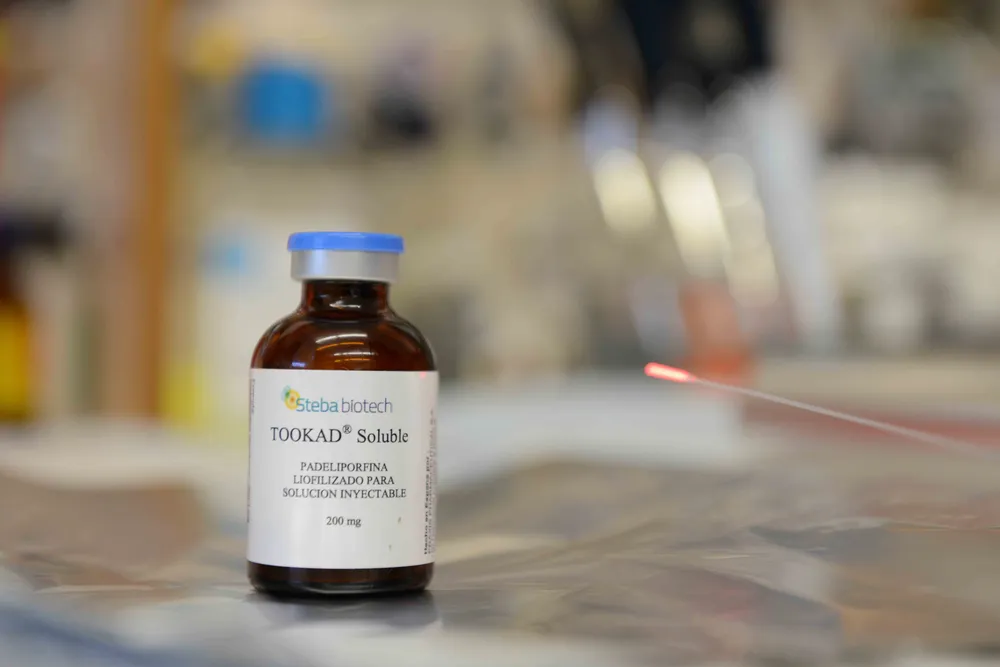
Table of Contents
- Package leaflet: Information for the user
- TOOKAD 183 mg powder for solution for injection, 366 mg powder for solution for injection
- 1. What TOOKAD is and what it is used for
- 2. What you should know before using TOOKAD
- 3. How to use TOOKAD
- 4. Possible side effects
- 5. How to store TOOKAD
- 6. Package contents and other information
- The following information is intended exclusively for healthcare professionals:
Package leaflet: Information for the user
TOOKAD 183 mg powder for solution for injection, 366 mg powder for solution for injection
padeliporfin
Please read this leaflet carefully before you are given this medicine because it contains important information for you.
- Keep this leaflet. You may need to read it again.
- If you have any questions, ask your doctor, pharmacist, or nurse.
- If you get any side effects, including those not listed in this leaflet, tell your doctor, pharmacist, or nurse. See section 4.
Contents of this leaflet
- What TOOKAD is and what it is used for
- What you need to know before receiving TOOKAD
- How to use TOOKAD
- Possible side effects
- How to store TOOKAD
- Contents of the pack and other information
1. What TOOKAD is and what it is used for
TOOKAD is a medicine containing padeliporfin (as potassium salt). It is used in the treatment of adult males with low-risk localized prostate cancer confined to one lobe, through a technique known as vascular-targeted photodynamic therapy (VTP). The treatment is performed under general anaesthesia (medicines that will put you to sleep to prevent pain and discomfort).
Hollow needles are used to insert the fibres into the correct position within the prostate.
Once administered, TOOKAD must be activated by laser light delivered along a fibre that directs the light to the cancer site. The activated medicine then causes the death of cancer cells.
2. What you should know before using TOOKAD
TOOKAD must not be used
- if you are allergic to padeliporfin or to any of the other ingredients of this medicine (listed in section 6);
- if you have undergone a procedure for the treatment of benign prostatic hyperplasia, including transurethral resection of the prostate (TURP);
- if you are currently undergoing or have previously undergone any treatment for prostate cancer;
- if you have been diagnosed with a liver condition called cholestasis;
- if you are experiencing worsening of inflammatory bowel disease affecting the rectum;
- if you cannot undergo general anesthesia or invasive procedures.
Warnings and precautions
TOOKAD must be used exclusively by qualified personnel performing the VTP procedure.
Contact your doctor or nurse:
- if you experience any skin or eye irritation or vision problems following the VTP procedure;
- if you have difficulty achieving or maintaining an erection;
- if you experience any unusual pain after the VTP procedure;
- if you have previously suffered from urethral stricture or urinary flow problems;
- if you experience involuntary leakage of urine following the VTP procedure;
- if you have had active inflammatory bowel disease or any condition that may increase the risk of developing an abnormal connection between the rectum and urethra (rectourethral fistula);
- if you have abnormal blood coagulation;
- if you have reduced kidney function or are on a low-potassium diet.
Currently, information beyond 2 years following the VTP procedure is limited, and therefore data are not available to determine whether the benefit of VTP therapy with TOOKAD is long-lasting.
If further treatment is needed, information on the effect of VTP treatment with TOOKAD on the efficacy and safety outcomes of other treatments (such as surgical removal of the prostate or radiotherapy) is currently limited.
Photosensitivity
While TOOKAD is in the bloodstream, intense light may cause skin reactions and eye discomfort.
Within the 48 hours following the procedure, you must avoid exposure to direct sunlight (including through windows) and all sources of intense light, both indoors and outdoors. This includes sunbeds, bright computer screens (see precautions below), and medical examination lamps.
Sunscreen creams do not protect you from the type of light (near-infrared) that may cause problems after the procedure.
If you experience skin or eye discomfort during your hospital stay, inform your doctor or nurse so that lighting levels can be reduced and special care taken to protect you from natural and artificial light.
First 12 hours after the VTP procedure
After the procedure, you will need to wear protective glasses and will be medically monitored for at least 6 hours in a dimly lit room.
The medical team will decide whether you can leave the hospital on the evening of the same day of treatment. You may need to stay overnight if you have not fully recovered from general anesthesia or based on your condition.
You must remain in a dimly lit environment, avoiding exposing your skin and eyes to daylight. Use only light bulbs with a maximum power of 60 watts (for incandescent bulbs), 6 watts (for LED lamps), or 12 watts (for energy-saving fluorescent lamps).
You may watch television from a distance of 2 meters, and after 6 hours post-procedure, you may use electronic devices such as smartphones, tablets, and computers. If you need to go outside during the day, you must wear protective clothing and high-protection sunglasses to shield your skin and eyes.
12–48 hours after the VTP procedure
You may go outdoors during the day but only in shaded areas or when the sky is overcast. You must wear dark clothing and take care to protect your hands and face from sunlight.
After 48 hours from the procedure, you may resume normal activities and exposure to direct sunlight.
In clinical studies, no patients with photosensitive conditions such as porphyria, or with a history of sunlight sensitivity or photosensitivity dermatitis, received TOOKAD. However, the short duration of action of TOOKAD means that the expected risk of increased phototoxicity is low, provided that light exposure precautions are strictly followed.
An additional risk of ocular photosensitivity may occur in patients who have undergone intraocular anti-VEGF therapy (medicines used to prevent the growth of new blood vessels). If you have previously received anti-VEGF therapy, you must pay particular attention to protecting your eyes from light for 48 hours after TOOKAD injection. Concomitant use of systemic VEGF inhibitors with TOOKAD is not recommended.
See also “Other medicines and TOOKAD” for photosensitizing medicines.
Difficulty achieving or maintaining an erection
Some difficulty in achieving or maintaining an erection may occur immediately after the procedure and may last for more than 6 months.
Risk of damage near the prostate gland
Since light-conducting fibers must be inserted to expose the entire prostate lobe, some damage outside the prostate may occur. This usually involves the fat surrounding the prostate and is not significant, but nearby organs such as the bladder and rectum may be affected. This complication is normally avoidable with careful planning, but if it occurs, there is a risk of developing an abnormal connection between the rectum and bladder or skin. This is very rare.
Problems related to the urethra
If you have previously suffered from urethral stricture or urinary flow problems, this treatment may increase the risk of poor urinary flow and urinary retention.
Urinary incontinence
Short-term urinary incontinence has been observed, which may result from a urinary tract infection or urgency due to urethral irritation caused by the procedure. This condition improves spontaneously or with treatment of the infection.
Active inflammatory bowel disease
If you have had active inflammatory bowel disease or any condition that may increase the risk of developing an abnormal connection between the rectum and urethra (rectourethral fistula), treatment should only be administered after careful evaluation.
Abnormal coagulation
Patients with abnormal blood coagulation may experience excessive bleeding from the needle insertions required to place the laser-conducting fibers. These insertions may also cause bruising, blood in the urine, and/or local pain. Abnormal coagulation is not believed to affect treatment efficacy; however, it is recommended that medications affecting blood coagulation be discontinued in the period before and immediately after the VTP procedure.
See also “Other medicines and TOOKAD” regarding the effects of anticoagulant and antiplatelet medicines.
Patients on a low-potassium diet
This medicine contains potassium. Generally, the dose of TOOKAD contains less than 1 mmol (39 mg) of potassium, i.e., it is essentially “potassium-free.” However, patients with a body weight above 115 kg will receive a quantity exceeding 1 mmol of potassium. This should be considered in patients with reduced kidney function or those on a low-potassium diet, for whom an increase in serum potassium would be harmful.
Children and adolescents
Do not administer this medicine to children or adolescents under 18 years of age.
Other medicines and TOOKAD
Inform your doctor or pharmacist if you are taking, have recently taken, or might take any other medicines, including those not requiring a prescription. Some medicines (especially photosensitizing agents or those affecting blood coagulation) may interact with TOOKAD and should be discontinued before using TOOKAD. Additionally, you may need to avoid taking certain medicines for several days after the VTP procedure. Your doctor will inform you which medicines may be substituted, if necessary, and when you can resume taking them after the VTP procedure.
The following types of medicines may be those your doctor will advise you to temporarily discontinue:
Medicines with potentially photosensitizing effects
- Some antibiotics used to treat infections (tetracyclines, sulfonamides, quinolones).
- Some medicines used to treat psychiatric conditions (phenothiazines).
- Some medicines used for type II diabetes (hypoglycemic sulfonamides).
- Some medicines used for hypertension, edema, heart failure, or renal failure (thiazide diuretics).
- A medicine used to treat fungal infections (griseofulvin).
- A medicine used to treat cardiac arrhythmia (amiodarone).
These medicines must be discontinued at least 10 days before the TOOKAD procedure and for at least 3 days after the procedure, or replaced with alternative treatments lacking photosensitizing properties.
If discontinuation of a photosensitizing medicine (such as amiodarone) is not possible, increased sensitivity may occur, and you may need to protect yourself from direct light exposure for a longer period.
Anticoagulants (medicines that prevent blood from clotting)
These medicines (e.g., acenocoumarol, warfarin) must be discontinued at least 10 days before the VTP procedure with TOOKAD.
Antiplatelet agents (medicines that reduce platelet aggregation (stickiness) in the blood and coagulation)
These medicines (e.g., acetylsalicylic acid) must be discontinued at least 10 days before the VTP procedure with TOOKAD and resumed at least 3 days after the procedure.
Other medicines that may interact with TOOKAD
Medicines such as repaglinide, atorvastatin, pitavastatin, pravastatin, rosuvastatin, simvastatin, bosentan, and gliburide must not be taken on the day of TOOKAD administration and for at least 24 hours thereafter.
Contraception
You or your partner or both must use an effective method of contraception to prevent pregnancy for 90 days after the VTP procedure. Consult your doctor regarding contraceptive methods and the duration of their use. If your partner becomes pregnant within three months of treatment, you must inform your doctor immediately.
Pregnancy and breastfeeding
TOOKAD is not indicated for the treatment of women.
Driving and using machines
TOOKAD does not affect the ability to drive or operate machinery. However, since the procedure involves general anesthesia, you must not perform complex tasks such as driving or operating machinery for 24 hours after receiving a general anesthetic.
3. How to use TOOKAD
TOOKAD is restricted exclusively to hospital use and must be administered only by qualified personnel trained in the VTP procedure.
Dosage
The recommended dose of TOOKAD is a single dose of 3.66 mg per kg of body weight administered by intravenous infusion over 10 minutes.
For instructions to healthcare providers on the reconstitution of TOOKAD prior to administration, see "Reconstitution of TOOKAD injectable solution powder".
Only the lobe containing the cancer will be treated. Additional VTP procedures are not recommended.
VTP Procedure
A rectal preparation will be performed the day before and at the start of the VTP procedure to clean the rectum. Your doctor may prescribe antibiotics to prevent infections and alpha-blockers (medicines given to prevent difficulty in urination). You will be given a general anaesthetic to put you to sleep before the VTP procedure. Optical fibres delivering laser light will be inserted into the prostate gland through hollow needles. TOOKAD is immediately activated after infusion by delivering light through the fibres from a connected laser device.
If you have any questions about the use of this medicine, consult your doctor, pharmacist, or nurse.
4. Possible side effects
Like all medicines, this medicine can cause side effects, although not everyone experiences them.
In addition, the insertion of needles into the prostate gland and a urinary catheter for the procedure may be associated with further side effects.
Possible side effects may occur with TOOKAD and with the VTP procedure.
If you experience any of the side effects listed below, contact your doctor immediately:
- Urinary retention (inability to urinate). In the first few days after the VTP procedure, some patients may have difficulty (weak stream due to urethral narrowing) or be unable to urinate. It may be necessary to insert a catheter into the bladder through the penis, and this catheter will be kept in place for a few days or weeks to drain urine.
- After the procedure, fever, pain, and swelling in the treated area may occur. These may be signs of infection of the urinary tract, prostate, or genital system. In such cases, you should contact your doctor, as further blood or urine tests and antibiotic treatment may be required. Generally, these infections are easily treated.
In addition to the side effects already listed, other side effects may occur.
Very common side effects (may affect more than 1 in 10 people)
- Difficulty or pain when urinating (including pain or discomfort when urinating, bladder pain, urgent need to urinate, increased frequency of urination or nocturia, involuntary leakage of urine).
- Sexual problems (including difficulty achieving or maintaining an erection, absence of ejaculation, decreased sexual desire, or pain during intercourse).
- Blood in the urine (haematuria).
- Perineal injury including bruising of the skin, bruising around the area where the needles were inserted into the prostate, pain and soreness.
- Genital pain and discomfort (inflammation of the testicles or epididymis, pain caused by inflammation or fibrosis of the prostate).
Common side effects (may affect up to 1 in 10 people)
- Anorectal discomfort (discomfort near or just inside the anus), haemorrhoids, proctalgia (pain in the anal region).
- Intestinal problems (including diarrhoea or occasional faecal incontinence).
- General and musculoskeletal pain (muscle or bone pain, limb extremity pain, back pain, or bleeding in the joints).
- Haemospermia (blood in the semen).
- High blood pressure.
- Increased blood lipids, increased lactate dehydrogenase, increased white blood cells, increased creatine phosphokinase, decreased potassium, increased prostate-specific antigen (PSA).
- Skin reaction, erythema (redness), rash, dryness, itching, depigmentation.
- Changes in blood coagulation parameters.
- Discomfort in the abdominal region.
- Fatigue (tiredness).
Uncommon side effects (may affect up to 1 in 100 people)
- Dizziness, fall.
- Headache.
- Sensory disturbance, paraesthesia (a sensation like insects crawling under or on the skin).
- Eye irritation, photophobia (light sensitivity).
- Exertional dyspnoea (shortness of breath during or after physical activity).
- Mood disturbance.
- Decreased weight.
Reporting of side effects
If you experience any side effect, including those not listed in this leaflet, contact your doctor, pharmacist, or nurse. You can also report side effects directly through the national reporting system detailed in Annex V. By reporting side effects, you can help provide more information on the safety of this medicine.
5. How to store TOOKAD
You must not store this medicinal product. This medicinal product is stored under the responsibility
of the specialist.
The following information is intended exclusively for the specialist.
Keep this medicinal product out of the sight and reach of children.
Do not use this medicinal product after the expiry date stated on the label of the shielded container
after “Exp.” The expiry date refers to the last day of that month.
Store in a refrigerator (2 °C – 8 °C).
Keep in the outer packaging to protect the medicinal product from light.
Any unused medicinal product and waste materials derived from its use must be disposed of in accordance with
local applicable regulations.
6. Package contents and other information
What TOOKAD contains
- The active substance is padeliporfin. Each vial of TOOKAD 183 mg contains 183 mg of padeliporfin (as potassium salt). Each vial of TOOKAD 366 mg contains 366 mg of padeliporfin (as potassium salt). 1 mL of reconstituted solution contains 9.15 mg of padeliporfin.
- The other component is mannitol.
Description of the appearance of TOOKAD and contents of the pack
TOOKAD is a dark powder for injectable solution.
Each pack of TOOKAD 183 mg powder for injectable solution contains one amber glass vial with a blue closure cap.
Each pack of TOOKAD 366 mg powder for injectable solution contains one amber glass vial with a white closure cap.
Marketing Authorization Holder
Steba Biotech S.A.
14a Rue des Bains
L-1212 Luxembourg
Luxembourg
Manufacturer
LIOF-PHARMA S.L.
c/ Hermanos Lumiere 5
Parque Tecnológico Miñano
01510 Alava
Spain
Other sources of information
More detailed information on this medicinal product is available on the website of the European Medicines Agency: http://www.ema.europa.eu.
The following information is intended exclusively for healthcare professionals:
Reconstitution of TOOKAD injectable solution powder
The solution must be prepared under dim light conditions due to the photosensitizing properties of the medicinal product.
- Reconstitute the solution by adding:
- for TOOKAD 183 mg: 20 mL of 5% glucose solution to the vial containing the powder;
- for TOOKAD 366 mg: 40 mL of 5% glucose solution to the vial containing the powder.
- Gently shake the vial for 2 minutes. The final concentration of the solution is 9.15 mg/mL.
- Let the vial stand undisturbed in an upright position for 3 minutes without shaking or moving it further.
- Transfer the contents of the vial into an opaque syringe.
- Let the opaque syringe stand undisturbed in an upright position for 3 minutes to allow any foam to dissipate.
- Attach a 0.22 µm injection filter to the syringe.
- Connect an opaque tubing to the filter.
The reconstituted solution for infusion is dark in color.
Illumination for TOOKAD photoactivation
TOOKAD is locally activated immediately after injection by a 753 nm laser light beam delivered via interstitial optical fibers from a laser device at a power of 150 mW/cm of fiber, delivering a total energy dose of 200 J/cm over 22 minutes and 15 seconds.
At the beginning of the procedure, fiber placement must be planned using the treatment guidance software. During the procedure, optical fibers are selected and positioned within the prostate gland via a transperineal approach under ultrasound guidance to achieve a Light Density Index (LDI) ≥ 1 in the target tissue.
Storage precautions
Store in a refrigerator (2 °C – 8 °C).
Keep the vial in the outer packaging to protect the medicinal product from light.
After reconstitution with 5% glucose solution in the vial, the physico-chemical stability of TOOKAD has been demonstrated for 8 hours at 15 °C–25 °C and at 5 °C ± 3 °C. From a microbiological standpoint, the product should be used immediately. If not used immediately, the user is responsible for the in-use storage duration and conditions prior to use.