Tomudex
Italy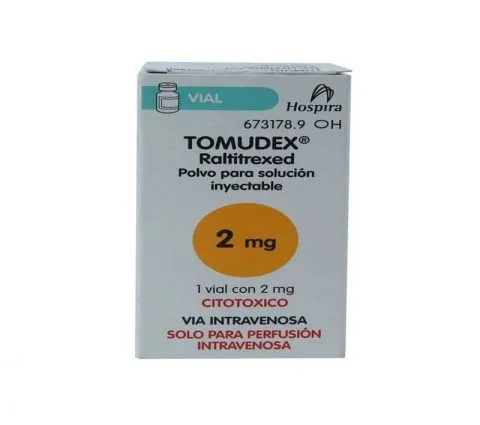
Table of Contents
- Patient Information Leaflet
- TOMUDEX 2 mg powder for solution for infusion
- 1. What Tomudex is and what it is used for
- 2. What you should know before using Tomudex
- 3. How to use Tomudex
- 4. Possible side effects
- 5. How to store Tomudex
- 6. Package contents and other information
- The following information is intended for healthcare professionals only:
Patient Information Leaflet
TOMUDEX 2 mg powder for solution for infusion
Raltitrexed
Please read this leaflet carefully before using this medicine as it contains important information for you.
- Keep this leaflet. You may need to read it again.
- If you have any questions, ask your doctor, pharmacist, or nurse.
- This medicine has been prescribed for you only. Do not give it to other people, even if they have the same symptoms as yours, because it may be harmful.
- If you experience any side effects, including those not listed in this leaflet, tell your doctor, pharmacist, or nurse. See section 4.
Contents of this leaflet:
- What Tomudex is and what it is used for
- What you need to know before using Tomudex
- How to use Tomudex
- Possible side effects
- How to store Tomudex
- Contents of the pack and other information
1. What Tomudex is and what it is used for
Tomudex contains the active substance raltitrexed, which is used in chemotherapy and belongs to the class of antimetabolites, folic acid analogues.
Tomudex is used:
- to relieve symptoms of advanced colorectal carcinoma
- in combination with another medicine (cisplatin), for the treatment of lung cancer (malignant pleural mesothelioma) that cannot be surgically removed, in patients who have never been treated with such drugs before.
2. What you should know before using Tomudex
Do NOT use Tomudex
- if you are allergic to raltitrexed or to medicines similar to it, or to any of the other ingredients of this medicine (listed in section 6).
- if you have severe kidney impairment (creatinine clearance < 25 ml/min)
- if you are pregnant or breastfeeding
Warnings and precautions
Talk to your doctor or nurse before taking Tomudex.
Tomudex must be administered only by a physician experienced in anticancer chemotherapy or under such physician's supervision.
Your doctor will closely monitor you to detect any adverse reactions, particularly those affecting the gastrointestinal tract (diarrhea or mucositis) and the bone marrow (reduction in white blood cells called neutrophils, leading to increased risk of infections, and reduction in platelets), and may reduce the dose or delay treatment accordingly.
Use Tomudex with caution if:
- you have impaired bone marrow function.
- your general health condition is poor.
- you have undergone radiotherapy.
- you have mild to moderate liver dysfunction.
- you are an elderly patient.
Before starting therapy and before each subsequent treatment, a full blood test must be performed (white blood cell count including neutrophils, platelets, liver transaminases, bilirubin, and serum creatinine).
Children
The use of Tomudex is not recommended in children, as its safety and efficacy have not been established in this patient group.
Other medicines and Tomudex
Inform your doctor or pharmacist if you are taking, have recently taken, or might take any other medicines.
Do not take the following medicines immediately before or during administration of Tomudex, as they may interfere with its antitumour effect:
- folinic acid
- folic acid
- vitamin preparations
Cisplatin
Concomitant use of cisplatin may increase the toxicity of Tomudex; therefore, this combination should be used with caution.
Pregnancy, breastfeeding and fertility
If you are pregnant, suspect you may be pregnant, plan to become pregnant, or are breastfeeding, consult your doctor before receiving this medicine.
Pregnancy
You must not receive Tomudex during pregnancy or if you are potentially at risk of becoming pregnant during treatment.
Before starting treatment with Tomudex, it must be confirmed that you are not pregnant.
Pregnancy should be avoided if either partner is receiving Tomudex. It is also recommended to avoid conception for at least 6 months after completion of treatment.
Breastfeeding
You must not take Tomudex if you are breastfeeding.
Fertility
Fertility studies in rats indicate that Tomudex may cause infertility in male rats. Fertility returned to normal 3 months after the end of treatment.
Driving and using machines
You should not drive or operate machinery due to possible malaise or muscle weakness following the use of Tomudex.
This medicine contains less than 1 mmol (23 mg) of sodium per vial, i.e., essentially 'sodium-free'.
3. How to use Tomudex
Tomudex will be administered to you intravenously as a single 15-minute intravenous infusion by a doctor or nurse. If you have any doubts, consult your doctor, pharmacist, or nurse.
Dosage
The dose will be calculated by your doctor based on your body surface area, the specific circumstances listed in section 2 “Warnings and precautions”, your response to treatment, and in the absence of toxicity, treatment may be repeated every 3 weeks.
Use in children
The use of Tomudex is not recommended in children, as its tolerability and efficacy have not been evaluated in this patient group.
Patients with renal impairment
For patients with abnormal renal function (serum creatinine), creatinine clearance should be assessed or calculated at the beginning of therapy and before each subsequent treatment.
If you use more Tomudex than you should
Since this medicine is administered in a hospital setting, it is unlikely that an incorrect amount will be given. However, if you have any concerns, speak to your doctor, nurse, or pharmacist.
4. Possible side effects
Like all medicines, this medicine can cause side effects, although not everyone experiences them.
Tomudex for the treatment of advanced colorectal carcinoma may cause the following side effects:
Very common side effects (may affect more than 1 in 10 people)
- abnormal reduction in white blood cells (leucopenia)
- anaemia
- excessive weight loss (anorexia)
- nausea, diarrhoea, vomiting
- difficulty passing stools (constipation), abdominal pain
- skin irritation (rash)
- lack of energy and muscle weakness (asthenia)
- fever
- inflammation of mucous membranes (mucositis)
- increased blood transaminase levels (GOT and GPT)
Common side effects (may affect up to 1 in 10 people)
- fluid accumulation under the skin (cellulitis)
- exaggerated body response to a bacterial infection (sepsis)
- illness with flu-like symptoms
- reduction in blood platelets (thrombocytopenia)
- loss of body fluids (dehydration)
- headache
- muscle cramps (hypertonia)
- taste disturbances
- inflammation of the white part of the eye (conjunctivitis)
- inflammation of the mouth and stomach burning or pain (stomatitis, dyspepsia, mouth ulceration)
- increased blood bilirubin levels (hyperbilirubinaemia)
- hair loss (alopecia), itching, sweating
- joint pain/inflammation (arthralgia)
- fluid accumulation in the lower limbs (peripheral oedema)
- pain
- malaise
- weight loss
- increased blood alkaline phosphatase levels
Uncommon side effects (may affect up to 1 in 100 people)
- desquamation
Side effects with unknown frequency
- gastrointestinal bleeding
Tomudex in combination with Cisplatin for the treatment of lung cancer may cause the following
side effects:
Very common side effects (may affect more than 1 in 10 people)
- infections due to low white blood cell count (neutrophils), cough, shortness of breath (dyspnoea), chest pain (not related to the heart or the membrane lining the lungs), pain in the membrane lining the lungs (pleura)
- headache, dizziness
- nervous system disorder (sensory neuropathy)
- ringing in the ears (tinnitus)
- nausea, vomiting, constipation, diarrhoea
- anorexia
- inflammation of the mouth/throat (stomatitis/pharyngitis)
- hair loss (alopecia)
- fatigue
- fluid accumulation (oedema)
- fever with reduction in white blood cells (neutropenia)
Common side effects (may affect up to 1 in 10 people)
- decrease in white blood cell count (leucopenia)
- hearing loss
- abdominal pain, inflammation of the stomach lining (gastritis)
- sweating, dehydration
- skin irritation (erythema)/desquamation
- joint pain/inflammation (arthralgia)
- decrease in body weight
Leucopenia (particularly neutropenia), anaemia, and thrombocytopenia, either alone or in combination, are usually mild to moderate and occur during the first or second week of treatment, with recovery typically by the third week.
Severe leucopenia (particularly neutropenia) and thrombocytopenia may occur and can be life-threatening or fatal, particularly when associated with signs of gastrointestinal toxicity.
Nausea and vomiting are usually mild and occur during the first week of treatment with Tomudex; they respond to antiemetic therapy.
Diarrhoea and vomiting may be severe and, if untreated, can lead to dehydration, hypovolaemia, and renal impairment.
After the first week of Tomudex treatment, asthenia and fever have generally been mild to moderate and reversible. Severe asthenia may occur and may be associated with malaise and a flu-like syndrome.
Elevations in GOT and GPT are usually asymptomatic and self-limiting unless associated with progression of the underlying malignancy.
Gastrointestinal bleeding may occur and may be associated with mucositis and/or thrombocytopenia.
Reporting of side effects
If you experience any side effect, including those not listed in this leaflet, please inform your doctor, pharmacist, or nurse. You can also report side effects directly via the national reporting system at the following website: http://www.aifa.gov.it/content/segnalazioni-reazioni-avverse.
By reporting side effects, you can help provide more information on the safety of this medicine.
5. How to store Tomudex
Store below 25°C. Keep the vial in the outer cardboard carton to protect the medicine from light.
Once reconstituted, Tomudex is chemically stable for 24 hours at 25°C under normal lighting conditions.
The reconstituted solution of Tomudex can be stored in the refrigerator (between 2°C and 8°C) for up to 12 hours.
Keep this medicine out of the sight and reach of children.
Do not use this medicine after the expiry date stated on the packaging.
The expiry date refers to the last day of that month.
Do not dispose of any medicine via wastewater or household waste. Ask your pharmacist how to dispose of medicines you no longer use. This will help protect the environment.
6. Package contents and other information
What Tomudex contains
- The active substance is raltitrexed 2 mg
- The other components are mannitol, disodium phosphate dodecahydrate, sodium hydroxide
Description of the appearance of Tomudex and contents of the pack
Powder for solution for infusion: 1 vial containing 2 mg
Marketing Authorization Holder and Manufacturer
Marketing Authorization Holder
Pfizer Italia S.r.l.
Via Isonzo, 71
04100 Latina
Manufacturer
Pfizer Service Company BVBA
Hoge Wei 10
1930 Zaventem
Belgium
The following information is intended for healthcare professionals only:
For prescribing information, please refer to the Summary of Product Characteristics.
Adult Patients
Prior to treatment, the total white blood cell count must be greater than 4,000/mm³, the neutrophil count greater than 2,000/mm³, and the platelet count greater than 100,000/mm³.
In case of toxicity, administration of the next dose should be delayed until signs of toxic effects have resolved.
Once a dose reduction has been implemented, all subsequent treatments must be administered at the reduced dose.
The recommended dose is 3 mg/m², diluted in 50–250 mL of 0.9% sodium chloride solution or 5% dextrose (glucose) solution, and administered as a single short intravenous infusion. The infusion should be given over 15 minutes.
No other medications should be added to the vial containing the Tomudex solution. In the absence of toxicity, treatment may be repeated every 3 weeks.
Tomudex treatment must be discontinued in the event of grade 4 WHO gastrointestinal toxicity (diarrhea or mucositis) or in case of grade 3 WHO gastrointestinal toxicity associated with grade 4 WHO hematological toxicity.
Strict adherence to the recommended dose reduction schedule is essential, as potentially fatal or life-threatening toxicity increases if the dose is not reduced or treatment is not suspended appropriately.
Cisplatin
When used in combination with Tomudex, cisplatin should be administered after each Tomudex infusion. The recommended dose of cisplatin is 80 mg/m² administered by intravenous infusion over 1–2 hours. In case of toxicity, the next dose should be withheld until signs of toxic effects have resolved, as with Tomudex. Patients must receive adequate hydration before and after cisplatin administration and may require antiemetic therapy. For this and other dosing and administration recommendations for cisplatin, refer to the Summary of Product Characteristics for this medicinal product.
Patients with Renal Impairment
For patients with abnormal serum creatinine levels, creatinine clearance should be assessed or calculated at the start of therapy and before each subsequent treatment.
The same approach should be followed for patients with normal serum creatinine levels that may not accurately reflect creatinine clearance due to age-related factors or weight loss.
If creatinine clearance is ≤ 65 mL/min, the following dose adjustments are recommended:
Creatinine clearance Percentage of 3 mg/m² Dosing interval
65 mL/min full dose every 3 weeks
55 to 65 mL/min 75% every 4 weeks
25 to 54 mL/min 50% every 4 weeks
< 25 mL/min no treatment ----------
Patients with Hepatic Impairment
No dose adjustment is necessary in patients with mild or moderate hepatic impairment. However, since a portion of the drug is excreted fecally and patients with hepatic impairment generally represent a poor-prognosis group, treatment should be administered with caution in cases of mild or moderate hepatic impairment (see section Precautions for Use). Tomudex has not been studied in patients with severe hepatic impairment, jaundice, or decompensated liver disease, and its use in these patients is not recommended.
Instructions for Reconstitution and Dilution
Tomudex must be reconstituted by adding 4 mL of sterile water for injections to the contents of each vial (containing 2 mg of raltitrexed) to yield a solution of 0.5 mg/mL.
The dose determined for each individual patient should then be further diluted in 50–250 mL of 0.9% sodium chloride solution or 5% dextrose (glucose) solution and administered as a short intravenous infusion over 15 minutes.
The chemical and physical stability of diluted infusion solutions has been demonstrated for 24 hours at 25°C under normal light conditions.
Neither Tomudex nor the substances specified for reconstitution or dilution contain preservatives or bacteriostatic agents.
From a microbiological standpoint, reconstituted and diluted solutions should be used immediately. If not used immediately, in-use storage times and conditions prior to use are the responsibility of the user and normally should not exceed 12 hours between 2°C and 8°C, unless reconstitution and dilution have been carried out under controlled and validated aseptic conditions.
It is recommended that administration of the solution, after dilution in 0.9% sodium chloride or 5% dextrose (glucose) solution, be initiated as soon as possible after preparation.
The solution must be completely used within 24 hours of reconstitution of the product or discarded.
Reconstituted or diluted solutions do not require protection from light.
Do not store partially used vials or reconstituted solutions for potential later use in the patient.
Any remaining reconstituted or diluted product must be disposed of according to procedures established for cytotoxic agents.
Tomudex should be reconstituted by experienced personnel in a designated area for cytotoxic agent reconstitution. Cytotoxic preparations such as Tomudex must not be handled by pregnant women.
Reconstitution should normally be performed in a containment facility equipped with exhaust systems such as laminar airflow cabinets, and work surfaces should be covered with disposable absorbent paper with a plastic backing.
Appropriate protective clothing, including surgical gloves and disposable eye protection, must be worn. In case of skin contact, wash thoroughly with water. In case of accidental splashing into the eyes, irrigate with running water, keeping eyelids apart, for at least 10 minutes. Seek medical advice.
Any spillage must be cleaned up using standard procedures.
Waste material must be disposed of by incineration according to procedures established for cytotoxic agents.
Overdose
No clinically tested antidotes are available. In the event of accidental overdose, preclinical data suggest considering administration of folinic acid, which, based on clinical experience with other drugs in the same class, may be given at a dose of 25 mg/m² intravenously every 6 hours. The effectiveness of folinic acid in counteracting toxic effects may decrease as the time interval between Tomudex and folinic acid administration increases.
Symptoms of overdose may simply represent a more severe form of adverse reactions than expected with normal drug administration. Patients should therefore be closely monitored for the onset of gastrointestinal and hematological toxicity. Symptomatic treatment and standard supportive measures should be employed to manage such toxicities.