Tofidence
Italy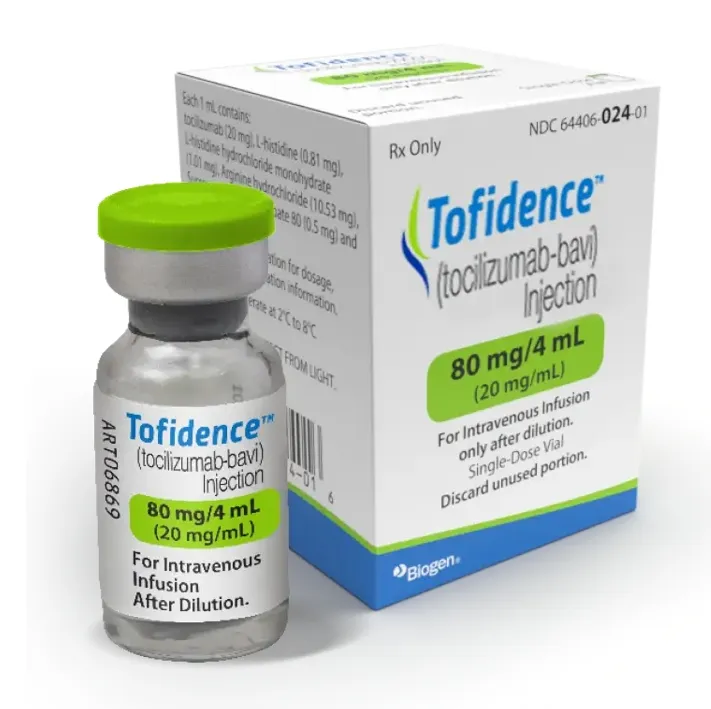
Table of Contents
- Patient Information Leaflet: Information for the User
- Tofidence 20 mg/mL concentrate for solution for infusion
- 1. What Tofidence is and what it is used for
- 2. What you should know before being given Tofidence
- 3. How Tofidence is administered
- 4. Possible side effects
- 5. How to store Tofidence
- 6. Package contents and other information
- The following information is intended exclusively for healthcare professionals:
Patient Information Leaflet: Information for the User
Tofidence 20 mg/mL concentrate for solution for infusion
tocilizumab
This medicinal product is subject to additional monitoring. This will allow for rapid identification of new safety information. You can help by reporting any side effects you experience while taking this medicine. See the end of section 4 for information on how to report side effects.
Please read this leaflet carefully before you are given this medicine as it contains important information for you.
- Keep this leaflet. You may need to read it again.
- If you have any questions, ask your doctor or nurse.
- If you experience any side effect, including those not listed in this leaflet, talk to your doctor or nurse. See section 4.
In addition to this patient information leaflet, you will be provided with a Patient Alert Card, which contains important safety information you must know before being administered Tofidence and during treatment with Tofidence 20 mg/mL concentrate for solution for infusion.
Contents of this leaflet
- What Tofidence is and what it is used for
- What you need to know before you are given Tofidence
- How Tofidence is given
- Possible side effects
- How to store Tofidence
- Contents of the pack and other information
1. What Tofidence is and what it is used for
Tofidence contains the active substance tocilizumab, a protein produced by specific immune cells (monoclonal antibody) that blocks the action of a specific protein (cytokine) called interleukin-6. This protein is involved in inflammatory processes in the body, and blocking it may reduce inflammation. Tofidence helps reduce symptoms such as joint pain and swelling, and may also improve your ability to perform daily activities. Tofidence has been shown to slow down joint cartilage and bone damage caused by the disease and to improve your ability to carry out normal daily activities.
-
Tofidence is used to treat adults with moderate to severe active rheumatoid arthritis (RA), an autoimmune disease, when previous treatments have not worked well enough. Tofidence is usually used in combination with methotrexate. Tofidence may also be used alone if your doctor considers methotrexate inappropriate.
-
Tofidence may also be used to treat adult patients who have not previously been treated with methotrexate, if they have severe, active and progressive rheumatoid arthritis.
-
Tofidence is used to treat children with sJIA. Tofidence is used in children aged 2 years and older who have active systemic juvenile idiopathic arthritis (sJIA), an inflammatory disease causing pain and swelling of one or more joints, accompanied by fever and rash. Tofidence is used to improve sJIA symptoms and may be given in combination with methotrexate or alone.
-
Tofidence is used to treat children with pJIA. Tofidence is used in children aged 2 years and older with active polyarticular juvenile idiopathic arthritis (pJIA), an inflammatory disease causing pain and swelling of one or more joints. Tofidence is used to improve pJIA symptoms and may be given in combination with methotrexate or alone.
-
Tofidence is used to treat adults with coronavirus disease 2019 (COVID-19) who are receiving systemic corticosteroids and require supplemental oxygen or mechanical ventilation.
2. What you should know before being given Tofidence
You must not be given Tofidence
- if you are allergic to tocilizumab or to any of the other ingredients of this medicine (listed in section 6)
- if you have an active severe infection. If either of these conditions applies to you, inform the doctor or nursing staff administering the infusion.
Warnings and precautions
Talk to your doctor or nurse before you are given Tofidence.
- If you experience allergic reactions, such as chest tightness, wheezing, severe dizziness or a feeling of faintness, swelling of the lips or skin rash during or immediately after the infusion, inform your doctor immediately.
- If you have any type of infection, short-term or long-term, or if you suffer from frequent infections. Inform your doctor immediately if you feel unwell. Tofidence may reduce your body’s ability to respond to infections and could worsen an existing infection or increase the risk of developing a new infection.
- If you have had tuberculosis, inform your doctor. Your doctor will check for signs and symptoms of tuberculosis before starting treatment with Tofidence. If symptoms of tuberculosis (persistent cough, weight loss, fatigue, mild fever) or any other infection occur during or after treatment, inform your doctor immediately.
- If you have a history of intestinal ulcers or diverticulitis, inform your doctor. Symptoms may include abdominal pain and unexplained changes in bowel habits associated with fever.
- If you have liver disease, inform your doctor. Before using Tofidence, your doctor may wish to perform a blood test to assess your liver function.
- If a patient has recently been vaccinated (whether adult or child), or plans to receive a vaccination, inform your doctor. All patients, especially children, should be up to date with all vaccinations before starting treatment with Tofidence, unless urgent initiation is required. Some types of vaccines should not be used during treatment with Tofidence.
- If you have a tumour, inform your doctor. Your doctor will need to decide whether you can still receive Tofidence.
- If you have cardiovascular risk factors, such as high blood pressure or elevated cholesterol levels, inform your doctor. These factors should be monitored while you are taking Tofidence.
- If you have moderate to severe kidney function impairment, your doctor will monitor you closely.
- If you have persistent headaches.
Your doctor will perform blood tests before administering Tofidence and during treatment to determine whether you have a low white blood cell or platelet count, or elevated liver enzymes.
Children and adolescents
The use of Tofidence is not recommended in children under 2 years of age.
If a child has a history of macrophage activation syndrome (uncontrolled activation and proliferation of specific blood cells), inform the doctor. The doctor will need to decide whether the patient can still receive Tofidence.
Tofidence contains polysorbate
This medicine contains 0.5 mg of polysorbate 80 (E 433) per 20 mg/mL of tocilizumab. Polysorbates may cause allergic reactions. Inform your doctor if you have known allergies.
Other medicines and Tofidence
Inform your doctor if you are taking any other medicines (or if your child is the patient, if they are taking any medicines) or if you have recently taken any, including medicines obtained without a prescription.
Tofidence may affect how some medicines work, and the dose of these medicines may need to be adjusted. Inform your doctor if you are taking medicines containing the following active substances:
- methylprednisolone, dexamethasone, used to reduce inflammation
- simvastatin or atorvastatin, used to reduce cholesterol levels
- calcium channel blockers (e.g., amlodipine), used to treat high blood pressure
- theophylline, used to treat asthma
- warfarin or phenprocoumon, anticoagulants used to thin the blood
- phenytoin, used to treat seizures
- cyclosporine, used to suppress the immune system during organ transplantation
- benzodiazepines (e.g., temazepam), used to treat anxiety.
Due to lack of clinical experience, Tofidence is not indicated for use with other biological medicines for the treatment of RA, sJIA or pJIA.
Pregnancy, breastfeeding and fertility
Tofidence must not be used during pregnancy unless strictly necessary. If you are pregnant, suspect you may be pregnant, planning to become pregnant, or are breastfeeding, consult your doctor before taking this medicine.
Women of childbearing potential should use an effective contraceptive method during treatment and for at least 3 months after treatment has ended.
Stop breastfeeding if you are about to be given Tofidence and inform your doctor. At least 3 months must pass from the last dose of Tofidence before breastfeeding can be resumed. It is not known whether Tofidence passes into breast milk.
Available data so far do not indicate an effect of this treatment on fertility.
Driving and using machines
This medicine may cause dizziness. If you experience dizziness, do not drive, ride a bicycle, or operate machinery.
3. How Tofidence is administered
This medicine is subject to restricted medical prescription.
Tofidence will be administered intravenously by drop-by-drop infusion by a doctor or nurse. They will prepare
a solution, set up the intravenous infusion, and monitor you during and after administration.
Adult patients with RA
The usual dose of Tofidence is 8 mg per kg of body weight. Depending on your response, your doctor
may reduce the dose to 4 mg/kg and increase it again to 8 mg/kg when appropriate.
In adult patients, Tofidence will be administered every 4 weeks via a one-hour intravenous infusion (intravenous
drop-by-drop injection).
Children with sJIA (aged 2 years and older)
The usual dose of Tofidence depends on body weight.
- If body weight is less than 30 kg: the dose is 12 mg per kilogram of body weight.
- If body weight is 30 kg or more: the dose is 8 mg per kilogram of body weight. The dose is calculated based on body weight at each administration.
In children with sJIA, Tofidence will be administered every 2 weeks via a one-hour intravenous infusion (intravenous
drop-by-drop injection).
Children with pJIA (aged 2 years and older)
The usual dose of Tofidence depends on body weight.
- If body weight is less than 30 kg: the dose is 10 mg per kilogram of body weight.
- If body weight is 30 kg or more: the dose is 8 mg per kilogram of body weight. The dose is calculated based on body weight at each administration.
In children with pJIA, Tofidence will be administered every 4 weeks via a one-hour intravenous infusion (intravenous
drop-by-drop injection).
Patients with COVID-19
The usual dose of Tofidence is 8 mg per kilogram of body weight. A second dose may be required.
If you are given more Tofidence than you should have
Since Tofidence will be administered by a doctor or nurse, it is unlikely that you will receive too much. However, if you have any concerns, speak to your doctor.
If you miss a dose of Tofidence
Since Tofidence will be administered by a doctor or nurse, it is unlikely that you will miss a dose. However, if you have any concerns, speak to your doctor or nurse.
If you stop treatment with Tofidence
Do not discontinue treatment with Tofidence without first discussing it with your doctor.
If you have any questions about the use of this medicine, consult your doctor or nurse.
4. Possible side effects
Like all medicines, this medicine can cause side effects, although not everybody gets them. Side effects may occur up to 3 months after the last dose of Tofidence.
Possible serious common side effects: report immediately to your doctor.
These are common: they may affect up to 1 in 10 people.
Allergic reactions during or after infusion:
- difficulty breathing, chest tightness or dizziness
- skin rash, itching, hives, swelling of the lips, tongue or face
If you notice any of these symptoms, inform your doctor immediately.
Signs of serious infections
- fever and chills
- blisters in the mouth or on the skin
- stomach pain
Signs and symptoms of liver toxicity
These are rare: they may affect up to 1 in 1000 people
- fatigue
- abdominal pain
- jaundice (yellowing of the skin and whites of the eyes)
If you notice any of these symptoms, inform your doctor as soon as possible.
Very common side effects: may affect more than 1 in 10 people
- upper respiratory tract infections with typical symptoms such as cough, nasal congestion, runny nose, sore throat and headache
- elevated levels of fats in the blood (cholesterol)
Common side effects: may affect up to 1 in 10 people
- lung infection (pneumonia)
- shingles (herpes zoster)
- cold sores (oral herpes simplex), blister formation
- skin infections (cellulitis), sometimes associated with fever and chills
- skin rash and itching, hives
- allergic reactions (hypersensitivity)
- eye infection (conjunctivitis)
- headache, dizziness, high blood pressure
- mouth ulcers, stomach pain
- fluid retention (edema) in the lower legs, weight gain
- cough, shortness of breath
- low white blood cell count (neutropenia, leucopenia) detected by blood tests
- abnormalities in liver function tests (increased transaminases)
- increased bilirubin levels as shown in blood tests
- low levels of fibrinogen in the blood (a protein involved in blood clotting)
Uncommon side effects: may affect up to 1 in 100 people
- diverticulitis (fever, nausea, diarrhea, constipation, stomach pain)
- red and swollen areas in the mouth
- high levels of fats in the blood (triglycerides)
- gastric ulcer
- kidney stones
- hypothyroidism
Rare side effects: may affect up to 1 in 1000 people
- Stevens-Johnson syndrome (skin rash, which may lead to severe blistering and skin peeling)
- fatal allergic reactions (anaphylaxis [fatal])
- inflammation of the liver (hepatitis), jaundice
Very rare side effects: may affect up to 1 in 10,000 people
- low counts of white blood cells, red blood cells and platelets in blood tests
- liver failure
Reporting of side effects
If you experience any side effect, including those not listed in this leaflet, talk to your doctor, pharmacist or nurse.
You can also report side effects directly via the national reporting system listed in Annex V. By reporting side effects, you can help provide more information on the safety of this medicine.
Children with AIGs
In general, in patients with AIGs, side effects similar to those in adult patients with RA have been observed. Some side effects were observed more frequently: inflammation of nose and throat, diarrhea, low white blood cell count and increased liver enzymes.
Children with AIGp
In general, side effects in AIGp patients were similar to those observed in adult patients with RA. Some side effects were observed more frequently: inflammation of nose and throat, headache, feeling unwell (nausea) and lower white blood cell count.
5. How to store Tofidence
Keep this medicine out of the sight and reach of children.
Do not use this medicine after the expiry date which is stated on the outer carton and on the label
of the vials after Exp./EXP. The expiry date refers to the last day of that month.
Store the vials in a refrigerator (2 °C – 8 °C). Do not freeze.
Information on the storage and duration of use of tocilizumab once diluted and ready for use
is provided in the section “The following information is intended exclusively for healthcare professionals”.
Keep the vial(s) in the outer packaging to protect the medicine from light.
Do not dispose of medicines via wastewater or household waste. Ask your pharmacist how to dispose of medicines you no longer use. This will help protect the environment.
6. Package contents and other information
What Tofidence contains
- The active substance is tocilizumab.
Each 4 mL vial contains 80 mg of tocilizumab (20 mg/mL).
Each 10 mL vial contains 200 mg of tocilizumab (20 mg/mL).
Each 20 mL vial contains 400 mg of tocilizumab (20 mg/mL).
- The other components are sucrose (E 473), polysorbate 80 (E 433), L-histidine, L-histidine monohydrochloride monohydrate, arginine hydrochloride, and water for injections.
Description of the appearance of Tofidence and contents of the pack
Tofidence is a concentrate for solution for infusion. The concentrate is a liquid that ranges from clear to opalescent, colourless to pale yellow.
Tofidence is supplied in a vial (Type I glass) with a stopper (butyl rubber) containing 4 mL, 10 mL or 20 mL of concentrate. Packs of 1 and 4 vials are available. Not all pack sizes may be marketed.
Marketing Authorisation Holder
STADA Arzneimittel AG
Stadastrasse 2–18
61118 Bad Vilbel
Germany
Manufacturer
Biogen Netherlands B.V.
Prins Mauritslaan 13
1171 LP Badhoevedorp
The Netherlands
For further information about this medicine, please contact the local representative of the Marketing Authorisation Holder:
België/Belgique/Belgien Lietuva
EG (Eurogenerics) NV UAB „STADA Baltics“
Tél/Tel: +32 24797878 Tel: +370 52603926
България Luxembourg/Luxemburg
STADA Bulgaria EOOD EG (Eurogenerics) NV
Teл.: +359 29624626 Tél/Tel: +32 24797878
Česká republika Magyarország
STADA PHARMA CZ s.r.o. STADA Hungary Kft
Tel: +420 257888111 Tel.: +36 18009747
Danmark Malta
STADA Nordic ApS Pharma.MT Ltd
Tlf: +45 44859999 Tel: +356 21337008
Deutschland Nederland
STADAPHARM GmbH Centrafarm B.V.
Tel: +49 61016030 Tel.: +31 765081000
Eesti Norge
UAB „STADA Baltics“ STADA Nordic ApS
Tel: +372 5307215 Tlf: +45 44859999
Ελλάδα Österreich
STADA Arzneimittel AG STADA Arzneimittel GmbH
Τηλ: +49 61016030 Tel: +43 136785850
España Polska
Laboratorio STADA, S.L. STADA Pharm Sp. z.o.o.
Tel: +34 934738889 Tel: +48 227377920
France Portugal
EG LABO - Laboratoires EuroGenerics Stada, Lda.
Tél: +33 146948686 Tel: +351 211209870
Hrvatska România
STADA d.o.o. STADA M&D SRL
Tel: +385 13764111 Tel: +40 213160640
Ireland Slovenija
Clonmel Healthcare Ltd. Stada d.o.o.
Tel: +353 526177777 Tel: +386 15896710
Ísland Slovenská republika
STADA Arzneimittel AG STADA PHARMA Slovakia, s.r.o.
Sími: +49 61016030 Tel: +421 252621933
Italia Suomi/Finland
EG SpA STADA Nordic ApS, Suomen sivuliike
Tel: +39 028310371 Puh/Tel: +358 207416888
Κύπρος Sverige
STADA Arzneimittel AG STADA Nordic ApS
Τηλ: +49 61016030 Tel: +45 44859999
Latvija
UAB „STADA Baltics“
Tel: +371 28016404
Other sources of information
More detailed information on this medicine is available on the European Medicines Agency website: https://www.ema.europa.eu/
The following information is intended exclusively for healthcare professionals:
Instructions for dilution prior to administration
Parenteral medications must be visually inspected before administration to ensure the absence of particulate matter and any discoloration. Only solutions that appear clear to opalescent, colorless to pale yellow, and free of visible particles should be diluted. Use a sterile needle and syringe to prepare Tofidence.
Patients with RA and COVID-19
Under aseptic conditions, withdraw a volume of sterile, non-pyrogenic sodium chloride 9 mg/mL (0.9%) injection solution from a 100 mL infusion bag equal to the volume of concentrated Tofidence required for the patient's dose. The required amount of concentrated Tofidence ( 0.4 mL/kg ) should be withdrawn from the vial and added to the 100 mL infusion bag. The final volume must be 100 mL. To mix the solution, gently invert the infusion bag to avoid foaming.
Use in the pediatric population
Patients with sJIA and pJIA weighing ≥ 30 kg
Under aseptic conditions, withdraw a volume of sterile, non-pyrogenic sodium chloride 9 mg/mL (0.9%) injection solution from a 100 mL infusion bag equal to the volume of concentrated Tofidence required for the patient's dose. The required amount of concentrated Tofidence ( 0.4 mL/kg ) should be withdrawn from the vial and added to the 100 mL infusion bag. The final volume must be 100 mL. To mix the solution, gently invert the infusion bag to avoid foaming.
Patients with sJIA weighing < 30 kg
Under aseptic conditions, withdraw a volume of sterile, non-pyrogenic sodium chloride 9 mg/mL (0.9%) injection solution from a 50 mL infusion bag equal to the volume of concentrated Tofidence required for the patient's dose. The required amount of concentrated Tofidence ( 0.6 mL/kg ) should be withdrawn from the vial and added to the 50 mL infusion bag. The final volume must be 50 mL. To mix the solution, gently invert the infusion bag to avoid foaming.
Patients with pJIA weighing < 30 kg
Under aseptic conditions, withdraw a volume of sterile, non-pyrogenic sodium chloride 9 mg/mL (0.9%) injection solution from a 50 mL infusion bag equal to the volume of concentrated Tofidence required for the patient's dose. The required amount of concentrated Tofidence ( 0.5 mL/kg ) should be withdrawn from the vial and added to the 50 mL infusion bag. The final volume must be 50 mL. To mix the solution, gently invert the infusion bag to avoid foaming.
Tofidence is for single use only.
Any unused medicinal product and waste materials derived from its use must be disposed of in accordance with local regulations.