Tixtar
Italy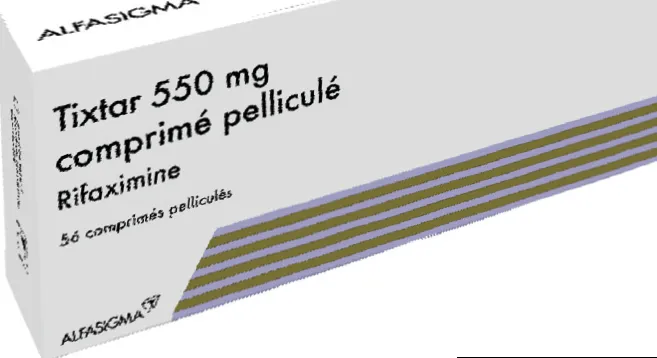
Table of Contents
Package leaflet: Information for the user
TIXTAR 550 mg film-coated tablets
rifaximin
Please read all of this leaflet carefully before taking this medicine because it contains
important information for you.
- Keep this leaflet. You may need to read it again.
- If you have any questions, ask your doctor or pharmacist.
- This medicine has been prescribed for you only. Do not give it to other people, even if they have the same symptoms as yours, as it may be harmful.
- If you experience any adverse reactions, including those not listed in this leaflet, contact your doctor or pharmacist. See section 4.
Contents of this leaflet:
- What Tixtar is and what it is used for
- What you need to know before taking Tixtar
- How to take Tixtar
- Possible side effects
- How to store Tixtar
- Contents of the pack and other information
1. What TIXTAR is and what it is used for
Tixtar contains the active substance rifaximin. Rifaximin is an antibiotic that destroys bacteria which
can cause a condition called hepatic encephalopathy (with symptoms including
agitation, confusion, muscle problems, difficulty speaking, and in some cases, coma).
Tixtar is used in adult patients with liver disease to reduce the recurrence of overt hepatic encephalopathy.
Tixtar can be used alone or more commonly in combination with medications containing
lactulose (a laxative).
2. What you need to know before taking TIXTAR
Do not take Tixtar if:
- you are allergic to:
- rifaximin
- antibiotics similar to rifaximin (such as rifampicin or rifabutin)
- any of the other ingredients of this medicine (listed in section 6)
- you have intestinal obstruction.
Warnings and precautions
Consult your doctor or pharmacist before taking Tixtar if you have developed a severe skin rash, skin peeling, blisters and/or mouth ulcers after taking rifaximin.
Pay special attention when taking rifaximin:
Severe skin reactions, including Stevens-Johnson syndrome and toxic epidermal necrolysis, have been reported during treatment with rifaximin. Stop taking rifaximin and contact your doctor immediately if you experience any of the symptoms related to these severe skin reactions described in section 4.
While taking Tixtar, your urine may turn reddish in color. This is a fairly common occurrence.
Antibiotic treatment, including rifaximin, may cause severe diarrhea, even several months after completing the course of medication. If you develop severe diarrhea during or after taking Tixtar, stop taking the medicine and contact your doctor immediately.
If you have severe liver problems, your doctor should monitor you closely.
Tixtar contains sodium
This medicine contains less than 1 mmol (23 mg) of sodium per tablet, i.e. it is essentially ‘sodium-free’.
Children and adolescents
Tixtar is not recommended for children and adolescents under 18 years of age. This medicine has not been studied in children and adolescents.
Other medicines and Tixtar
Inform your doctor or pharmacist if you are taking, have recently taken, or might take any other medicines.
Tell your doctor if you are taking any of the following medicines:
- antibiotics (medicines used to treat infections)
- warfarin (a medicine used to prevent blood clotting)
- antiepileptics (medicines used to treat epilepsy)
- antiarrhythmics (medicines used to treat irregular heartbeats)
- cyclosporine (an immunosuppressant)
- oral contraceptives
Pregnancy and breastfeeding
If you are pregnant, think you might be pregnant, planning a pregnancy, or breastfeeding, consult your doctor or pharmacist before taking this medicine.
It is not known whether Tixtar may cause harm to the fetus. Therefore, Tixtar should not be used during pregnancy.
It is not known whether rifaximin is excreted in breast milk. Therefore, Tixtar should not be used during breastfeeding.
Driving and using machines
Tixtar generally does not affect the ability to drive or operate machinery, but it may cause dizziness in some patients. If you experience dizziness, you must not drive or operate machinery.
3. How to take TIXTAR
Take this medicine exactly as directed by your doctor. If you have any doubts, consult your doctor or pharmacist.
The recommended dose is 1 tablet twice daily, taken with a glass of water.
Continue taking TIXTAR until your doctor tells you to stop treatment.
If you take more TIXTAR than you should
Contact your doctor if you take more tablets than recommended, even if you notice no problems.
If you forget to take TIXTAR
Take the next dose at your usual time. Do not take a double dose to make up for a forgotten tablet.
If you stop taking TIXTAR
Do not stop treatment with TIXTAR without first consulting your doctor, as your symptoms may return.
If you have any doubts about how to use this medicine, consult your doctor or pharmacist.
4. Possible side effects
Like all medicines, this medicine can cause side effects, although not everybody gets them.
Stop treatment with Tixtar and contact your doctor immediately if you notice any of the
following symptoms:
Uncommon (may affect up to 1 in 100 people)
- If you have bleeding from dilated blood vessels in the throat (oesophageal varices).
- If you have severe diarrhoea during or after taking this medicine. This could be due to an intestinal infection. Unknown frequency (frequency cannot be estimated from the available data).
- Reddish, flat spots on the trunk, target-shaped or circular, often with central blisters, skin peeling, mouth, throat, nose, genital or eye ulcers. These skin rashes may be preceded by fever and flu-like symptoms.
- If you develop an allergic reaction, hypersensitivity or angioedema. Symptoms include:
- swelling of the face, tongue or throat
- difficulty swallowing
- hives or difficulty breathing
- If you experience unexpected or unusual bleeding or bruising. This could be due to a reduction in the number of platelets in the blood, leading to an increased risk of bleeding.
Other side effects that may occur
Common (may affect up to 1 in 10 people)
- Depressed mood
- Dizziness
- Headache
- Shortness of breath
- Nausea or vomiting
- Stomach ache, bloating or abdominal distension
- Diarrhoea
- Fluid accumulation in the abdominal cavity (ascites)
- Skin rash or itching
- Muscle cramps
- Joint pain
- Swelling of ankles, feet or fingers
Uncommon (may affect up to 1 in 100 people)
- Fungal infections (such as candidiasis)
- Urinary tract infection (such as cystitis)
- Anaemia (reduction in red blood cells which may cause paleness, weakness or shortness of breath)
- Loss of appetite
- Hyperkalaemia (high levels of potassium in the blood)
- Confusion
- Anxiety
- Drowsiness
- Sleep disturbances
- Feeling unsteady
- Memory loss or poor memory
- Difficulty concentrating
- Reduced sense of touch
- Seizures (epileptic fits)
- Hot flushes
- Fluid accumulation around the lungs (pleural effusion)
- Abdominal pain
- Dry mouth
- Muscle pain
- Need to urinate more frequently
- Difficulty or pain passing urine
- Fever
- Oedema (swelling due to excess fluid in the body)
- Falls
Rare (may affect up to 1 in 1,000 people)
- Chest infections, including pneumonia
- Cellulitis (inflammation of the subcutaneous tissue)
- Upper respiratory tract infections (nose, mouth, throat)
- Rhinitis (inflammation of the nasal cavities)
- Dehydration (loss of body fluids)
- Changes in blood pressure
- Ongoing breathing problems (such as chronic bronchitis)
- Constipation
- Back pain
- Presence of protein in the urine
- Feeling of weakness
- Bruising
- Post-surgical pain
Unknown frequency (frequency cannot be estimated from the available data).
- Fainting or feeling faint
- Skin irritation, eczema (itching, redness, dry skin)
- Reduction in the number of platelets (observed in blood tests)
- Changes in liver function (observed in blood tests)
- Changes in blood coagulation (International Normalised Ratio observed in blood tests)
Reporting of side effects
If you get any side effects, including ones not listed in this leaflet, talk to your doctor or pharmacist.
You can also report side effects directly via the national reporting system at https://www.aifa.gov.it/content/segnalazioni-reazioni-avverse
By reporting side effects, you can help provide more information on the safety of this medicine.
5. How to store TIXTAR
Keep this medicine out of the sight and reach of children.
Do not use this medicine after the expiry date stated on the carton and blister after EXP. The expiry date refers to the last day of the month.
Tixtar does not require any special storage conditions.
Do not dispose of medicines via wastewater or household waste. Ask your pharmacist how to dispose of medicines you no longer use. This will help protect the environment.
6. Package contents and other information
What Tixtar contains
The active substance is rifaximin. Each tablet contains 550 mg of rifaximin.
The other components are:
Tablet core: sodium starch glycolate (type A), glycerol distearate, anhydrous colloidal silica,
talc, microcrystalline cellulose.
Tablet coating (Opadry oy-s-34907): hypromellose, titanium dioxide (E171), disodium edetate,
propylene glycol, red iron oxide (E172).
Description of the appearance of Tixtar and package contents
Pink, oval-shaped, biconvex film-coated tablets, with "RX" engraved on one side.
Tixtar is available in packs of 14, 28, 42, 56 and 98 tablets.
Not all pack sizes may be marketed.
Marketing Authorization Holder and Manufacturer
Marketing Authorization Holder:
Alfasigma S.p.A. – Via Ragazzi del ’99, n. 5 - 40133 Bologna (BO)
Manufacturer:
Alfasigma S.p.A. – Via Enrico Fermi, n.1 – 65020 Alanno (PE)
Alfasigma S.p.A. – Via Pontina Km 30,400 – 00071 Pomezia (RM)
This medicinal product is authorized in the European Economic Area Member States under the
following trade names:
Refero: Austria, Hungary, Luxembourg, Portugal, Slovak Republic
Tixteller: Belgium, Germany, Italy, Netherlands, Poland, Romania, Spain
Tixtar: France, Italy, Spain
Rifaximin Alfasigma: Ireland