Tisseel
Italy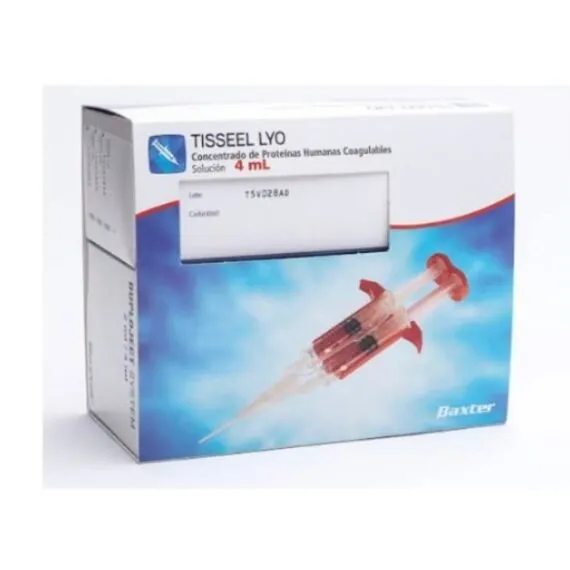
Table of Contents
- Package leaflet: Information for the patient
- TISSEEL 2 ml solution for tissue adhesive, 4 ml solution for tissue adhesive, 10 ml solution for tissue adhesive
- 1. What TISSEEL is and what it is used for
- 2. What you should know before being administered TISSEEL
- 3. How TISSEEL will be administered to you
- 4. Possible side effects
- 5. How to store TISSEEL
- 6. Package contents and other information
Package leaflet: Information for the patient
TISSEEL 2 ml solution for tissue adhesive, 4 ml solution for tissue adhesive, 10 ml solution for tissue adhesive
Human fibrinogen, human thrombin, synthetic aprotinin, calcium chloride dihydrate
Please read this leaflet carefully before you are given this medicine
because it contains important information for you.
- Keep this leaflet. You may need to read it again.
- If you have any questions, ask your doctor.
- If you get any side effects, talk to your doctor, pharmacist or nurse. This includes any possible side effects not listed in this leaflet. See section 4.
Contents of this leaflet:
- What TISSEEL is and what it is used for
- What you must know before being given TISSEEL
- How TISSEEL will be administered to you
- Possible side effects
- How to store TISSEEL
- Contents of the pack and other information
1. What TISSEEL is and what it is used for
What it is
TISSEEL is a medicinal product composed of two liquid components: fibrinogen (a sealing protein) and thrombin. These two blood proteins are very important for blood coagulation, and when mixed together, they form a clot at the application site.
The clot formed by TISSEEL is very similar to the one naturally formed during blood coagulation, and like the natural clot, it is degraded without leaving any residue. To prevent premature breakdown of the clot, a third synthetic protein, aprotinin, has been added to TISSEEL.
What it is used for
TISSEEL is applied to tissues of various organs during surgical procedures of different types in adults, in order to stop bleeding, seal the affected area, and support tissue regeneration.
TISSEEL adheres quickly and permanently; after surgery, it is left in place and is gradually absorbed by the body over time.
TISSEEL can be used in all applications of general and specialist surgery.
2. What you should know before being administered TISSEEL
You must not be given TISSEEL
- If you are allergic to products derived from human blood (human fibrinogen, human thrombin) or to any of the other components of this medicine (listed in section 6).
- If you are allergic to aprotinin, a protein (see section “Warnings and precautions”).
- Via intravascular route.
- For the treatment of severe or brisk venous or arterial bleeding. Administration of TISSEEL alone is not indicated in such situations.
- For injection into soft tissues, as there is a risk of anaphylactic reactions and/or local tissue damage.
Warnings and precautions
Talk to your doctor, pharmacist, or nurse before you are administered TISSEEL:
- if you are prone to allergies or have an allergy to proteins (e.g. aprotinin);
- if you are pregnant;
- if you are allergic to bovine proteins, since the synthetic aprotinin present in TISSEEL is structurally similar to bovine aprotinin;
- if you suffer from a blood disorder (e.g. haemolytic anaemia);
- if you have a disease affecting the immune system, the body's defence system (immunodeficiency);
- if you have previously been administered aprotinin, a protein.
- Very rare cases of potentially fatal/fatal gas embolism (air entering the bloodstream, which may be serious or life-threatening) have been reported with the use of spray devices using pressure regulators for the administration of fibrin sealants. This event appears to be related to the use of spray devices at pressures higher than recommended and/or too close to the tissue surface. The risk appears to be higher when fibrin sealants are nebulized with air rather than with CO_, and therefore cannot be excluded with TISSEEL when it is nebulized onto open surgical wounds.
- Spray devices and accessory tips are supplied with instructions for use and recommendations regarding pressure ranges and distance from the tissue surface for nebulization.
- TISSEEL must be administered strictly following the provided instructions and only with devices recommended for this product.
- When spraying TISSEEL, any changes in arterial pressure, pulse, oxygen saturation, and end-tidal CO_ concentration should be monitored, as gas embolism may occur.
Viral safety
TISSEEL is a medicine derived from human plasma (the liquid component of blood). When medicines are manufactured from human blood or plasma, several safety measures are applied to prevent transmission of infections to patients. These include careful selection of blood and plasma donors to ensure potential carriers of infection are excluded, and testing of each donation and plasma pool to detect the presence of viruses and infections. Manufacturers of such medicines also apply processing procedures that inactivate or remove viruses during production. Nevertheless, whenever medicines prepared from human blood or plasma are used, the possibility of transmitting infection cannot be completely ruled out. This also applies to unknown or emerging viruses or other types of infections.
The measures taken during the manufacturing of TISSEEL are considered effective against lipid-enveloped viruses such as human immunodeficiency virus (HIV), hepatitis B virus (HBV), hepatitis C virus (HCV), and against the non-lipid-enveloped hepatitis A virus.
The measures taken may have limited effectiveness against non-lipid-enveloped viruses such as parvovirus B19. Parvovirus B19 infection may be severe in pregnant women (fetal infection) and in individuals with immunodeficiency or increased red blood cell production (e.g. haemolytic anaemia).
Children and adolescents
The safety and efficacy of this product in paediatric patients have not been established.
Other medicines and TISSEEL
Inform your doctor if you are taking, have recently taken, or might take any other medicines.
TISSEEL with food and drink
Ask your doctor; they will assess whether you may drink or eat before the application of TISSEEL.
Pregnancy, breastfeeding and fertility
If you are pregnant, suspect you may be pregnant, plan to become pregnant, or are breastfeeding, ask your doctor for advice before being administered this medicine.
TISSEEL will be administered during pregnancy and breastfeeding only if clearly necessary.
The effects of TISSEEL on fertility have not been established.
Driving and using machines
Not applicable.
3. How TISSEEL will be administered to you
TISSEEL will be administered by surgeons experienced in the use of this type of medicinal product.
The surgeon will apply TISSEEL during surgery.
The amount of TISSEEL to be applied and the frequency of application will be determined by the surgeon, depending on the type of surgery and the surface area to be treated.
The use of TISSEEL is restricted to experienced surgeons specialized in the use of TISSEEL.
Before applying TISSEEL, the wound surface must be dried using standard techniques (e.g., intermittent application of swabs or gauze, use of suction devices).
When applying TISSEEL using a spray device, ensure that the pressure and distance from the tissue are within the ranges recommended by the manufacturer as indicated below:
| Pressure, distance, and recommended devices for Tisseel spray application | |||||
| Surgical procedures | Spray to be used | Applicator tips to be used | Pressure regulator to be used | Recommended distance from tissue | Recommended spray pressure |
| Open wound | Tisseel/Artiss Spray Set | n.a. | EasySpray | 10-15 cm | 1.5-2.0 bar (21.5-28.5 psi) |
| Package of 10 Tisseel/Artiss Spray Sets | n.a. | EasySpray | |||
| Laparoscopic / minimally invasive procedures | n.a. | Duplospray MIS 20 cm applicator | Duplospray MIS 1.5 bar pressure regulator | 2-5 cm | 1.2-1.5 bar (18-22 psi) |
| Duplospray MIS 30 cm applicator | |||||
| Duplospray MIS 40 cm applicator | |||||
| 360° endoscopic applicator with spray set and snap lock | |||||
| 360° endoscopic applicator with spray set and fixation | |||||
| Disposable tip | |||||
When spraying TISSEEL, any changes in arterial pressure, pulse, oxygen saturation, and end-tidal CO2 concentration should be monitored, as gaseous embolism may occur (see section 2).
4. Possible side effects
Like all medicines, this medicine can cause side effects, although not everyone gets them.
The following side effects may occur during or after administration of Tisseel:
- obstruction of a blood vessel caused by a gas bubble (gas embolism);
- severe allergic reactions. These reactions may occur, in particular, if the preparation is applied repeatedly or administered to patients with known allergy to aprotinin (see section 2 You will not be given TISSEEL) or to any of the other components of the medicine. Even if you have previously been administered TISSEEL and tolerated it well, a further administration of TISSEEL or accidental injection into a blood vessel could cause you severe allergic reactions;
- allergic reactions (anaphylactic reactions, anaphylactic shock) which may include:
- swelling of the skin (angioedema),
- burning and itching sensation at the site of administration,
- difficulty breathing (bronchospasm),
- chills,
- flushing,
- generalized hives,
- headache,
- drop in blood pressure, drowsiness,
- nausea, vomiting,
- restlessness, rapid heartbeat,
- feeling of tightness in the chest,
- tingling, shortness of breath;
- formation of blood clots that obstruct or prevent normal blood circulation (thrombosis, thromboembolism, disseminated intravascular coagulation - DIC);
- reduced blood flow to the body (shock);
- rarely, antibodies against components of fibrin glue/hemostatic agents may develop.
If you experience any of these side effects during administration of TISSEEL, your doctor will IMMEDIATELY STOP the administration at the first sign of warning, remove any remaining medicine, and administer appropriate therapy.
Immediate availability of equipment, medications, and trained personnel for emergency treatment is necessary, as rare but serious, sometimes fatal, side effects have been reported following the use of tissue adhesives, even in the absence of known allergy.
Regarding safety with respect to transmissible agents, see section "Viral safety".
Potentially life-threatening or fatal gas or air embolism has occurred when devices using pressurized gas or air are used; this event appears to be related to inappropriate use of the spray device (e.g. pressure higher than recommended or application too close to the tissue surface).
The side effects observed with TISSEEL and their frequency are summarized below:
very common (may affect more than 1 in 10 people)
- Accumulation of lymph fluid under the skin (seroma)
common (may affect up to 1 in 10 people)
- Wound infection after surgery
- Sensory disturbances
- Obstruction of the axillary vein
- Pain in arms and legs
- Increase in body temperature
- Skin rash
uncommon (may affect up to 1 in 100 people)
- Changes in blood tests (increase in fibrin degradation products)
- Procedure-related pain
frequency not known (cannot be estimated from the available data)
- Numbness
- Itching
- Erythema
- Decreased or increased heart rate
- Bruising
- Redness of the skin
- Blockage of a blood vessel, including in the brain (arterial embolism, cerebral artery embolism)
- Lack of blood flow to the brain (cerebral infarction)
- Difficulty breathing (dyspnea)
- Intestinal obstruction
- Impaired wound healing
- Swelling (edema)
Other side effects that have been reported with other medicines containing the same active substances as Tisseel (fibrinogen and thrombin), and which therefore may also be potential side effects of Tisseel, include:
- Blockage of a blood vessel (gas embolism or air embolism)
- Allergic reactions including:
- irritation at the application site
- tightness in the chest
- chills
- headache
- drowsiness
- restlessness
- vomiting
Reporting of side effects
If you experience any side effect, including those not listed in this leaflet, talk to your doctor, pharmacist, or nurse. You can also report side effects directly via the national reporting system at the website https://www.aifa.gov.it/content/segnalazioni-reazioni-avverse. By reporting side effects, you can help provide more information on the safety of this medicine.
5. How to store TISSEEL
Store and transport in a freezer (at a temperature equal to or below -20°C). The cold chain must not be interrupted until the time of use.
Keep in the original packaging to protect the medicine from light.
Keep this medicine out of the sight and reach of children.
Do not use this medicine after the expiry date which is stated on the carton after EXP.
The expiry date refers to the last day of that month.
Storage after thawing:
The unopened product, once thawed at room temperature, may be stored for up to 72 hours at controlled room temperature (not exceeding 25°C).
After thawing, the solution must not be refrozen or refrigerated!
Do not dispose of any medicine via wastewater or household waste. Ask your pharmacist how to dispose of medicines no longer in use. This will help protect the environment.
6. Package contents and other information
What TISSEEL contains
TISSEEL consists of 2 components:
-
Component 1
-
The active substances in 1 ml of solution are Human fibrinogen (clotting protein), 91 mg/ml; Synthetic aprotinin, 3000 KIU/ml.
-
The other components are Human albumin, L-Histidine, Niacinamide, Polysorbate 80 (Tween 80), Disodium citrate dihydrate, Water for injections.
-
Component 2 thrombin
-
The active substances in 1 ml of thrombin solution are: Human thrombin, 500 IU/ml; Calcium chloride dihydrate, 40 μmol/ml.
-
The other components are Human albumin, Sodium chloride, Water for injections.
Description of the appearance of TISSEEL and package contents
The Clottable protein solution and the Thrombin solution are contained in ready-to-use, single-use plastic dual-chamber syringes.
When frozen, TISSEEL appears as colorless or pale yellow, clear or slightly opalescent solutions.
After thawing, it appears as colorless or pale yellow liquids.
TISSEEL is available in the following pack sizes:
TISSEEL 2 ml solution for tissue adhesive
(composed of 1 ml of Clottable protein solution and 1 ml of Thrombin solution)
- One dual-chamber pre-filled syringe containing one of the two components in each chamber.
- One application device set (Duploject Combi - Set): 2 connectors, 4 blunt-tip applicator needles.
TISSEEL 4 ml solution for tissue adhesive
(composed of 2 ml of Clottable protein solution and 2 ml of Thrombin solution)
- One dual-chamber pre-filled syringe containing one of the two components in each chamber.
- One application device set (Duploject Combi - Set): 2 connectors, 4 blunt-tip applicator needles.
TISSEEL 10 ml solution for tissue adhesive
(composed of 5 ml of Clottable protein solution and 5 ml of Thrombin solution)
- One dual-chamber pre-filled syringe containing one of the two components in each chamber.
- One application device set (Duploject Combi - Set): 2 connectors, 4 blunt-tip applicator needles.
Not all pack sizes may be marketed.
Additional application accessories for the product may be requested from BAXTER.
Marketing Authorization Holder and Manufacturer
Baxter S.p.A. Piazzale dell’Industria, 20 I-00144 Roma
Takeda Manufacturing Austria AG
Industriestraße 67
1221 Wien
Austria
The following information is intended for medical professionals only:
What TISSEEL contains
TISSEEL contains two components:
Component 1
Solution of sealant or adhesive clotting proteins.
1 ml of solution contains human plasma clotting proteins in an amount of 96–125 mg/ml, of which:
Human fibrinogen (clotting protein) 91 mg
Synthetic aprotinin 3000 KIU
Component 2
Thrombin solution.
1 ml of solution contains:
Human thrombin 500 IU
Calcium chloride dihydrate 40 μmol
One ready-to-use, dual-chamber pre-filled syringe contains in one chamber the solution of sealant or adhesive clotting proteins (with synthetic aprotinin), frozen at volumes of 1 ml, 2 ml, or 5 ml, and in the other chamber the thrombin solution (with calcium chloride dihydrate), also frozen at volumes of 1 ml, 2 ml, or 5 ml,
allowing to obtain a total volume of 2 ml, 4 ml, or 10 ml of ready-to-use product.
| After mixing the two components | 2 ml | 4 ml | 10 ml |
| Component 1: Sealing protein solution Human Fibrinogen (as clotting protein) Aprotinin (synthetic) |
91 mg (45.5 mg/ml of solution) 3000 KIU (1500 KIU/ml of solution) |
182 mg (45.5 mg/ml of solution) 6000 KIU (1500 KIU/ml of solution) |
455 mg (45.5 mg/ml of solution) 15000 KIU (1500 KIU/ml of solution) |
| Component 2: Thrombin solution Human Thrombin Calcium Chloride Dihydrate |
500 IU (250 IU/ml of solution) 40 μmol (20 μmol/ml of solution) |
1000 IU (250 IU/ml of solution) 80 μmol (20 μmol/ml of solution) |
2500 IU (250 IU/ml of solution) 200 μmol (20 μmol/ml of solution) |
The product also contains Factor XIII in an amount less than or equal to 10 IU/ml.
Warnings for use
It is strongly recommended that whenever TISSEEL is administered to a patient, the product name and batch number be recorded in order to maintain a traceable link between the patient and the product batch.
Intravascular administration may increase the likelihood and severity of acute hypersensitivity reactions in sensitive patients.
INSTRUCTIONS FOR USE, HANDLING, AND DISPOSAL
General information
Before administering TISSEEL, ensure that areas of the body outside the application site are adequately protected to prevent tissue adhesion at unintended sites.
To prevent TISSEEL from adhering to gloves and instruments, moisten them with physiological saline solution prior to contact.
Like other similar products or thrombin solutions, the product may denature if exposed to solutions containing alcohol, iodine, or heavy metals (e.g., antiseptic solutions). Remove such substances as thoroughly as possible before applying the product.
Separate and sequential application of the two components of TISSEEL must be avoided.
Handling and preparation of the product for use
The Fibrinogen-containing solution and the Thrombin solution are contained in a ready-to-use, double-chamber, single-use syringe. The syringe nozzles of the pre-filled double-chamber syringe are sealed with a protective cap, and each syringe barrel is closed with a siliconized rubber stopper. The entire unit is packaged and hermetically sealed under aseptic conditions within two sterilized plastic-aluminum foil pouches.
The inner pouch and its contents are sterile unless the integrity of the outer packaging is compromised.
Thaw the pre-filled syringe using one of the following methods:
It is recommended to thaw and warm the two adhesive components using a sterile water bath at a temperature of 33–37°C. The water bath temperature must not exceed 37°C. (To maintain the specified temperature range, the water temperature should be monitored with a thermometer and the water replaced if necessary. If a sterile water bath is used for thawing and warming, the pre-filled double-chamber syringe system must be removed from the plastic-aluminum foil pouches.)
The protective cap of the syringe must not be removed until thawing is complete and the application device is ready for assembly. Do not use TISSEEL until it is completely thawed and warmed.
The ready-to-use syringe may also be thawed and stored at room temperature (not exceeding 25°C) for up to 72 hours. Warming is required before use.
1) Rapid thawing (using sterile water bath) – recommended method
Table 1 below provides thawing and warming times when using a sterile water bath. If a sterile water bath is used for thawing and warming, the pre-filled double-chamber syringe system must be removed from the plastic-aluminum foil pouches. Ensure that the syringe is completely immersed in the water.
Table 1: Thawing and warming times using a sterile water bath at 33°C up to a maximum of 37°C
| Package | Thawing and warming times in sterile water bath (product removed from plastic-aluminum packaging) |
| 2 ml | 5 minutes |
| 4 ml | 5 minutes |
| 10 ml | 10 minutes |
2) Thawing using a non-sterile water bath
Leave the ready-to-use syringe inside both bags and place it in a water bath outside the sterile area for the required time (see Table 2). Ensure that the packaging remains immersed in water throughout the entire thawing period. After thawing, remove the packages from the water bath, dry the outer packaging, and transfer the ready-to-use syringe and plunger into the sterile area.
Table 2 - Thawing and warming times using a non-sterile water bath from 33 °C to a maximum of 37 °C
| Package size | Thawing and warming times in a non-sterile water bath (product kept in plastic-aluminum packaging) |
| 2 ml | 15 minutes |
| 4 ml | 20 minutes |
| 10 ml | 35 minutes |
3) Thawing in an incubator
Alternatively, the adhesive components can be thawed and warmed in an incubator at a temperature between 33 °C and 37 °C. The thawing and warming times in an incubator are indicated in Table 3 below and refer to the product packaged in plastic-aluminum pouches.
Table 3: Thawing and warming times in an incubator from 33 °C up to a maximum of 37 °C.
| Package | Thawing and warming times in incubator (product kept in plastic-aluminum packaging) |
| 2 ml | 40 minutes |
| 4 ml | 50 minutes |
| 10 ml | 90 minutes |
4) Thawing at room temperature
A fourth alternative consists of thawing the product at room temperature. The times indicated in Table 4 are the minimum thawing times at room temperature not exceeding 25°C.
When thawing at room temperature, the product must be further warmed to 33°C–37°C in an incubator immediately before use. Table 4 also indicates the warming times in the incubator.
Table 4: Thawing times and warming times at room temperature (= R.T.), followed by additional warming immediately before use in an incubator from 33°C to a maximum of 37°C.
| Package | Thawing time at room temperature (product kept in plastic-aluminum packaging) | Heating time at 33-37°C in incubator after thawing at room temperature (product kept in plastic-aluminum packaging) |
| 2 ml | 80 minutes + 11 minutes | |
| 4 ml | 90 minutes + 13 minutes | |
| 10 ml | 160 minutes + 25 minutes | |
Note: Do not thaw the product by holding it in the hand.
Do not heat in a microwave.
After thawing, do not refrigerate or refreeze.
Stability after thawing
After thawing and warming (at temperatures between 33°C and 37°C, methods 1, 2, and 3), chemical and physical stability of the product has been demonstrated for 12 hours at 33°C to 37°C.
For product thawed at room temperature (method 4), chemical and physical stability has been demonstrated for 72 hours at temperatures not exceeding 25°C. Warm to 33°C to 37°C immediately before use.
From a microbiological standpoint, unless the method of opening/thawing excludes the risk of microbial contamination, the product must be used immediately after warming to 33°C to 37°C.
Handling after thawing / before application
To ensure optimal mixing of the two solutions, it is necessary to warm both adhesive components to a temperature of 33–37°C immediately before use. (The temperature of 37°C must in no case ever be exceeded!)
The solutions of coagulable sealing proteins and thrombin should be clear or slightly opalescent. Do not use solutions that are cloudy or contain deposits.
Before administration, the thawed product must be inspected visually for the presence of particulate matter, abnormal discoloration, or any changes in physical appearance. In such cases, discard the solution.
The thawed solution of coagulable proteins should appear as a slightly viscous liquid. If the solution has the consistency of a solidified gel, it should be considered denatured, for example due to a break in the cold chain or excessive heating. In this case, do not use TISSEEL.
Thawed product must not be refrozen or refrigerated.
For further instructions regarding preparation, please consult the responsible nurse or physician.
Storage after thawing:
After thawing, if kept in its intact plastic-aluminum packaging, the product may be stored for up to 72 hours at room temperature not exceeding 25°C. If not used within 72 hours after thawing, TISSEEL must be discarded.
After rapid thawing (at a temperature between 33°C and 37°C) without plastic-aluminum packaging, the product must be used immediately.
Thawed product must not be refrozen or refrigerated. Protect from light.
Administration
For application, the dual-chamber syringe containing the Solution of Coagulable Sealing Proteins and the Solution of Thrombin must be connected to a connector piece and an application needle provided in the package kit. The single plunger of the dual-chamber syringe ensures that equal volumes are dispensed through the connector piece before being mixed in the application needle and delivered.
The dose to be used depends on several variables, such as, but not exclusively, the type of surgical procedure, the extent of the area to be treated, the intended mode of application, and the number of applications.
The application of the product must always be decided on a case-by-case basis by the treating physician.
In clinical trials, individual doses typically ranged between 4 and 20 ml. For certain procedures (e.g., liver trauma or repair of extensive burn areas), larger volumes may be required.
The initial amount of product applied to a specific anatomical site or target area should be sufficient to cover the entire area intended for treatment. Application may be repeated if necessary. However, avoid reapplying TISSEEL onto a pre-existing polymerized layer of TISSEEL, as it will not adhere.
As a guideline for bonding surfaces, consider the following table:
Surface to be bonded Required TISSEEL package
8 cm TISSEEL 2 ml solution for tissue adhesive
16 cm TISSEEL 4 ml solution for tissue adhesive
40 cm TISSEEL 10 ml solution for tissue adhesive
Using the TISSEEL 2 ml package with the spray application technique, depending on the indication, surface areas from 25 to 100 cm² can be treated.
To avoid formation of excessively granular tissue and to ensure gradual absorption of the solidified fibrin glue, apply only a thin layer of TISSEEL.
Preparations containing oxidized cellulose must not be used with TISSEEL.
Preparations containing oxidized cellulose may reduce the effectiveness of TISSEEL and must not be used as carrier materials.
How to use
For topical use only.
To ensure optimal safety when using TISSEEL with spray application, the following recommendations must be followed:
In open surgical wounds, a pressure-regulating device delivering a maximum pressure not exceeding 2.0 bar (28.5 psi) must be used.
In minimally invasive/laparoscopic procedures, a pressure-regulating device delivering a maximum pressure not exceeding 1.5 bar (22 psi) and using exclusively carbon dioxide must be used.
Before applying TISSEEL, the wound surface must be dried using standard techniques (e.g., intermittent application of gauze, swabs, or use of suction devices).
Do not use air or pressurized gas to dry the site.
TISSEEL must be sprayed only onto visible application sites.
When fibrin glues are applied in confined spaces, the risk of compression-related complications should be considered.
Instructions for use
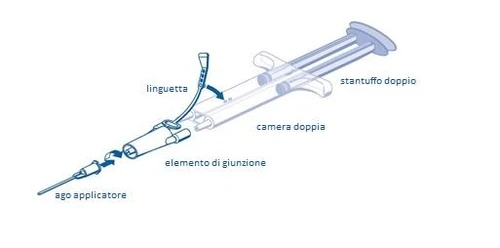
- Attach the nozzles of the dual-chamber syringe to the connector piece, ensuring a secure fit. Lock the connector piece by engaging the tab onto the dual-chamber syringe. If the tab breaks, use the spare connector piece provided. If no spare connector pieces are available, the device may still be used, provided that care is taken to ensure the connection is tight enough to prevent leakage.
- Insert an application needle into the connector piece. Do not expel residual air from the connector piece or application needle until application begins, as the needle opening could become blocked.
- Apply the mixed solution of coagulable proteins and thrombin to the surface to be treated or to the surfaces of the parts to be bonded.
Note: If the application of the fibrin glue components is interrupted, the needle will immediately become blocked. In this case, replace the application needle with a new one immediately before resuming application. If the openings of the connector piece are blocked, use the spare connector piece provided in the package.
After mixing of the adhesive components, fibrin glue formation begins within a few seconds due to the high concentration of thrombin (500 IU/ml).
In cases where very small volumes of TISSEEL are administered, immediately before application, expel and discard the first few drops from the application needle to ensure adequate mixing of the Solution of Sealing Adhesive Proteins with the Solution of Thrombin.
Application may also be performed using other accessories supplied by BAXTER that are particularly suitable, for example, for endoscopic use, minimally invasive surgery, or applications over large or hard-to-reach areas. When using these application devices, strictly follow the instructions for use provided with such devices.
Use only authorized/CE-marked devices for the administration of TISSEEL.
After applying TISSEEL, hold the two glued parts together with light pressure for approximately 3–5 minutes to allow sufficient polymerization to occur.
In some applications, a biocompatible material, for example, a collagen sheet, may be used as a carrier substance or as reinforcement.
Spray application
When applying TISSEEL using a spray device, ensure that the pressure and distance from the tissue are within the ranges recommended by the manufacturer as indicated below:
| Pressure, distance, and recommended devices for TISSEEL spray application | |||||
| Surgical procedures | Spray to use | Applicator tips to use | Pressure regulator to use | Recommended distance from tissue | Recommended spray pressure |
| Open wound | Tisseel/Artiss Spray Set | n.a. | EasySpray | 10-15 cm | 1.5-2.0 bar (21.5-28.5 psi) |
| Package of 10 Tisseel/Artiss Spray Sets | n.a. | EasySpray | |||
| Laparoscopic / minimally invasive procedures | n.a. | Duplospray MIS 20 cm applicator | Duplospray MIS 1.5 bar regulator | 2-5 cm | 1.2-1.5 bar (18-22 psi) |
| Duplospray MIS 30 cm applicator | |||||
| Duplospray MIS 40 cm applicator | |||||
| 360° endoscopic applicator with spray set and snap lock | |||||
| 360° endoscopic applicator with spray set and fixation | |||||
| Replaceable tip | |||||
When spraying TISSEEL, any changes in arterial pressure, pulse, oxygen saturation, and end-tidal CO concentration should be monitored, as gaseous embolism may occur (see section “Warnings and precautions”).
For spray application of TISSEEL in thoracoscopy and laparoscopic abdominal surgery, use of the DuploSpray MIS applicator and regulator system is recommended. However, the instructions for use provided in the user manual of this device must be strictly followed.
Very rare cases of potentially life-threatening/fatal gaseous embolism (air entering the bloodstream, which may be serious or life-threatening) have been reported with the use of spray devices employing pressure regulators for the administration of fibrin sealants. This event appears to be associated with the use of the spray device at pressures higher than recommended and/or too close to the tissue surface. The risk appears to be greater when fibrin sealants are nebulized using air instead of CO ; therefore, it cannot be excluded with TISSEEL when it is nebulized onto open surgical wounds.
Spray devices and accessory tips are supplied with instructions for use and recommendations regarding pressure ranges and spray distance from the tissue surface.
TISSEEL must be administered strictly in accordance with the provided instructions and only with devices recommended for this product.
When spraying TISSEEL, any changes in arterial pressure, pulse, oxygen saturation, and end-tidal CO concentration should be monitored, as gaseous embolism may occur.
Before administering TISSEEL, ensure that body parts outside the application area are adequately protected/covered to prevent unwanted tissue adhesion.
Disposal
Any unused product and waste material derived from this medicinal product should be disposed of in accordance with local regulations.