Tetanus gamma
Italy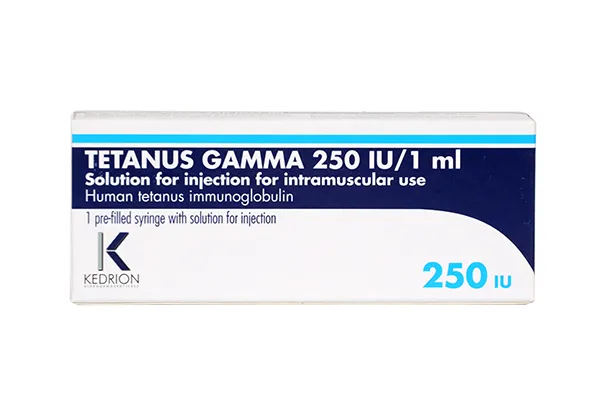
Table of Contents
- Package leaflet: Information for the patient
- TETANUS GAMMA 250 UI/1 ml Solution for injection for intramuscular use, 250 UI/2 ml Solution for injection for intramuscular use, 500 UI/2 ml Solution for injection for intramuscular use
- 1. What TETANUS GAMMA is and what it is used for
- 2. What you need to know before using TETANUS GAMMA
- 3. How to use TETANUS GAMMA
- 4. Possible adverse reactions
- 5. How to store TETANUS GAMMA
- 6. Contents of the package and other information
- The following information is intended exclusively for physicians or healthcare professionals
Package leaflet: Information for the patient
TETANUS GAMMA 250 UI/1 ml Solution for injection for intramuscular use, 250 UI/2 ml Solution for injection for intramuscular use, 500 UI/2 ml Solution for injection for intramuscular use
Human anti-tetanus immunoglobulin
Please read all of this leaflet carefully before using this medicine because it contains important information for you.
- Keep this leaflet. You may need to read it again.
- If you have any questions, ask your doctor, pharmacist, or nurse.
- This medicine has been prescribed for you only. Do not give it to other people, even if they have the same symptoms as yours, because it may be harmful.
- If you experience any adverse reaction, including those not listed in this leaflet, contact your doctor or nurse. See section 4.
Contents of this leaflet:
- What TETANUS GAMMA is and what it is used for
- What you need to know before using TETANUS GAMMA
- How to use TETANUS GAMMA
- Possible side effects
- How to store TETANUS GAMMA
- Contents of the pack and other information
1. What TETANUS GAMMA is and what it is used for
What TETANUS GAMMA is
TETANUS GAMMA is a solution of human anti-tetanus immunoglobulin, an antibody
produced by the human immune system and effective against toxins produced by the tetanus bacterium Clostridium tetani.
How TETANUS GAMMA works
Tetanus toxin causes a severe disease called tetanus, characterized by strong and intense
muscle spasms and rigidity, usually following infection of a wound. The infection
can be prevented through proper vaccination or post-exposure prophylaxis
(administration of antibodies immediately after exposure to the toxin). The antibodies
present in TETANUS GAMMA neutralize the tetanus toxin, counteracting its harmful effects and preventing the onset of tetanus (passive immunization).
What TETANUS GAMMA is used for
TETANUS GAMMA is usually used following possible exposure of wounds to tetanus (post-exposure prophylaxis) if:
- you have not been adequately vaccinated;
- your immune status is uncertain;
- you have a significant deficiency in antibody production.
TETANUS GAMMA may also be used in cases of clinically manifest tetanus,
always administered concomitantly with active tetanus vaccination, unless contraindications exist or adequate vaccination has been confirmed.
Your doctor or nurse will provide you with further information on why this medicine has been administered to you.
2. What you need to know before using TETANUS GAMMA
Do not use TETANUS GAMMA:
- if you are allergic to human immunoglobulins or to any of the other ingredients of this medicine (listed in section 6);
- by intravascular injection, due to the risk of shock;
- if you have antibodies directed against IgA immunoglobulins. This condition is very rare and may occur if you lack immunoglobulin A (IgA) in your blood.
Warnings and precautions
Talk to your doctor, pharmacist, or nurse before using TETANUS GAMMA.
- TETANUS GAMMA contains small amounts of immunoglobulin A (IgA). If you have IgA deficiency, you may develop anti-IgA antibodies and may experience severe allergic reactions (anaphylactic reactions) after administration of TETANUS GAMMA. In such cases, the doctor must carefully weigh the benefits of treatment with TETANUS GAMMA against the potential risk of hypersensitivity reactions.
- Rarely, human antitetanus immunoglobulin may cause a drop in blood pressure accompanied by an anaphylactic reaction, even in patients who previously tolerated treatment with human immunoglobulin.
- If allergic or anaphylactic reactions are suspected, administration must be stopped immediately. In case of shock, your doctor will initiate standard treatment appropriate for such situations.
Viral safety
Medicinal products prepared from human blood or plasma are subject to a series of safety measures to prevent transmission of infections to patients. These measures include:
- careful selection of blood or plasma donors to ensure that potentially infected donors are excluded;
- testing of each donation and plasma pool to detect the possible presence of viruses;
- inclusion of production steps capable of inactivating or removing pathogens.
Despite these measures, when administering medicinal products prepared from human blood or plasma, the possibility of transmitting infection cannot be completely ruled out. This also applies to emerging or unknown viruses or other infectious agents.
The measures taken are considered effective against lipid-enveloped viruses such as human immunodeficiency virus (HIV), hepatitis B virus (HBV), hepatitis C virus (HCV), and the non-lipid-enveloped hepatitis A virus (HAV).
The measures taken have limited effectiveness against non-lipid-enveloped viruses such as parvovirus B19.
Immunoglobulins have not been associated with hepatitis A (HAV) or parvovirus B19 infections, which may be due to the protective capacity of the antibodies contained in the product.
It is strongly recommended to record the brand name and batch number each time a dose of TETANUS GAMMA is administered, in order to maintain documentation of the batches used.
Blood tests
The use of TETANUS GAMMA may interfere with the results of certain blood tests (serological tests). Inform your doctor if you have been treated with TETANUS GAMMA, especially if you require blood testing.
Following immunoglobulin injection, the transient increase in passively transferred antibodies in the patient's blood may lead to false-positive results in serological tests.
Passive transfer of antibodies against erythrocyte antigens, e.g., A, B, D, may interfere with certain serological tests for red blood cell antibodies, such as the antiglobulin test (Coombs test).
Children
Specific data in the paediatric population are not available. The warnings and precautions mentioned above also apply to children and adolescents (0–18 years).
Other medicines and TETANUS GAMMA
Antitetanus immunoglobulin must not be mixed with other medicinal products.
Inform your doctor if you are currently taking, have recently taken, or might take any other medicines, including those obtained without a prescription.
Vaccines
After administration of TETANUS GAMMA, an interval of at least 3 months should elapse before vaccination with live attenuated virus vaccines such as those for rubella, mumps, and varicella, because TETANUS GAMMA may reduce the effectiveness of these vaccines. In the case of measles, this interference may persist for up to 5 months.
Pregnancy, breastfeeding, and fertility
If you are pregnant, think you may be pregnant, are planning to become pregnant, or are breastfeeding, consult your doctor before using this medicine.
Pregnancy and breastfeeding
The safety of this medicine during pregnancy has not been established in controlled clinical studies. Clinical experience with immunoglobulins suggests that harmful effects on the course of pregnancy and breastfeeding, or on the fetus and newborn, are not expected.
Fertility
The effect of TETANUS GAMMA treatment on fertility has not been established in controlled clinical studies. Clinical experience with immunoglobulins suggests that harmful effects on fertility are not expected.
Driving and using machines
TETANUS GAMMA has no effect or has a negligible effect on the ability to drive vehicles or operate machinery.
TETANUS GAMMA contains sodium
This medicine contains less than 1 mmol (23 mg) of sodium per 1 ml and 2 ml pre-filled syringe, i.e., essentially "sodium-free".
3. How to use TETANUS GAMMA
Use this medicine exactly as instructed by your doctor, pharmacist, or nurse. If you have any doubts, consult your doctor, pharmacist, or nurse.
In the absence of compatibility studies, TETANUS GAMMA must not be mixed with other medicines.
If administering the product alone, use TETANUS GAMMA exactly as directed by your doctor and consider the following recommendations:
- Inject TETANUS GAMMA by intramuscular injection, for example into the buttock or thigh.
- If more than one injection is required, administer divided doses at different injection sites.
- When concomitant vaccination is necessary, the immunoglobulin and the vaccine must be administered at two separate sites.
Your doctor will determine the dose of TETANUS GAMMA you will receive.
If you use more TETANUS GAMMA than you should
The consequences of overdose are unknown.
In case of accidental injection or ingestion of an excessive dose of this medicine, seek immediate advice from your doctor or go to the nearest hospital emergency department.
If you have any doubts about how to use this medicine, consult your doctor, pharmacist, or nurse.
4. Possible adverse reactions
Like all medicines, this medicine can cause adverse reactions, although not everybody gets them.
If you experience any of the following adverse reactions, you must inform your doctor:
- allergic reactions (hypersensitivity)
- anaphylactic shock
Other possible side effects may include:
- fast heartbeat (tachycardia)
- low blood pressure (hypotension)
- headache (cephalaea)
- nausea
- vomiting
- skin redness (erythema)
- itching (pruritus)
- joint pain (arthralgia)
- fever
- malaise
- chills
At the injection site, swelling (tumefaction), pain, erythema, induration, warmth, skin rash, and pruritus may occur.
Additional adverse reactions in children
Specific data in the paediatric population are not available.
Reporting of adverse reactions
If you get any adverse reactions, including those not listed in this leaflet, consult your doctor or nurse.
You may also report adverse reactions directly via the national reporting system at the following website:
https://www.aifa.gov.it/content/segnalazioni-reazioni-avverse .
By reporting adverse reactions, you can help provide more information on the safety of this medicine.
For information on viral safety, see section 2 "What you need to know before using TETANUS GAMMA".
5. How to store TETANUS GAMMA
Keep this medicine out of the sight and reach of children.
Do not use this medicine after the expiry date stated on the label after "EXP".
The expiry date refers to the last day of that month.
The expiry date applies to the product in its original packaging, stored correctly.
Do not use this medicine if you notice that the solution is cloudy or contains deposits.
Store in a refrigerator (2°C - 8°C).
Do not freeze.
Keep in the original packaging to protect from light.
Do not dispose of any medicine via wastewater or household waste. Ask your pharmacist how to dispose of medicines you no longer use. This will help protect the environment.
6. Contents of the package and other information
What TETANUS GAMMA contains
The active substance is human tetanus immunoglobulin.
The pre-filled syringes with the injection solution contain:
| TETANUS GAMMA 250 IU/1 ml | TETANUS GAMMA 250 IU/2 ml | TETANUS GAMMA 500 IU/2 ml | |
| Human proteins | 100 – 180 g/l | 100 – 180 g/l | 100 – 180 g/l |
| of which immunoglobulins G (IgG) not less than | 90% | 90% | 90% |
| antibodies against tetanus toxin | 250 IU/ml (250 IU/prefilled syringe) | 125 IU/ml (250 IU/prefilled syringe) | 250 IU/ml (500 IU/prefilled syringe) |
Distribution of IgG subclasses:
IgG 65.1%
IgG 30.3%
IgG 3.2%
IgG 1.4%
The maximum IgA content is 300 micrograms/ml.
Other components are glycine, sodium chloride, water for injections.
Description of the appearance of TETANUS GAMMA and contents of the pack
Injectable solution for intramuscular use
1 pre-filled syringe of 1 ml containing 250 IU of injectable solution
Pack containing one 1 ml pre-filled neutral transparent glass syringe containing 250 IU of human anti-tetanus immunoglobulin.
1 pre-filled syringe of 2 ml containing 250 IU of injectable solution
Pack containing one 2 ml pre-filled neutral transparent glass syringe containing 250 IU of human anti-tetanus immunoglobulin.
1 pre-filled syringe of 2 ml containing 500 IU of injectable solution
Pack containing one 2 ml pre-filled neutral transparent glass syringe containing 500 IU of human anti-tetanus immunoglobulin.
Marketing Authorization Holder and Manufacturer
Marketing Authorization Holder:
Kedrion S.p.A. - Loc. Ai Conti, 55051 Castelvecchio Pascoli, Barga (Lucca), Italy.
Manufacturer
Kedrion S.p.A. - S.S. 7 bis Km 19.5, S. Antimo (Naples), Italy.
The following information is intended exclusively for physicians or healthcare professionals
Instructions for Use
Dosage
Tetanus prophylaxis in potentially tetanus-infected wounds:
- 250 IU, unless the risk is considered extremely high. The dose may be increased to 500 IU in the following cases: infected wounds where adequate surgical treatment cannot be performed within 24 hours; deep or contaminated wounds with tissue damage and reduced oxygen supply, as well as wounds caused by foreign bodies (e.g., bites, stings, or gunshot injuries).
Treatment of clinically manifest tetanus:
Several studies suggest the value of human anti-tetanus immunoglobulin in the treatment of clinically manifest tetanus, using a single dose of 3000–6000 IU in combination with other appropriate clinical procedures.
Route of administration
Human anti-tetanus immunoglobulin must be administered intramuscularly.
If a large volume is required (>2 ml in children or >5 ml in adults), it is recommended to administer it in divided doses at different injection sites.
When simultaneous vaccination is required, immunoglobulin and vaccine should be administered at separate sites.
For prophylaxis, if intramuscular administration is contraindicated (e.g., coagulation disorders), the injection may be given subcutaneously. However, it should be noted that there are no clinical efficacy data supporting subcutaneous administration.
For acute treatment, if intramuscular administration is not clinically appropriate, an alternative intravenous product may be used if available.
Special Warnings and Precautions for Use
Ensure that TETANUS GAMMA is not administered intravascularly due to the risk of shock.
True hypersensitivity reactions are rare.