Tenkasi
Italy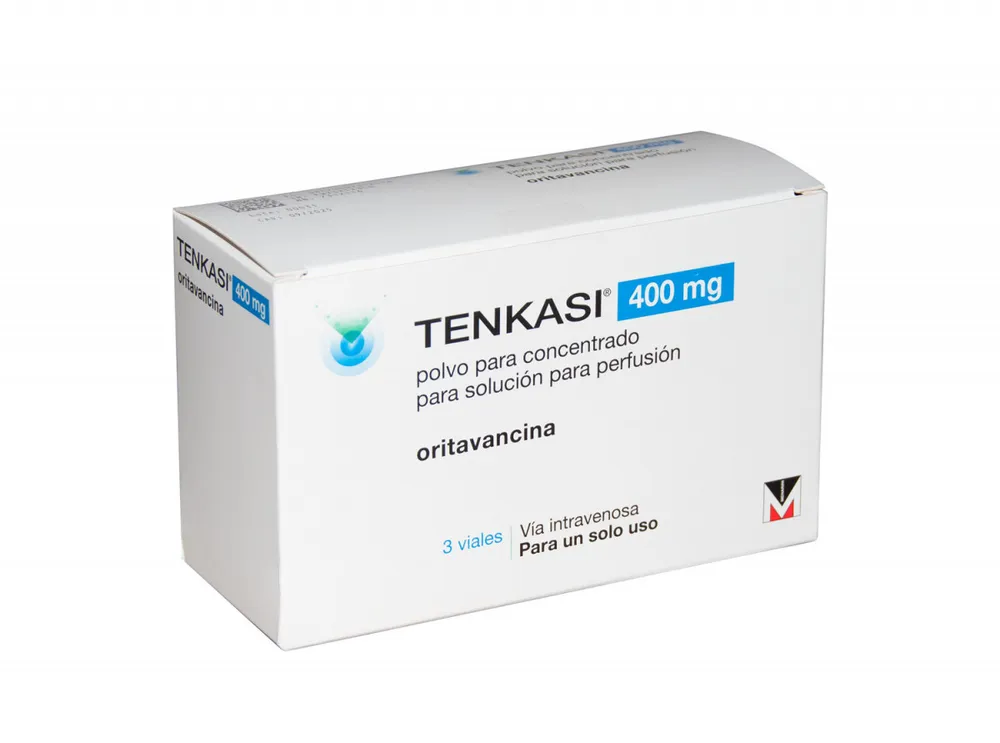
Table of Contents
- Package leaflet: Information for the patient
- Tenkasi 400 mg powder for concentrate for solution for infusion
- 1. What Tenkasi is and what it is used for
- 2. What you need to know before receiving Tenkasi
- 3. How Tenkasi will be administered to you
- 4. Possible side effects
- 5. How to store Tenkasi
- 6. Package contents and other information
- The following information is intended exclusively for healthcare professionals:
- Package leaflet: Information for the patient
- Tenkasi 1 200 mg powder for concentrate for solution for infusion
- 1. What Tenkasi is and what it is used for
- 2. What you should know before receiving Tenkasi
- 3. How Tenkasi will be administered to you
- 4. Possible side effects
- 5. How to store Tenkasi
- 6. Package contents and other information
- The following information is intended for healthcare professionals only:
Package leaflet: Information for the patient
Tenkasi 400 mg powder for concentrate for solution for infusion
oritavancin
Please read this leaflet carefully before receiving this medicine because it contains
important information for you.
- Keep this leaflet. You may need to read it again.
- If you have any questions, ask your doctor or nurse.
- If you experience any side effects, including those not listed in this leaflet, inform your doctor or nurse. See section 4.
Contents of this leaflet:
- What Tenkasi is and what it is used for
- What you need to know before receiving Tenkasi
- How Tenkasi will be administered to you
- Possible side effects
- How to store Tenkasi
- Contents of the pack and other information
1. What Tenkasi is and what it is used for
Tenkasi is an antibiotic that contains the active substance oritavancin. Oritavancin is a type of antibiotic (a lipoglycopeptide antibiotic) that can kill or stop the growth of certain bacteria.
Tenkasi is used to treat skin and underlying tissue infections.
It is intended for use in adults and pediatric patients aged 3 months and older.
Tenkasi can only be used to treat infections caused by bacteria known as Gram-positive bacteria. In mixed infections where other types of bacteria are suspected, your doctor will give you other appropriate antibiotics alongside Tenkasi.
2. What you need to know before receiving Tenkasi
Do not receive Tenkasi
- if you are allergic to oritavancin or to any of the other ingredients of this medicine (listed in section 6).
- if you are expected to receive a blood thinner (unfractionated sodium heparin) within 5 days (120 hours) after your dose of Tenkasi.
Warnings and precautions
Talk to your doctor or nurse before receiving Tenkasi if:
- you have ever had an allergic reaction to another glycopeptide antibiotic (such as vancomycin and telavancin)
- you have previously developed severe diarrhea during or after antibiotic treatment.
- you have or suspect you have a bone infection caused by bacteria (osteomyelitis). Your doctor will treat you as necessary.
- you have or suspect you have a painful collection of pus on the skin (abscess). Your doctor will treat you as necessary.
Intravenous infusions of Tenkasi may cause flushing of the upper body,
hives, itching and/or skin rashes. Infusion-related reactions have also been observed,
characterized by chest pain, chest discomfort, chills, shivering, back pain, neck pain,
shortness of breath, abdominal pain, fever and headache, fatigue, drowsiness, which could
be symptoms of hypoxia. If such reactions occur, your doctor may decide to
stop or slow down the infusion.
Tenkasi may interfere with laboratory tests measuring your blood's clotting ability and may cause a false reading.
Antibiotics, including Tenkasi, fight certain bacteria, but may not be effective against other
bacteria or fungi, which may therefore continue to grow. This is known as overgrowth.
Your doctor will monitor you in case this occurs and treat you if necessary.
After receiving Tenkasi, you may develop a new infection at another site on the skin. In this
case, you will be monitored and treated by your doctor as needed.
Children and adolescents
Tenkasi must not be used in children under 3 months of age. Tenkasi has not yet been
studied in this age group.
Other medicines and Tenkasi
Tell your doctor if you are using, have recently used, or might use any other medicines.
If you are to be given a blood thinner called unfractionated heparin, inform your doctor if you have received Tenkasi in the past 5 days (120 hours).
It is particularly important to tell your doctor if you are currently taking medicines that prevent blood clotting (oral anticoagulants, e.g. coumarin anticoagulants). Tenkasi may interfere with laboratory tests or self-testing used to measure blood clotting (INR), altering the results for up to 12 hours after infusion.
Pregnancy and breastfeeding
If you are pregnant, think you might be pregnant, planning to become pregnant, or are breastfeeding, ask your doctor or pharmacist for advice before taking this medicine.
You should not be given this medicine during pregnancy unless the benefit is considered greater than the risk to the unborn child.
Driving and using machines
Tenkasi may cause dizziness which could affect your ability to drive vehicles and use
machinery.
3. How Tenkasi will be administered to you
Tenkasi is available as Tenkasi 400 mg and Tenkasi 1,200 mg. The two products differ in the
amount of oritavancin per vial, infusion duration, and preparation instructions for administration.
Your doctor or nurse will carefully administer Tenkasi 400 mg to you by intravenous infusion (into a vein).
In adults, the recommended dose of Tenkasi is a single 3-hour infusion of 1,200 mg (equivalent to 3 vials of 400 mg) given intravenously.
For pediatric patients aged 3 months and older, the recommended dose of Tenkasi will be calculated based on body weight and age: a single intravenous infusion of 15 mg per kg of body weight administered over 3 hours (maximum 1,200 mg). Please refer to section 6 for further details.
If you receive more Tenkasi than you should
Your doctor will decide how to manage your treatment, including possible discontinuation of therapy and monitoring for signs of adverse effects.
4. Possible side effects
Like all medicines, this medicine can cause side effects, although not everybody gets them.
Tell your doctor or nurse immediately if you have an infusion reaction, including any of the following symptoms:
- Flushing of the face and upper body, hives, itching and/or skin rashes
- Shortness of breath (or wheezing)
- Difficulty breathing
- Swelling around the throat or under the skin that develops quickly
- Chills or shaking
- Rapid or weak pulse
- Chest pain or tightness
- Low blood pressure (which may make you feel weak or confused)
These reactions can be life-threatening.
Other side effects occur at the following frequencies:
Common side effects (may affect up to 1 in 10 people):
- Reduced number of red blood cells or lower haemoglobin levels than normal
- Feeling dizzy
- Headache
- Nausea or vomiting
- Diarrhoea
- Constipation
- Pain or irritation at the site where the infusion was given
- Itching, skin rash
- Muscle pain
- Increased liver enzymes (shown by blood tests)
- Fast or rapid heartbeat
- Worsening of an infection or a new infection at another site on the skin
- Red, swollen area on or under the skin that feels warm and tender
- Collection of pus under the skin
Uncommon side effects (may affect up to 1 in 100 people):
- Higher than normal levels of eosinophils, a type of white blood cells (eosinophilia)
- Low blood glucose levels
- High levels of uric acid in the blood
- Increased levels of bilirubin in the blood
- Severe skin rash
- Flushing
- Inflammation around a tendon (known as tenosynovitis)
- Bone infection caused by bacteria (known as osteomyelitis)
- Reduced platelet count in the blood below the normal range (known as thrombocytopenia)
- Abdominal pain
- Chest pain
- Fever
- Shortness of breath
Rare side effects (may affect up to 1 in 1,000 people):
- Headache, fatigue, drowsiness, which could be symptoms of low oxygen levels in body tissues (hypoxia)
- Back pain
- Neck pain
- Chills
- Tremor
Additional side effects in children and adolescents
Side effects in paediatric patients are similar to those observed in adults. Side effects observed only in paediatric patients include: irritability, changes in heart rhythm on electrocardiogram (ECG) (transient, asymptomatic and not associated with other cardiac changes), intestinal infection (colitis due to Clostridioides difficile).
Reporting of side effects
If you get any side effects, including those not listed in this leaflet, talk to your doctor or nurse. You can also report side effects directly via the national reporting system listed in Annex V. By reporting side effects, you can help provide more information on the safety of this medicine.
5. How to store Tenkasi
Keep this medicine out of the sight and reach of children.
Do not use this medicine after the expiry date stated on the label. The expiry date refers to the last day of that month.
Do not store above 25 °C.
The diluted solution must be used immediately.
From a microbiological standpoint, the product should be used immediately. If not used immediately, the storage duration and conditions prior to use are the responsibility of the user and normally do not exceed 12 hours at 25 °C and 24 hours at 2 °C - 8 °C for Tenkasi diluted in a 5% glucose intravenous infusion bag.
Do not dispose of any medicine via wastewater or household waste. Ask your pharmacist how to dispose of medicines you no longer use. This will help protect the environment.
6. Package contents and other information
What Tenkasi contains
- The active substance is oritavancin. Each vial contains oritavancin diphosphate equivalent to 400 mg of oritavancin.
- The other components are mannitol and phosphoric acid (for pH adjustment).
Description of the appearance of Tenkasi and contents of the pack
- Tenkasi is a powder for concentrate for solution for infusion.
- Tenkasi is a white to off-white powder supplied in a 50 mL glass vial.
- Tenkasi is available in cartons containing 3 vials.
Marketing Authorisation Holder
Menarini International Operations Luxembourg S.A.
1, Avenue de la Gare
L-1611, Luxembourg
Luxembourg
Manufacturer
Falorni S.r.l.
Via dei Frilli 25
50019 Sesto Fiorentino (FI)
Italy
For further information about this medicinal product, please contact the local representative of the Marketing Authorisation Holder:
België/Belgique/Belgien Lietuva
Menarini Benelux NV/SA UAB “BERLIN-CHEMIE MENARINI
Tél/Tel: + 32 (0)2 721 4545 BALTIC”
Tel: +370 52 691 947
България Luxembourg/Luxemburg
Берлин-Хеми/А. Менарини България EООД Menarini Benelux NV/SA
тел.: +359 24540950 Tél/Tel: + 32 (0)2 721 4545
Česká republika Magyarország
Berlin-Chemie/A.Menarini Ceska republika s.r.o. Berlin-Chemie/A. Menarini Kft.
Tel: +420 267 199 333 Tel.: +36 1799 7320
Danmark Malta
Menarini International Operations Luxembourg Menarini International Operations Luxembourg
S.A. S.A.
Tlf: +352 264976 Tel: +352 264976
Deutschland Nederland
Berlin-Chemie AG Menarini Benelux NV/SA
Tel: +49 (0) 30 67070 Tel: +32 (0)2 721 4545
Eesti Norge
OÜ Berlin-Chemie Menarini Eesti Menarini International Operations Luxembourg
Tel: +372 667 5001 S.A.
Tlf: +352 264976
Ελλάδα Österreich
MENARINI HELLAS AE A. Menarini Pharma GmbH
Τηλ: +30 210 8316111-13 Tel: +43 1 879 95 85-0
España Polska
Laboratorios Menarini S.A. Berlin-Chemie/Menarini Polska Sp. z o.o.
Tel: +34-93 462 88 00 Tel.: +48 22 566 21 00
France Portugal
MENARINI France A. Menarini Portugal – Farmacêutica, S.A.
Tél: +33 (0)1 45 60 77 20 Tel: +351 210 935 500
Hrvatska România
Berlin-Chemie Menarini Hrvatska d.o.o. Berlin-Chemie A.Menarini S.R.L.
Tel: + 385 1 4821 361 Tel: +40 21 232 34 32
Ireland Slovenija
A. Menarini Pharmaceuticals Ireland Ltd Berlin-Chemie / A. Menarini Distribution
Tel: +353 1 284 6744 Ljubljana d.o.o.
Tel: +386 01 300 2160
Ísland Slovenská republika
Menarini International Operations Luxembourg Berlin-Chemie / A. Menarini Distribution
S.A. Slovakia s.r.o
Sími: +352 264976 Tel: +421 2 544 30 730
Italia Suomi/Finland
A. Menarini - Industrie Farmaceutiche Riunite - Berlin-Chemie/A.Menarini Suomi OY
s.r.l. Puh/Tel: +358 403 000 760
Tel: +39-055 56801
Κύπρος Sverige
MENARINI HELLAS AE Menarini International Operations Luxembourg
Τηλ: +30 210 8316111-13 S.A.
Tel: +352 264976
Latvija United Kingdom (Northern Ireland)
SIA Berlin-Chemie/Menarini Baltic A. Menarini Farmaceutica Internazionale S.R.L.
Tel: +371 67103210 Tel: +44 (0)1628 856400
Other sources of information
More detailed information on this medicinal product is available on the website of the European Medicines Agency: http://www.ema.europa.eu.
The following information is intended exclusively for healthcare professionals:
Tenkasi is intended for intravenous (IV) administration only after reconstitution and dilution.
Tenkasi should be prepared in a pharmacy using aseptic techniques.
There are two oritavancin-containing medicinal products (Tenkasi 400 mg and Tenkasi 1,200 mg) that:
- Are supplied in different oritavancin strengths.
- Have different recommended infusion durations.
- Have different preparation instructions, including differences in reconstitution, dilution, and compatible diluents. Follow the recommended instructions for each medicinal product carefully.
Three Tenkasi 400 mg vials must be reconstituted and diluted to prepare a single 1,200 mg IV dose for single use. The powder must be reconstituted with Water for Injections and the resulting concentrate must be diluted with a 5% dextrose intravenous infusion bag prior to use. Both the reconstituted solution and the diluted infusion solution should be clear, colourless to pale yellow solutions. Parenteral products should be inspected visually for particulate matter after reconstitution. Aseptic procedures must be used in the preparation of Tenkasi.
Adults
Three Tenkasi 400 mg vials must be reconstituted and diluted to prepare a single single-use 1,200 mg IV dose.
Reconstitution: Aseptic technique must be used to reconstitute three Tenkasi 400 mg vials.
- 40 mL of Sterile Water for Injections (WFI) must be added using a sterile syringe to each vial to provide a 10 mg/mL solution per vial.
- To avoid excessive foaming, it is recommended to carefully add the Sterile Water for Injections along the walls of the vials.
- Each vial should be gently rotated to avoid foaming and ensure that all Tenkasi powder is completely reconstituted in solution.
The reconstituted solution must be further diluted immediately in a 5% dextrose intravenous infusion bag.
Dilution: Three reconstituted vials are required for dilution and administration of a single 1,200 mg IV infusion. Only a 5% dextrose intravenous infusion bag (D5W) must be used for dilution.
To dilute:
- Withdraw and discard 120 mL from a 1,000 mL D5W IV infusion bag.
- Withdraw 40 mL from each of the three reconstituted vials and add to the D5W IV infusion bag to bring the bag volume back to 1,000 mL. This results in an oritavancin concentration of 1.2 mg/mL. Polypropylene (PP) or polyvinyl chloride (PVC) bags must be used for preparation for administration.
Use in the paediatric population (aged 3 months to < 18 years)
Calculate the required oritavancin dose based on patient weight (a single 15 mg/kg IV infusion administered over 3 hours).
Determine the number of oritavancin vials required for the patient (each vial contains oritavancin difosphate equivalent to 400 mg of oritavancin).
Reconstitution:
- 40 mL of Water for Injections (WFI) must be added using a sterile syringe to each vial to provide a 10 mg/mL solution per vial.
- To avoid excessive foaming, WFI should be added carefully along the walls of the vials.
- Each vial should be gently agitated to avoid foaming and ensure all powder is completely reconstituted in solution.
Dilution: Only a 5% dextrose intravenous infusion bag (D5W) must be used for dilution. Sodium chloride solution must not be used for dilution.
To dilute:
Withdraw the required volume of oritavancin using a sterile syringe and add it to an IV infusion bag containing sterile D5W (refer to Table 1 for the relevant example). The size of the IV bag will be based on the total volume to be administered. For small volumes, an infusion pump may be used.
Table 1: Oritavancin 15 mg/kg: 3-hour infusion (concentration of 1.2 mg/mL)
[Note: Table content not provided in source text.]
| Patient weight (kg) | Oritavancin dose calculated (mg) | Total infusion volume (mL) | Volume of reconstituted oritavancin (mL) | Volume of D5W to be added to the intravenous infusion bag (IV-Bag) (mL) |
| 5 | 75 | 62.5 | 7.5 | 55 |
| 10 | 150 | 125 | 15 | 110 |
| 15 | 225 | 187.5 | 22.5 | 165 |
| 20 | 300 | 250 | 30 | 220 |
| 25 | 375 | 312.5 | 37.5 | 275 |
| 30 | 450 | 375 | 45 | 330 |
| 35 | 525 | 437.5 | 52.5 | 385 |
| 40 | 600 | 500 | 60 | 440 |
Calculations
- Use the patient's actual body weight, ROUNDED ONLY TO THE NEAREST WHOLE NUMBER
- Dose: Weight (kg) x 15 mg/kg = ______ mg (Maximum dose 1200 mg)
- Total infusion volume: Dose (mg) ÷ 1.2 mg/mL = _______ mL
- Volume of reconstituted oritavancin: Dose (mg) ÷ 10 = ______ mL
- Volume of D5W to be added to the IV bag: Total infusion volume (C) – Volume of reconstituted oritavancin (D) = _______ mL
The reconstituted solution must be used immediately.
From a microbiological standpoint, the product should be used immediately. If not used immediately, storage times and conditions prior to use are the responsibility of the user and normally should not exceed 12 hours at 25 °C or 24 hours at 2 °C–8 °C for Tenkasi diluted in the 5% dextrose infusion bag.
Package leaflet: Information for the patient
Tenkasi 1 200 mg powder for concentrate for solution for infusion
oritavancin
Please read this leaflet carefully before receiving this medicine because it contains
important information for you.
- Keep this leaflet. You may need to read it again.
- If you have any questions, ask your doctor or nurse.
- If you experience any side effects, including those not listed in this leaflet, tell your doctor or nurse. See section 4.
Contents of this leaflet:
- What Tenkasi is and what it is used for
- What you need to know before receiving Tenkasi
- How Tenkasi will be administered to you
- Possible side effects
- How to store Tenkasi
- Contents of the pack and other information
1. What Tenkasi is and what it is used for
Tenkasi is an antibiotic that contains the active substance oritavancin. Oritavancin is a type of antibiotic (a lipoglycopeptide antibiotic) that can kill or stop the growth of certain bacteria.
Tenkasi is used to treat skin and underlying tissue infections.
It is intended for use in adults only.
Tenkasi can only be used to treat infections caused by bacteria known as Gram-positive bacteria. In mixed infections where other types of bacteria are suspected, your doctor will give you other appropriate antibiotics in addition to Tenkasi.
2. What you should know before receiving Tenkasi
Do not receive Tenkasi
- if you are allergic to oritavancin or to any of the other ingredients of this medicine (listed in section 6).
- if you are expected to need a blood thinner (unfractionated sodium heparin) within 5 days (120 hours) after your dose of Tenkasi.
Warnings and precautions
Talk to your doctor or nurse before receiving Tenkasi if:
- you have ever had an allergic reaction to another glycopeptide antibiotic (such as vancomycin and telavancin)
- you have previously developed severe diarrhoea during or after treatment with antibiotics.
- you have or suspect you have a bone infection caused by bacteria (osteomyelitis). Your doctor will treat you as necessary.
- you have or suspect you have a painful collection of pus on the skin (abscess). Your doctor will treat you as necessary.
Intravenous infusions of Tenkasi may cause flushing of the upper body, hives, itching and/or skin rashes. Infusion-related reactions have also been observed, characterized by chest pain, chest discomfort, chills, shivering, back pain, neck pain, shortness of breath, abdominal pain, fever and headache, fatigue, drowsiness, which could be symptoms of hypoxia. If such reactions occur, your doctor may decide to stop or slow down the infusion.
Tenkasi may interfere with laboratory tests measuring your blood’s clotting ability and may cause a false reading.
Antibiotics, including Tenkasi, fight certain bacteria but may not be active against other bacteria or fungi, which may therefore continue to grow. This is called overgrowth. Your doctor will monitor you if this occurs and treat you if necessary.
After receiving Tenkasi, you may develop a new infection at another site on the skin. In such cases, you will be monitored and treated by your doctor as needed.
Children and adolescents
Tenkasi must not be used in children or adolescents under 18 years of age.
Other medicines and Tenkasi
Tell your doctor if you are using, have recently used, or might use any other medicines.
If you are due to receive a blood thinner called unfractionated heparin, inform your doctor if you have received Tenkasi within the last 5 days (120 hours).
It is particularly important to tell your doctor if you are currently taking medicines that prevent blood clotting (oral anticoagulants, e.g. coumarin anticoagulants). Tenkasi may interfere with laboratory tests or self-testing used to measure blood clotting (INR), altering the results for up to 12 hours after infusion.
Pregnancy and breastfeeding
If you are pregnant, think you might be pregnant, planning to become pregnant, or breastfeeding, consult your doctor or pharmacist before taking this medicine.
This medicine should not be given during pregnancy unless the benefit outweighs the risk to the unborn child.
Driving and using machines
Tenkasi may cause dizziness, which may affect your ability to drive or operate machinery.
Tenkasi contains cyclodextrin
Tenkasi 1200 mg contains 2400 mg of hydroxypropylbetadex per vial, equivalent to 9.6 mg/mL.
3. How Tenkasi will be administered to you
Tenkasi is available as Tenkasi 1 200 mg and Tenkasi 400 mg. The two products differ in the
amount of oritavancin per vial, the duration of infusion, and the preparation instructions for
administration.
Your doctor or nurse will carefully administer Tenkasi 400 mg to you as an intravenous infusion (into a vein).
In adults, the recommended dose for Tenkasi is a single 3-hour infusion of 1 200 mg administered into a vein.
If you receive more Tenkasi than you should
Your doctor will decide how to manage your treatment, including stopping the treatment and monitoring for signs of adverse effects.
4. Possible side effects
Like all medicines, this medicine can cause side effects, although not everybody gets them.
Tell your doctor or nurse immediately if you have an infusion reaction, including any of the following symptoms:
- Flushing of the face and upper body, hives, itching and/or skin rash
- Shortness of breath (or wheezing)
- Difficulty breathing
- Swelling around the throat or under the skin that develops rapidly
- Chills or shivering
- Fast or weak pulse
- Chest pain or tightness
- Drop in blood pressure (which may make you feel weak or confused)
These reactions can be life-threatening.
Other side effects occur with the following frequencies:
Common side effects (may affect up to 1 in 10 people):
- Reduced number of red blood cells or lower haemoglobin levels than normal
- Feeling dizzy
- Headache
- Nausea or vomiting
- Diarrhoea
- Constipation
- Pain or irritation at the site where the infusion was given
- Itching, skin rash
- Muscle pain
- Increased liver enzymes (shown in blood tests)
- Rapid or pounding heartbeat
- Worsening of an infection or a new infection at another site on the skin
- Red, swollen area on or under the skin that is warm and tender
- Collection of pus under the skin
Uncommon side effects (may affect up to 1 in 100 people):
- Higher than normal levels of eosinophils, a type of white blood cell (eosinophilia)
- Low blood glucose levels
- High levels of uric acid in the blood
- Increased levels of bilirubin in the blood
- Severe skin rash
- Flushing
- Inflammation around a tendon (known as tenosynovitis)
- Bone infection caused by bacteria (known as osteomyelitis)
- Reduced platelet count in the blood below the lower limit of normal (known as thrombocytopenia)
- Abdominal pain
- Chest pain
- Fever
- Shortness of breath
Rare side effects (may affect up to 1 in 1,000 people):
- Headache, fatigue, drowsiness, which could be symptoms of low oxygen levels in body tissues (hypoxia)
- Back pain
- Neck pain
- Chills
- Tremor
Reporting of side effects
If you get any side effects, including those not listed in this leaflet, talk to your doctor or nurse.
You can also report side effects directly via the national reporting system listed in Annex V. By reporting side effects, you can help provide more information on the safety of this medicine.
5. How to store Tenkasi
Keep this medicine out of the sight and reach of children.
Do not use this medicine after the expiry date stated on the label. The expiry date refers to the last
day of that month.
This medicine requires no special storage conditions.
The diluted solution must be used immediately.
From a microbiological standpoint, the product should be used immediately. If not used immediately,
the storage times and conditions prior to use are the responsibility of the user and normally do not exceed
4 hours at 25 °C and 12 hours at 2 °C - 8 °C for Tenkasi diluted in 5% glucose or 0.9% sodium chloride
infusion bag for intravenous use.
Do not dispose of any medicine via wastewater or household waste. Ask your pharmacist how to
dispose of medicines no longer required. This will help protect the environment.
6. Package contents and other information
What Tenkasi contains
- The active substance is oritavancin. The vial contains oritavancin diphosphate equivalent to 1,200 mg of oritavancin.
- The other components are hydroxypropylbetadex (see section 2 “Tenkasi contains cyclodextrins”), mannitol, phosphoric acid (for pH adjustment), and sodium hydroxide (for pH adjustment).
Description of the appearance of Tenkasi and contents of the pack
- Tenkasi is a powder for concentrate for solution for infusion.
- Tenkasi is a white to pinkish powder supplied in a 50 mL glass vial.
- Tenkasi is available in cartons containing 3 vials.
Marketing Authorization Holder
Menarini International Operations Luxembourg S.A.
1, Avenue de la Gare
L-1611, Luxembourg
Luxembourg
Manufacturer
Falorni S.r.l.
Via dei Frilli 25
50019 Sesto Fiorentino (FI)
Italy
For further information about this medicinal product, please contact the local representative of the Marketing Authorization Holder:
België/Belgique/Belgien Lietuva
Menarini Benelux NV/SA UAB “BERLIN-CHEMIE MENARINI
Tél/Tel: + 32 (0)2 721 4545 BALTIC”
Tel: +370 52 691 947
България Luxembourg/Luxemburg
Берлин-Хеми/А. Менарини България EООД Menarini Benelux NV/SA
тел.: +359 24540950 Tél/Tel: + 32 (0)2 721 4545
Česká republika Magyarország
Berlin-Chemie/A.Menarini Ceska republika s.r.o. Berlin-Chemie/A. Menarini Kft.
Tel: +420 267 199 333 Tel.: +36 1799 7320
Danmark Malta
Menarini International Operations Luxembourg Menarini International Operations Luxembourg
S.A. S.A.
Tlf: +352 264976 Tel: +352 264976
Deutschland Nederland
Berlin-Chemie AG Menarini Benelux NV/SA
Tel: +49 (0) 30 67070 Tel: +32 (0)2 721 4545
Eesti Norge
OÜ Berlin-Chemie Menarini Eesti Menarini International Operations Luxembourg
Tel: +372 667 5001 S.A.
Tlf: +352 264976
Ελλάδα Österreich
MENARINI HELLAS AE A. Menarini Pharma GmbH
Τηλ: +30 210 8316111-13 Tel: +43 1 879 95 85-0
España Polska
Laboratorios Menarini S.A. Berlin-Chemie/Menarini Polska Sp. z o.o.
Tel: +34-93 462 88 00 Tel.: +48 22 566 21 00
France Portugal
MENARINI France A. Menarini Portugal – Farmacêutica, S.A.
Tél: +33 (0)1 45 60 77 20 Tel: +351 210 935 500
Hrvatska România
Berlin-Chemie Menarini Hrvatska d.o.o. Berlin-Chemie A.Menarini S.R.L.
Tel: + 385 1 4821 361 Tel: +40 21 232 34 32
Ireland Slovenija
A. Menarini Pharmaceuticals Ireland Ltd Berlin-Chemie / A. Menarini Distribution
Tel: +353 1 284 6744 Ljubljana d.o.o.
Tel: +386 01 300 2160
Ísland Slovenská republika
Menarini International Operations Luxembourg Berlin-Chemie / A. Menarini Distribution
S.A. Slovakia s.r.o
Sími: +352 264976 Tel: +421 2 544 30 730
Italia Suomi/Finland
A. Menarini - Industrie Farmaceutiche Riunite - Berlin-Chemie/A.Menarini Suomi OY
s.r.l. Puh/Tel: +358 403 000 760
Tel: +39-055 56801
Κύπρος Sverige
MENARINI HELLAS AE Menarini International Operations Luxembourg
Τηλ: +30 210 8316111-13 S.A.
Tel: +352 264976
Latvija United Kingdom (Northern Ireland)
SIA Berlin-Chemie/Menarini Baltic A. Menarini Farmaceutica Internazionale S.R.L.
Tel: +371 67103210 Tel: +44 (0)1628 856400
Other sources of information
More detailed information on this medicinal product is available on the website of the European Medicines Agency: http://www.ema.europa.eu.
The following information is intended for healthcare professionals only:
Tenkasi is intended for intravenous (IV) administration only after reconstitution and dilution.
Tenkasi should be prepared using aseptic techniques.
There are two oritavancin-containing medicinal products (Tenkasi 400 mg and Tenkasi 1 200 mg) that:
- Are supplied in different oritavancin strengths.
- Have different recommended infusion durations.
- Have different preparation instructions, including differences in reconstitution, dilution, and compatible diluents. Follow the recommended instructions carefully for each medicinal product.
Tenkasi 1 200 mg must be reconstituted and diluted to prepare a single single-dose of 1 200 mg IV for single use. The powder must be reconstituted with sterile Water for Injections and the resulting concentrate must be diluted with a 5% dextrose or 9 mg/mL (0.9%) sodium chloride intravenous infusion bag prior to use. Both the reconstituted solution and the diluted infusion solution must be clear, colourless to pink in colour. Parenteral medicinal products should be inspected visually for particulate matter after reconstitution. Aseptic procedures must be used for the preparation of Tenkasi.
Reconstitution:
- 40 mL of sterile Water for Injections (WFI) should be added using a sterile syringe to reconstitute the vial, yielding a solution of 30 mg/mL per vial.
- To avoid excessive foaming, it is recommended to carefully add sterile Water for Injections along the walls of the vial.
- The vial should be gently rotated to avoid foam formation and ensure complete reconstitution of all Tenkasi powder in solution.
Dilution: For dilution, intravenous infusion bags containing 5% dextrose (D5W) or 9 mg/mL (0.9%) sodium chloride must be used.
To dilute:
- Withdraw and discard 40 mL from a 250 mL D5W or 0.9% sodium chloride intravenous infusion bag.
- Withdraw 40 mL from the reconstituted vial and add it to the D5W or 0.9% sodium chloride intravenous infusion bag to bring the bag volume back to 250 mL. This results in a concentration of 4.8 mg/mL of oritavancin. For administration preparation, PP (polypropylene) or PVC (polyvinyl chloride) bags should be used.
The diluted solution should be used immediately.
From a microbiological standpoint, the product should be used immediately. If not used immediately, the storage duration and conditions prior to use are the responsibility of the user and normally should not exceed 12 hours at 25 °C or 24 hours at 2 °C–8 °C for Tenkasi diluted in a 5% dextrose or 0.9% sodium chloride intravenous infusion bag.