Tardyfer
Italy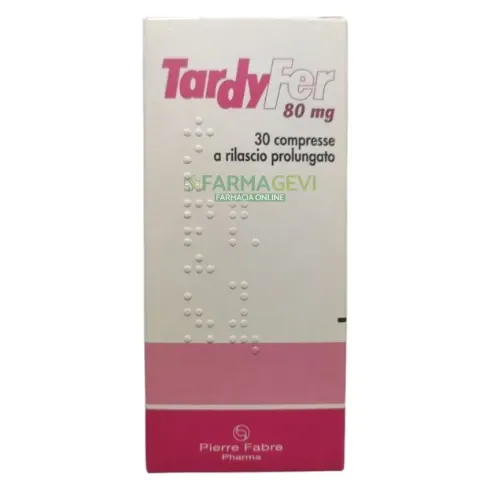
Table of Contents
Package leaflet: Information for the patient
TARDYFER 80 mg prolonged-release tablets
Iron as dried ferrous sulfate
Please read this leaflet carefully before using this medicine because it contains important information for you.
- Keep this leaflet. You may need to read it again.
- If you have any questions, consult your doctor or pharmacist.
- This medicine has been prescribed for you only. Do not give it to other people, even if their symptoms are the same as yours, as it may be harmful.
- If you experience any side effects, including those not listed in this leaflet, consult your doctor or pharmacist. See section 4. Contents of this leaflet:
- What Tardyfer is and what it is used for
- What you need to know before taking Tardyfer
- How to take Tardyfer
- Possible side effects
- How to store Tardyfer
- Contents of the pack and other information
1. What Tardyfer is and what it is used for
Tardyfer contains iron.
Tardyfer is used for the treatment of iron deficiency.
This medicine is intended for use in adults and children over 10 years of age.
2. What you should know before using Tardyfer
Do not use Tardyfer
- If you (or your child) are allergic to iron or to any of the other ingredients of this medicine (listed in section 6).
- If you (or your child) have more iron in the body than needed.
- If you (or your child) have a type of anaemia (insufficient red blood cells) not caused by iron deficiency or that causes iron overload (e.g. thalassaemia, refractory anaemia, anaemia caused by bone marrow deficiency).
Warnings and precautions
Talk to your doctor or pharmacist before using Tardyfer.
-
If you (or your child) are taking dietary supplements and/or iron supplements, because high doses of iron (10–20 times the usual dose) may cause poisoning, especially in children.
-
If you (or your child) have a disease affecting iron storage and absorption (e.g. haemolytic anaemia, haemoglobinopathy, myelodysplasia).
-
If you (or your child) have iron-deficiency anaemia associated with an inflammatory condition, treatment with Tardyfer will not be effective.
-
If you (or your child) have difficulty swallowing.
-
If you (or your child) choke and a tablet accidentally goes down the wrong way, contact your doctor as soon as possible. This is because there is a risk of ulcers and bronchial narrowing if the tablet enters the airways. This may cause persistent cough, coughing up blood and/or shortness of breath, even if the choking incident occurred days or months before these symptoms appear. Therefore, you (or your child) should undergo urgent evaluation to ensure the tablet has not damaged the airways.
-
According to literature data, gastrointestinal wall discoloration has been observed in elderly patients taking iron supplements who also have chronic kidney disease, diabetes (abnormally high blood sugar levels) and/or hypertension (high blood pressure), and who are being treated for these conditions. This gastrointestinal discoloration may interfere with gastrointestinal surgery. In view of this risk, if surgery is planned, it is advisable to inform the surgeon about ongoing iron supplementation (see section 4).
-
According to literature data, gastrointestinal side effects and changes in bowel habits after starting treatment have been reported less frequently in patients receiving alternate-day dosing compared to daily oral iron supplementation. If these effects occur, contact your doctor, who will decide together with you the most suitable regimen.
-
According to literature data, cases of gastric ulceration and gastrointestinal bleeding have been reported in patients treated with iron tablets. In such cases, it is recommended to switch to a liquid formulation of iron.
-
Due to the risk of mouth ulceration and tooth discoloration, the tablets must not be sucked, chewed, or held in the mouth, but should be swallowed whole with water. If you are unable to follow these instructions or have difficulty swallowing, contact your doctor.
Children and adolescents
Tardyfer can be used in children over 10 years of age.
Other medicines and Tardyfer
Tell your doctor or pharmacist if you are taking, have recently taken, or might take any other medicines.
If you (or your child) are already taking any of the medicines listed below, do not take Tardyfer unless your doctor has instructed you to do so. Some medicines should not be used at the same time, while others may require adjustments (e.g. in timing of administration).
If you (or your child) are taking injectable medicines containing iron or chloramphenicol, you must avoid using Tardyfer.
If you are taking any of the following medicines, separate the administration of Tardyfer by at least 2 hours:
- certain antibiotics (tetracyclines, fluoroquinolones, cefdinir).
- medicines for treating bone fragility (bisphosphonates).
- medicines for treating joint diseases, Wilson’s disease, or to prevent kidney stones (penicillamine, trientine).
- medicines for treating excess stomach acid: mineral gastrointestinal preparations, charcoal, or antacids (aluminum, calcium, and magnesium salts).
- medicines for treating thyroid disorders (thyroxine).
- medicines for treating Parkinson’s disease (methyldopa, levodopa, carbidopa, entacapone).
- supplements and/or medicines containing calcium or zinc.
If you are taking medicines for HIV treatment (integrase inhibitors):
Bictegravir: bictegravir must be administered at least 2 hours before iron salts or taken with food.
Dolutegravir: dolutegravir must be administered at least 2 hours before or 6 hours after iron salts, or taken with food.
For other integrase inhibitors, there must be a time interval between the administration of the two medicines, in accordance with the prescribing information for the integrase inhibitor, but this interval must not be less than 2 hours.
If you are taking a medicine for chronic urinary tract infections (acetohydroxamic acid), inform your doctor.
If you (or your child) are taking anti-inflammatory medicines belonging to the group of non-steroidal anti-inflammatory drugs (NSAIDs), they should be taken with food to reduce gastrointestinal irritation and bleeding caused by these medicines.
If you (or your child) are taking colestyramine (used in patients with high cholesterol levels), Tardyfer should be taken 1 to 2 hours before or 4 to 6 hours after colestyramine.
Tardyfer with food, drinks and alcohol
You should not drink large amounts of tea, coffee, or red wine, as this may reduce iron absorption in your body.
It is not advisable to take this medicine at the same time as whole grains (bran, legumes, oilseeds), certain proteins (eggs), or foods or drinks containing calcium (such as cheese, milk, etc.).
Allow an interval (at least 2 hours) between taking iron salts and these foods.
Pregnancy, breastfeeding and fertility
If you are pregnant, think you may be pregnant, planning to become pregnant, or breastfeeding, ask your doctor or pharmacist for advice before taking this medicine.
No specific studies are available in pregnant women during the first trimester to assess the risk of malformations. However, a large amount of bibliographic data from the second and third trimesters of pregnancy do not indicate any malformations or foeto-neonatal toxicity.
Therefore, Tardyfer may be used during pregnancy if clinically necessary.
Tardyfer may be used during breastfeeding.
Driving and using machines
It is unlikely that the use of Tardyfer will affect the ability to drive vehicles or operate machinery.
Tardyfer contains less than 1 mmol of sodium (23 mg) per tablet, i.e. it is essentially “sodium-free”.
3. How to use Tardyfer
Use this medicine exactly as directed by your doctor or pharmacist. If you have any doubts, consult your doctor or pharmacist.
Tardyfer is indicated for children over ten years of age and for adults.
The recommended dose for adults and children over 10 years of age is: 1 tablet daily (80 mg daily).
In cases of more pronounced iron deficiency, the dose may be increased to 2 tablets daily, 1 in the morning and 1 in the evening (160 mg daily).
Your doctor may temporarily recommend alternate-day administration depending on the severity and individual tolerance, to avoid interruption of treatment.
Method of administration
Tardyfer is in the form of tablets for oral use.
Swallow the tablet whole with water. Do not suck, chew, or hold the tablet in the mouth. The tablets should be taken with a full glass of water, either before or during meals, depending on gastrointestinal tolerance (except with foods specified in the section "Tardyfer with food, drink, and alcohol").
Duration of treatment
The treatment duration should be sufficient to correct iron deficiency (anaemia) and restore iron stores; generally from 3 to 6 months. Your doctor will inform you about the appropriate duration of treatment.
If you have any doubts, consult your doctor or pharmacist.
If you (or your child) have taken more Tardyfer than you should
In case of overdose, contact your doctor or the nearest emergency unit immediately, especially if it concerns a child.
Symptoms of iron overdose include the following:
- Severe gastrointestinal irritation which may lead to digestive tissue necrosis: abdominal pain, nausea, vomiting (sometimes containing blood), and diarrhoea (sometimes with black stools).
- Metabolic acidosis, blood coagulation disorders, rapid drop in blood pressure, insufficient blood supply to the body's organs and tissues (signs of kidney dysfunction, lack of energy, coma often accompanied by seizures), which may progress to shock.
- Signs of impaired liver function which may lead to brain damage.
Long-term gastrointestinal consequences may include digestive tract narrowing (digestive stenosis): nausea, bloating, constipation, and abdominal distension.
If you forget to take/administer Tardyfer
If you forget to take/administer a tablet, take/give it as soon as possible. However, if it is almost time for the next dose, skip the missed dose and continue with your regular dosing schedule.
If you stop taking Tardyfer
Tardyfer should be taken/administered according to your doctor's prescription. If treatment is stopped prematurely, symptoms may recur.
If you have any further questions about the use of this medicine, consult your doctor or pharmacist.
4. Possible side effects
Like all medicines, this medicine can cause side effects, although not everybody gets them.
You (or your child) may experience the following side effects, listed from most to least common:
Common (may occur in up to 1 in 10 people)
Constipation, diarrhoea, bloated abdomen, abdominal pain, altered stool colour, nausea.
Uncommon (may occur in up to 1 in 100 people)
Swelling of the throat (laryngeal oedema), abnormal stools, indigestion (dyspepsia), vomiting, inflammation of the stomach lining (gastritis), itching (pruritus), skin rash with redness (erythematous rash).
Frequency not known (frequency cannot be estimated from the available data)
Allergic reaction, itchy skin rash (urticaria), death of lung cells or tissue (pulmonary necrosis)*, inflammation of lung tissue (pulmonary granuloma)*, narrowing of the airways (bronchostenosis)*, ulceration of the throat*, oesophageal lesions*, oesophageal ulceration*, discolouration of teeth**, mouth ulceration**, oesophageal lesions*, abnormal pigmentation of the gastrointestinal tract wall (gastrointestinal melanosis) (see section 2), open gastric wound, gastric bleeding (see section 2).
All patients, but especially elderly patients and those with swallowing difficulties, may be at risk of throat or oesophageal ulceration (the tube connecting the mouth to the stomach) if the tablet enters the airways. If the tablet enters the respiratory tract, there may be a risk of bronchial ulceration (the main airways of the lungs) and pulmonary granuloma (inflammation), resulting in bronchial narrowing.
**in case of incorrect use, when tablets are chewed, sucked, or held in the mouth.
If any of the side effects worsen, or if you notice any side effects not listed in this leaflet, inform your doctor or pharmacist.
Reporting of side effects
If you experience any side effect, including those not listed in this leaflet, talk to your doctor or pharmacist. You may also report side effects directly via the national reporting system at https://www.aifa.gov.it/content/segnalazioni-reazioni-avverse.
By reporting side effects, you can help provide more information on the safety of this medicine.
5. How to store Tardyfer
Keep this medicine out of the sight and reach of children.
Do not use this medicine after the expiry date stated on the blister and carton. The expiry date refers to the last day of the month.
This medicine does not require any special storage conditions. Do not dispose of medicines via wastewater or household waste. Ask your pharmacist how to dispose of medicines you no longer use. This will help protect the environment.
6. Package contents and other information
What Tardyfer contains
- The active substance is: iron (80 mg), as dried ferrous sulfate (247.25 mg) per prolonged-release tablet.
- The other components are: maltodextrin, microcrystalline cellulose, triethyl citrate, talc, methacrylic acid-ammonium copolymer dispersion type B (Eudragit RS 30D), methacrylic acid-ammonium copolymer dispersion type A (Eudragit RL 30D), glyceryl dibehenate, titanium dioxide (E171), sepifilm LP010*, iron oxide yellow (E172), iron oxide red (E172). * Composition of sepifilm LP010: hypromellose, microcrystalline cellulose, stearic acid.
Description of the appearance of Tardyfer and contents of the pack
This medicine is an orange-pink, coated, round tablet.
It is available in packs containing 20, 30, 60 or 90 prolonged-release tablets.
Not all pack sizes may be marketed.
Pierre Fabre Pharma S.r.l.
Via G. Washington, 70
20146 MILAN
ITALY
Responsible manufacturer for batch release
Pierre Fabre Médicament Production
Etablissement Progipharm
Rue du Lycée
45500 Gien – France
This leaflet was last approved on: