Tamarine
Italy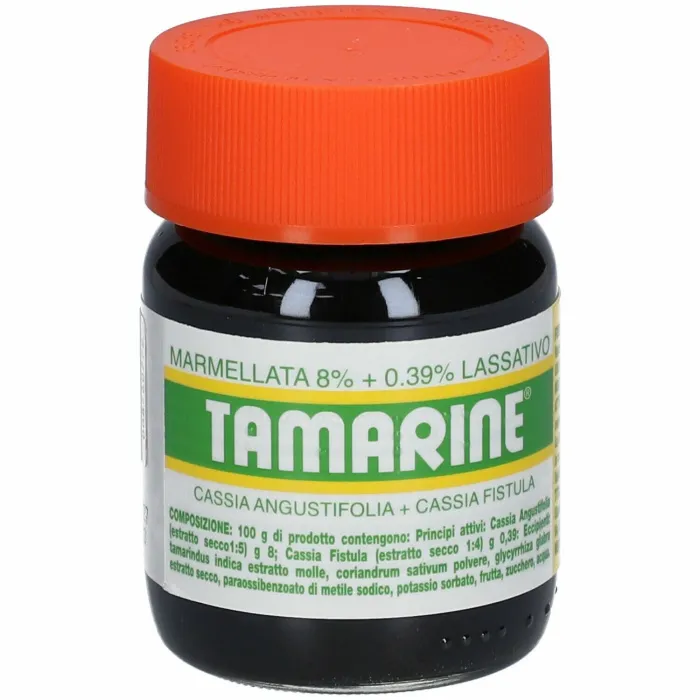
Table of Contents
Package leaflet: Information for the patient
Tamarine 80 mg/g + 3.9 mg/g jam
cassia angustifolia + cassia fistula
Please read this leaflet carefully before using this medicine because it contains important information for you.
Use this medicine exactly as described in this leaflet or as your doctor or pharmacist has instructed you.
- Keep this leaflet. You may need to read it again.
- If you need more information or advice, consult your pharmacist.
- If any of the side effects occur, including those not listed in this leaflet, contact your doctor or pharmacist. See section 4.
- Contact your doctor if you do not notice improvement or if your symptoms worsen after 7 days.
Contents of this leaflet:
- What Tamarine is and what it is used for
- What you need to know before using Tamarine
- How to use Tamarine
- Possible side effects
- How to store Tamarine
- Contents of the pack and other information
1. What Tamarine is and what it is used for
Tamarine contains the active ingredients cassia angustifolia and cassia fistula, which have a laxative effect.
Tamarine is indicated for short-term treatment of occasional constipation.
Consult your doctor if you do not feel better or if you feel worse after 7 days.
2. What you need to know before using Tamarine
Do not use Tamarine if:
- you are allergic to Cassia angustifolia, Cassia fistula, or any of the other ingredients of this medicine (listed in section 6);
- you have Crohn’s disease or ulcerative proctocolitis (inflammatory bowel diseases);
- you have been diagnosed with peritonitis (inflammation of the tissues lining the organs within the abdomen);
- you have liver diseases;
- you have abdominal pain, even of unknown origin;
- you are experiencing episodes of nausea or vomiting;
- you have intestinal obstruction;
- you have rectal bleeding of unknown origin;
- you have or are at risk of gastrointestinal tract perforation (stomach and intestine);
- you have acute diverticulitis (recent onset inflammation of diverticula, small balloon-shaped pouches forming on the intestinal wall);
- you have appendicitis (inflammation of a small intestinal outpouching located in the lower right part of the abdomen);
- you are suffering from severe dehydration (excessive loss of body water) and have lost essential blood electrolytes (sodium and potassium);
- you are pregnant or breastfeeding (see "Fertility, pregnancy and breastfeeding"). Tamarine must not be administered to children under 12 years of age.
Warnings and precautions
Consult your pharmacist before using Tamarine.
Health education notes
First of all, it should be noted that, in most cases, a balanced diet rich in water and fiber (bran, vegetables, and fruit) can durably resolve constipation problems.
Many people believe they suffer from constipation if they cannot defecate every day. This is a misconception, as this condition is completely normal for many individuals.
Constipation should instead be considered when bowel movements are reduced compared to your usual habits and are associated with the passage of hard stools.
If episodes of constipation recur frequently, consult your doctor.
The treatment of chronic or recurrent constipation always requires medical supervision for diagnosis, prescription of medicines, and monitoring during treatment.
Consult your doctor:
- if the need for this medicine is due to a sudden change in your bowel habits (frequency and characteristics of bowel movements) lasting more than two weeks, or when the use of laxatives fails to produce effects.
- if you are elderly or in poor general health.
Laxative abuse
Frequent, prolonged, or excessive-dose use of laxatives may cause persistent diarrhea, resulting in loss of water, blood electrolytes (especially potassium), and other essential nutrients. In severe cases, dehydration (excessive loss of body water) or hypokalemia (decreased blood potassium levels) may occur, potentially causing problems to the heart, nerves, and muscles—especially if you are also being treated with cardiac glycosides (medicines used to treat heart problems), diuretics (medicines used to lower blood pressure), or corticosteroids (anti-inflammatory agents)—see “Other medicines and Tamarine”. Laxative abuse may lead to dependence (possible need to progressively increase the dose), chronic constipation, and intestinal atony (loss of normal intestinal function).
Other medicines and Tamarine
Inform your doctor or pharmacist if you are taking, have recently taken, or might take any other medicines, including those without a prescription.
Avoid taking laxatives together with other medicines: if you are taking another medicine, wait at least 2 hours before taking the laxative.
Do not take Tamarine at the same time as antacids (medicines that reduce stomach acidity).
Wait at least 1 hour after taking an antacid before taking the laxative.
Inform your doctor if you are being treated with:
- diuretics (medicines used to lower blood pressure)
- adrenocorticosteroids (anti-inflammatory agents)
- cardiac glycosides (medicines used to treat heart problems)
- quinidine or other antiarrhythmic drugs (medicines used to treat heart rhythm disorders).
Tamarine with food and drinks
Milk may alter the effect of Tamarine.
Wait at least 1 hour after drinking milk before taking the laxative.
Do not take Tamarine if you consume licorice excessively.
Fertility, pregnancy and breastfeeding
If you are pregnant, think you may be pregnant, are planning a pregnancy, or are breastfeeding, consult your doctor or pharmacist before taking this medicine.
Tamarine must not be used during pregnancy or breastfeeding (see “Do not use Tamarine if”).
Driving and using machines
It is not known whether Tamarine affects the ability to drive or use machinery.
Tamarine contains sucrose
Tamarine contains sucrose: if your doctor has diagnosed you with an intolerance to certain sugars, contact him/her before taking this medicine.
Tamarine contains sodium methyl parahydroxybenzoate.
It may cause delayed allergic reactions.
Tamarine contains less than 1 mmol (23 mg) of sodium per dose (1 coffee spoon), i.e., essentially "sodium-free".
3. How to use Tamarine
Take this medicine exactly as stated in this leaflet or as prescribed by your doctor or pharmacist. If you have any doubts, consult your doctor or pharmacist.
Dosage
Adults
The recommended dose is 1 coffee spoonful.
Adolescents over 12 years of age
The recommended dose is 1/4 (one quarter) of a coffee spoonful.
It is recommended to follow the dosage instructions provided.
Do not exceed the recommended doses.
TAMARINE is contraindicated in children under 12 years of age.
Duration of treatment
Laxatives should be used as infrequently as possible and for no longer than 7 days.
Use for longer periods requires a doctor's prescription following appropriate clinical evaluation.
Method of administration
For oral use.
Take with a full glass of water.
It is preferable to take it in the evening.
If you take more Tamarine than you should
In case of accidental ingestion of an excessive dose of Tamarine, contact your doctor immediately or go to the nearest hospital.
In case of accidental ingestion/overdose, abdominal pain and diarrhoea may occur; in such cases, discontinue treatment and drink fluids to replace fluid and electrolyte losses (blood salts).
In case of overdose, symptomatic treatment should be provided; refer to the recommendations of a poison control centre, if available.
If you forget to take Tamarine
Do not take a double dose to make up for the missed dose.
If you stop using Tamarine
If you have any doubts about using this medicine, consult your doctor or pharmacist.
4. Possible side effects
Like all medicines, this medicine can cause side effects, although not everybody gets them.
Side effects with unknown frequency (frequency cannot be estimated from the available data):
- allergic reactions
- hyperaldosteronism (increased activity of the adrenal glands causing fluid retention, increased blood pressure, and weakness), decreased levels of calcium, magnesium, sodium, and potassium in the blood, dehydration (excessive loss of water from the body), loss of electrolytes from the blood
- hypotension (low blood pressure)
- megacolon (enlargement of the intestine), diarrhoea, nausea, abdominal discomfort
- myopathy (muscle disorder)
- kidney problems
- chromaturia (abnormal colouration of urine)
- fatigue
- drug tolerance (loss of medicine effectiveness)
Following the instructions provided in the package leaflet reduces the risk of side effects.
Reporting of side effects
If you experience any side effect, including those not listed in this leaflet, contact your doctor or pharmacist.
You may also report side effects directly via the national reporting system at the following website: https://www.aifa.gov.it/content/segnalazioni-reazioni-avverse. By reporting side effects, you can help provide more information on the safety of this medicine.
5. How to store Tamarine
Do not store above 25 °C. Store in the original packaging. Keep the container tightly closed.
Keep this medicine out of the sight and reach of children.
Do not use this medicine after the expiry date stated on the label after "Exp". The expiry date refers to the last day of that month.
Shelf life after first opening the container: 60 days
Do not dispose of any medicine via wastewater or household waste. Ask your pharmacist how to dispose of medicines no longer in use. This will help protect the environment.
6. Package contents and other information
What Tamarine contains
- The active substances are cassia angustifolia and cassia fistula. 100 g of product contain 8 g of Cassia angustifolia Vahl powder (leaves), equivalent to 0.2 g of hydroxyanthracene glycosides, as sennoside B, and 0.39 g of aqueous extract of Cassia fistula (4:1), (fruit pulp).
- The other components are Tamarindus indica soft extract, Coriandrum sativum powder, Glycyrrhiza glabra dry extract, sodium parahydroxybenzoate, mirabella flavour, sodium hydroxide (for pH adjustment), citric acid (for taste adjustment), jam (sucrose, fruit, tartaric acid, potassium sorbate, water).
Description of the appearance of Tamarine and contents of the pack
Glass jar with cap and non-toxic liner: 170 g, 260 g of jam.
PE jar: 260 g of jam.
Not all pack sizes may be marketed.
Marketing Authorization Holder
Haleon Italy S.r.l. - Via Monte Rosa 91 - 20149 Milan
Manufacturer
Gerolymatos International S.A.
Athens, Greece