Tad
Italy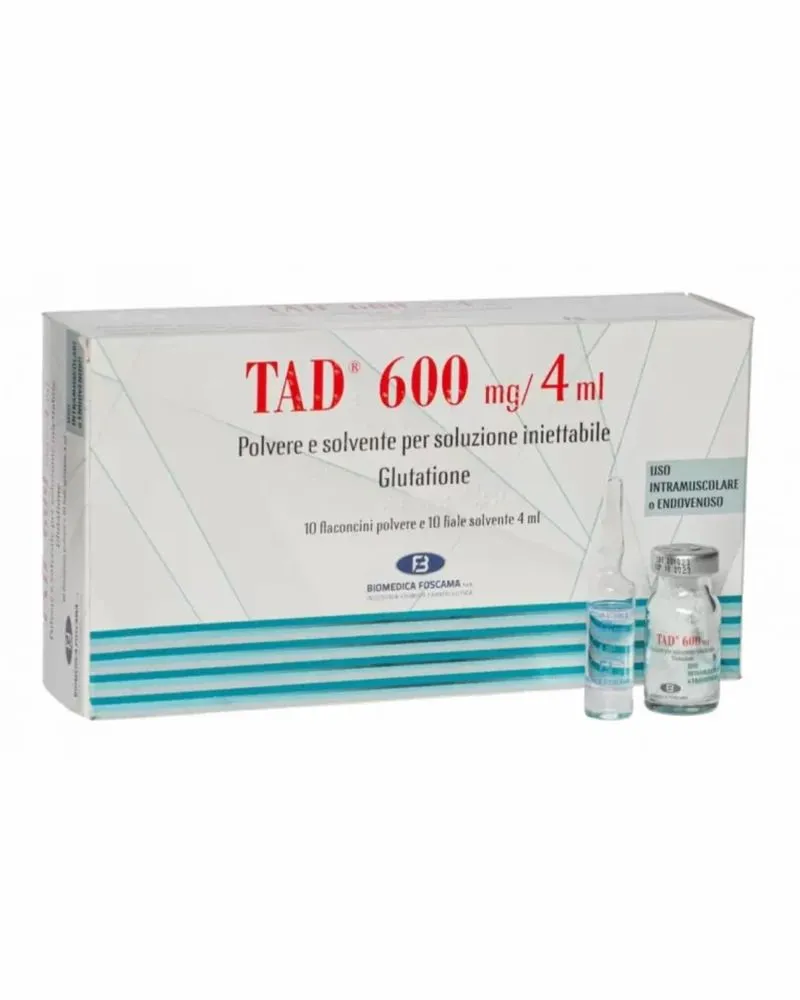
Table of Contents
- Package leaflet: Information for the user
- TAD 600 mg/4 ml powder and solvent for injectable solution, 2500 mg/25 ml powder and solvent for infusion solution
- 1. What TAD is and what it is used for
- 2. What you should know before taking TAD
- 3. How to take TAD
- 4. Possible adverse reactions
- 5. How to store TAD
- 6. Package contents and other information
Package leaflet: Information for the user
TAD 600 mg/4 ml powder and solvent for injectable solution, 2500 mg/25 ml powder and solvent for infusion solution
Glutathione
Please read all of this leaflet carefully before taking this medicine because it contains
important information for you.
- Keep this leaflet.
- You may need to read it again.
- If you have any questions, ask your doctor or pharmacist.
- This medicine has been prescribed for you only. Do not give it to others, even if their symptoms are the same as yours, as it may be harmful.
- If you experience any adverse reactions, including those not listed in this leaflet, contact your doctor or pharmacist. See section 4.
Contents of this leaflet:
- What TAD is and what it is used for
- What you need to know before taking TAD
- How to take TAD
- Possible side effects
- How to store TAD
- Contents of the pack and other information
1. What TAD is and what it is used for
TAD contains glutathione (GSH), a physiological tripeptide composed of glutamic acid, cysteine, and glycine, which participates in numerous biological processes and plays an important role in the detoxification reactions that eliminate toxic substances from the body. When administered parenterally, glutathione belongs to the pharmacotherapeutic category of antidotes—substances capable of transforming a toxic agent into a harmless or minimally harmful compound.
TAD is used to prevent neuropathy (disease of the nervous system) that may occur as a consequence of treatment with chemotherapeutic drugs such as cisplatin or its analogues, which are used in the treatment of certain types of cancer.
2. What you should know before taking TAD
Do not take TAD
If you are allergic to glutathione or to any of the other components of this medicine.
Warnings and precautions
Talk to your doctor or nurse before using TAD.
Children and adolescents
The safety and efficacy of TAD in children have not been established.
Other medicines and TAD
Tell your doctor or pharmacist if you are taking, have recently taken, or might take any other medicines.
At the recommended doses, TAD does not interfere with the therapeutic activity of chemotherapeutic agents.
In the absence of incompatibility studies, this medicine must not be mixed with other products.
Pregnancy and breastfeeding
If you are pregnant, suspect you may be pregnant, planning a pregnancy, or breastfeeding, consult your doctor before taking this medicine.
Available data indicate that glutathione, being a substance physiologically present in cells, does not cause adverse effects in pregnant or breastfeeding women. Animal studies do not show direct or indirect harmful effects related to pregnancy, embryofetal development, delivery, or postnatal development.
Driving and using machines
TAD has no effect or has a negligible effect on the ability to drive vehicles or operate machinery.
3. How to take TAD
The generally recommended daily dose of TAD in patients undergoing chemotherapy with cisplatin or analogues is 1.5 g/m² (corresponding to 2.5 g), administered by slow intravenous infusion.
However, the dosage depends on the patient's age, weight, and clinical condition, and should also be correlated with the dose and schedule of the chemotherapeutic agent.
When administering glutathione in combination with chemotherapy, the intravenous infusion of TAD should be completed within 15–30 minutes before the start of chemotherapy.
In the case of long-term treatments, lower doses of the product (600 mg) may be used, administered by intramuscular or slow intravenous injection.
Method of administration
TAD “600 mg/4 ml powder and solvent for injectable solution”
Reconstitute the solution in the vial of powder by withdrawing the water from the solvent vial using a syringe fitted with a suitable needle. Remove the aluminium cap from the vial and disinfect the stopper with an alcohol-soaked cotton swab; then insert the needle of the syringe into the vial through the center of the rubber stopper, directing the flow of water toward the glass wall of the vial. Gently shake to ensure complete dissolution, then administer the resulting solution by intramuscular or slow intravenous injection.
TAD “2500 mg/25 ml powder and solvent for infusion solution”
First reconstitute the solution under aseptic conditions using the following procedure:
- Remove the aluminium cap from the powder vial and disinfect the stopper with an alcohol-soaked cotton swab
- Remove only one cap from the single-use double-ended needle (transfer device) and insert the tip into the powder vial through the center of the rubber stopper
- Remove the aluminium cap from the water vial and disinfect the rubber stopper; remove the second cap from the transfer device and insert the tip into the water vial, turning it upside down
- Briefly shake to facilitate the flow of water into the powder vial; once the water vial is empty, remove the transfer device and shake to promote dissolution
The reconstituted solution is then administered intravenously as follows:
- Disinfect the vial stopper again, then remove the cap from the needle piercer at the end of the infusion set and insert it into the center of the vial stopper
- Apply the roller clamp and completely close the tubing
- Remove the cap from the needle hub and attach a needle
- Squeeze the drip chamber to fill it about halfway, then open the roller clamp until all air has been expelled from the set
- Completely close the roller clamp, insert the needle into the vein, and slowly reopen the roller clamp to achieve the desired flow rate
Important: Use immediately after opening the containers.
The reconstituted solution must be clear and free from visible particles. It is intended for single, uninterrupted administration; any remaining residue must not be used.
Use in children and adolescents
The safety and efficacy of TAD in children have not been established.
If you take more TAD than you should
No cases of overdose have been reported. If necessary, symptomatic treatment may be administered.
4. Possible adverse reactions
Like all medicines, this medicine may cause adverse reactions, although not everybody experiences them.
Very rarely, skin rashes have been reported after intramuscular administration, resolving upon discontinuation of therapy. Pain at the injection site has also been reported.
As with all parenteral solutions, febrile reactions, injection site infections, venous thrombosis or phlebitis, and extravasation may occur.
In case of an immediate adverse reaction during intravenous infusion, discontinue administration and, if possible, retain the unused fluid for potential testing.
Reporting of adverse reactions
If you experience any adverse reaction, including those not listed in this leaflet, inform your doctor, pharmacist, or nurse. You may also report adverse reactions directly through the national reporting system at the following website:
www.agenziafarmaco.gov.it/it/responsabili.
By reporting adverse reactions, you can help provide more information on the safety of this medicine.
5. How to store TAD
Keep this medicine out of the sight and reach of children.
This medicine does not require any special storage conditions.
Do not use this medicine after the expiry date stated on the label after "Exp.". The
expiry date refers to the last day of that month.
The reconstituted solution is stable for 8 hours at room temperature.
Do not use this medicine if you notice the presence of particles, abnormal discoloration,
numbness, or precipitate.
Do not dispose of any medicine via wastewater or household waste. Ask your pharmacist
how to dispose of medicines you no longer use. This will help protect the environment.
6. Package contents and other information
What TAD contains
TAD 600 mg/4 ml powder and solvent for injectable solution
- The active substance is sodium glutathione salt 646 mg, equivalent to glutathione 600 mg.
- The other component is water for injections. The reconstituted solution contains 150 mg/ml of glutathione.
TAD 2500 mg/25 ml powder and solvent for infusion solution
- The active substance is sodium glutathione salt 2680 mg, equivalent to glutathione 2500 mg.
- The other component is water for injections. The reconstituted solution contains 100 mg/ml of glutathione.
The powder vials contain only the active substance, while the solvent ampoules or solvent vials contain water for injections.
Description of the appearance of TAD and contents of the pack
TAD 600 mg/4 ml powder and solvent for injectable solution
The carton contains 5 powder vials of 600 mg and 5 solvent ampoules of 4 ml.
The carton contains 10 powder vials of 600 mg and 10 solvent ampoules of 4 ml.
TAD 2500 mg/25 ml powder and solvent for infusion solution
The carton contains 1 powder vial of 2500 mg and 1 solvent vial of 25 ml.
The pack also includes an intravenous infusion set for the extemporaneous preparation of the solution.
Marketing Authorization Holder
BIOMEDICA FOSCAMA INDUSTRIA CHIMICO-FARMACEUTICA S.p.A.
Via dei Castelli Romani, 22
00071 Pomezia (RM), Italy
Manufacturer
BIOMEDICA FOSCAMA INDUSTRIA CHIMICO-FARMACEUTICA S.p.A.
Site: Via Morolense, 87
03013 Ferentino (FR) – (Italy)