Tachosil
Italy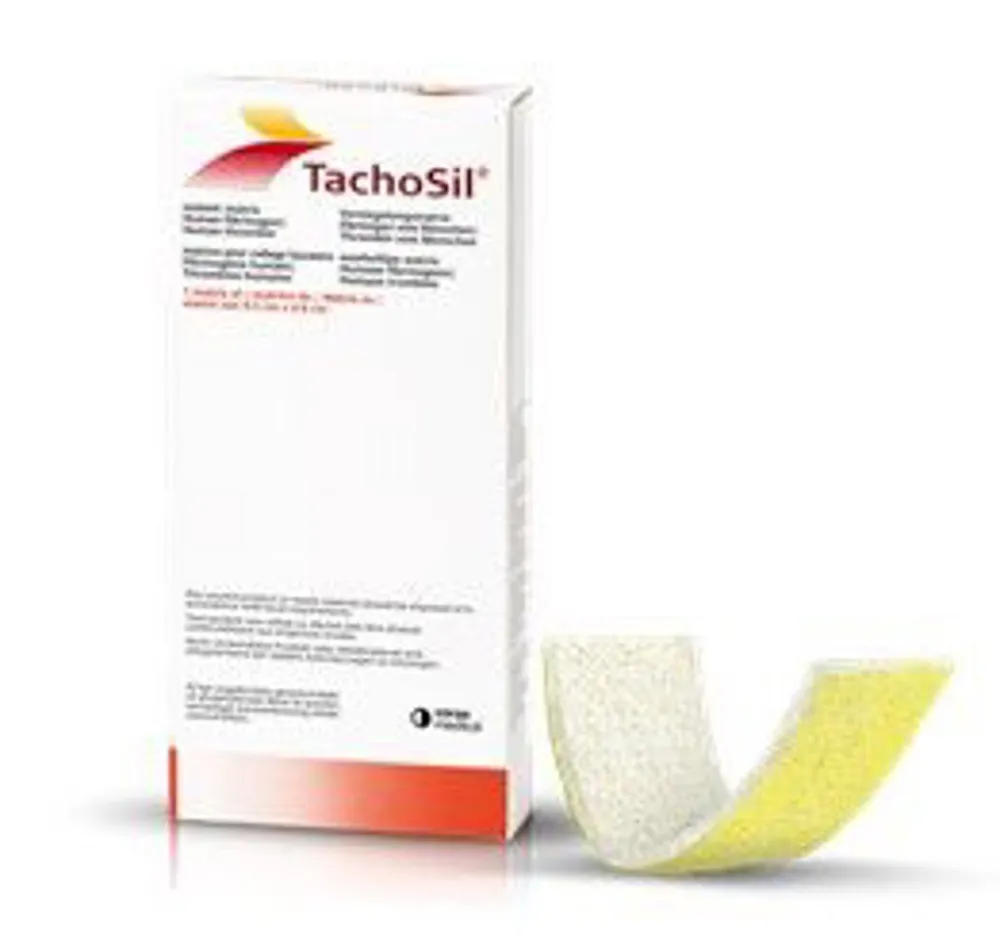
Table of Contents
Package leaflet: Information for the user
TachoSil sealing matrix
human fibrinogen/human thrombin
Please read all of this leaflet carefully before you are given this medicine because it contains important information for you.
- Keep this leaflet. You may need to read it again.
- If you have any questions, ask your doctor.
- If you get any side effects, including those not listed in this leaflet, tell your doctor. See section 4.
Contents of this leaflet
- What TachoSil is and what it is used for
- What you need to know before TachoSil is used
- How to use TachoSil
- Possible side effects
- How to store TachoSil
- Contents of the pack and other information
1. What TachoSil is and what it is used for
How does TachoSil work?
The yellow side of TachoSil contains the active substances: fibrinogen and thrombin. The yellow side of TachoSil is therefore the active side. When the active side comes into contact with liquids (such as blood, lymph, or physiological saline solution), the fibrinogen and thrombin activate to form a fibrin network. This means that TachoSil adheres to the tissue surface, blood coagulates (local haemostasis), and the tissue is sealed. TachoSil will dissolve and disappear completely.
What is TachoSil used for?
TachoSil is used in surgery to control local bleeding (haemostasis) and to seal tissue surfaces of internal organs in adults and children from the age of 1 month.
TachoSil is also indicated in adults for neurosurgical procedures as a dural sealant to support dura repair and to prevent postoperative cerebrospinal fluid leakage.
2. What you should know before TachoSil is used
Do not use TachoSil
- if you are allergic to human fibrinogen, human thrombin, or any of the other ingredients of this medicine (listed in section 6).
Warnings and precautions
TachoSil is for local use only and must not be applied inside blood vessels. Blood clots may occur if TachoSil is accidentally applied inside blood vessels.
You may experience an allergic reaction after TachoSil has been applied. Symptoms may include hives or a hive-like skin rash, discomfort or tightness in the chest, wheezing, or a drop in blood pressure.
Contact your doctor immediately if you experience any of these symptoms.
After abdominal surgery, if TachoSil adheres to surrounding tissues, scar tissue may form at the surgical site. Scar tissue may connect intestinal surfaces and cause intestinal obstruction.
When medicines are manufactured from human blood or plasma, special measures are taken to prevent the transmission of infections to patients. These include careful selection of blood and plasma donors to ensure that potential carriers of infections are excluded, and testing of each blood donation and plasma batch to ensure the absence of viruses/infections. In addition, manufacturers include specific steps in the processing of blood or plasma to inactivate or remove viruses. Despite these measures, when medicines prepared from human blood or plasma are administered, the possibility of transmitting infections cannot be completely ruled out. This also applies to unknown or newly emerging viruses or other types of infections.
The measures taken are considered effective against enveloped viruses such as human immunodeficiency virus (HIV), hepatitis B virus, hepatitis C virus, and against the non-enveloped hepatitis A virus. These measures may have limited effectiveness against non-enveloped viruses such as parvovirus B19. Parvovirus B19 infection may be serious for pregnant women (fetal infection) and for individuals with weakened immune systems or certain types of anemia (e.g., sickle cell anemia or hemolytic anemia).
Other medicines and TachoSil
Inform your doctor if you are taking, have recently taken, or might take any other medicine.
3. How to use TachoSil
The surgeon will apply TachoSil during surgery. The amount of TachoSil used depends on the size of the wound. The surgeon will apply TachoSil to the internal organ to stop bleeding or to seal the tissue. TachoSil will then dissolve and disappear.
4. Possible side effects
Like all medicines, this medicinal product can cause side effects, although not everyone experiences them.
TachoSil consists of protein-based components. The active substances are derived from human blood. All human blood-derived medicinal products may rarely cause allergic reactions. In isolated cases, these allergic reactions may progress to anaphylactic shock.
Such allergic reactions may occur especially when TachoSil is used repeatedly or if the patient is allergic to any of the excipients of TachoSil.
A clinical study has shown that some patients develop antibodies against the components of TachoSil; however, no adverse effects related to the development of these antibodies have been reported.
After surgical intervention and the use of TachoSil, scar tissue formation may occur in some patients. Following abdominal surgery, intestinal obstruction and pain may also occur. Foreign body granuloma formation has been identified as a potential risk.
The frequency of these reactions is unknown (cannot be estimated based on the available data).
To reduce this risk, the surgeon must ensure thorough cleaning of the application site when applying TachoSil.
Reporting of side effects
If you experience any side effects, including those not listed in this leaflet, please inform your doctor.
You may also report side effects directly via the national reporting system indicated in Annex V. By reporting side effects, you can help provide further information on the safety of this medicinal product.
5. How to store TachoSil
Keep this medicine out of the sight and reach of children.
Do not use this medicine after the expiry date stated on the label after the term
“Exp./EXP”. The expiry date refers to the last day of the month.
Do not store above 25°C.
Do not dispose of any medicine via wastewater or household waste. Ask your pharmacist how
to dispose of medicines you no longer use. This will help protect the environment.
6. Package contents and other information
What TachoSil contains
- The active substances are human fibrinogen (5.5 mg per cm²) and human thrombin (2.0 IU per cm²).
- The other components are equine collagen, human albumin, riboflavin (E101), sodium chloride, sodium citrate (E331), L-arginine hydrochloride.
Description of the appearance of TachoSil and package contents
TachoSil is a collagen-based sealing matrix coated on the yellow side with human fibrinogen and human thrombin.
The product is available in various sizes and in packages containing up to 5 units:
Pack containing 1 matrix of 9.5 cm x 4.8 cm
Pack containing 2 matrices of 4.8 cm x 4.8 cm
Pack containing 1 matrix of 3.0 cm x 2.5 cm
Pack containing 5 matrices of 3.0 cm x 2.5 cm
Pack containing 1 pre-rolled matrix of 4.8 cm x 4.8 cm
Not all pack sizes may be marketed.
Marketing Authorisation Holder
Corza Medical GmbH
Speditionstraße 21
40221 Düsseldorf, Germany
Manufacturer
Corza Medical Distribution GmbH, Austria Branch
St. Peter Strasse 25
A-4020 Linz, Austria
Other sources of information
More detailed information on this medicinal product is available on the website of the European Medicines Agency: http://www.ema.europa.eu.
This leaflet is available in all languages of the European Union/European Economic Area on the website of the European Medicines Agency.
The following information is intended exclusively for physicians or healthcare professionals:
INSTRUCTIONS FOR USE
Read before opening the package:
TachoSil is supplied in sterile packaging, therefore it is important:
- to use only undamaged packages that have not been previously opened (the product cannot be re-sterilized).
- that a non-sterile person opens the outer aluminium package.
- that a sterile person opens the inner sterile package.
- to use TachoSil immediately after opening the outer aluminium package.
- to use TachoSil immediately after opening the inner sterile package.
Instructions
Use TachoSil only under sterile conditions.
Select the most appropriate size of TachoSil. The size of the sealing matrix depends on the size of the wound. Note, however, that the matrix should extend 1–2 cm beyond the wound margins. If more than one matrix is required, they should overlap. For small wounds, e.g. in minimally invasive surgery, use of the smaller matrices (4.8 cm x 4.8 cm or 3.0 cm x 2.5 cm) or the pre-rolled matrix (4.8 cm x 4.8 cm) is recommended. TachoSil may be cut to the appropriate size and shape to fit the wound.
- Gently clean the wound surface before applying TachoSil to the wound. Active (pulsating) bleeding must be controlled surgically.
- Open the inner sterile package and remove the matrix. Pre-moisten the flat TachoSil matrix with saline solution and apply it immediately to the wound (if the wound site is completely covered with blood and other fluids, pre-moistening is not necessary). The pre-rolled TachoSil must not be pre-moistened before passing through the trocar or port.
- If necessary, pre-clean surgical instruments, gloves, and adjacent tissues. TachoSil may adhere to blood-covered surgical instruments, gloves, or adjacent tissues. If adjacent tissues are not adequately cleaned, adhesions may occur.
- If a trocar is used to access the wound site, the inside of the trocar must be dry. It is recommended to remove the top part of the trocar before passing the pre-rolled TachoSil through the trocar.
- Apply the yellow, active side of TachoSil to the wound. Gently press on TachoSil for 3–5 minutes. To keep TachoSil in place, use a moist glove or sponge. In minimally invasive surgery, the pre-rolled TachoSil can be unrolled at the application site using instruments. The unrolled TachoSil may then be moistened at the application site with a moist sponge and held in place with gentle pressure for 3–5 minutes.
- After 3–5 minutes, release the pressure. To ensure that TachoSil does not adhere to the glove or moist sponge and consequently detach from the wound, one end may be held in place, e.g. with forceps. Residual material does not need to be removed; the entire matrix will dissolve (be absorbed). However, there have been reports of residual product which may have caused a foreign body reaction in the form of granuloma.
Traceability
In order to improve the traceability of biological medicinal products, the name and batch number of the administered product should be clearly documented.