Syntocinon
Italy
Table of Contents
- Package leaflet: Information for the patient
- Syntocinon 5 IU/ml injection solution
- 1. What Syntocinon is and what it is used for
- 2. What you need to know before you are given Syntocinon
- 3. How to use Syntocinon
- 4. Possible adverse effects
- 5. How to store Syntocinon
- 6. Contents of the pack and other information
- The following information is intended exclusively for healthcare professionals:
Package leaflet: Information for the patient
Syntocinon 5 IU/ml injection solution
oxytocin
Please read all of this leaflet carefully before you start using this medicine because it contains important information for you.
- Keep this leaflet. You may need to read it again.
- If you have any questions, ask your doctor or nurse.
- If you experience any side effects, including those not listed in this leaflet, inform your doctor or pharmacist. See section 4.
Contents of this leaflet:
- What Syntocinon is and what it is used for
- What you need to know before using Syntocinon
- How to use Syntocinon
- Possible side effects
- How to store Syntocinon
- Contents of the pack and other information
1. What Syntocinon is and what it is used for
Syntocinin contains the active substance oxytocin, obtained by chemical synthesis.
Syntocinon is indicated for:
- inducing labour in cases of:
o pregnancy beyond term
o premature rupture of membranes
o pre-eclampsia, a condition characterised by high blood pressure, presence of protein in the urine and oedema (swelling) starting from the 20th week of pregnancy
o selected cases of primary or secondary uterine inertia, a condition in which the uterine muscle is unable to contract adequately to complete delivery - treating postpartum bleeding (haemorrhage).
2. What you need to know before you are given Syntocinon
Do not use Syntocinon
- if you are allergic to oxytocin or to any of the other ingredients of this medicine (listed in section 6)
- if you have strong uterine contractions
- if there is fetal distress when delivery is not imminent
- if spontaneous labour is not apparent and/or natural delivery is contraindicated, for example if:
o the fetal head is too large to pass through the pelvis (significant cephalopelvic disproportion)
o the fetus is in an abnormal position
o you have placenta praevia or vasa praevia, conditions in which the placenta and blood vessels lie over or near the cervix and which may cause severe bleeding
o you have placental abruption
o you have a prolapsed or presenting umbilical cord
o you have excessive uterine distension or reduced resistance of the uterus to rupture, as in multiple pregnancy, polyhydramnios (a condition associated with excessive and pathological production of amniotic fluid)
o you are elderly and have had many pregnancies (grand multiparity)
o you have had multiple twin deliveries or many pregnancies (multiparity)
o you have a uterine scar from major surgical procedures, including caesarean section - if you have severe toxaemia, a condition characterized by the accumulation of substances in the blood at toxic concentrations
- if you are predisposed to amniotic fluid embolism (intrauterine fetal death, placental abruption)
- for prolonged use in cases of uterine inertia within 6 hours following vaginal administration of prostaglandins (see section “Other medicines and Syntocinon”).
Consult your doctor if you think that any of the conditions listed above apply to you.
Warnings and precautions
Talk to your doctor or nurse before using Syntocinon.
Syntocinon will be administered to induce labour only when strictly necessary for medical reasons and in a hospital setting equipped to provide constant monitoring by specialized medical personnel.
Inform your doctor before Syntocinon is administered to you:
- if you have previously undergone a caesarean section involving the lower segment of the uterus
- if you have oxytocin-resistant uterine inertia, secondary uterine inertia, or severe pre-eclamptic toxaemia (see section “Do not use Syntocinon”)
- if you have moderate or severe high blood pressure (gestational hypertension)
- if the size of the fetal head is borderline for passing through your pelvis (borderline cephalopelvic disproportion)
- if you have serious heart or blood vessel problems, for example hypertrophic cardiomyopathy, valvular and/or ischemic heart disease, including coronary vasospasm
- if you have heart rhythm disorders, such as long QT syndrome, a clear sign on the electrocardiogram, or related symptoms
- if you are taking medicines that prolong the QTc interval (see section “Other medicines and Syntocinon”)
- if you have severe kidney problems
- if you are allergic to latex.
Important information
- When oxytocin is used by intravenous infusion for induction or facilitation of labour, excessive dosing may cause uterine hyperstimulation, which can lead to complications in the fetus and mother (fetal distress, asphyxia, fetal death, excessive uterine tone, tetanic contractions, or uterine rupture in the mother). During treatment with Syntocinon, your doctor will carefully monitor you and your baby to ensure the correct dose is administered and to avoid unwanted effects for you or your baby.
- In rare cases, labour induction with uterotonic agents such as oxytocin may increase the risk of disseminated intravascular coagulation (DIC) after delivery. This risk is particularly increased if you have risk factors for DIC such as:
o age equal to or over 35 years
o complications during pregnancy
o gestational age over 40 weeks - Prolonged intravenous administration of high doses of oxytocin together with large volumes of fluids may cause water intoxication associated with low sodium levels in both mother and newborn, due to fluid overload, leading to a pulmonary complication (pulmonary oedema).
Children and adolescents
The safety and efficacy of Syntocinon in children and adolescents have not been established. No data are available.
Other medicines and Syntocinon
Inform your doctor if you are taking, have recently taken, or might take any other medicines.
Syntocinon must not be administered together with:
- other medicines similar to oxytocin (oxytocics), even if administered orally or nasally.
Syntocinon should be administered with caution together with:
- prostaglandins and their analogues, used to increase uterine motility; it must not be administered within 6 hours after vaginal use of prostaglandins
- inhaled anaesthetics, e.g. cyclopropane, halothane, sevoflurane, and desflurane
- medicines that prolong the QTc interval, vasoconstrictors, and sympathomimetics (used to induce anaesthesia), including those contained in local anaesthetics
- caudal anaesthetics (used to induce local anaesthesia in the sacral bone area).
Pregnancy and breastfeeding
If you are pregnant, think you may be pregnant, planning a pregnancy, or are breastfeeding, consult your doctor or nurse before using this medicine.
Pregnancy
Based on extensive experience with this medicine, no risks of fetal abnormalities are expected.
Breastfeeding
Oxytocin may be present in breast milk in small amounts, and no adverse effects on the newborn are expected.
Driving and using machines
Syntocinon may induce labour; therefore, take particular care when driving or operating machinery. Women experiencing uterine contractions should not drive or operate machinery.
Latex allergy
The active substance in Syntocinon may cause a severe allergic reaction (anaphylaxis) in patients with latex allergy. Inform your doctor if you are allergic to latex.
Syntocinon contains sodium and ethanol
This medicine contains less than 1 mmol (23 mg) of sodium per dose, i.e., it is practically “sodium-free”.
This medicine contains 5 mg of alcohol (ethanol) in each dosage unit. The amount in each dose of this medicine is equivalent to less than 0.12 ml of beer or 0.05 ml of wine.
The small amount of alcohol in this medicine will not produce any significant effects.
3. How to use Syntocinon
Use this medicine exactly as instructed by your doctor or nurse. If you have any doubts, consult your doctor or nurse.
Always use this medicine exactly as described in this leaflet or as instructed by your doctor or nurse. If you have any doubts, consult your doctor or nurse.
Induction or facilitation of labour
Syntocinon will be administered to you by slow intravenous infusion (drop by drop) or via an infusion pump with variable rate. The recommended dose is 5 IU.
Treatment of postpartum haemorrhage
Syntocinon will be administered to you either intramuscularly or slowly into a vein (slow intravenous injection).
The recommended dose is 5–10 IU intramuscularly or 5 IU by slow intravenous injection (drop by drop or by infusion pump). In severe cases, 5 to 20 IU intravenously at a rate sufficient to control uterine atony.
How to open the ampoules
To open the ampoules correctly, follow these instructions:
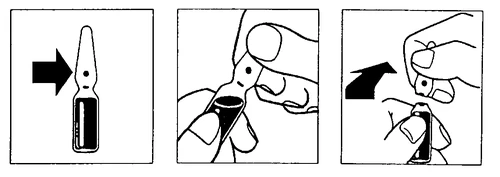
The break line is located under the coloured dot. Position the ampoule as shown in the figure. Place your thumb on the coloured dot and push backwards.
If you use more Syntocinon than you should
If Syntocinon is accidentally ingested or an excessive dose is administered, inform your doctor or nurse immediately.
The symptoms and consequences of an overdose of Syntocinon are those described in the sections “Warnings and precautions” and “Side effects”. In addition, rupture of the placenta and/or amniotic embolism (formation of an embolus caused by amniotic fluid entering the maternal bloodstream) have been reported.
4. Possible adverse effects
Like all medicines, this medicine can cause adverse effects, although not everyone experiences them.
ADVERSE EFFECTS IN THE MOTHER
Common (may affect up to 1 in 10 people)
- headache (cephalaea)
- increased heart rate (tachycardia)
- decreased heart rate (bradycardia)
- nausea
- vomiting
Uncommon (may affect up to 1 in 100 people)
- changes in heart rhythm (arrhythmia)
Rare (may affect up to 1 in 1,000 people)
- severe allergic reactions (anaphylactic/anaphylactoid reaction) associated with difficulty in breathing (dyspnea), reduced blood pressure (hypotension), anaphylactic/anaphylactoid shock
- skin rash
Not known (frequency cannot be estimated from the available data)
- heart problems (myocardial ischemia, QTc prolongation)
- reduced blood pressure (hypotension)
- excessive uterine muscle tone (uterine hypertonicity), tetanic contractions of the uterus, uterine rupture
- water intoxication, low sodium levels in the blood (hyponatremia)
- acute pulmonary edema (fluid accumulation in the lungs)
- sudden flushing (flushing)
- rapid swelling (edema) of the skin, mucosa, and submucosal tissues (angioedema)
- disseminated intravascular coagulation (DIC)
- bleeding after childbirth (postpartum hemorrhage), pelvic hematoma
ADVERSE EFFECTS IN THE FETUS/NEWBORN
Not known (frequency cannot be estimated from the available data)
- fetal distress, asphyxia, death
- low sodium levels in the blood (neonatal hyponatremia)
OTHER ADVERSE EFFECTS
- When oxytocin is used for intravenous infusion to induce or assist labour, administration of excessive doses may cause uterine hyperstimulation, which can lead to complications in the fetus and mother (fetal distress, asphyxia, fetal death, or excessive uterine tone, tetanic contractions, or uterine rupture in the mother). See section “Warnings and precautions”.
- Rapid intravenous bolus injection of doses consisting of several IU of oxytocin may cause:
– a severe, short-lived drop in blood pressure, accompanied by flushing and increased heart rate (reflex tachycardia). These effects may lead to myocardial ischemia, especially in patients who have or have had heart or vascular disease (see section “Warnings and precautions”), or QTc interval prolongation (see section “Warnings and precautions”). - In rare cases, induction of labour with uterotonics such as oxytocin may increase the risk of disseminated blood clot formation after delivery (disseminated intravascular coagulation – DIC). See section “Warnings and precautions”.
- Prolonged intravenous administration of high doses of oxytocin together with large volumes of fluids may cause water intoxication associated with low sodium levels in both mother and newborn (see section “Warnings and precautions”).
- The antidiuretic effect resulting from the administration of oxytocin and intravenous fluids may lead to fluid overload, causing pulmonary complications (acute pulmonary edema) without reduced sodium levels (hyponatremia). It may also cause excessive and transient water retention associated with headache (cephalaea), reduced or loss of appetite (anorexia), vomiting, abdominal pain, drowsiness, unconsciousness, epileptiform convulsions, and decreased blood electrolyte levels (see section “Warnings and precautions”).
Reporting of adverse effects
If you experience any adverse effect, including those not listed in this leaflet, talk to your doctor, pharmacist, or nurse. You can also report adverse effects directly via the national reporting system at https://www.aifa.gov.it/content/segnalazioni-reazioni-avverse. By reporting adverse effects, you can help provide more information on the safety of this medicine.
5. How to store Syntocinon
Keep this medicine out of the sight and reach of children.
Store in a refrigerator (2°C – 8°C). Keep in the original packaging to protect the medicine from light.
The solution reconstituted with dextrose must be used within 8 hours after reconstitution.
Do not use this medicine after the expiry date stated on the packaging after “Exp.”. The expiry date refers to the last day of that month.
Do not dispose of medicines via wastewater or household waste. Ask your pharmacist how to dispose of medicines no longer required. This will help protect the environment.
6. Contents of the pack and other information
What Syntocinon contains
- The active substance is oxytocin. Each vial contains 8.3 mcg of oxytocin (equivalent to 5 IU).
- The other components are sodium acetate trihydrate, chlorobutanol, glacial acetic acid, ethanol 94%, sodium chloride, water for injections.
Description of the appearance of Syntocinon and contents of the pack
Each pack contains 6 glass vials of 1 ml containing solution for injection for intramuscular,
intravenous and intravenous infusion use.
Marketing Authorization Holder
Alfasigma S.p.A. - Via Ragazzi del '99, n. 5 - 40133 Bologna (BO)
Manufacturer
Alfasigma S.p.A. - Via Pontina km 30,400 - 00071 Pomezia (RM)
The following information is intended exclusively for healthcare professionals:
DOSAGE AND ADMINISTRATION
Induction or facilitation of labour
Syntocinon must be administered by intravenous infusion drop by drop or, preferably, using an infusion pump with variable rate. When using drop-by-drop infusion, it is recommended to add 5 IU of Syntocinon to 500 ml of electrolyte physiological solution (e.g., 0.9% sodium chloride). For patients in whom sodium chloride solution should be avoided, 5% dextrose solution may be used as diluent (see "Special warnings and precautions for use"). To ensure uniform mixing of the solution, it is advisable to invert the infusion bottle or bag several times before use.
The reconstituted solution in dextrose must be used within 8 hours after reconstitution.
The initial infusion rate should be 1–4 milliunits/minute (2–8 drops/minute). This may be gradually increased at intervals of at least 20 minutes, by no more than 1–2 milliunits/minute, until regular contractions resembling normal labour are achieved. In near-term pregnancies, regular contractions are usually obtained with less than 10 milliunits/minute (20 drops/minute), and the maximum recommended rate is 20 milliunits/minute (40 drops/minute).
When using a motor-driven pump delivering volumes smaller than those delivered by drop-by-drop infusion, the appropriate infusion flow must be calculated based on the technical specifications of the pump, while maintaining the dosage within the limits recommended for drop-by-drop infusion.
Frequency, strength, and duration of contractions, as well as fetal heart rate, must be continuously monitored throughout the entire infusion period. Once regular uterine activity is achieved, the infusion rate may be reduced. In case of uterine hyperactivity and/or fetal distress, the infusion must be immediately discontinued.
If regular contractions have not been achieved after infusion of a total of 5 IU in full-term or near-term women, any attempt at labour induction should be abandoned; generally, this may be repeated the following day, starting again at a rate of 1–4 milliunits/minute.
Note
Occasional unintentional paravenous infusion of oxytocin is not harmful.
Treatment of postpartum uterine haemorrhage
5 IU by intravenous infusion (5 IU diluted in 500 ml of an electrolyte physiological solution and administered as drop-by-drop intravenous infusion or, preferably, by infusion pump); initial infusion rate should be set at 1–4 milliunits/minute (2–8 drops/minute), or 5–10 IU intramuscularly. In severe cases, an infusion of a solution containing 5–20 IU of oxytocin in 500 ml of an electrolyte physiological solution, administered at a rate sufficient to control uterine atony.
To open ampoules correctly, follow the instructions provided in section 3 “How to use Syntocinon” of this leaflet.
OVERDOSAGE
The symptoms and consequences of overdose are those described in sections 4.4 and 4.8 of the Summary of Product Characteristics.
Additionally, as a result of uterine overstimulation, cases of placental rupture and/or amniotic embolism have been reported.
Treatment: if signs and symptoms of overdose occur during continuous intravenous administration of Syntocinon, the infusion must be immediately stopped and oxygen administered to the mother. In cases of water intoxication, it is essential to restrict fluid intake, promote diuresis, correct electrolyte imbalances, and control possible seizures through appropriate use of diazepam.
INCOMPATIBILITIES
This medicinal product must not be mixed with other medicinal products except those mentioned in section 4.2.