Sunitinib Teva
Italy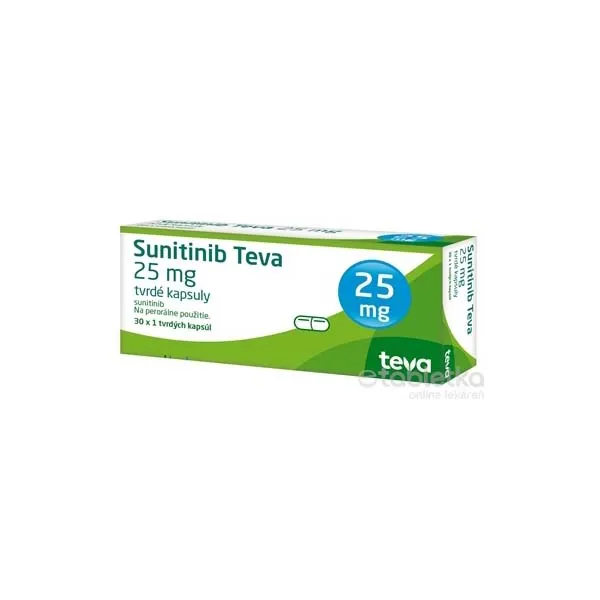
Table of Contents
- Patient Information Leaflet
- Sunitinib Teva 12.5 mg hard capsules, 25 mg hard capsules, 37.5 mg hard capsules, 50 mg hard capsules
- 1. What Sunitinib Teva is and what it is used for
- 2. What you need to know before taking Sunitinib Teva
- 3. How to take Sunitinib Teva
- 4. Possible side effects
- 5. How to store Sunitinib Teva
- 6. Package contents and other information
Patient Information Leaflet
Sunitinib Teva 12.5 mg hard capsules, 25 mg hard capsules, 37.5 mg hard capsules, 50 mg hard capsules
sunitinib
Generic medicine
Please read all of this leaflet carefully before you start taking this medicine, as it contains important information for you.
- Keep this leaflet. You may need to read it again.
- If you have any questions, ask your doctor or pharmacist.
- This medicine has been prescribed for you only. Do not give it to others, even if they have the same symptoms as you, because it could be harmful.
- If you experience any side effects, including those not listed in this leaflet, tell your doctor. See section 4.
Contents of this leaflet:
- What Sunitinib Teva is and what it is used for
- What you need to know before taking Sunitinib Teva
- How to take Sunitinib Teva
- Possible side effects
- How to store Sunitinib Teva
- Contents of the pack and other information
1. What Sunitinib Teva is and what it is used for
Sunitinib Teva contains the active substance sunitinib, which is a protein kinase inhibitor. It is used to treat cancer by blocking the activity of a specific group of proteins known to be involved in the growth and spread of tumour cells.
Sunitinib Teva is used to treat adults with the following types of cancer:
- Gastrointestinal stromal tumour (GIST), a type of stomach and intestinal tumour, in cases where imatinib (another anticancer medicine) is no longer effective or can no longer be used.
- Metastatic renal cell carcinoma (MRCC), a type of kidney cancer that has spread to other parts of the body.
- Progressive or non-resectable pancreatic neuroendocrine tumours (pNET) (tumours of hormone-producing cells in the pancreas).
If you have any doubts about how Sunitinib Teva works or why it has been prescribed for you, please consult your doctor.
2. What you need to know before taking Sunitinib Teva
Do not take Sunitinib Teva:
- If you are allergic to sunitinib or to any of the other ingredients of this medicine (listed in section 6).
Warnings and precautions
Tell your doctor before taking Sunitinib Teva:
- If you have high blood pressure. Sunitinib Teva can cause an increase in blood pressure. Your doctor may monitor your blood pressure during treatment with Sunitinib Teva, and you may need to take medicines to lower your blood pressure.
- If you have or have had blood disorders, bleeding problems or bruising. Treatment with Sunitinib Teva may increase the risk of bleeding, changes in the number of certain blood cells whose deficiency leads to anaemia, or affect the blood’s ability to clot. The risk of bleeding may be higher if you are taking warfarin or acenocoumarol, medicines that thin the blood to prevent blood clots. Inform your doctor if you experience any bleeding while taking Sunitinib Teva.
- If you have heart problems. Sunitinib Teva can cause heart-related issues. Inform your doctor if you feel very tired, have shortness of breath, or experience swollen feet or ankles.
- If you experience abnormal changes in heart rhythm. Sunitinib Teva can cause changes in heart rhythm. During treatment with Sunitinib Teva, your doctor may perform an electrocardiogram (ECG) to assess these changes. Inform your doctor if, during treatment, you feel dizzy, faint, or have irregular heartbeats.
- If you have recently had problems due to blood clots forming in veins and/or arteries (types of blood vessels), including stroke, heart attack, embolism, or thrombosis. Contact your doctor immediately if, during treatment with Sunitinib Teva, you experience symptoms such as chest tightness or pain, pain in the arms, back, neck, or jaw, shortness of breath, numbness or weakness on one side of the body, difficulty speaking, headache, or dizziness.
- If you have or have had an aneurysm (a bulging and weakening of a blood vessel wall) or a tear in the wall of a blood vessel.
- If you have or have had damage to small blood vessels called thrombotic microangiopathy (TMA). Inform your doctor if you notice fever, fatigue, tiredness, bruising, bleeding, swelling, mental confusion, vision loss, or seizures.
- If you have thyroid problems. Sunitinib Teva can cause thyroid-related issues. Inform your doctor if, while taking Sunitinib Teva, you become more easily fatigued, generally feel colder than others, or your voice becomes deeper. Thyroid function should be checked before starting Sunitinib Teva and regularly during treatment. If your thyroid does not produce enough thyroid hormone, you may need to take a thyroid hormone replacement.
- If you have or have had pancreas or gallbladder problems. Inform your doctor if you experience any of the following signs and symptoms: stomach pain (upper abdomen), nausea, vomiting, or fever. These could be caused by inflammation of the pancreas or gallbladder.
- If you have or have had liver problems. Inform your doctor if, during treatment with Sunitinib Teva, you experience any of the following signs and symptoms of liver problems: itching, yellowing of the skin or eyes, dark urine, or pain or discomfort in the upper right part of the stomach. Your doctor should perform blood tests to check liver function before and during treatment with Sunitinib Teva, and as clinically appropriate.
- If you have or have had kidney problems. Your doctor will monitor your kidney function.
- If you are about to undergo surgery or have recently had an operation. Sunitinib Teva may affect how wounds heal. Generally, you should stop treatment with Sunitinib Teva before undergoing surgery. Your doctor will decide when to restart treatment with Sunitinib Teva.
- It is advisable to have a dental check-up before starting treatment with Sunitinib Teva.
- If you have or have had mouth, tooth, and/or jaw pain, swelling or sores in the mouth, numbness or a feeling of heaviness in the jaw, or tooth loss, inform your doctor and dentist immediately.
- If you need to undergo invasive dental treatment or dental surgery, inform your doctor that you are being treated with Sunitinib Teva, especially if you are also taking or have previously taken intravenous bisphosphonates. Bisphosphonates are medicines used to prevent bone complications that may have been prescribed for another medical condition.
- If you have or have had skin and subcutaneous tissue disorders. During treatment with this medicine, conditions such as “pyoderma gangrenosum” (painful skin ulceration) or “necrotizing fasciitis” (a rapidly spreading infection of the skin/soft tissue that can be fatal) may occur. Contact your doctor immediately if you experience signs of infection around a skin wound, including fever, pain, redness, swelling, or pus or blood drainage. These events are generally reversible after stopping sunitinib treatment. Serious skin reactions (Stevens-Johnson syndrome, toxic epidermal necrolysis, erythema multiforme) have been reported with sunitinib use. These reactions typically start on the trunk as red, target-shaped spots or circular patches, often with blisters in the center. The reaction may progress to widespread blistering or skin peeling and can be fatal. If you develop a skin rash or any of these skin symptoms, consult a doctor immediately.
- If you have had seizures. Inform your doctor as soon as possible if you have high blood pressure, headache, or vision loss.
- If you have diabetes. Blood sugar levels should be monitored regularly in diabetic patients to determine whether the dosage of diabetes medicines needs adjustment, in order to minimize the risk of low blood sugar. Inform your doctor as soon as possible if you notice signs and symptoms of low blood sugar (fatigue, palpitations, sweating, hunger, or loss of consciousness).
Children and adolescents
Sunitinib Teva is not indicated for patients under 18 years of age.
Other medicines and Sunitinib Teva
Inform your doctor or pharmacist if you are taking, have recently taken, or might take any other medicines, including those purchased without a prescription and over-the-counter medicines.
Some medicines can alter the levels of Sunitinib Teva in the body. You must inform your doctor if you are taking medicines containing the following active substances:
- ketoconazole, itraconazole – used to treat fungal infections
- erythromycin, clarithromycin, rifampicin – used to treat infections
- ritonavir – used to treat AIDS
- dexamethasone – a corticosteroid used for various conditions (such as allergic/respiratory disorders or skin diseases)
- phenytoin, carbamazepine, phenobarbital – used to treat epilepsy and other neurological conditions
- herbal preparations containing St. John’s wort (Hypericum perforatum) – used to treat depression and anxiety
Sunitinib Teva with food and drink
Grapefruit juice should be avoided during treatment with Sunitinib Teva.
Pregnancy and breastfeeding
If you are pregnant, think you may be pregnant, are planning to become pregnant, or are breastfeeding, consult your doctor or pharmacist before taking this medicine.
If you could become pregnant, you must use a reliable method of contraception during treatment with Sunitinib Teva.
If you are breastfeeding, inform your doctor. You must not breastfeed during treatment with Sunitinib Teva.
Driving and using machines
If you experience dizziness or unusual tiredness, exercise particular caution when driving or operating machinery.
Sunitinib Teva contains sodium
This medicine contains less than 1 mmol (23 mg) of sodium per hard capsule, i.e., essentially “sodium-free”.
3. How to take Sunitinib Teva
Take this medicine exactly as your doctor has told you. If you are unsure, consult your doctor.
Your doctor will prescribe the dose appropriate for you, depending on the type of cancer being treated. If you are being treated for:
- GIST or MRCC: the usual dose is 50 mg once daily for 28 days (4 weeks), followed by a 14-day (2-week) rest period (without medication), in 6-week cycles.
- pNET: the usual dose is 37.5 mg once daily, without a rest period.
Your doctor will determine the dose needed for you and when to stop treatment with Sunitinib Teva.
Sunitinib Teva may be taken with or without food.
If you take more Sunitinib Teva than you should
If you accidentally take too many capsules, speak to your doctor immediately. Medical intervention may be necessary.
If you forget to take Sunitinib Teva
Do not take a double dose to make up for the missed dose.
4. Possible side effects
Like all medicines, this medicine can cause side effects, although not everybody gets them.
Contact your doctor immediately if you experience any of the following serious side effects (see also What you should know before taking Sunitinib Teva):
Heart problems. Inform your doctor if you feel very tired, have shortness of breath, or have swollen feet and ankles. These could be symptoms of heart problems such as heart failure or problems with the heart muscle (cardiomyopathy).
Lung or breathing problems. Inform your doctor if you develop cough, chest pain, sudden onset of shortness of breath, or coughing up blood. These could be symptoms of a condition known as pulmonary embolism, which occurs when blood clots reach the lungs.
Kidney problems. Inform your doctor if you notice changes in how often you urinate or if you stop passing urine, which could be symptoms of kidney failure.
Bleeding. Inform your doctor if you experience any of the following symptoms or a serious bleeding problem while being treated with Sunitinib Teva: swollen, painful stomach (abdomen); vomiting blood; dark, sticky stools; blood in the urine; headache or changes in mental state; coughing up blood or blood-stained sputum from the lungs or airways.
Tumour destruction causing perforation of the intestine. Inform your doctor if you have severe intestinal pain, fever, nausea, vomiting, blood in the stools, or changes in bowel habits.
Other side effects that may occur with Sunitinib Teva are:
Very common: may affect more than 1 in 10 people
- Decrease in the number of platelets, red blood cells and/or white blood cells (e.g. neutrophils).
- Shortness of breath.
- High blood pressure.
- Excessive tiredness, loss of strength.
- Swelling due to fluid retention under the skin and around the eyes, deep allergic rash.
- Pain/irritation in the mouth, soreness/inflammation/dryness of the mouth, changes in taste, stomach discomfort, nausea, vomiting, diarrhoea, constipation, abdominal pain/distension, loss/reduction of appetite.
- Reduced activity of the thyroid gland (hypothyroidism).
- Dizziness.
- Headache.
- Nosebleeds.
- Back pain, joint pain.
- Pain in the arms and legs.
- Yellowing of the skin/changes in skin colour, excessive skin pigmentation, changes in hair colour, rash on the palms of the hands and soles of the feet, skin rash, dry skin.
- Cough.
- Fever.
- Difficulty falling asleep.
Common: may affect up to 1 in 10 people
- Formation of blood clots in blood vessels.
- Inadequate blood supply to the heart muscle due to blockage or narrowing of the coronary arteries.
- Chest pain.
- Reduced amount of blood pumped by the heart.
- Fluid retention, including around the lungs.
- Infections.
- Complication of severe infections (infection present in the bloodstream), which may cause tissue damage, organ failure, and death.
- Low blood sugar levels (see section 2).
- Loss of protein in the urine, which sometimes leads to swelling.
- Flu-like syndrome.
- Abnormal blood tests, including levels of liver and pancreatic enzymes.
- High levels of uric acid in the blood.
- Haemorrhoids, rectal pain, bleeding gums, difficulty swallowing or inability to swallow.
- Burning or painful sensation on the tongue, inflammation of the lining of the digestive tract, excess gas in the stomach or intestines.
- Weight loss.
- Musculoskeletal pain (pain in muscles and bones), muscle weakness, muscle fatigue, muscle pain, muscle spasms.
- Dry nose, nasal congestion.
- Excessive tearing.
- Skin sensitivity changes, itching, peeling and inflammation of the skin, blistering, acne, discolouration of the nails, hair loss.
- Abnormal sensations in the extremities.
- Excessive reduction/increase in sensitivity, particularly to touch.
- Stomach burning.
- Dehydration.
- Hot flushes.
- Change in urine colour.
- Depression.
- Chills.
Uncommon: may affect up to 1 in 100 people
- Soft tissue infections, including in the anogenital region, potentially life-threatening (see section 2).
- Stroke.
- Heart attack caused by interrupted or reduced blood supply to the heart.
- Changes in the heart's electrical activity or altered heart rhythm.
- Fluid around the heart (pericardial effusion).
- Liver failure.
- Stomach (abdominal) pain caused by inflammation of the pancreas.
- Tumour destruction causing perforation of the intestine.
- Inflammation (swelling and redness) of the gallbladder with or without associated gallstones.
- Abnormal passage connecting two body cavities or the skin.
- Pain in the mouth, teeth and/or jaw, swelling or irritation in the mouth, numbness or a feeling of heaviness in the jaw, or tooth loss. These could be signs and symptoms of damage to the jawbone (osteonecrosis), see section 2.
- Excessive production of thyroid hormones leading to increased energy consumption at rest.
- Problems with wound healing after surgery.
- Increased levels of a muscle enzyme in the blood (creatine phosphokinase).
- Severe allergic reaction, including hay fever, skin rash, skin itching, hives, localized swelling, and breathing difficulties.
- Inflammation of the colon (colitis, ischemic colitis).
Rare: may affect up to 1 in 1,000 people
- Severe skin and/or mucous membrane reactions (Stevens-Johnson syndrome, toxic epidermal necrolysis, erythema multiforme).
Tumour lysis syndrome (TLS) – TLS includes a set of metabolic complications that may occur during tumour treatment. These are caused by the breakdown products of affected tumour cells and may include: nausea, shortness of breath, irregular heartbeat, muscle cramps, seizures, cloudy urine and fatigue, associated with abnormal laboratory test results (elevated levels of potassium, uric acid and phosphorus, and low calcium levels in the blood), which may lead to changes in kidney function and acute kidney failure. - Abnormal breakdown of muscle tissue that may cause kidney problems (rhabdomyolysis).
- Changes in brain function that may lead to a variety of symptoms such as headache, confusion, seizures, and loss of vision (reversible posterior leukoencephalopathy syndrome).
- Painful skin ulceration (pyoderma gangrenosum).
- Inflammation of the liver (hepatitis).
- Inflammation of the thyroid gland.
- Damage to small blood vessels known as thrombotic microangiopathy (TMA).
Not known: frequency cannot be estimated from the available data
- Enlargement or "bulging" of the aortic vessel or a tear in the aortic wall (aortic aneurysms and dissections).
Reporting of side effects
If you experience any side effect, including those not listed in this leaflet, talk to your doctor.
You can also report side effects directly via the Italian national reporting system: www.aifa.gov.it/content/segnalazioni-reazioni-avverse.
By reporting side effects, you can help provide more information on the safety of this medicine.
5. How to store Sunitinib Teva
- Keep this medicine out of the sight and reach of children.
- Do not use this medicine after the expiry date which is stated on the carton, bottle, and blister after "EXP". The expiry date refers to the last day of that month.
- Do not store above 30 °C. Store in the original packaging to protect the product from moisture.
- Do not use this medicine if you notice that the packaging is damaged or shows signs of tampering. Do not dispose of any medicine via wastewater or household waste. Ask your pharmacist how to dispose of medicines no longer in use. This will help protect the environment.
6. Package contents and other information
What Sunitinib Teva contains
Sunitinib Teva 12.5 mg hard capsules
The active substance is sunitinib. Each capsule contains 12.5 mg of sunitinib.
The other components are:
- Capsule contents: mannitol, povidone K-25, sodium croscarmellose, magnesium stearate.
- Capsule shell: gelatin, titanium dioxide (E171), red iron oxide (E172), and yellow iron oxide (E172)
- Printing ink: shellac, black iron oxide (E172), propylene glycol, concentrated ammonia solution, and potassium hydroxide
Sunitinib Teva 25 mg hard capsules
The active substance is sunitinib. Each capsule contains 25 mg of sunitinib.
The other components are:
- Capsule contents: mannitol, povidone K-25, sodium croscarmellose, magnesium stearate.
- Capsule shell: gelatin, titanium dioxide (E171), red iron oxide (E172), and yellow iron oxide (E172)
- Printing ink: shellac, black iron oxide (E172), propylene glycol, concentrated ammonia solution, and potassium hydroxide.
Sunitinib Teva 37.5 mg hard capsules
The active substance is sunitinib. Each capsule contains 37.5 mg of sunitinib.
The other components are:
- Capsule contents: mannitol, povidone K-25, sodium croscarmellose, magnesium stearate.
- Capsule shell: gelatin, titanium dioxide (E171), and yellow iron oxide (E172)
- Printing ink: shellac, black iron oxide (E172), propylene glycol, concentrated ammonia solution, and potassium hydroxide.
Sunitinib Teva 50 mg hard capsules
The active substance is sunitinib. Each capsule contains 50 mg of sunitinib.
The other components are:
- Capsule contents: mannitol, povidone K-25, sodium croscarmellose, magnesium stearate.
- Capsule shell: gelatin, titanium dioxide (E171), red iron oxide (E172), and yellow iron oxide (E172)
- Printing ink: shellac, black iron oxide (E172), propylene glycol, concentrated ammonia solution, and potassium hydroxide.
Description of the appearance of Sunitinib Teva and contents of the pack
Sunitinib Teva 12.5 mg hard capsules
Hard gelatin capsules with an opaque medium orange cap and body, marked in black ink with "12.5" on the cap. Each size 4 capsule (total closed length approximately 14.2 mm) contains orange granular powder.
Sunitinib Teva 25 mg hard capsules
Hard gelatin capsules with an opaque light orange cap and opaque medium orange body, marked in black ink with "25" on the cap. Each size 3 capsule (total closed length approximately 15.8 mm) contains orange granular powder.
Sunitinib Teva 37.5 mg hard capsules
Hard gelatin capsules with an opaque bright yellow cap and body, marked in black ink with "37.5" on the cap. Each size 2 capsule (total closed length approximately 17.6 mm) contains orange granular powder.
Sunitinib Teva 50 mg hard capsules
Hard gelatin capsules with an opaque light orange cap and body, marked in black ink with "50" on the cap. Each size 2 capsule (total closed length approximately 17.6 mm) contains orange granular powder.
Sunitinib Teva is available in white HDPE bottles containing 30 capsules, in blister packs of 28 or 30 capsules, and in single-dose blister packs containing 28 x 1 and 30 x 1 capsules.
Not all pack sizes may be marketed.
Marketing Authorisation Holder and Manufacturer
Marketing Authorisation Holder
Teva B.V.
Swensweg 5
2031 GA Haarlem
The Netherlands
Manufacturer
Teva Operations Poland Sp. z.o.o, ul. Mogilska 80, Kraków, 31-546 – Poland
Merckle GmbH, Ludwig-Merckle-Strasse 3, Blaubeuren, Baden-Wuerttemberg, 89143 – Germany
PLIVA Hrvatska d.o.o. (PLIVA Croatia Ltd.), Prilaz baruna Filipovića 25, Zagreb, 10000 – Croatia
This medicinal product is authorised in the European Economic Area countries under the following names:
Austria Sunitinib Teva 12.5, 25, 37.5, 50 mg Hard Capsules
Belgium Sunitinib Teva 12.5, 25, 37.5, 50 mg harde capsules, gélules, Hartkapseln
Bulgaria Сунитиниб Тева 12,5, 25, 50 mg твърди капсули
Cyprus Sunitinib/Teva 12.5, 25, 37.5, 50 mg καψάκια σκληρά
Croatia Sunitinib Pliva 12.5, 25, 37.5, 50 mg tvrde kapsule
Denmark Sunitinib Teva
Estonia Sunitinib Teva
Finland Sunitinib ratiopharm 12.5, 25, 37.5, 50 mg kapseli, kova
France Sunitinib Teva 12.5, 25, 50 mg, gélule
Germany Sunitinib ratiopharm 12.5, 25, 37.5, 50 mg Hartkapseln
Greece Sunitinib/Teva 12.5, 25, 37.5, 50 mg καψάκια σκληρά
Italy Sunitinib Teva
Latvia Sunitinib Teva 12.5, 50 mg cietās kapsulas
Lithuania Sunitinib Teva 12.5, 50 mg kietosios kapsulės
Luxembourg Sunitinib Teva 12.5, 25, 37.5, 50 mg gélules
Malta Sunitinib Teva 12.5, 25, 50 mg Hard Capsules
Norway Sunitinib Teva
The Netherlands Sunitinib Teva 12.5, 25, 37.5, 50 mg, harde capsules
Poland Sunitinib Teva
Portugal Sunitinib Teva
Czech Republic Sunitinib Teva
Slovakia Sunitinib Teva 12.5, 25, 50 mg tvrdé kapsuly
Romania Sunitinib Teva 12.5, 25, 50 mg capsule
Spain Sunitinib Teva 12.5, 25, 50 mg cápsulas duras EFG
Sweden Sunitinib Teva
Slovenia Sunitinib Teva 12.5, 25, 37.5, 50 mg trde kapsule
United Kingdom Sunitinib 12.5 mg Hard Capsules
Hungary Sunitinib Teva 12.5, 25, 37.5, 50 mg kemény kapszula