Sugammadex Fresenius Kabi
Italy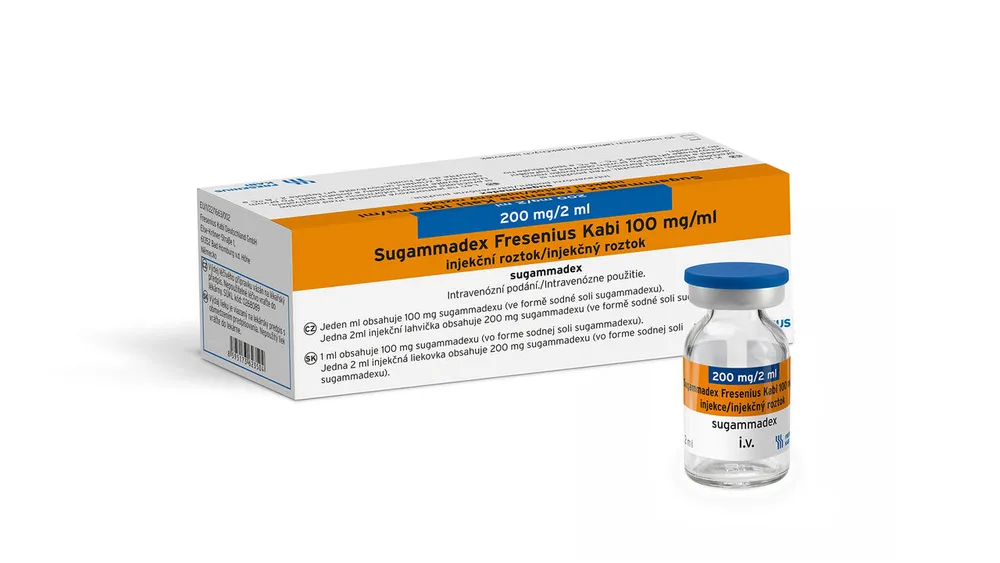
Table of Contents
- Package leaflet: Information for the user
- Sugammadex Fresenius Kabi 100 mg/mL solution for injection
- 1. What is Sugammadex Fresenius Kabi and what is it used for
- 3. How Sugammadex Fresenius Kabi is administered
- 4. Possible side effects
- 5. How to store Sugammadex Fresenius Kabi
- 6. Package contents and other information
- The following information is intended for healthcare professionals only:
Package leaflet: Information for the user
Sugammadex Fresenius Kabi 100 mg/mL solution for injection
sugammadex
Read this leaflet carefully before you are given this medicine because it contains important information for you.
- Keep this leaflet. You may need to read it again.
- If you have any questions, ask your anaesthetist or doctor.
- If you get any side effects, talk to your anaesthetist or doctor. This includes any side effects not listed in this leaflet. See section 4.
Contents of this leaflet
- What Sugammadex Fresenius Kabi is and what it is used for
- What you need to know before it is given to you
- How Sugammadex Fresenius Kabi is given
- Possible side effects
- How to store Sugammadex Fresenius Kabi
- Contents of the pack and other information
1. What is Sugammadex Fresenius Kabi and what is it used for
What is Sugammadex Fresenius Kabi
Sugammadex Fresenius Kabi contains the active substance sugammadex. Sugammadex is considered to be a selective relaxant binding agent because it selectively binds to other medicines, rocuronium bromide or vecuronium bromide, known as muscle relaxants, which relax the muscles.
What is Sugammadex Fresenius Kabi used for
When undergoing certain types of surgery, the muscles must be completely relaxed. This makes the surgeon’s task easier. For this purpose, muscle-relaxing medicines are added to the general anaesthesia administered. These medicines are called muscle relaxants, and include rocuronium bromide and vecuronium bromide. Since these medicines also relax the muscles controlling breathing, breathing assistance (so-called artificial ventilation) is required during and after surgery, until you are able to breathe on your own again.
Sugammadex is used to speed up muscle recovery after surgery, allowing you to breathe on your own again as soon as possible. It works by binding to rocuronium bromide or vecuronium bromide present in the body. It can be used in adults whenever rocuronium bromide or vecuronium bromide is used.
It can be used in neonates, infants, young children, children, and adolescents (from birth up to 17 years of age) when rocuronium bromide is used.
2 What you need to know before Sugammadex Fresenius Kabi is administered
Do not receive Sugammadex Fresenius Kabi
- if you are allergic to sugammadex or to any of the excipients of this medicine (listed in section 6). Inform your anaesthetist if this applies to you.
Warnings and precautions
Inform your anaesthetist before sugammadex is administered
- If you have or have previously had kidney disease. This is important because sugammadex is eliminated from the body through the kidneys.
- If you have or have previously had liver disease.
- If you have fluid retention (oedema).
- If you have conditions known to increase the risk of bleeding (blood coagulation disorders) or if you are receiving anticoagulant therapy.
Other medicines and Sugammadex Fresenius Kabi
Inform your anaesthetist if you are taking, have recently taken, or might take any other medicines. Sugammadex may affect or be affected by other medicines.
Some medicines reduce the effect of Sugammadex Fresenius Kabi
It is particularly important that you inform your anaesthetist if you have recently taken:
- toremifene (used to treat breast cancer).
- fusidic acid (an antibiotic).
Sugammadex Fresenius Kabi may affect hormonal contraceptives
- Sugammadex Fresenius Kabi may reduce the effectiveness of hormonal contraceptives (including oral contraceptive pills, vaginal ring, implant, or hormonal intrauterine system (IUS)), because it reduces the amount of absorbed progestogenic hormone. The amount of progestogen lost when using sugammadex is approximately equivalent to missing one dose of the contraceptive pill.
- If you need to take your oral contraceptive pill on the same day that sugammadex is administered, follow the instructions in the contraceptive pill’s package leaflet regarding a missed dose.
- If you are using other hormonal contraceptives (e.g. a vaginal ring, implant, or IUS), you should use an additional non-hormonal contraceptive method (such as a condom) for the next 7 days and follow the instructions provided in the package leaflet.
Effects on blood test results
In general, sugammadex has no effect on blood test results. However, it may affect the results of a test measuring blood levels of a hormone called progesterone. Consult your doctor if testing of progesterone levels is required on the same day you receive sugammadex.
Pregnancy and breastfeeding
Inform your anaesthetist if you are pregnant or could be pregnant, or if you are breastfeeding. You may still receive sugammadex, but you must discuss this with your doctor first.
It is not known whether sugammadex passes into breast milk. Your anaesthetist will help you decide whether to discontinue breastfeeding or to refrain from treatment with sugammadex, taking into account the benefit of breastfeeding for the child and the benefit of sugammadex for the mother.
Driving and using machines
Sugammadex Fresenius Kabi has no known influence on the ability to drive vehicles and use machinery.
Sugammadex Fresenius Kabi contains sodium
This medicine contains up to 9.7 mg of sodium (a key component of table salt) per mL. This corresponds to 0.5% of the maximum daily recommended dietary intake for an adult.
3. How Sugammadex Fresenius Kabi is administered
Sugammadex Fresenius Kabi will be administered to you by an anaesthetist or under the supervision of an anaesthetist.
The dose
The anaesthetist will determine the appropriate dose of sugammadex for you, taking into consideration:
- your body weight
- the extent to which the muscle relaxant is still affecting you.
The usual dose is 2–4 mg per kg of body weight in patients of any age. A dose of 16 mg/kg may be used in adults if rapid reversal of neuromuscular blockade is required.
How Sugammadex Fresenius Kabi is administered
Sugammadex will be administered by the anaesthetist as a single intravenous injection.
If more Sugammadex Fresenius Kabi is administered than recommended
Since the anaesthetist will closely monitor your condition, it is unlikely that you will receive an excessive amount of sugammadex. However, if this were to occur, it is unlikely to cause you problems.
If you have any doubts about the use of this medicine, consult your anaesthetist or doctor.
4. Possible side effects
Like all medicines, this medicine can cause side effects, although not everybody gets them.
If these side effects occur during anaesthesia, they will be detected and treated by the anaesthetist.
Common side effects (may affect up to 1 in 10 people)
- Cough
- Breathing difficulties which may include coughing or movements as if waking up or gasping for breath
- Light anaesthesia – you may begin to come out of deep sleep and may therefore require additional anaesthetic. This could cause the patient to move or cough at the end of surgery
- Complications during the procedure such as changes in heart rate, coughing or movements
- Decrease in blood pressure due to the surgical procedure
Uncommon side effects (may affect up to 1 in 100 people)
- In patients with a history of lung problems, shortness of breath due to muscle contractions of the airways (bronchospasm) has been observed
- Allergic reactions (hypersensitivity to the active substance), such as skin rash, flushed skin, swelling of the tongue and/or throat, shortness of breath, changes in blood pressure or heart rate, which sometimes can lead to severe drops in blood pressure. Severe allergic or anaphylactoid reactions can be life-threatening. Allergic reactions have been reported more commonly in healthy, aware volunteers
- Return of muscle relaxation after surgery.
Frequency not known
- When sugammadex is administered, severe slowing of the heart and slowing of the heart leading to cardiac arrest may occur.
Reporting of side effects
If you experience any side effect, including those not listed in this leaflet, talk to your anaesthetist or doctor. You can also report side effects directly via the national reporting system listed in Annex V. Reporting side effects can help provide more information on the safety of this medicine.
5. How to store Sugammadex Fresenius Kabi
Storage will be managed by healthcare professionals.
Keep this medicine out of the sight and reach of children.
Do not use this medicine after the expiry date stated on the carton and label after "Exp.". The expiry date refers to the last day of that month.
This medicine does not require any special storage temperature. Do not freeze.
Keep the vial in the outer carton to protect the medicine from light.
After first opening and dilution, store at a temperature between 2°C and 8°C and use within 24 hours.
Do not dispose of any medicine via wastewater or household waste. Ask your pharmacist how to dispose of medicines you no longer use. This will help protect the environment.
6. Package contents and other information
- The active substance is sugammadex. 1 mL of injectable solution contains sodium sugammadex equivalent to 100 mg of sugammadex. Each 1 mL vial contains sodium sugammadex equivalent to 100 mg of sugammadex. Each 2 mL vial contains sodium sugammadex equivalent to 200 mg of sugammadex. Each 5 mL vial contains sodium sugammadex equivalent to 500 mg of sugammadex.
- The other components are water for injections, hydrochloric acid (to adjust pH), sodium hydroxide (to adjust pH). See section 2 “Sugammadex Fresenius Kabi contains sodium”.
Description of the appearance of Sugammadex Fresenius Kabi and contents of the pack
Sugammadex Fresenius Kabi is a clear, particle-free injectable solution, colourless to pale yellow.
It is available in three different pack sizes, containing 10 vials with 1 mL, 2 mL, or 5 mL of injectable solution.
Not all pack sizes may be marketed.
Marketing Authorization Holder
Fresenius Kabi Deutschland GmbH
Else-Kröner-Straße 1,
61352 Bad Homburg v.d.Höhe
Germany
Manufacturer
Labesfal - Laboratórios Almiro, S.A.
Zona Industrial do Lagedo
3465-157 Santiago de Besteiros
Portugal
More detailed information on this medicinal product is available on the European Medicines Agency website, http://www.ema.europa.eu.
The following information is intended for healthcare professionals only:
Sugammadex Fresenius Kabi may be injected into an intravenous infusion line containing the following intravenous solutions: sodium chloride 9 mg/mL (0.9%), glucose 50 mg/mL (5%), sodium chloride 4.5 mg/mL (0.45%) and glucose 25 mg/mL (2.5%), Ringer's lactate solution, Ringer's solution, glucose 50 mg/mL (5%) in sodium chloride 9 mg/mL (0.9%).
The infusion line should be adequately flushed (e.g., with sodium chloride 9 mg/mL (0.9%)) between administration of Sugammadex Fresenius Kabi and other medicinal products.
Use in the paediatric population
For paediatric patients, Sugammadex Fresenius Kabi may be diluted with sodium chloride 9 mg/mL (0.9%) to a concentration of 10 mg/mL (see section 6.3).
Any unused medicinal product and waste materials derived from this medicinal product must be disposed of in accordance with local requirements.
For detailed information, refer to the Summary of Product Characteristics for Sugammadex Fresenius Kabi.