Sublivac Betulla
Italy
Table of Contents
Package leaflet: Information for the patient
Sublivac Betula
40,000 AUN/mL, oral mucosal drops, solution
▼ This medicinal product is subject to additional monitoring. This will allow rapid identification of new safety information. You can help by reporting any side effects you experience while taking this medicine. See the end of section 4 for information on how to report side effects.
For treatment of adult patients
Please read this leaflet carefully before taking this medicine, as it contains important information for you.
- Keep this leaflet. You may need to read it again.
- If you have any questions, ask your doctor or pharmacist.
- This medicine has been prescribed for you only. Do not give it to others, even if their symptoms are the same as yours, as it may be harmful.
- If you experience any side effect, including those not listed in this leaflet, contact your doctor or pharmacist. See section 4.
Contents of this leaflet
- What Sublivac Betula is and what it is used for
- What you need to know before taking Sublivac Betula
- How to take Sublivac Betula
- Possible side effects
- How to store Sublivac Betula
- Contents of the pack and other information
1. What Sublivac Betulla is and what it is used for
Sublivac Betulla is a solution applied under the tongue. This type of treatment is known as sublingual immunotherapy. These medicines contain small amounts of substances that trigger allergies (so-called allergens). By exposing your body to the allergens contained in this medicine, your body becomes accustomed to them, making you less sensitive or even insensitive to them.
This medicine is used to treat allergic rhinitis (hay fever) in adults, caused by a clinically proven hypersensitivity to birch pollen. Before starting treatment, your doctor will diagnose your allergy by performing appropriate skin and/or blood tests. Typical symptoms of hay fever include runny or blocked nose, sneezing, and watery, burning or itchy eyes. In addition, asthmatic symptoms may occur (see section 2, point 1).
2. What you need to know before taking Sublivac Birch
Do not take Sublivac Birch
■ if you suffer from uncontrolled or inadequately treated asthma with limited lung function
(FEV1 less than 70% of predicted)
■ if you have a severe disorder of the immune system (your body's natural defense system against
diseases), if your immune system is compromised, or if you are being treated with medicines that
suppress your natural defenses.
■ if you have cancer
■ if you have a severe infection in your mouth
■ if you are allergic to any of the other ingredients of this medicine listed in section 6.
Warnings and precautions
Inform your doctor if you have previously taken this type of medicine and experienced severe adverse reactions. Also inform your doctor if you have cardiovascular disease.
If, after taking the medicine, you develop severe allergic symptoms such as difficulty swallowing or breathing, throat tightness, voice changes, low blood pressure, or rapid heartbeat, stop treatment immediately and contact your doctor (see also "Other medicines and Sublivac Birch").
Consult your doctor if you experience persistent swallowing difficulties or stomach problems. This may be a sign of inflammation of the esophagus (eosinophilic esophagitis).
Treatment should be postponed if you develop acute fever, a severe infection, a mouth infection, or if you have recently had a tooth extraction.
Sublivac Birch contains peppermint oil.
In sensitized patients, Sublivac Birch may trigger hypersensitivity reactions (including respiratory distress).
Children and adolescents
The safety and efficacy in children and adolescents under 18 years of age have not yet been established. Sublivac Birch is not authorized for use in children and adolescents.
Other medicines and Sublivac Birch
Inform your doctor or pharmacist if you are currently using, have recently used, or might use any other medicines. In particular, if you are already taking medicines to treat your symptoms, such as antihistamines, corticosteroids, so-called mast cell stabilizers, or other medicines with antihistamine effects (e.g., some psychoactive medicines), or anti-IgE medicines such as omalizumab, your doctor must evaluate whether these medicines should be used. These may affect the tolerability of this medicine.
Tolerability fluctuations may occur if you are also exposed to tree pollen present in nature, for example during the pollen season in spring.
Inform your doctor if you are due to receive a vaccination. Your doctor will then decide whether treatment with this medicine can continue as planned.
You must not take this medicine if you are being treated with medicines that suppress your immune system (your body's natural defense system).
If you experience severe allergic symptoms after taking the medicine (see "Warnings and precautions"), you may need to be treated with adrenaline, an emergency medicine used to treat severe allergic reactions.
Inform your doctor if you are taking medicines to reduce heart rate, blood pressure, or intraocular pressure, known as beta-blockers. These may also be available as eye drops. Beta-blockers, as well as alpha-receptor blockers (used, for example, to reduce blood pressure or treat enlarged prostate), may reduce the effect of adrenaline.
The effect of adrenaline may also be increased if you are taking medicines for depression (tricyclic antidepressants or MAO inhibitors) or for Parkinson's disease (COMT inhibitors).
Sublivac Birch must not be used together with other immunotherapeutic medicines containing birch allergen or other allergens from the same homologous group.
If you are being treated simultaneously with Sublivac Birch and another sublingual immunotherapy medicine (e.g., for grass pollen), you must not take the two medicines at the same time. An interval of at least 30 minutes is recommended.
Sublivac Birch with food, drinks and alcohol
Alcohol consumption is not expected to affect treatment.
Inform your doctor immediately if you experience sudden mouth irritation or severe swelling of the lips or tongue after eating apples or nuts (e.g., walnuts).
Pregnancy and breastfeeding
Pregnancy
If you are pregnant, suspect you may be pregnant, are planning a pregnancy, or are breastfeeding, consult your doctor before taking this medicine.
Initiation of treatment with Sublivac Birch should not occur during pregnancy. If you become pregnant during maintenance treatment, discuss with your doctor the risks associated with continuing treatment.
Breastfeeding
It is not known whether Sublivac Birch passes into breast milk. If you are breastfeeding, consult your doctor before starting treatment.
Driving and using machines
This medicine does not affect, or has a negligible effect on, the ability to drive or operate machinery. Occasionally, you may feel slightly tired after taking the medicine. This should be taken into account if you need to drive motor vehicles or operate machinery.
3. How to take Sublivac Betulla
Take this medicine exactly as directed by your doctor. If you have any doubts, consult your doctor. The dosing schedule provided serves as a guideline. Your doctor may deviate from this guideline and recommend a different dose.
Treatment with Sublivac Betulla must be administered only by physicians experienced in the treatment of allergic diseases. The first dose must be given under medical supervision, and the patient must be monitored for at least 30 minutes afterwards, so that any adverse reactions can be discussed and appropriate measures taken if necessary.
Before first use, remove the seal ring from the red cap. Shake the bottle well before each use. Place the required number of drops under the tongue and hold them under the tongue for two or three minutes before swallowing. Alternatively, the drops may also be administered under the tongue using a spoon. After use, clean the blue dropper with a clean, dry paper towel. The red protective cap should then be replaced on the blue dropper.
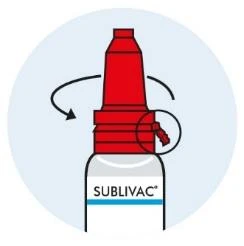
- 1. Remove the seal ring from the red protective cap before first use.
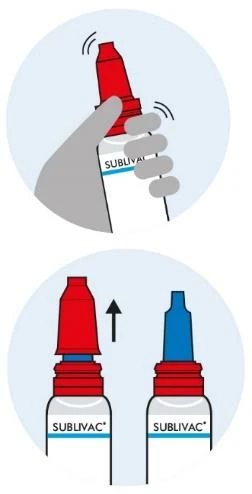
- 2. Shake the dropper bottle briefly before each use.
- 3. Remove the red protective cap.
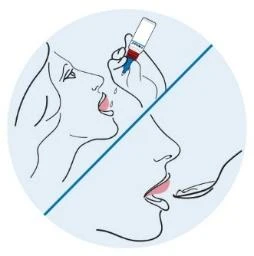
4. Place the required number of daily drops under the tongue.
(Alternatively, the drops may also be administered under the tongue using a spoon.)
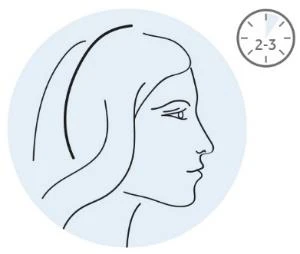
- 5. Hold the drops under the tongue for two or three minutes before swallowing.
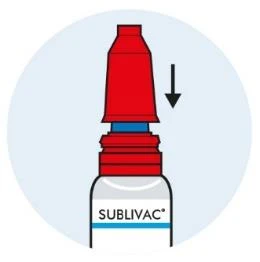
- 6. Clean the blue dropper with a clean, dry paper towel. Replace the red protective cap on the blue dropper.
It is recommended to start treatment outside the pollen season. If you have reached the maximum dose and tolerate the medicine well, you may continue taking it during the pollen season.
Treatment may also be initiated during the pollen season, provided careful monitoring by the doctor is ensured. If you experience adverse effects, the dose may be temporarily reduced.
It is recommended to continue this treatment for three consecutive years.
Dose reduction in case of treatment interruptions
If treatment is temporarily interrupted for one or more weeks (e.g. due to illness), consult your doctor. It may be necessary to adjust the dose.
As a general rule, the daily dose should be reduced by one drop for each week of interruption. After this reduction, the dose may be gradually increased again until the original maximum dose is reached.
If you take more Sublivac Betulla than you should
Consult your doctor if you have accidentally taken too many drops during the initial treatment phase. If you have accidentally taken too many drops during the maintenance phase, resume the correct dose the following day and continue taking that dose.
If you forget to take Sublivac Betulla
Do not take a double dose to make up for the missed dose. If you have missed a dose for more than one week, dose adjustment may be necessary. Consult your doctor.
If you stop taking Sublivac Betulla
It is recommended to continue this treatment for three consecutive years in order to achieve a lasting improvement. If you stop taking this medicine too early, you may experience the same allergic symptoms you had before starting treatment.
If you have any questions about the use of this medicine, consult your doctor or pharmacist.
4. Possible side effects
Like all medicines, this medicine can cause side effects, although not everybody gets them.
During treatment, you may be exposed to tree pollen allergens that can cause allergic reactions. Local reactions may occur, such as swelling, itching or pain in the throat or mouth, lips or tongue, or itching in the ears. Nausea and abdominal pain may also occur. Allergic reactions such as runny nose, sneezing, itchy eyes or shortness of breath may also occur. Most allergic adverse reactions occur within 30 minutes after taking the drops, but adverse reactions may also occur several hours later.
In rare cases, severe allergic reactions, known as anaphylactic reactions, may occur. Typical warning signs include:
- Widespread itching and flushing; the most commonly affected areas are the scalp, mouth, throat, palms of the hands or soles of the feet.
- Wheezing or heavy breathing/shortness of breath
- Severe hives
- Swelling of the lips or throat
- Pallor or grayish skin color
- Rapid heartbeat
- Feeling of weakness or collapse
If you notice any of these warning signs, contact a doctor immediately. Treatment must be stopped immediately until your doctor advises otherwise.
Persistent difficulty swallowing or stomach pain may be signs of eosinophilic esophagitis (inflammation of the esophagus), which may occur during sublingual immunotherapy (see Warnings and precautions).
The adverse effects observed during clinical studies with Sublivac Birch and after market authorization are listed in Table 1.
Table 1: Nature and frequency of adverse reactions
| Very common (may affect more than 1 in 10 treated patients) |
|
| Common (may affect up to 1 in 10 treated patients) |
|
| Common (may affect up to 1 in 100 treated patients) |
|
| |
| Not known (frequency cannot be estimated from the available data) |
|
Reporting of adverse reactions
If you experience any adverse reaction, including those not listed in this leaflet, contact your
doctor or pharmacist. You can also report adverse reactions directly via the national reporting system
at the website https://www.aifa.gov.it/content/segnalazioni-reazioni-avverse. By reporting
adverse reactions, you can help provide further information on the safety of this medicine.
5. How to store Sublivac Birch
Keep this medicine out of the sight and reach of children.
Sublivac Birch must be stored upright in the refrigerator (between 2°C and 8°C; do not freeze).
Do not use this medicine after the expiry date stated on the carton and on the dropper bottle
after “Exp.:”. The expiry date refers to the last day of that month.
After first opening, the contents of the dropper bottle may be used for a period of six
months. This period must not exceed the expiry date indicated on the carton and on the dropper bottle.
After first opening, the dropper bottle may be stored outside the refrigerator, but at a temperature
below 25°C. The dropper bottle must be stored upright.
A single dropper bottle lasts approximately three months. Please consult your doctor in advance regarding the prescription
of a new pack for maintenance treatment.
Do not use this medicine if you notice particles in the dropper bottle or changes in the colour of the contents compared to when the dropper bottle was first opened.
Do not dispose of medicines via wastewater or household waste. Ask your pharmacist how to dispose of medicines no longer in use. This will help protect the environment.
6. Package contents and other information
What Sublivac Betulla contains
The active substance is allergen extract from birch pollen. 1 mL contains 40,000 AUN.
The dosage of the product is expressed in units of biological activity (AUN).
The other components are:
Glycerol
Aminocaproic acid
Disodium hydrogen phosphate
Sodium dihydrogen phosphate
Peppermint oil
Water for injections
Description of the appearance of Sublivac Betulla and contents of the pack
Clear, viscous solution, colourless to yellowish-brown, with a peppermint odour. The product is
supplied in a transparent glass dropper bottle containing a 24 mL solution. It is equipped
with a blue synthetic rubber dropper and sealed with a red protective cap. The dropper bottle is
packaged in a box. The single pack contains one dropper bottle, while the multiple pack contains two dropper bottles.
Marketing Authorisation Holder and Manufacturer
HAL Allergy B.V.
J.H. Oortweg 15
NL-2333 CH Leiden
The Netherlands
Tel: +31 (0)88 – 19 59 000
Fax: +31 (0)88 – 19 59 001
E-mail: [email protected]
This medicinal product is authorised in the European Economic Area Member States
under the following names:
Denmark: Sublivac Birk
Finland: Sublivac Koivu
Germany: Sublivac Birke
Italy: Sublivac Betulla
Norway: Sublivac Bjørk
Slovenia: Breza Sublivac 40.000 AUN/mL oralne kapljice
Sweden: Sublivac Björk
Sublivac Dose Recommendation
Please detach, complete daily and bring to every appointment with your doctor.
Dose recommendation for initial treatment and maintenance treatment with daily administration.
Dose recommendation for maintenance treatment with daily administration.
Patient's name: __________________ Batch number: __________________
Patient's name: __________________ Batch number: __________________
| Day | Drops | Date of administration | Notes |
| 1 | 1 | ||
| 2 | 2 | ||
| 3 | 3 | ||
| 4 | 4 | ||
| 5 | 5 | ||
| 5 drops per day | 5 | ||
| 5 | |||
| 5 | |||
| 5 | |||
| 5 | |||
| 5 | |||
| 5 | |||
| 5 | |||
| 5 | |||
| 5 | |||
| 5 | |||
| 5 | |||
| 5 | |||
| 5 | |||
| 5 | |||
| 5 | |||
| 5 | |||
| 5 | |||
| 5 | |||
| Drops | Date of administration | Notes | |
| 5 drops per day | 5 | ||
| 5 | |||
| 5 | |||
| 5 | |||
| 5 | |||
| 5 | |||
| 5 | |||
| 5 | |||
| 5 | |||
| 5 | |||
| 5 | |||
| 5 | |||
| 5 | |||
| 5 | |||
| 5 | |||
| 5 | |||
| 5 | |||
| 5 | |||
| 5 | |||
| 5 | |||
| 5 | |||
| 5 | |||
| 5 | |||
| 5 |
One vial lasts approximately 3 months
Sublivac Dose recommendation
Please detach, complete daily and bring to every appointment with your doctor.
Dose recommendation for maintenance treatment with daily administration
Patient's name: __________________ Batch no.: ____________
| Drops | Date of administration | Notes | Drops | Date of administration | Notes | |
| 5 | 5 | |||||
| 5 | 5 | |||||
| 5 | 5 | |||||
| 5 | 5 | |||||
| 5 | 5 | |||||
| 5 | 5 | |||||
| 5 | 5 | |||||
| 5 | 5 | |||||
| 5 | 5 | |||||
| 5 | 5 | |||||
| 5 | 5 | |||||
| 5 | 5 | |||||
| 5 | 5 | |||||
| 5 | 5 | |||||
| 5 | 5 | |||||
| 5 | 5 | |||||
| 5 | 5 | |||||
| 5 | 5 | |||||
| 5 | 5 | |||||
| 5 | 5 | |||||
| 5 | 5 | |||||
| 5 | 5 | |||||
| 5 | 5 | |||||
| 5 | 5 |
One bottle lasts approximately 3 months One bottle lasts approximately 3 months