Spiriva Respimat
Italy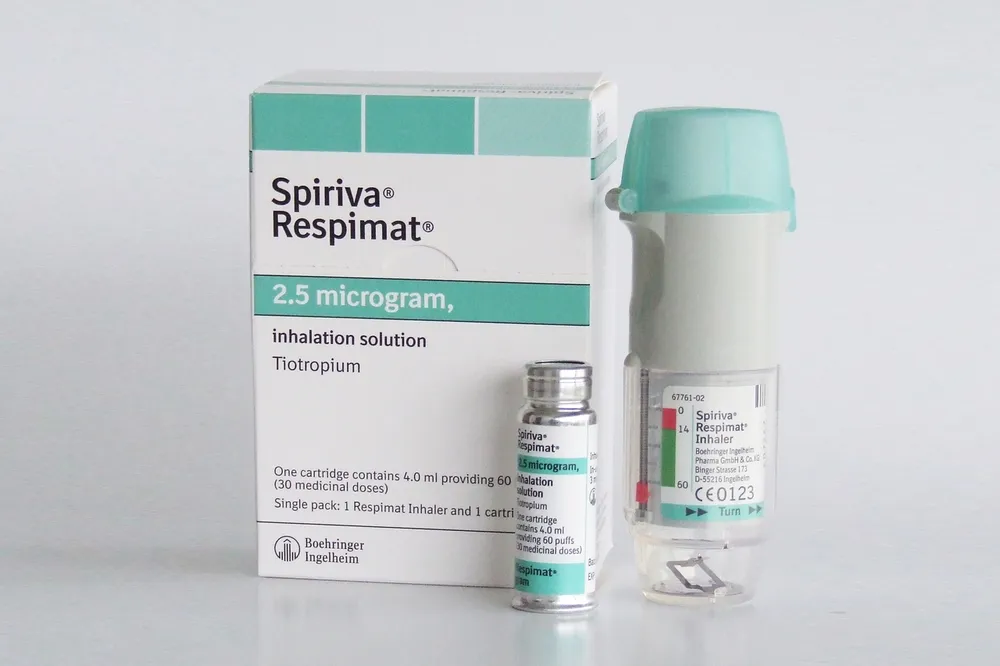
Table of Contents
- Patient Information Leaflet: Information for the User
- Spiriva Respimat 2.5 micrograms, inhalation solution
- 1. What Spiriva Respimat is and what it is used for
- 2. What you need to know before using Spiriva Respimat
- 3. How to use Spiriva Respimat
- 4. Possible side effects
- 5. How to store Spiriva Respimat
- 6. Package contents and other information
- Instructions for Use
Patient Information Leaflet: Information for the User
Spiriva Respimat 2.5 micrograms, inhalation solution
tiotropium
Please read this entire leaflet carefully before you start using this medicine, as it contains important information for you.
- Keep this leaflet. You may need to read it again.
- If you have any questions, ask your doctor or pharmacist.
- This medicine has been prescribed for you only. Do not give it to others, even if they have the same symptoms as you, because it may be harmful.
- If you experience any adverse reactions, including those not listed in this leaflet, contact your doctor or pharmacist. See section 4.
Contents of this leaflet:
- What Spiriva Respimat is and what it is used for
- What you need to know before using Spiriva Respimat
- How to use Spiriva Respimat
- Possible side effects
- How to store Spiriva Respimat
- Contents of the pack and other information
1. What Spiriva Respimat is and what it is used for
Spiriva Respimat helps people with chronic obstructive pulmonary disease (COPD) or asthma to breathe more easily. COPD is a chronic lung disease that causes shortness of breath and cough. The term COPD is associated with chronic conditions of bronchitis and emphysema. Asthma is a chronic disease characterized by inflammation and narrowing of the airways.
Since COPD and asthma are chronic diseases, Spiriva Respimat must be used every day, not only when breathing difficulties or other symptoms occur. When used to treat asthma, Spiriva Respimat must be used in addition to inhaled corticosteroids and long-acting beta-2-agonists.
Spiriva Respimat is a long-acting bronchodilator that opens the bronchial tubes and makes breathing easier. Regular use of Spiriva Respimat may also help reduce breathlessness associated with the disease and minimize the impact of the disease on daily life. Daily use of Spiriva Respimat helps prevent sudden short-term worsening of COPD symptoms, which may last for several days.
For the correct dosage of Spiriva Respimat, please refer to section 3 “How to use Spiriva Respimat” and the “Instructions for Use” provided on the reverse side of the package leaflet.
2. What you need to know before using Spiriva Respimat
Do not use Spiriva Respimat
- if you are allergic (hypersensitive) to tiotropium or to any of the other ingredients of this medicine (listed in section 6).
- if you are allergic (hypersensitive) to atropine or substances related to it, such as ipratropium or oxitropium.
Warnings and precautions
Talk to your doctor or pharmacist before using Spiriva Respimat.
Consult your doctor if you have narrow-angle glaucoma, prostate problems, or difficulty urinating.
If you have kidney problems, consult your doctor.
When using Spiriva Respimat, take care to avoid spraying the product into your eyes. If this happens, you may experience eye pain or discomfort, blurred vision, seeing halos around lights, or colored images, together with eye redness (i.e., narrow-angle glaucoma). Eye symptoms may be accompanied by headache, nausea, or vomiting. Rinse your eyes with warm water, stop taking tiotropium bromide, and contact your doctor immediately for further advice.
If your breathing worsens immediately after using the inhaler, or if you develop skin irritation, swelling, or itching, stop using it and inform your doctor immediately.
Dry mouth, which has been observed during anticholinergic treatment, may be associated with dental caries over the long term. Therefore, maintain adequate oral hygiene.
Spiriva Respimat is indicated for the maintenance treatment of chronic obstructive pulmonary disease (COPD) or asthma. Do not use this medicine to treat sudden attacks of breathlessness or shortness of breath.
For such cases, your doctor should have prescribed another inhaler (“rescue medicine”). Follow your doctor’s instructions.
If Spiriva Respimat has been prescribed for your asthma, it should be added to inhaled corticosteroids and long-acting beta-2 agonists. Continue taking inhaled corticosteroids as prescribed by your doctor, even if you feel better.
If you have suffered a myocardial infarction within the last 6 months, or have any unstable or life-threatening irregular heart rhythm, or severe heart failure within the past year, inform your doctor. This information is important to determine whether Spiriva Respimat is suitable for you.
Do not use Spiriva Respimat more than once a day.
Contact your doctor if you feel that your breathing is getting worse.
If you have cystic fibrosis, inform your doctor, as Spiriva Respimat may worsen symptoms of your cystic fibrosis.
Children and adolescents
Spiriva Respimat is not recommended for children and adolescents under 18 years of age.
Other medicines and Spiriva Respimat
Tell your doctor or pharmacist if you are currently using, have recently used, or might use any other medicines, including those not requiring a prescription.
In particular, inform your doctor or pharmacist if you are using or have used anticholinergic medicines, such as ipratropium or oxitropium.
No adverse interaction effects have been reported when Spiriva Respimat is used together with other medicines commonly used to treat COPD, such as inhaled symptom-relieving medicines (e.g., salbutamol), methylxanthines (e.g., theophylline), antihistamines, mucolytics (e.g., ambroxol), leukotriene modifiers (e.g., montelukast), cromones, anti-IgE treatments (e.g., omalizumab), and/or oral or inhaled steroids (e.g., budesonide, prednisolone).
Pregnancy and breastfeeding
If you are pregnant, think you might be pregnant, planning to become pregnant, or breastfeeding, please consult your doctor before taking this medicine.
Do not use this medicine unless specifically prescribed by your doctor.
Driving and using machines
No studies have been conducted on the effects on the ability to drive or operate machinery.
Dizziness or blurred vision may affect your ability to drive or operate machinery.
Spiriva Respimat contains benzalkonium chloride
This medicine contains 0.0011 mg of benzalkonium chloride per dose.
Benzalkonium chloride may cause wheezing and breathing difficulties (bronchospasm), especially if you have asthma.
3. How to use Spiriva Respimat
Use this medicine exactly as instructed by your doctor or pharmacist. If you have
any doubts, consult your doctor or pharmacist.
Spiriva Respimat is for inhalation use only.
The recommended dose for adults is:
Spiriva Respimat is effective for 24 hours; therefore, you must use Spiriva Respimat only ONCE
DAILY, preferably at the same time each day. Each time, you must inhale TWO PUFFS.
Since COPD and asthma are chronic diseases, use Spiriva Respimat every day and not only when you
experience breathing difficulties. Do not take a higher dose than recommended.
The use of Spiriva Respimat is not recommended in children and adolescents under 18 years of age due
to lack of safety and efficacy data.
Make sure you know how to use Spiriva Respimat correctly. Instructions for using Spiriva Respimat are
provided on the reverse side of this patient information leaflet.
If you use more Spiriva Respimat than you should
If you take more than two puffs of Spiriva Respimat in one day, contact your doctor immediately.
You may be at increased risk of experiencing side effects such as dry mouth,
constipation, difficulty urinating, increased heart rate, or blurred vision.
If you forget to use Spiriva Respimat
If you forget to take a dose (TWO PUFFS ONCE DAILY), take it as soon as you remember, but do not
take two doses at the same time or on the same day. Take the next dose as usual.
If you stop using Spiriva Respimat
Before stopping treatment with Spiriva Respimat, speak to your doctor or pharmacist. If you stop
treatment with Spiriva Respimat, your COPD symptoms may worsen.
If you have any questions about how to use this medicine, consult your doctor or pharmacist.
4. Possible side effects
Like all medicines, this medicine can cause side effects, although not everybody gets them.
The assessment of side effects is based on the following frequencies:
Common: may affect up to 1 in 10 people
Uncommon: may affect up to 1 in 100 people
Rare: may affect up to 1 in 1,000 people
Not known: frequency cannot be estimated from the available data
The side effects described below have been observed in patients taking this medicine and are listed by frequency, categorized as common, uncommon, rare, or not known.
| Undesirable effect | COPD frequency | Asthma frequency |
| Dry mouth | Common | Common |
| Dizziness | Uncommon | Uncommon |
| Headache | Uncommon | Uncommon |
| Sleep difficulties (insomnia) | Rare | Uncommon |
| Irregular heartbeat (atrial fibrillation, supraventricular tachycardia) | Rare | Not known |
| Perception of heartbeat (palpitations) | Rare | Uncommon |
| Increased heart rate (tachycardia) | Rare | Not known |
| Cough | Uncommon | Uncommon |
| Nosebleeds (epistaxis) | Rare | Not known |
| Sore throat (pharyngitis) | Uncommon | Uncommon |
| Hoarseness (dysphonia) | Uncommon | Uncommon |
| Chest tightness, associated with cough, wheezing or shortness of breath immediately after inhalation (bronchospasm) | Rare | Uncommon |
| Constipation | Uncommon | Rare |
| Fungal infections in mouth and throat (oropharyngeal candidiasis) | Uncommon | Uncommon |
| Difficulty swallowing (dysphagia) | Rare | Not known |
| Rash | Uncommon | Rare |
| Itching (pruritus) | Uncommon | Rare |
| Difficulty urinating (urinary retention) | Uncommon | Not known |
| Painful urination (dysuria) | Uncommon | Not known |
| Seeing halos around lights or colored images associated with eye redness (glaucoma) | Rare | Not known |
| Increased measured eye pressure | Rare | Not known |
| Blurred vision | Rare | Not known |
| Inflammation of the larynx (laryngitis) | Rare | Not known |
| Heartburn (gastroesophageal reflux) | Rare | Not known |
| Dental caries | Rare | Not known |
| Inflammation of the gums (gingivitis) | Rare | Rare |
| Inflammation of the tongue (glossitis) | Rare | Not known |
| Inflammation of the mouth (stomatitis) | Not known | Rare |
| Severe allergic reactions causing swelling of mouth, face or throat (angioedema) | Rare | Rare |
| Hives (urticaria) | Rare | Rare |
| Skin infections or ulcerations | Rare | Not known |
| Dry skin | Rare | Not known |
| Hypersensitivity, including immediate reactions | Not known | Rare |
| Urinary tract infection | Rare | Not known |
| Loss of body fluids (dehydration) | Not known | Not known |
| Inflammation of the sinuses (sinusitis) | Not known | Not known |
| Intestinal blockage or absence of intestinal movement (intestinal obstruction including paralytic ileus) | Not known | Not known |
| Feeling unwell (nausea) | Not known | Not known |
| Severe allergic reaction (anaphylactic reaction) | Not known | Not known |
| Joint swelling | Not known | Not known |
With Spiriva Respimat, immediate allergic reactions such as rash, urticaria, swelling of the mouth and face, or sudden breathing difficulty (angioedema), or other hypersensitivity reactions (such as sudden drop in blood pressure or dizziness) occurring individually or as part of a severe allergic reaction (anaphylactic reaction) may occur.
Additionally, as may occur with all other inhaled medications, unexpected chest tightness, cough, wheezing, or shortness of breath (bronchospasm) may occur in some patients immediately after inhalation.
If any of these effects occur, contact your doctor immediately.
Reporting of adverse reactions
If you experience any adverse reaction, including those not listed in this leaflet, consult your doctor or pharmacist. You may also report adverse reactions directly through the national reporting system at https://www.aifa.gov.it/content/segnalazioni-reazioni-avverse.
By reporting adverse reactions, you can help provide more information on the safety of this medicine.
5. How to store Spiriva Respimat
Keep this medicine out of the sight and reach of children.
Do not use this medicine after the expiry date stated on the box and on the label of the inhaler.
The expiry date refers to the last day of that month.
Do not freeze.
Period of validity during use
Replace the cartridge no later than 3 months after insertion.
Do not use the reusable Respimat inhaler for longer than one year.
Recommended use: 6 cartridges per inhaler
Note: The performance of the reusable Respimat inhaler has been tested for 540 actuations
(corresponding to 9 cartridges).
Do not dispose of any medicine via wastewater or household waste. Ask your pharmacist how to dispose of medicines you no longer use. This will help protect the environment.
6. Package contents and other information
What Spiriva Respimat contains
The active substance is tiotropium. The delivered dose is 2.5 micrograms of tiotropium per actuation (2
actuations constitute the medicinal dose) and is equivalent to 3.124 micrograms of tiotropium
bromide monohydrate. The delivered dose is the amount available to the patient after passing through
the mouthpiece.
The other components are benzalkonium chloride, edetate disodium, purified water, and hydrochloric acid 3.6%
used to adjust pH.
Description of the appearance of Spiriva Respimat and contents of the package
Spiriva Respimat 2.5 micrograms consists of a cartridge containing the inhalation solution and a Respimat inhaler. The cartridge must be inserted into the inhaler before first use.
Single pack: 1 reusable Respimat inhaler and 1 cartridge providing 60 actuations (30 medicinal doses)
Triple pack: 1 reusable Respimat inhaler and 3 cartridges, each providing 60 actuations (30 medicinal doses)
Single refill pack: 1 cartridge providing 60 actuations (30 medicinal doses)
Triple refill pack: 3 cartridges, each providing 60 actuations (30 medicinal doses)
Not all pack sizes may be marketed.
Marketing Authorization Holder and Manufacturer
Marketing Authorization Holder:
Boehringer Ingelheim International GmbH
Binger Strasse 173
D-55216 Ingelheim am Rhein
Germany
Manufacturers:
Boehringer Ingelheim Pharma GmbH & Co. KG
Binger Strasse 173
D-55216 Ingelheim am Rhein
Germany
Boehringer Ingelheim España, S.A.
c/ Prat de la Riba, 50
08174 Sant Cugat del Vallès (Barcelona)
Spain
This medicinal product is authorized in the European Economic Area member states under the
following names:
Austria, Liechtenstein: Spiriva Respimat 2,5 Mikrogramm - Lösung zur Inhalation
Belgium, Luxembourg: Spiriva Respimat 2,5 microgrammes, solution à inhaler
Bulgaria: Спирива Респимат 2,5 микрограма, разтвор за инхалация
Cyprus, Greece: Spiriva Respimat 2.5 μικρογραμμάρια, εισπνεόμενο διάλυμα
Czech Republic: Spiriva Respimat 2,5 mikrogramu, roztok k inhalaci
Denmark: Spiriva Respimat Inhalationsvæske, opløsning 2,5 microgram
Estonia: Spiriva Respimat inhalatsioonilahus 2,5µg/annuses
Finland: Spiriva Respimat 2.5 mikrog inhalaationeste, liuos
France: Spiriva Respimat 2,5 microgrammes/dose, solution pour inhalation
Germany: Spiriva Respimat 2,5 Mikrogramm Lösung zur Inhalation
Hungary: Spiriva Respimat 2,5 mikrogramm inhalációs oldat
Iceland: Spiriva Respimat 2.5 mikróg/skammt
Ireland, Malta,
United Kingdom: Spiriva Respimat 2.5 microgram, inhalation solution
Italy: Spiriva Respimat 2.5 microgrammi, soluzione per inalazione
Latvia: Spiriva Respimat 2,5 mikrogrami šķīdums inhalācijām
Lithuania: Spiriva Respimat 2,5 mikrogramo/išpurškime įkvepiamasis tirpalas
Netherlands: Spiriva Respimat 2,5 microgram, inhalatieoplossing
Norway: Spiriva Respimat 2,5 mikrogram inhalasjonsvæske, oppløsning
Poland: Spiriva Respimat 2,5 mikrograma/dawkę odmierzoną, roztwór do inhalacji
Portugal: Spiriva Respimat 2.5 mg/dose, Solução para inalação por nebulização
Romania: Spiriva Respimat 2,5 micrograme soluţie de inhalat
Slovakia: Spiriva Respimat sol ihl 2,5 µg/1 dávka
Slovenia: Spiriva Respimat 2,5 mikrogramov raztopina za inhaliranje
Spain: Spiriva Respimat 2,5 microgramos, solución para inhalación
Sweden: Spiriva Respimat 2,5 mikrogram, inhalationsvätska, lösning
This leaflet was last updated on
SPIRIVA RESPIMAT
Instructions for Use
Introduction
Read these instructions for use before starting to use the reusable Spiriva Respimat inhaler.
You must use this inhaler only ONCE DAILY. Each time, take TWO PUFFS.
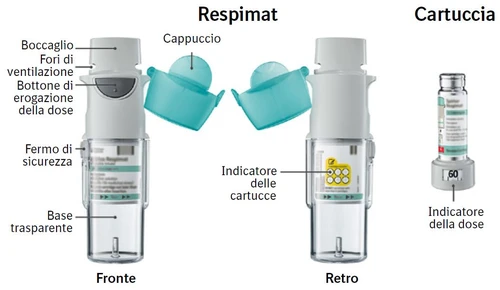
- If not used for more than 7 days, release one puff towards the ground.
- If not used for more than 21 days, repeat steps 4 to 6 of the section "Preparing for use" until a spray becomes visible. Then repeat steps 4 to 6 three more times.
Maintenance of the reusable Spiriva Respimat
Clean the mouthpiece, including the metal part inside, only with a damp cloth or damp paper tissue, at least once a week.
Slight discolouration of the mouthpiece does not affect the performance of the reusable Spiriva Respimat inhaler.
If necessary, clean the outside of the reusable Spiriva Respimat inhaler with a damp cloth.
When to replace the inhaler
When you have used an inhaler with 6 cartridges, you must obtain a new package of the reusable Spiriva Respimat, containing a new inhaler.
Preparing for use
| 1. Remove the transparent base Keep the cap closed. Press the safety lock and pull off the transparent base with the other hand. | 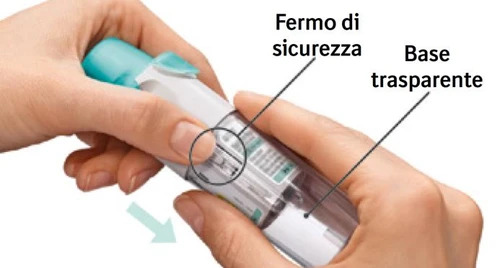 |
| 2. Insert the cartridge Insert the cartridge into the inhaler. Place the inhaler on a solid surface and press firmly until the cartridge is fully inserted. | 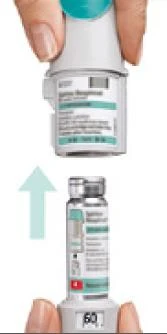 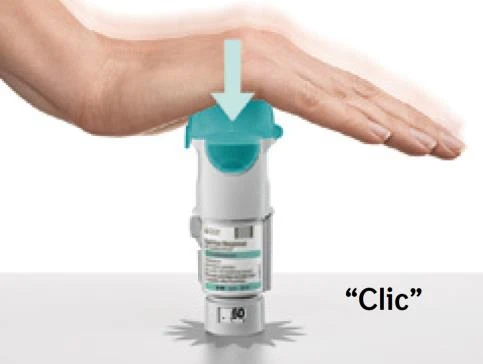 |
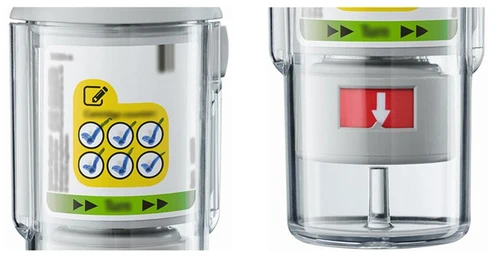
| 3. Track the cartridge Mark the check box on the inhaler label to keep track of the number of cartridges already used. Reattach the transparent base until a click is heard. | |
| 4. Rotate Keep the cap closed. Rotate the transparent base in the direction of the arrows shown | 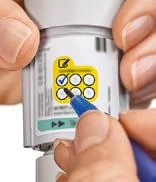 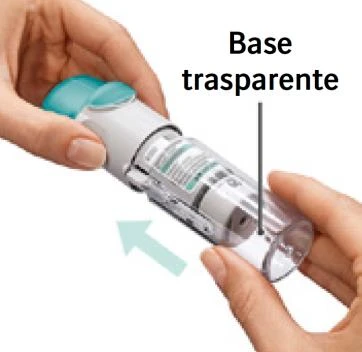 |
| on the label until a click is heard (half a turn). | 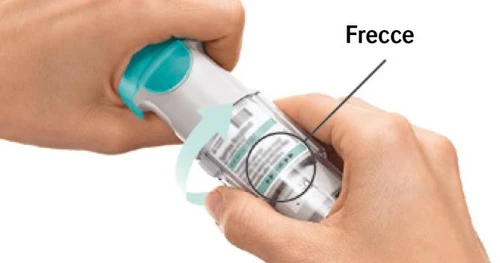 |
| 5. Open Snap open the cap and open fully. | 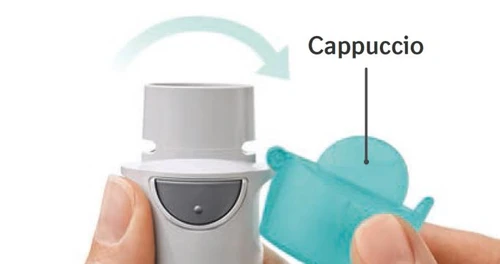 |
| 6. Press Point the inhaler downward. Press the dose release button. Close the cap. Repeat steps 4–6 until a cloud becomes visible. After a cloud is visible, repeat steps 4–6 three more times. The inhaler is now ready for use and will deliver 60 actuations (30 doses). | 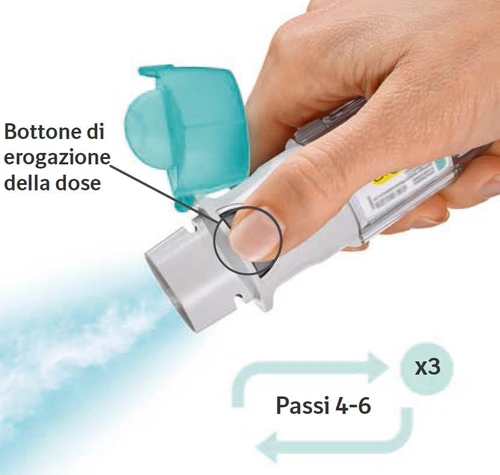 |
Daily use
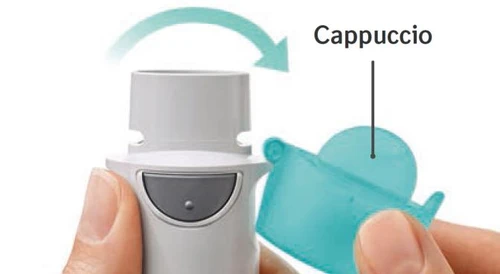
| ROTATE Keep the cap closed. ROTATE the transparent base in the direction of the arrows shown on the label until you hear a click (half a turn). | 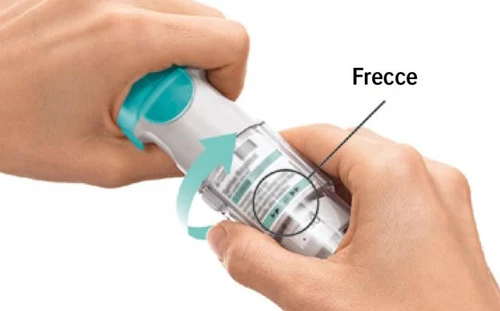 |
| OPEN | |
|  |
| PRESS Breathe out slowly and fully. Close lips around the mouthpiece without covering the air vents. Point the inhaler towards the back of the throat. While breathing in slowly and deeply through the mouth, PRESS the dose-release button and continue to inhale slowly as deeply as possible. Hold breath for 10 seconds or as long as possible. Repeat the ROTATE, OPEN, PRESS steps for a total of 2 actuations. Close the cap until next use of the inhaler. | 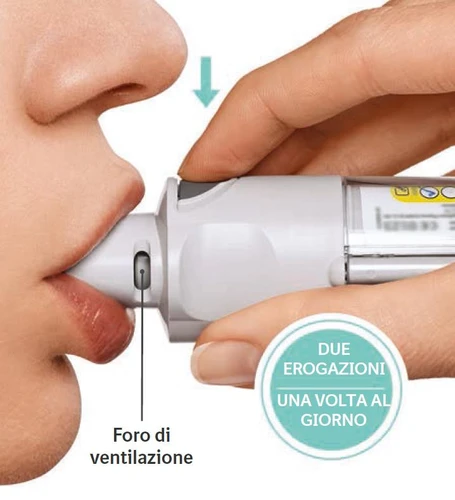 |
When to replace the Spiriva Respimat cartridge
The dose indicator shows how many actuations remain in the cartridge.
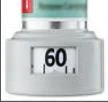
60 actuations remaining
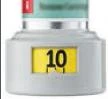
Less than 10 actuations remaining. Obtain a new cartridge.
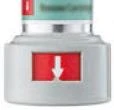
The cartridge is empty. Rotate the transparent base to loosen it. The inhaler is now in a locked position. Remove the cartridge from the inhaler. Insert a new cartridge (continue from step 2).
Answers to common questions
It is difficult to fully insert the cartridge.
Was the transparent base accidentally rotated before inserting the cartridge?
Open the cap, press the dose release button, then insert the cartridge.
Are you replacing the cartridge?
The new cartridge will protrude further than the first cartridge inserted. Insert it until you hear a
click, then reposition the transparent base.
The dose release button cannot be pressed.
Has the transparent base been rotated?
If not, rotate the transparent base with a continuous motion until you hear a
click (half a turn).
Does the dose indicator on the cartridge show a white arrow on a red background?
The cartridge is empty. Insert a new cartridge.
It is difficult to remove the cartridge after it has been emptied.
Pull and simultaneously rotate the cartridge.
The transparent base cannot be rotated or repositioned.
Has the transparent base already been rotated?
If the transparent base has already been rotated, follow the “OPEN” and “PRESs” steps in the
“Daily use” section to take your medicine.
Is the transparent base loose and does the dose indicator on the cartridge show a white arrow
on a red background?
The cartridge is empty. Insert a new cartridge.
The reusable Respimat has run out too quickly.
Has the reusable Respimat been used as directed (two actuations/once daily)?
The Respimat is sufficient for 30 days when used with two actuations once daily.
Have you frequently performed test actuations into the air to check the function of the
reusable Respimat?
After preparing the reusable Respimat, there is no need to perform test actuations into the air if
it is used daily.
The reusable Respimat does not deliver the dose.
Has the cartridge been inserted?
If not, insert the cartridge. After the reusable Respimat has been assembled, do not remove the transparent base or the cartridge until the cartridge is empty.
Were the steps ROTATE, OPEN, PRESS repeated fewer than three times after
inserting the cartridge?
Repeat the steps ROTATE, OPEN, PRESS three times after inserting the cartridge as
shown in steps 4 to 6 of the section “Preparing for use”.
Does the dose indicator on the cartridge show a white arrow on a red background?
The cartridge is empty. Insert a new cartridge.
The reusable Respimat automatically delivers the dose.
Was the cap open when the transparent base was rotated?
Close the cap, then rotate the transparent base.
Was the dose release button pressed when the transparent base was rotated?
Close the cap so that the dose release button is covered, then rotate the transparent base.
Was the rotation of the transparent base interrupted before hearing a click?
Rotate the transparent base with a continuous motion until you hear a click (half a turn).
Was the cap open when the cartridge was replaced?
Close the cap, then replace the cartridge.
Other information
Boehringer Ingelheim Pharma GmbH & Co. KG
D – 55216 Ingelheim am Rhein
Germany
