Spinraza
Italy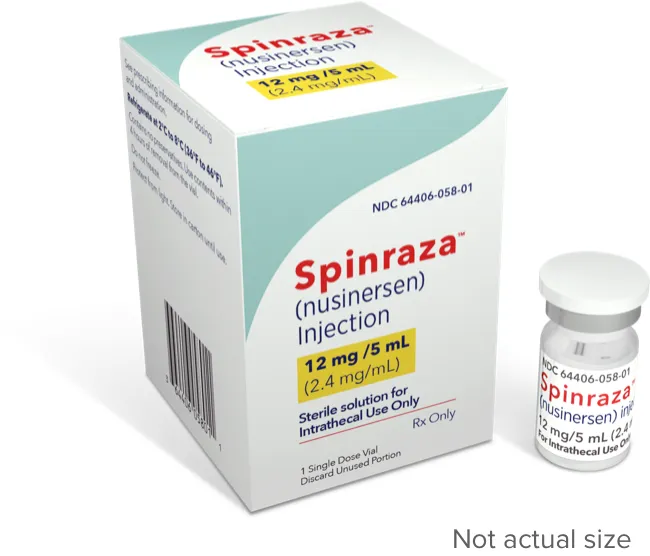
Table of Contents
- Package leaflet: Information for the user
- Spinraza 12 mg solution for injection
- 1. What is Spinraza and what is it used for?
- 2. What you should know before you or your child receives Spinraza
- 3. How Spinraza is administered
- 4. Possible side effects
- 5. How to store Spinraza
- 6. Package contents and other information
- The following information is intended for healthcare professionals only:
- Package leaflet: Information for the user
- Spinraza 28 mg solution for injection, 50 mg solution for injection
- 3. How Spinraza is administered
- 4. Possible side effects
- 5. How to store Spinraza
- 6. Package contents and other information
- The following information is intended for healthcare professionals only:
Package leaflet: Information for the user
Spinraza 12 mg solution for injection
nusinersen
Please read this leaflet carefully before you or your child is given this medicine because it contains important information for you.
- Keep this leaflet. You may need to read it again.
- If you have any questions, ask your doctor or nurse.
- If you or your child experience any side effects, including those not listed in this leaflet, tell your doctor or nurse. See section 4.
Contents of this leaflet
- What Spinraza is and what it is used for
- What you need to know before you or your child is given Spinraza
- How Spinraza is administered
- Possible side effects
- How to store Spinraza
- Contents of the pack and other information
1. What is Spinraza and what is it used for?
Spinraza contains the active substance nusinersen, which belongs to a group of medicines known as antisense oligonucleotides. Spinraza is used to treat a genetic disease called spinal muscular atrophy (SMA).
Spinal muscular atrophy is caused by a deficiency of a protein called survival motor neuron (SMN) in the body, leading to the loss of nerve cells in the spinal cord, resulting in weakness of the muscles of the shoulders, hips, thighs, and upper back. It may also weaken the muscles used for breathing and swallowing.
Spinraza works by helping the body produce increased amounts of the SMN protein that is lacking in people with SMA. This reduces the loss of nerve cells and may thereby improve muscle strength.
2. What you should know before you or your child receives Spinraza
Spinraza must not be administered
- if you or your child are allergic to nusinersen or to any of the other ingredients of this medicine (listed in section 6).
If you have any doubts, consult your doctor or nurse before you or your child receives Spinraza.
Warnings and precautions
There is a risk of experiencing adverse reactions following administration of Spinraza via lumbar puncture (see section 3). These may include headache, vomiting, and back pain. There may also be difficulties administering the medicine using this method in very young patients and in those affected by scoliosis (rotation and curvature of the spine).
Other medicines belonging to the same group as Spinraza have shown an effect on blood platelets, which help blood to clot. Before you or your child receives Spinraza, the doctor may decide to perform a blood test to check proper blood clotting. This test may not be necessary every time you or your child receives Spinraza.
Other medicines in the same class as Spinraza have shown an effect on the kidneys. Before you or your child receives Spinraza, the doctor may decide to perform a urine test to check proper kidney function. This test may not be necessary every time you or your child receives Spinraza.
There have been a small number of reports of patients developing hydrocephalus (accumulation of excessive fluid around the brain) after receiving Spinraza. In some of these patients, treatment of hydrocephalus required the implantation of a device called a ventriculo-peritoneal shunt. If you notice symptoms such as increased head size, reduced level of consciousness, nausea, persistent vomiting or headache, or any other concerning symptoms, inform your doctor or your child’s doctor immediately to receive appropriate treatment. The benefits and risks of continuing treatment with Spinraza after implantation of a ventriculo-peritoneal shunt are currently unknown.
Please speak with your doctor before you or your child receives Spinraza.
Other medicines and Spinraza
Inform your doctor if you or your child are taking, have recently taken, or might take any other medicines.
Pregnancy and breastfeeding
If you are pregnant, suspect you may be pregnant, planning to become pregnant, or are breastfeeding, please consult your doctor before receiving this medicine. It is advisable to avoid using Spinraza during pregnancy and breastfeeding.
Driving and using machines
Spinraza does not affect or has a negligible effect on the ability to drive vehicles and operate machinery.
Spinraza contains a small amount of sodium
This medicine contains less than 1 mmol (23 mg) of sodium per 5 ml vial, i.e. essentially 'sodium-free', and can be used by individuals on a low-sodium diet.
Spinraza contains a small amount of potassium
This medicine contains potassium, less than 1 mmol (39 mg) per 5 ml vial, i.e. essentially 'potassium-free'.
3. How Spinraza is administered
Spinraza is administered at a dose of 12 mg:
- On the first day of treatment, day 0
- Then around day 14, day 28, and day 63
- After that, once every 4 months.
Spinraza is given by injection into the lower back. This injection, called a lumbar puncture, is performed by inserting a needle into the space surrounding the spinal cord. This procedure is carried out by a doctor experienced in performing lumbar punctures. You or your child may also be given a medicine to help you relax or sleep during the procedure.
Duration of treatment with Spinraza
Your doctor will inform you how long you or your child needs to receive Spinraza. Do not stop treatment with Spinraza unless instructed by your doctor.
If you or your child miss an injection
If you or your child misses a dose of Spinraza, consult your doctor so that Spinraza can be administered as soon as possible.
If you have any questions about how Spinraza is administered, speak to your doctor.
4. Possible side effects
Like all medicines, this medicine can cause side effects, although not everybody gets them.
Side effects related to lumbar puncture may occur during administration of Spinraza or afterwards.
Most of these side effects are reported within 72 hours after the procedure.
Very common (may affect more than 1 in 10 people)
- Back pain
- Headache
- Vomiting
- Fever (elevated body temperature)
Not known (frequency cannot be estimated from the available data)
- Serious lumbar puncture-related infection (e.g. meningitis)
- Hydrocephalus (accumulation of excessive fluid around the brain)
- Aseptic meningitis (inflammation of the membrane surrounding the spinal cord and brain, which may present as neck stiffness, headache, fever, nausea, and vomiting)
- Hypersensitivity (an allergic or allergic-like reaction that may include swelling of the face, lips, or tongue, rash, or itching)
- Arachnoiditis (inflammation of a membrane surrounding the brain and spinal cord), which may cause lower back pain or pain, numbness, or weakness in the legs
Reporting of side effects
If you or your child experiences any side effect, including those not listed in this leaflet, talk to your doctor or nurse. You can also report side effects directly via the national reporting system listed in Annex V. By reporting side effects, you can help provide more information on the safety of this medicine.
5. How to store Spinraza
Keep this medicine out of the sight and reach of children.
Do not use this medicine after the expiry date which is stated on the vial and the carton after
"Exp". The expiry date refers to the last day of that month.
Store in the refrigerator (2°C-8°C). Do not freeze.
Keep the vial in the outer packaging to protect the medicine from light.
If refrigeration is not available, Spinraza may be stored in the original packaging, protected from light,
or at a temperature not exceeding 30°C for up to 14 days.
If necessary, intact Spinraza vials may be removed from the refrigerator and then returned. If removed
from the original packaging, the total storage time at non-refrigerated conditions must not exceed 30 hours,
at a temperature not exceeding 25°C.
Medicines must not be disposed of via wastewater or household waste. Unused medicines will be
disposed of by healthcare professionals. This will help protect the environment.
6. Package contents and other information
What Spinraza contains
- The active substance is nusinersen. Spinraza 12 mg.
- Each 5 ml vial contains sodium nusinersen equivalent to 12 mg of nusinersen.
- Each ml contains 2.4 mg of nusinersen.
- The other components are monobasic sodium phosphate dihydrate, dibasic sodium phosphate, sodium chloride (see section 2 “Spinraza contains a small amount of sodium”), potassium chloride (see section 2 “Spinraza contains a small amount of potassium”), calcium chloride dihydrate, magnesium chloride hexahydrate, sodium hydroxide, hydrochloric acid, water for injections.
Description of the appearance of Spinraza and contents of the pack
Spinraza is a clear, colourless injectable solution.
Each pack of Spinraza contains one vial.
Each vial is single-use and intended for a single patient only. Do not dilute.
Marketing Authorisation Holder and Manufacturer
Biogen Netherlands B.V.
Prins Mauritslaan 13
1171 LP Badhoevedorp
The Netherlands
For further information about this medicinal product, please contact the local representative of the Marketing Authorisation Holder:
België/Belgique/Belgien Lietuva
Biogen Belgium N.V./S.A. Biogen Lithuania UAB
Tél/Tel: +32 2 219 12 18 Tel: +370 5 259 6176
България Luxembourg/Luxemburg
ЕВОФАРМА ЕООД Biogen Belgium N.V./S.A.
Teл.: +359 2 962 12 00 Tél/Tel: +32 2 219 12 18
Česká republika Magyarország
Biogen (Czech Republic) s.r.o. Biogen Hungary Kft.
Tel: +420 255 706 200 Tel.: +36 1 899 9880
Danmark Malta
Biogen (Denmark) A/S Pharma MT limited
Tlf.: +45 77 41 57 57 Tel: +356 213 37008/9
Deutschland Nederland
Biogen GmbH Biogen Netherlands B.V.
Tel: +49 (0) 89 99 6170 Tel: +31 20 542 2000
Eesti Norge
Biogen Estonia OÜ Biogen Norway AS
Tel: +372 618 9551 Tlf: +47 23 40 01 00
Ελλάδα Österreich
Genesis Pharma SA Biogen Austria GmbH
Τηλ: +30 210 8771500 Tel: +43 1 484 46 13
España Polska
Biogen Spain SL Biogen Poland Sp. z o.o.
Tel: +34 91 310 7110 Tel.: +48 22 351 51 00
France Portugal
Biogen France SAS Biogen Portugal
Tél: +33 (0)1 41 37 95 95 Tel.: +351 21 318 8450
Hrvatska România
Biogen Pharma d.o.o. Ewopharma România SRL
Tel: +385 (0) 1 775 73 22 Tel: +40 21 260 13 44
Ireland Slovenija
Biogen Idec (Ireland) Ltd. Biogen Pharma d.o.o.
Tel: +353 (0)1 463 7799 Tel.: +386 1 511 02 90
Ísland Slovenská republika
Icepharma hf Biogen Slovakia s.r.o.
Sími: +354 540 8000 Tel.: +421 2 323 340 08
Italia Suomi/Finland
Biogen Italia s.r.l. Biogen Finland Oy
Tel: +39 02 584 9901 Puh/Tel: +358 207 401 200
Κύπρος Sverige
Genesis Pharma Cyprus Ltd Biogen Sweden AB
Τηλ: +357 22765715 Tel: +46 8 594 113 60
Latvija
Biogen Latvia SIA
Tel: +371 68 688 158
Other sources of information
More detailed information on this medicinal product is available on the website of the European Medicines Agency: https://www.ema.europa.eu
<------------------------------------------------------------------------------------------------------------------------>
The following information is intended for healthcare professionals only:
- The Spinraza vial should be inspected before administration for the presence of particles. If particles are observed and/or if the liquid is not clear and colourless, the vial must not be used.
- An aseptic technique must be used when preparing the Spinraza solution for intrathecal administration.
- Prior to administration, the vial must be removed from the refrigerator and allowed to warm to room temperature (25°C) without the use of external heat sources.
- If the vial remains intact and the solution is not used, it must be returned to the refrigerator.
- Immediately before administration, remove the plastic closure cap and insert the syringe needle into the vial through the center of the seal to withdraw the appropriate volume. Spinraza must not be diluted. The use of external filters is not required.
- Spinraza is administered by intrathecal bolus injection over 1–3 minutes using a spinal anaesthetic needle.
- The injection must not be performed in areas of skin with signs of infection or inflammation.
- It is recommended to remove a volume of CSF equivalent to the volume of Spinraza to be injected, prior to administering Spinraza.
- Once withdrawn into the syringe, the solution must be discarded if not used within 6 hours.
- Any unused medicine in the vial must be discarded, and waste materials derived from this medicine must be disposed of in accordance with local regulations.
Package leaflet: Information for the user
Spinraza 28 mg solution for injection, 50 mg solution for injection
nusinersen
Read this leaflet carefully before you or your child receives Spinraza
Spinraza must not be administered
- if you or your child are allergic to nusinersen or to any of the other ingredients of this medicine (listed in section 6).
If you have any doubts, consult your doctor or nurse before you or your child receives Spinraza.
Warnings and precautions
There is a risk of developing adverse effects after administration of Spinraza via lumbar puncture (see section 3). These may include headache, vomiting, and back pain. There may also be difficulties administering a medicine by this method in very young patients and in those with scoliosis (rotation and curvature of the spine).
Other medicines belonging to the same group as Spinraza have shown an effect on blood platelets, the cells involved in blood clotting. Before you or your child receives Spinraza, your doctor may decide to perform a blood test to check proper blood clotting. This test may not be necessary every time you or your child receives Spinraza.
Other medicines belonging to the same group as Spinraza have shown an effect on the kidneys. Before you or your child receives Spinraza, your doctor may decide to perform a urine test to check proper kidney function. This test may not be necessary every time you or your child receives Spinraza.
There have been a small number of reports of patients developing hydrocephalus (accumulation of excessive fluid around the brain) after administration of Spinraza. In some of these patients, treatment of hydrocephalus required implantation of a device called a ventriculo-peritoneal shunt. If you notice symptoms such as increased head size, reduced level of consciousness, persistent nausea, vomiting, or headache, or any other concerning symptoms, inform your doctor or your child’s doctor immediately to receive appropriate treatment. The benefits and risks of continuing treatment with Spinraza after implantation of a ventriculo-peritoneal shunt are currently unknown.
Talk to your doctor before you or your child receives Spinraza.
Other medicines and Spinraza
Inform your doctor if you or your child are taking, have recently taken, or might take any other medicines.
Pregnancy and breastfeeding
If you are pregnant, suspect you may be pregnant, planning a pregnancy, or are breastfeeding, ask your doctor for advice before receiving this medicine. It is preferable to avoid using Spinraza during pregnancy and breastfeeding.
Driving and use of machines
Spinraza does not affect or has a negligible effect on the ability to drive vehicles and use machines.
Spinraza contains a small amount of sodium
This medicine contains less than 1 mmol (23 mg) of sodium per 5 ml vial, i.e. essentially ‘sodium-free’, and can be used by individuals on a low-sodium diet.
Spinraza contains a small amount of potassium
This medicine contains potassium, less than 1 mmol (39 mg) per 5 ml vial, i.e. essentially ‘potassium-free’.
3. How Spinraza is administered
If you have never been treated with Spinraza:
- A dose of Spinraza 50 mg is administered on day 0 and then on day 14.
- Then Spinraza 28 mg is administered once every 4 months.
If you have been treated with Spinraza 12 mg and your doctor decides to administer the 50 mg and 28 mg doses:
- A dose of Spinraza 50 mg is administered at least 4 months after the last 12 mg dose.
- Then Spinraza 28 mg is administered once every 4 months.
Spinraza is administered by injection into the lower back. This injection, called a lumbar puncture, is performed by inserting a needle into the space surrounding the spinal cord. This is done by a doctor experienced in performing lumbar punctures. You or your child may also be given a medicine to help you relax or sleep during the procedure.
Duration of treatment with Spinraza
Your doctor will tell you how long you or your child needs to receive Spinraza. Do not stop treatment with Spinraza unless instructed by your doctor.
If you or your child miss an injection
If you or your child miss a dose of Spinraza, consult your doctor so that Spinraza can be administered as soon as possible.
If you have any questions about how Spinraza is administered, speak to your doctor.
4. Possible side effects
Like all medicines, this medicine can cause side effects, although not everyone experiences them.
Side effects related to lumbar puncture may occur during administration of Spinraza or afterwards. Most of these side effects are reported within 72 hours after the procedure.
Very common (may affect more than 1 in 10 people)
- Back pain
- Headache
- Vomiting
- Fever (elevated body temperature)
Not known (frequency cannot be determined from the available data)
- Serious infection related to lumbar puncture (e.g. meningitis)
- Hydrocephalus (accumulation of excessive fluid around the brain)
- Meningitis not caused by infection (inflammation of the membrane surrounding the spinal cord and brain, which may present as neck stiffness, headache, fever, nausea and vomiting)
- Hypersensitivity (an allergic or allergy-like reaction which may include swelling of the face, lips or tongue, skin rash or itching)
- Arachnoiditis (inflammation of a membrane surrounding the brain and spinal cord), which may cause lower back pain or pain, numbness or weakness in the legs
Reporting of side effects
If you or your child experience any side effect, including those not listed in this leaflet, talk to your doctor or nurse. You can also report side effects directly through the national reporting system listed in Annex V. By reporting side effects, you can help provide more information on the safety of this medicine.
5. How to store Spinraza
Keep this medicine out of the sight and reach of children.
Do not use this medicine after the expiry date stated on the vial and the carton after "Exp". The expiry date refers to the last day of that month.
Store in the refrigerator (2°C-8°C). Do not freeze.
Keep the vial in the outer packaging to protect the medicine from light.
If refrigeration is not available, Spinraza may be stored in the original packaging, protected from light and at a temperature not exceeding 30°C for up to 14 days.
If necessary, intact Spinraza vials may be removed from the refrigerator and returned. If removed from the original packaging, the total storage time at non-refrigerated conditions must not exceed 30 hours, at a temperature not exceeding 25°C.
Medicines must not be disposed of via wastewater or household waste. Healthcare professionals will dispose of unused medicines. This will help protect the environment.
6. Package contents and other information
What Spinraza contains
- The active substance is nusinersen. Spinraza 28 mg
- Each 5 ml vial contains sodium nusinersen equivalent to 28 mg of nusinersen.
- Each ml contains 5.6 mg of nusinersen. Spinraza 50 mg
- Each 5 ml vial contains sodium nusinersen equivalent to 50 mg of nusinersen.
- Each ml contains 10 mg of nusinersen.
The other components are monosodium phosphate dihydrate, disodium phosphate, sodium chloride
(see section 2 “Spinraza contains a small amount of sodium”), potassium chloride (see
section 2 “Spinraza contains a small amount of potassium”), calcium chloride dihydrate, magnesium
chloride hexahydrate, sodium hydroxide, hydrochloric acid, water for injections.
Description of the appearance of Spinraza and contents of the pack
Spinraza is a clear, colourless injectable solution.
Each pack of Spinraza contains one vial.
Each vial is single-use for a single patient. Do not dilute.
Marketing Authorisation Holder and Manufacturer
Biogen Netherlands B.V.
Prins Mauritslaan 13
1171 LP Badhoevedorp
The Netherlands
For further information on this medicinal product, please contact the local representative of the Marketing Authorisation Holder:
Belgium/Belgium/Belgium Lithuania
Biogen Belgium N.V./S.A. Biogen Lithuania UAB
Tél/Tel: +32 2 219 12 18 Tel: +370 5 259 6176
Bulgaria Luxembourg/Luxembourg
EVOPHARM EOOD Biogen Belgium N.V./S.A.
Tel.: +359 2 962 12 00 Tél/Tel: +32 2 219 12 18
Czech Republic Hungary
Biogen (Czech Republic) s.r.o. Biogen Hungary Kft.
Tel: +420 255 706 200 Tel.: +36 1 899 9880
Denmark Malta
Biogen (Denmark) A/S Pharma MT limited
Tlf.: +45 77 41 57 57 Tel: +356 213 37008/9
Germany Netherlands
Biogen GmbH Biogen Netherlands B.V.
Tel: +49 (0) 89 99 6170 Tel: +31 20 542 2000
Estonia Norway
Biogen Estonia OÜ Biogen Norway AS
Tel: +372 618 9551 Tlf: +47 23 40 01 00
Greece Austria
Genesis Pharma SA Biogen Austria GmbH
Tel: +30 210 8771500 Tel: +43 1 484 46 13
Spain Poland
Biogen Spain SL Biogen Poland Sp. z o.o.
Tel: +34 91 310 7110 Tel.: +48 22 351 51 00
France Portugal
Biogen France SAS Biogen Portugal
Tél: +33 (0)1 41 37 95 95 Tel.: +351 21 318 8450
Croatia Romania
Biogen Pharma d.o.o. Ewopharma Romania SRL
Tel: +385 (0) 1 775 73 22 Tel: +40 21 260 13 44
Ireland Slovenia
Biogen Idec (Ireland) Ltd. Biogen Pharma d.o.o.
Tel: +353 (0)1 463 7799 Tel.: +386 1 511 02 90
Iceland Slovakia
Icepharma hf Biogen Slovakia s.r.o.
Sími: +354 540 8000 Tel.: +421 2 323 340 08
Italy Finland
Biogen Italia s.r.l. Biogen Finland Oy
Tel: +39 02 584 9901 Puh/Tel: +358 207 401 200
Cyprus Sweden
Genesis Pharma Cyprus Ltd Biogen Sweden AB
Tel: +357 22765715 Tel: +46 8 594 113 60
Latvia
Biogen Latvia SIA
Tel: +371 68 688 158
Other sources of information
More detailed information on this medicinal product is available on the website of the European Medicines Agency: https://www.ema.europa.eu
<------------------------------------------------------------------------------------------------------------------------>
The following information is intended for healthcare professionals only:
- The Spinraza vial must be inspected before administration for the presence of particulate matter. If particles are observed and/or if the solution is not clear and colourless, the vial must not be used.
- An aseptic technique must be used during the preparation of Spinraza solution for intrathecal administration.
- Prior to administration, the vial must be removed from the refrigerator and allowed to warm to room temperature (25°C) without using external heat sources.
- If the vial remains intact and the solution is not used, it must be returned to the refrigerator.
- Immediately before administration, remove the plastic closure cap and insert the syringe needle into the vial through the centre of the seal to withdraw the appropriate volume. Spinraza must not be diluted. The use of external filters is not required.
- Spinraza is administered by intrathecal bolus injection over 1 to 3 minutes, using a spinal anaesthesia needle.
- The injection must not be performed in areas of skin with signs of infection or inflammation.
- It is recommended to remove a volume of cerebrospinal fluid (CSF) equivalent to the volume of Spinraza to be injected, prior to administering Spinraza.
- Once drawn into the syringe, the solution must be discarded if not used within 6 hours.
- Any unused medicinal product remaining in the vial must be discarded, and waste materials derived from this medicine must be disposed of in accordance with local regulations.