Spikevax JN.1
Italy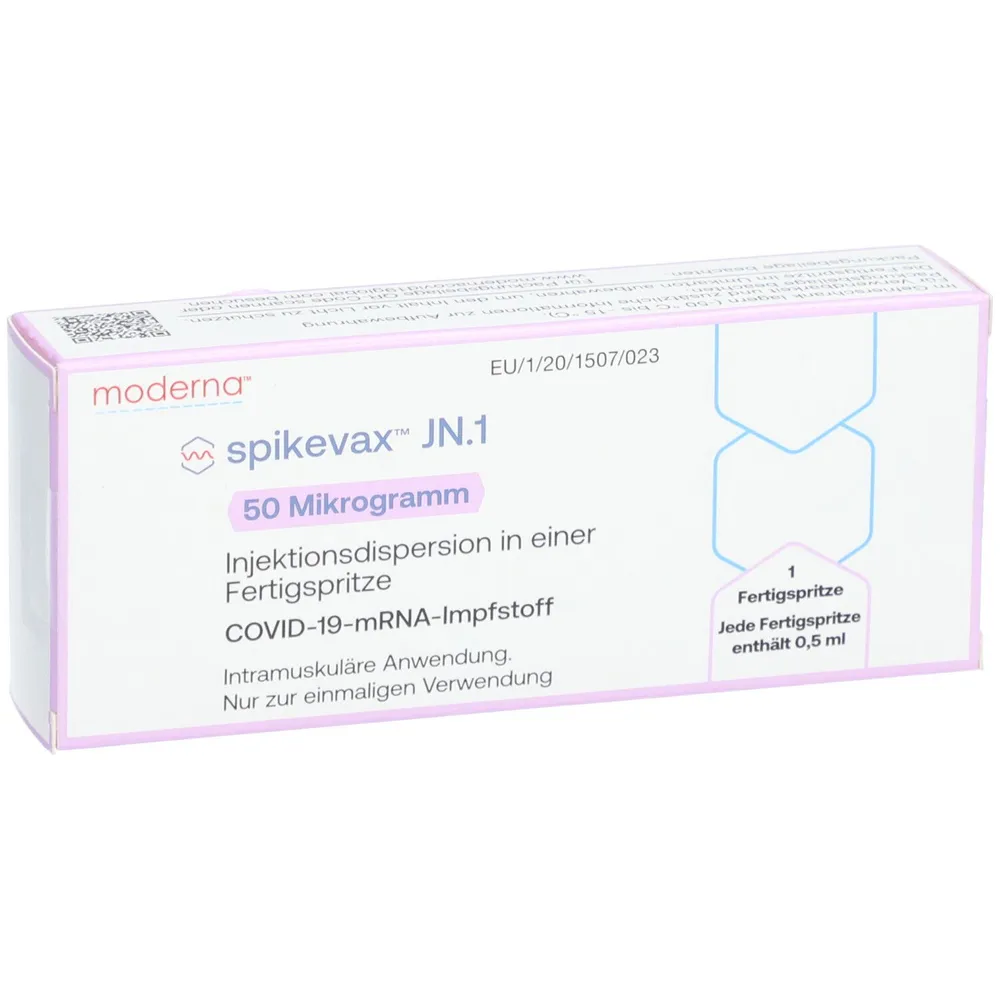
Table of Contents
- Package leaflet: Information for the user
- Spikevax JN.1 0.1 mg/mL dispersion for injectable suspension, 50 micrograms injectable dispersion, 50 micrograms injectable dispersion in pre-filled syringe
- 1. What Spikevax JN.1 is and what it is used for
- 2. What you need to know before receiving Spikevax JN.1
- 3. How Spikevax JN.1 is administered
- 4. Possible side effects
- 5. How to store Spikevax JN.1
- 6. Package contents and other information
- The following information is intended exclusively for healthcare professionals:
Package leaflet: Information for the user
Spikevax JN.1 0.1 mg/mL dispersion for injectable suspension, 50 micrograms injectable dispersion, 50 micrograms injectable dispersion in pre-filled syringe
mRNA-based COVID-19 vaccine
This medicinal product is subject to additional monitoring. This will allow rapid identification of new safety information.
You can help by reporting any side effects you experience while receiving this medicine. See the end of section 4 for information on how to report side effects.
Please read all of this leaflet carefully before receiving this vaccine as it contains important information for you.
- Keep this leaflet. You may need to read it again.
- If you have any questions, ask your doctor, pharmacist, or nurse.
- If you experience any side effects, including those not listed in this leaflet, tell your doctor, pharmacist, or nurse. See section 4.
Contents of this leaflet
- What Spikevax JN.1 is and what it is used for
- What you need to know before receiving Spikevax JN.1
- How Spikevax JN.1 is administered
- Possible side effects
- How to store Spikevax JN.1
- Contents of the pack and other information
1. What Spikevax JN.1 is and what it is used for
Spikevax JN.1 is a vaccine used to prevent COVID-19, a disease caused by the coronavirus SARS-CoV-2. It is administered to adults and children aged 6 months and older. The active substance of Spikevax JN.1 is mRNA encoding the spike protein of SARS-CoV-2. The mRNA is encapsulated in lipid nanoparticles SM-102.
Since Spikevax JN.1 does not contain the virus, it cannot cause COVID-19.
How the vaccine works
Spikevax JN.1 stimulates the body's natural defenses (the immune system). The vaccine prompts the body to produce protection (antibodies) against the virus that causes COVID-19. Spikevax JN.1 uses a substance called messenger ribonucleic acid (mRNA) to deliver a set of instructions that the body's cells can use to produce the spike protein found on the virus. The cells then produce antibodies against the spike protein, helping to fight the virus. This helps protect against COVID-19.
2. What you need to know before receiving Spikevax JN.1
The vaccine must not be administered if you are allergic to the active substance or to any of the
other components of this vaccine (listed in section 6).
Warnings and precautions
Talk to your doctor, pharmacist, or nurse before receiving Spikevax JN.1 if:
- you have previously had a severe, potentially life-threatening allergic reaction to any other vaccine injection or after administration of Spikevax (original)
- you have a very weak or compromised immune system
- you have previously fainted following an injection with a needle
- you have a blood clotting disorder
- you have a high fever or a serious infection; however, you may receive vaccination if you have a mild fever or a mild respiratory infection such as a cold
- you have a serious illness
- you suffer from anxiety related to injections
After vaccination with Spikevax, there is an increased risk of myocarditis (inflammation of the
heart) and pericarditis (inflammation of the outer lining of the heart) (see section 4).
These conditions may develop a few days after vaccination and have mainly occurred within 14 days.
They have been observed more frequently in young males and more often after the second dose than
after the first dose.
Most cases of myocarditis and pericarditis resolve. Some cases have required intensive care treatment and fatal cases have been reported.
After vaccination, pay particular attention to signs of myocarditis and pericarditis, such as shortness
of breath, palpitations, and chest pain, and seek immediate medical advice if these symptoms occur.
If you have any of the conditions listed above (or if you have any doubts), talk to your doctor,
pharmacist, or nurse before receiving Spikevax JN.1.
Recurrence of capillary leak syndrome (CLS)
There have been reports of recurrence of capillary leak syndrome following vaccination with Spikevax (original). This condition causes fluid leakage from small blood vessels (capillaries), resulting in rapid swelling of the arms and legs, sudden weight gain, feeling faint, and low blood pressure. If you have previously experienced episodes of CLS, consult your doctor before administration of Spikevax JN.1.
Duration of protection
As with any vaccine, the additional dose of Spikevax JN.1 may not fully protect all individuals who receive it, and the duration of protection is not known.
Children
Spikevax JN.1 is not recommended for children under 6 months of age.
Other medicines and Spikevax JN.1
Inform your doctor or pharmacist if you are taking, have recently taken, or might take any other
medicines. Spikevax JN.1 may affect how other medicines work, and other medicines may affect how
Spikevax JN.1 works.
Immunocompromised individuals
The effectiveness of Spikevax JN.1 may be reduced in immunocompromised individuals. In such
cases, you should continue to take physical precautions to help prevent COVID-19. Where appropriate, your close contacts should also be vaccinated. Talk to your doctor about the most appropriate recommendations for you.
Pregnancy and breastfeeding
If you are pregnant or suspect you may be pregnant, inform your doctor, nurse, or pharmacist before receiving this vaccine. There are currently no data available on the use of
Spikevax JN.1 during pregnancy. However, a large number of data from pregnant women vaccinated with Spikevax (original) during the second and third trimesters of pregnancy have not shown adverse effects on pregnancy or the newborn. Although data on effects during pregnancy or on the newborn after vaccination during the first trimester are limited, no increased risk of spontaneous abortions has been observed. Since the differences between the two products involve only the spike protein in the vaccine and there are no clinically relevant differences,
Spikevax JN.1 may be used during pregnancy.
Data on the use of Spikevax JN.1 during breastfeeding are not yet available.
However, adverse effects in breastfed infants are not expected. Data from women who breastfed after vaccination with Spikevax (original) have not shown a risk of adverse events in breastfed infants. Spikevax JN.1 may be administered during breastfeeding.
Driving and using machines
Avoid driving or operating machinery if you do not feel well after vaccination. Wait until any side effects from the vaccine have disappeared before driving or using machinery.
Spikevax JN.1 contains sodium
This medicine contains less than 1 mmol of sodium (23 mg) per dose, i.e., essentially “sodium-free”.
3. How Spikevax JN.1 is administered
Table 1. Dosage of Spikevax JN.1
| Age | Dose | Additional recommendations |
| Children aged 6 months to 4 years, previously unvaccinated and with no known history of SARS-CoV-2 infection | Two doses of 0.25 mL each, administered intramuscularly* | Administer the second dose 28 days after the first. If a child has previously received one dose of any Spikevax vaccine, administer one dose of Spikevax JN.1 to complete the two-dose series. |
| Children aged 6 months to 4 years, previously vaccinated or with known history of SARS-CoV-2 infection | One dose of 0.25 mL, administered intramuscularly* | Spikevax JN.1 should be administered at least 3 months after the most recent dose of a COVID-19 vaccine. |
| Children aged 5 to 11 years, previously vaccinated or unvaccinated | One dose of 0.25 mL, administered intramuscularly* | |
| Individuals aged 12 years and older, previously vaccinated or unvaccinated | One dose of 0.5 mL, administered intramuscularly | |
| Individuals aged 65 years and older | One dose of 0.5 mL, administered intramuscularly | An additional dose may be administered at least 3 months after the most recent dose of a COVID-19 vaccine. |
* Do not use the single-dose vial or the pre-filled syringe to administer a partial volume
of 0.25 mL.
Table 2. Dosage of Spikevax JN.1 in immunocompromised individuals
| Age | Dose | Additional recommendations |
| Immunocompromised children aged 6 months through 4 years, previously unvaccinated | Two doses of 0.25 mL, administered intramuscularly* | A third dose may be administered to severely immunocompromised individuals at least 28 days after the second dose. |
| Immunocompromised children aged 6 months through 4 years, previously vaccinated | One dose of 0.25 mL, administered intramuscularly* | Additional age-appropriate doses may be administered to severely immunocompromised individuals at least 2 months after the most recent dose of a COVID-19 vaccine, at the discretion of the healthcare professional, taking into account the individual's clinical condition. |
| Immunocompromised children aged 5 through 11 years, previously vaccinated or unvaccinated | One dose of 0.25 mL, administered intramuscularly* | |
| Immunocompromised individuals aged 12 years and older, previously vaccinated or unvaccinated | One dose of 0.5 mL, administered intramuscularly |
* Do not use the single-dose vial or the pre-filled syringe to administer a partial volume of 0.25 mL.
The doctor, pharmacist, or nurse will inject the vaccine into a muscle (intramuscular injection) in the upper arm.
After each vaccine injection, the doctor, pharmacist, or nurse will keep you under observation for at least 15 minutes to monitor for any signs of an allergic reaction.
If you have any doubts about the use of this vaccine, consult your doctor, pharmacist, or nurse.
4. Possible side effects
Like all medicines, this vaccine can cause side effects, although not everyone experiences them.
Seek urgent medical advice if you experience any of the following signs and symptoms of an allergic reaction:
- feeling faint or dizzy;
- changes in heart rate;
- shortness of breath;
- wheezing;
- swelling of the tongue, face or throat;
- hives or skin rash;
- nausea or vomiting;
- stomach pain.
Contact your doctor or nurse if any other side effect occurs. These may include:
Very common (may affect more than 1 in 10 people)
- swelling/tenderness under the arms
- reduced appetite (observed in children aged between 6 months and 5 years)
- irritability/crying (observed in children aged between 6 months and 5 years)
- headache
- sleepiness (observed in children aged between 6 months and 5 years)
- nausea
- vomiting
- muscle, joint pain and stiffness
- pain or swelling at the injection site
- redness at the injection site (in some cases may occur approximately 9 to 11 days after injection)
- feeling extremely tired
- chills
- fever
Common (may affect up to 1 in 10 people)
- diarrhoea
- skin rash
- skin rash or hives at the injection site (in some cases may occur approximately 9 to 11 days after injection)
Uncommon (may affect up to 1 in 100 people)
- itching at the injection site
- dizziness
- stomach pain
- itchy skin swellings (hives) (which may appear shortly after injection and up to approximately two weeks after injection)
Rare (may affect up to 1 in 1,000 people)
- temporary facial paralysis (Bell's palsy)
- facial swelling (facial swelling may occur in individuals who have previously received cosmetic facial injections)
- decreased sense of touch or sensitivity
- unusual skin sensations, such as tingling or prickling (paraesthesia)
Very rare (may affect up to 1 in 10,000 people)
- inflammation of the heart (myocarditis) or inflammation of the outer lining of the heart (pericarditis), which may cause shortness of breath, palpitations or chest pain
Frequency not known
- severe allergic reactions with breathing difficulties (anaphylaxis)
- immune system reaction causing increased sensitivity or intolerance (hypersensitivity)
- skin reaction causing red spots or patches on the skin, which may look like a target or "bull's eye" with a dark red centre surrounded by lighter red rings (erythema multiforme)
- extensive swelling of the vaccinated limb
- heavy menstrual bleeding (most cases were non-serious and transient)
- skin irritation triggered by external stimuli such as rubbing, itching or pressure on the skin (mechanical urticaria)
- itchy, raised skin lesions lasting longer than six weeks (chronic urticaria)
Reporting of side effects
If you experience any side effect, including those not listed in this leaflet, talk to your doctor, pharmacist or nurse. You can also report side effects directly via the national reporting system detailed in Annex V. By reporting side effects, you can help provide more information on the safety of this vaccine.
5. How to store Spikevax JN.1
Keep this vaccine out of the sight and reach of children.
Do not use this vaccine after the expiry date stated on the label after "Exp". The expiry date refers to the last day of that month.
Information on storage, expiry, use and handling is described in the section for healthcare professionals at the end of this leaflet.
Do not dispose of medicines via wastewater or household waste. Ask your pharmacist how to dispose of medicines you no longer use. This will help protect the environment.
6. Package contents and other information
What Spikevax JN.1 contains
Table 3. Composition by container type
| Dosage | Container | Dose(s) | Composition |
| Spikevax JN.1 0.1 mg/mL dispersion for injectable preparation | Multi-dose vial of 2.5 mL | 5 doses of 0.5 mL each or up to 10 doses of 0.25 mL each | One dose (0.5 mL) contains 50 micrograms of SARS-CoV-2 JN.1 mRNA, an anti-COVID-19 mRNA vaccine (nucleoside modified) (encapsulated in lipid nanoparticles SM-102). One dose (0.25 mL) contains 25 micrograms of SARS-CoV-2 JN.1 mRNA, an anti-COVID-19 mRNA vaccine (nucleoside modified) (encapsulated in lipid nanoparticles SM-102). |
| Spikevax JN.1 50 mcg dispersion for injectable preparation | Single-dose vial of 0.5 mL | 1 dose of 0.5 mL, for single use only | One dose (0.5 mL) contains 50 micrograms of SARS-CoV-2 JN.1 mRNA, an anti-COVID-19 mRNA vaccine (nucleoside modified) (encapsulated in lipid nanoparticles SM-102). |
| Dosage | Container | Dose(s) | Composition |
| Spikevax JN.1 50 mcg injectable dispersion in pre-filled syringe | Pre-filled syringe | 1 dose of 0.5 mL, for single use only | One dose (0.5 mL) contains 50 micrograms of SARS-CoV-2 JN.1 mRNA, an anti-COVID-19 mRNA vaccine (nucleoside modified) (encapsulated in lipid nanoparticles SM-102). |
SARS-CoV-2 JN.1 mRNA is a single-stranded messenger RNA (mRNA) with 5’ capping, produced
by in vitro transcription without the use of cells from the corresponding DNA templates, which encodes
for the SARS-CoV-2 (JN.1) viral spike (S) protein.
Other components are SM-102 (heptadecan-9-yl 8-{(2-hydroxyethyl)[6-oxo-6-(undecyloxy)hexyl]amino}octanoate), cholesterol, 1,2-distearoyl-sn-glycero-3-phosphocholine (DSPC), 1,2-dimyristoyl-rac-glycero-3-methoxy-polyethylene glycol-2000 (PEG2000-DMG), tromethamine, tromethamine hydrochloride, acetic acid, sodium acetate trihydrate, sucrose, water for injections.
Description of the appearance of Spikevax JN.1 and contents of the pack
Spikevax JN.1 0.1 mg/mL dispersion for injectable preparation
Spikevax JN.1 is a white to off-white dispersion supplied in a multidose glass vial with a rubber stopper and a removable blue plastic cap with an aluminium seal.
Pack size: 10 multidose vials. Each vial contains 2.5 mL.
Spikevax JN.1 50 micrograms dispersion for injectable preparation
Spikevax JN.1 is a white to off-white dispersion supplied in a single-dose glass vial with a rubber stopper and a removable blue plastic cap with an aluminium seal.
Pack sizes:
1 single-dose vial
10 single-dose vials
Each vial contains 0.5 mL.
Not all pack sizes may be marketed.
Spikevax JN.1 50 micrograms injectable dispersion in pre-filled syringe
Spikevax JN.1 is a white to off-white dispersion supplied in a pre-filled syringe (cyclic olefin copolymer) with a plunger stopper and a closure cap (without needle).
The pre-filled syringe is packaged in a paper tray inside a carton or in 1 transparent blister containing 1 pre-filled syringe or in 5 transparent blisters, each containing 2 pre-filled syringes.
Pack sizes:
1 pre-filled syringe
10 pre-filled syringes
Not all pack sizes may be marketed.
Marketing Authorisation Holder
MODERNA BIOTECH SPAIN, S.L.
C/ Julián Camarillo nº 31
28037 Madrid
Spain
Manufacturers
Rovi Pharma Industrial Services, S.A.
Paseo de Europa, 50
28703, San Sebastián de los Reyes
Madrid
Spain
Moderna Biotech Spain S.L.
C/ Julián Camarillo nº 31
28037 Madrid
Spain
Rovi Pharma Industrial Services, S.A.
Calle Julián Camarillo n°35
28037 Madrid
Spain
For further information about this medicinal product, please contact the local representative of the Marketing Authorisation Holder.
België/Belgique/Belgien Lietuva
Tél/Tel: 0800 81 460 Tel: 88 003 1114
България Luxembourg/Luxemburg
Teл: 0800 115 4477 Tél/Tel: 800 85 499
Česká republika Magyarország
Tel: 800 050 719 Tel: 06 809 87488
Danmark Malta
Tlf.: 80 81 06 53 Tel: 8006 5066
Deutschland Nederland
Tel: 0800 100 9632 Tel: 0800 409 0001
Eesti Norge
Tel: 800 0044 702 Tlf: 800 31 401
Ελλάδα Österreich
Τηλ: 008004 4149571 Tel: 0800 909636
España Polska
Tel: 900 031 015 Tel: 800 702 406
France Portugal
Tél: 0805 54 30 16 Tel: 800 210 256
Hrvatska România
Tel: 08009614 Tel: 0800 400 625
Ireland Slovenija
Tel: 1800 800 354 Tel: 080 083082
Ísland Slovenská republika
Sími: 800 4382 Tel: 0800 191 647
Italia Suomi/Finland
Tel: 800 928 007 Puh/Tel: 0800 774198
Κύπρος Sverige
Τηλ: 80091080 Tel: 020 10 92 13
Latvija
Tel: 80 005 898
Scan with a mobile device to obtain the package leaflet in other languages.

Or visit the website https://www.ModernaCovid19Global.com
More detailed information on this vaccine is available on the website of the European Medicines Agency, https://www.ema.europa.eu .
This leaflet is available in all languages of the European Union/European Economic Area on the European Medicines Agency website.
The following information is intended exclusively for healthcare professionals:
Traceability
In order to improve the traceability of biological medicinal products, the name and batch number of the administered medicinal product must be clearly recorded.
Spikevax JN.1 must be administered by a trained healthcare professional.
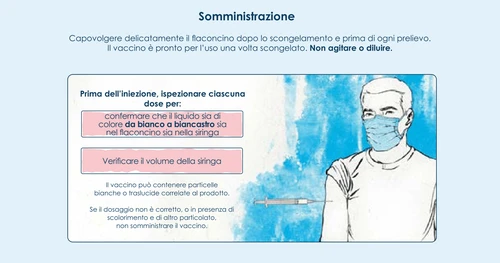
Once thawed, the vaccine is ready for use.
Do not shake or dilute.
The vaccine should be inspected visually for the presence of particulate matter and discoloration prior to administration.
Spikevax JN.1 is a dispersion ranging in color from white to off-white. It may contain white or translucent particles related to the product. Do not administer the vaccine if discoloration is observed or if it contains any other particulate matter.
Frozen vaccine
Vials are stored in a freezer at a temperature between -50 °C and -15 °C.
Spikevax JN.1 0.1 mg/mL dispersion for injectable preparation (multi-dose vials with removable blue closure cap)
Five (5) doses (each 0.5 mL) or up to ten (10) doses (each 0.25 mL) can be withdrawn from each multi-dose vial.
It is recommended to puncture the stopper at a different site each time.
Check that the vial has a removable blue closure cap and that the product name is Spikevax JN.1. If the vial has a removable blue closure cap but the product name is Spikevax 0.1 mg/mL, Spikevax bivalent Original/Omicron BA.1, Spikevax bivalent Original/Omicron BA.4-5, or Spikevax XBB.1.5, please refer to the Summary of Product Characteristics for that specific formulation.
Thawed vaccine
The vaccine may be transported and delivered either frozen or thawed. If frozen, each multi-dose vial must be thawed before use according to the instructions provided below (Table 4).
Table 4. Instructions for thawing multi-dose vials prior to use
| Configuration | Instructions for thawing and duration of thawing | |||
| Thawing temperature (in refrigerator) | Duration of thawing | Thawing temperature (at room temperature) | Duration of thawing | |
| Multidose vial | 2° – 8°C | 2 hours and 30 minutes | 15°C – 25°C | 1 hour |
If the vaccine is received at a temperature between 2°C and 8°C, the vaccine must be stored at a temperature between 2°C and 8°C. The new expiry date at 2°C to 8°C must be indicated on the outer packaging.
During this period, transportation for up to 36 hours at a temperature between 2°C and 8°C is permitted.
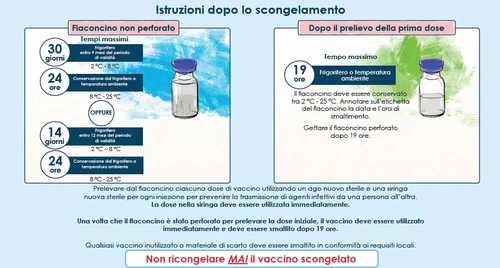
Spikevax JN.1 50 micrograms dispersion for injectable preparation (single-dose vial)
Once thawed, the vaccine is ready for use.
Do not shake or dilute. Gently rotate the vial after thawing and before withdrawal.
Check that the vial has a blue removable closure cap and that the product name is Spikevax JN.1. If the vial has a blue removable closure cap and the product name is Spikevax bivalent Original/Omicron BA.1, Spikevax bivalent Original/Omicron BA.4-5 or Spikevax XBB.1.5, please refer to the Summary of Product Characteristics for that formulation.
Thawed vaccine
The vaccine is transported and delivered either frozen or thawed. If frozen, thaw each single-dose vial before use according to the instructions below. Each single-dose vial or the entire box containing 1 or 10 vials can be thawed in a refrigerator or at room temperature (Table 5).
Table 5. Instructions for thawing single-dose vials and boxes before use
| Configuration | Instructions for thawing and duration of thawing | |||
| Thawing temperature (in refrigerator) | Duration of thawing | Thawing temperature (at room temperature) | Duration of thawing | |
| Single-dose vial | From 2 °C to 8 °C | 45 minutes | From 15 °C to 25 °C | 15 minutes |
| Carton | From 2 °C to 8 °C | 1 hour and 45 minutes | From 15 °C to 25 °C | 45 minutes |
If the vaccine is received at a temperature between 2°C and 8°C, it must be stored at a temperature between 2°C and 8°C.
The new expiry date at 2°C to 8°C must be indicated on the outer packaging.
During this period, transportation for up to 36 hours at a temperature between 2°C and 8°C is permitted.
Spikevax JN.1 50 micrograms injectable dispersion in a pre-filled syringe
Do not shake or dilute the contents of the pre-filled syringe.
Each pre-filled syringe is for single use only. Once thawed, the vaccine is ready for administration.
One (1) dose of 0.5 mL can be administered from each pre-filled syringe.
Spikevax JN.1 is supplied in a single-dose pre-filled syringe (without needle) containing 0.5 mL (50 micrograms of SARS-CoV-2 JN.1 mRNA) and must be thawed prior to administration.
During storage, minimize exposure to ambient light and avoid exposure to direct sunlight and ultraviolet light.
Thawed vaccine
The vaccine is transported and delivered either frozen or thawed. If frozen, thaw each pre-filled syringe before use according to the following instructions. The syringes may be thawed while still in their blisters (each blister contains 1 or 2 pre-filled syringes, depending on the pack size) or within the box, either in a refrigerator or at room temperature (Table 6).
Table 6. Instructions for thawing pre-filled syringes of Spikevax JN.1 and boxes prior to use
| Configuration | Instructions for thawing and duration of thawing | |||
| Thawing temperature (in refrigerator) (°C) | Duration of thawing (minutes) | Thawing temperature (at room temperature) (°C) | Duration of thawing (minutes) | |
| Pre-filled syringe in blister | 2 – 8 | 55 | 15 – 25 | 45 |
| Carton | 2 – 8 | 155 | 15 – 25 | 140 |
If the vaccine is received at a temperature between 2°C and 8°C, the vaccine must be stored at a temperature between 2°C and 8°C. The new expiry date at a temperature between 2°C and 8°C must be indicated on the outer packaging.
The duration of transport for pre-filled syringes depends on the validated transport time in the appropriate container.
Check that the product name on the pre-filled syringe is Spikevax JN.1. If the product name is Spikevax 50 micrograms, Spikevax bivalent Original/Omicron BA.1, Spikevax bivalent Original/Omicron BA.4-5 or Spikevax XBB.1.5, please refer to the Summary of Product Characteristics for that formulation.
Instructions for handling pre-filled syringes
- Do not shake.
- The pre-filled syringe should be inspected visually for the presence of particles and discoloration before administration.
- Spikevax JN.1 is a white to off-white dispersion. It may contain white or translucent product-related particles. Do not administer the vaccine if discoloration is observed or if it contains any other particulate matter.
- Needles are not included in the pre-filled syringe cartons.
- Use a sterile needle of appropriate size for intramuscular injection (21 gauge or finer needles).
- Remove the closure cap vertically by rotating it counterclockwise until it detaches. Remove the closure cap with a slow, steady motion. Do not pull the closure cap while rotating it.
- Attach the needle by screwing it clockwise onto the syringe until firmly secured.
- Remove the needle cap when ready for administration.
- Administer the entire dose intramuscularly.
- Do not re-freeze after thawing.
Disposal
Any unused medicinal product and waste material derived from this medicinal product must be disposed of in accordance with local regulations.
Dosage and schedule
Table 7. Dosage of Spikevax JN.1
| Age | Dose | Additional recommendations |
| Children aged 6 months to 4 years, previously unvaccinated and with no known history of SARS-CoV-2 infection | Two doses of 0.25 mL each, administered intramuscularly* | Administer the second dose 28 days after the first. If a child has previously received a dose of Spikevax, administer a dose of Spikevax JN.1 to complete the two-dose series. |
| Children aged 6 months to 4 years, previously vaccinated or with a known history of SARS-CoV-2 infection | One dose of 0.25 mL, administered intramuscularly* | Spikevax JN.1 should be administered at least 3 months after the most recent dose of a COVID-19 vaccine. |
| Children aged 5 to 11 years, previously vaccinated or unvaccinated | One dose of 0.25 mL, administered intramuscularly* | |
| Individuals aged 12 years and older, previously vaccinated or unvaccinated | One dose of 0.5 mL, administered intramuscularly | |
| Individuals aged 65 years and older | One dose of 0.5 mL, administered intramuscularly | An additional dose may be administered at least 3 months after the most recent dose of a COVID-19 vaccine. |
* Do not use the single-dose vial or the pre-filled syringe to administer a partial volume
of 0.25 mL.
Table 8. Dosage of Spikevax JN.1 in immunocompromised individuals
| Age | Dose | Additional recommendations |
| Immunocompromised children aged 6 months through 4 years, previously unvaccinated | Two doses of 0.25 mL, administered intramuscularly* | A third dose may be administered to severely immunocompromised individuals at least 28 days after the second dose. |
| Immunocompromised children aged 6 months through 4 years, previously vaccinated | One dose of 0.25 mL, administered intramuscularly* | Additional age-appropriate doses may be administered to severely immunocompromised individuals at least 2 months after the most recent dose of a COVID-19 vaccine, at the discretion of the healthcare provider, taking into account the individual's clinical condition |
| Immunocompromised children aged 5 through 11 years, previously vaccinated or unvaccinated | One dose of 0.25 mL, administered intramuscularly* | |
| Immunocompromised individuals aged 12 years and older, previously vaccinated or unvaccinated | One dose of 0.5 mL, administered intramuscularly |
* Do not use the single-dose vial or the pre-filled syringe to administer a partial volume of 0.25 mL.
As with all injectable vaccines, medical supervision and appropriate medical treatments must always be readily available in case of an anaphylactic reaction following administration of Spikevax JN.1.
Vaccinated individuals must be observed by a healthcare professional for at least 15 minutes after vaccination.
Spikevax (all different variants) may be administered concomitantly with influenza vaccines (standard and high-dose) and with the recombinant subunit herpes zoster (shingles) vaccine.
Different injectable vaccines must be administered at separate injection sites.
Spikevax JN.1 must not be mixed in the same syringe with other vaccines or medicinal products.
Administration
The vaccine must be administered by intramuscular injection. The preferred site is the deltoid region of the arm. Do not inject this vaccine intravascularly, subcutaneously, or intradermally.
Multi-dose vials
Pre-filled syringes
Use a sterile needle of appropriate size for intramuscular injection (21 gauge or finer).
Remove the closure cap vertically by turning it counterclockwise until it disengages. Remove the closure cap with a slow, steady motion. Do not pull on the closure cap while rotating it. Attach the needle by turning it clockwise until firmly secured to the syringe. Remove the needle cap when ready for administration. Administer the entire dose intramuscularly. Dispose of the syringe after use. For single use only.