Spexotras
ItalyTable of Contents
- Patient Information Leaflet
- Spexotras 0.05 mg/ml powder for oral solution
- 1. What Spexotras is and what it is used for
- 2. What you should know before administering Spexotras
- 3. How to administer Spexotras
- 4. Possible side effects
- 5. How to store Spexotras
- 6. Contents of the pack and other information
- INSTRUCTIONS FOR USE
Patient Information Leaflet
Spexotras 0.05 mg/ml powder for oral solution
trametinib
Please read all of this leaflet carefully before the child takes this medicine because it contains important information.
- Keep this leaflet. You may need to read it again.
- If you have any questions, ask your doctor, pharmacist, or nurse.
- This medicine has been prescribed for the child only. Do not give it to other people, even if their symptoms are the same as the child’s, because it could be harmful.
- If the child experiences any side effects, including those not listed in this leaflet, speak to your doctor, pharmacist, or nurse. See section 4.
- The information in this leaflet is intended for you or the child, but throughout the text the term "the child" will be used.
Contents of this leaflet
- What Spexotras is and what it is used for
- What you need to know before giving Spexotras to the child
- How to give Spexotras
- Possible side effects
- How to store Spexotras
- Contents of the pack and other information
1. What Spexotras is and what it is used for
Spexotras is a medicine that contains the active substance trametinib.
This medicine is used in combination with another medicine (dabrafenib dispersible tablets) in children aged 1 year and older to treat a type of brain tumour called glioma.
Spexotras may be used in patients with:
- low-grade glioma
- high-grade glioma, when the patient has received at least one treatment with radiotherapy and/or chemotherapy.
Spexotras in combination with dabrafenib dispersible tablets is used to treat patients whose brain tumour has a specific mutation (alteration) in the gene called BRAF. This mutation causes the body to produce defective proteins which in turn can lead to tumour development. Your doctor will test for this mutation before starting treatment.
In combination with dabrafenib, Spexotras acts on these defective proteins and slows down or stops tumour growth. Also read the package leaflet for dabrafenib dispersible tablets.
2. What you should know before administering Spexotras
Do not administer Spexotras
- if the child is allergic to trametinib or to any of the other ingredients of this medicine (listed in section 6).
Warnings and precautions
Talk to the doctor before administering Spexotras. The doctor needs to know whether the
child:
- has heart problems, such as heart failure or irregular heartbeat.
- has or has ever had any lung or breathing problems, including difficulty breathing often accompanied by dry cough, shortness of breath, and fatigue.
- has eye problems, including blockage of the vein draining the eye (retinal vein occlusion) or swelling of the eyes that may be caused by fluid leakage (chorioretinopathy).
- has or has ever had any liver problems.
- has or has ever had any kidney problems.
- has or has ever had gastrointestinal problems such as diverticulitis (inflamed pouches in the colon) or metastases in the gastrointestinal tract.
Before the child starts taking Spexotras, and during and after treatment, the doctor will perform checks to prevent complications.
Skin monitoring
Treatment may cause skin tumours. Generally, these skin changes remain localized and can be removed surgically, allowing treatment to continue without interruption. The doctor may examine the child’s skin before and regularly during treatment.
Check the child’s skin monthly during treatment and for 6 months after stopping this medicine. Inform the doctor as soon as possible if you notice any skin changes such as a new wart, a sore or red bump that bleeds and does not heal, or a change in size or colour of a mole.
Tumour lysis syndrome
If the child experiences any of the following symptoms, inform the doctor immediately, as this may be a life-threatening condition: nausea, shortness of breath, irregular heartbeat, muscle cramps, seizures, cloudy urine, reduced urine output, and fatigue. These may be caused by a group of metabolic complications that can occur during cancer treatment due to the breakdown products of dying cancer cells (tumour lysis syndrome or TLS), which may lead to changes in kidney function (see also section 4).
Children under 1 year of age
Spexotras in combination with dabrafenib dispersible tablets has not been studied in children under 1 year of age. Therefore, Spexotras is not recommended in this age group.
Patients over 18 years of age
Information on the treatment of patients over 18 years of age with glioma is limited; therefore, continuation of treatment into adulthood should be evaluated by the doctor.
Other medicines and Spexotras
Before starting treatment, inform the doctor, pharmacist, or nurse if the child is taking, has recently taken, or might take any other medicines, including medicines used to thin the blood or any other medicines obtained without a prescription.
Pregnancy, breastfeeding, and fertility
Pregnancy
- If the girl is pregnant or suspects she might be, consult the doctor or nurse before administering this medicine. Spexotras may harm the unborn baby.
- If the girl becomes pregnant while taking this medicine, inform the doctor immediately.
Breastfeeding
It is not known whether Spexotras passes into breast milk. If the girl is breastfeeding or planning to breastfeed, she must inform the doctor. The doctor, the girl, and you will decide whether to take Spexotras or to breastfeed.
Fertility
Spexotras may impair fertility in males and females.
Administration of Spexotras with dabrafenib dispersible tablets: Dabrafenib may reduce sperm count, and this may not return to normal levels after stopping treatment with dabrafenib.
Before starting treatment with dabrafenib dispersible tablets, discuss with the doctor options to improve the child’s chances of having children in the future.
Contraception
- If the girl could become pregnant, she must use a reliable method of contraception (birth control) while taking Spexotras and for at least 16 weeks after stopping it.
- Hormonal birth control methods (such as pills, injections, or patches) may not work properly during treatment with Spexotras in combination with dabrafenib dispersible tablets. An alternative effective method of birth control must be used to avoid the risk of pregnancy during treatment with this combination of medicines. Ask the doctor or nurse for advice.
Driving and using machines
Spexotras may cause side effects that could affect the child’s ability to drive, ride a bicycle/scooter, use machinery, or participate in other activities requiring alertness. If the child has vision problems, feels tired or weak, or has low energy levels, such activities should be avoided.
Descriptions of these effects can be found in section 4. Read all the information in this leaflet for reference.
Discuss with the doctor, pharmacist, or nurse if you are unsure about anything. The child’s illness, symptoms, and treatment conditions may also affect their ability to participate in such activities.
Spexotras contains cyclodextrins
This medicine contains 100 mg of a cyclodextrin per ml of Spexotras oral solution.
Spexotras contains methylhydroxybenzoate
May cause allergic reactions (including delayed reactions).
Spexotras contains sodium
This medicine contains 1.98 mg of sodium (a main component of table salt) per ml of Spexotras oral solution. This corresponds to 4% of the maximum daily recommended dietary intake for an adult at the highest recommended dose of trametinib.
Spexotras contains potassium
This medicine contains less than 1 mmol (39 mg) of potassium per maximum daily dose, i.e., essentially ‘potassium-free’.
3. How to administer Spexotras
Administer this medicine to the child exactly as directed by the
doctor, pharmacist, or nurse. If you have any doubts, consult the doctor, pharmacist, or nurse.
How much to give
The doctor will determine the correct dose of Spexotras based on the child's body weight.
The doctor may decide that the child should receive a lower dose if they experience any adverse effects.
How to administer it
Read the instructions for use at the end of this leaflet for details on how to administer the oral solution. The oral solution will be prepared for you by the pharmacist.
- Administer Spexotras once daily. Giving Spexotras at the same time each day will help you remember when to administer the medicine. Administer Spexotras either with the morning dose or with the evening dose of dabrafenib dispersible tablets. Doses of dabrafenib must be taken approximately 12 hours apart.
- Administer Spexotras on an empty stomach, at least 1 hour before or 2 hours after a meal, meaning:
- After taking Spexotras, the child must wait at least 1 hour before eating.
- After eating, the child must wait at least 2 hours before taking Spexotras.
- If necessary, breastfeeding and/or formula feeding may be given on demand.
If you give more Spexotras than you should
If you administer an excessive dose of Spexotras, contact the doctor, pharmacist, or nurse for advice. If possible, show them the Spexotras packaging and this leaflet.
If you forget to administer Spexotras
If you forget a dose and less than 12 hours have passed, administer it as soon as you remember.
If the missed dose is 12 hours or more late, skip that dose and administer the next dose at the usual time. Then continue giving Spexotras regularly as usual.
Do not administer a double dose to make up for a forgotten dose.
If the child vomits after taking Spexotras
If the child vomits after taking Spexotras, do not administer another dose until the next scheduled dose.
If you stop treatment with Spexotras
Administer Spexotras for the entire duration recommended by the doctor. Do not stop unless instructed by the doctor.
If you have any questions about the use of this medicine, consult the doctor, pharmacist, or nurse.
4. Possible side effects
Like all medicines, this medicine can cause side effects, although not everybody gets them.
Stop administering the medicine and contact your doctor urgently if the child shows any of the following symptoms:
- Coughing up blood, blood in the urine, vomiting blood or material that looks like coffee grounds, red or black tarry stools. These may be signs of bleeding.
- Fever (temperature of 38°C or higher).
- Chest pain or shortness of breath, sometimes with fever or cough. These may be signs of pneumonia or lung inflammation (interstitial lung disease).
- Blurred vision, loss of vision, or other changes in vision. These may be signs of retinal detachment.
- Redness of the eye, eye pain, increased sensitivity to light. These may be signs of uveitis.
- Unexplained muscle pain, muscle cramps, or muscle weakness, dark urine. These may be signs of rhabdomyolysis.
- Severe abdominal pain. This may be a sign of pancreatitis.
- Fever, swollen lymph nodes, bruising, or rash occurring at the same time. These may be signs of a condition in which the immune system produces too many infection-fighting cells, leading to various symptoms (hemophagocytic lymphohistiocytosis).
- Nausea, shortness of breath, irregular heartbeat, muscle cramps, seizures, cloudy urine, reduced urine output, and fatigue. These may be signs of a condition caused by the rapid breakdown of cancer cells, which can be fatal in some people (tumor lysis syndrome or TLS).
- Circular or target-shaped red patches on the trunk, with or without central blisters, skin peeling, mouth, throat, nose, genital, or eye ulcers. These may be signs of severe skin rashes, which can be life-threatening and may be preceded by fever and flu-like symptoms (Stevens-Johnson syndrome), widespread rash, fever, and swollen lymph nodes (DRESS).
Other possible side effects
Very common (may affect more than 1 in 10 people)
- Headache
- Dizziness
- Cough
- Diarrhea, nausea, vomiting, constipation, stomach ache
- Skin problems such as rash, acne-like rash, dry or itchy skin, skin redness
- Wart-like growths (cutaneous papilloma)
- Nail infection
- Pain in arms, legs, or joints
- Lack of energy or feeling weak or tired
- Weight gain
- Upper respiratory tract infections with symptoms such as sore throat and stuffy nose (nasopharyngitis)
- Increased liver enzymes in blood tests
- Decreased levels of white blood cells (neutropenia, leucopenia)
- Decreased levels of red blood cells (anemia)
Common (may affect up to 1 in 10 people)
- Frequent urination with pain or burning sensation (urinary tract infection)
- Skin effects including skin infection (cellulitis), inflammation of hair follicles (folliculitis), inflamed scaly skin (generalized exfoliative dermatitis), thickening of the outer layer of skin (hyperkeratosis)
- Loss of appetite
- Low blood pressure (hypotension)
- High blood pressure (hypertension)
- Shortness of breath
- Mouth pain or mouth ulcers, inflammation of the mucosa
- Inflammation of the subcutaneous fat layer (panniculitis)
- Unusual hair loss or thinning
- Red, painful hands and feet (hand-foot syndrome)
- Muscle spasms
- Chills
- Allergic reaction (hypersensitivity)
- Dehydration
- Vision problems including blurred vision
- Decreased heart rate (bradycardia)
- Fatigue, chest discomfort, dizziness, palpitations (reduced ejection fraction)
- Swelling of tissues (edema)
- Muscle pain (myalgia)
- Fatigue, chills, sore throat, joint or muscle pain (flu-like illness)
- Abnormal test results for creatine phosphokinase, an enzyme found mainly in the heart, brain, and skeletal muscle
- Increased blood sugar levels
- Low levels of sodium or phosphate in the blood
- Decreased platelet count in the blood (cells that help blood clotting)
- Increased sensitivity of the skin to sunlight
Uncommon (may affect up to 1 in 100 people)
- Irregular heartbeat (atrioventricular block)
- Inflammation of the intestine (colitis)
- Cracked skin
- Night sweats
- Excessive sweating
- Raised, painful red to dark red spots or ulcers on the skin, mainly on arms, legs, face, and neck, accompanied by fever (signs of acute febrile neutrophilic dermatosis)
In addition to the side effects listed above, the following side effects have been reported only in adult patients but may also occur in children:
- A condition affecting the nerves that may cause pain, loss of sensation, or tingling in the hands and feet and/or muscle weakness (peripheral neuropathy)
- Dry mouth
- Kidney failure
- Benign skin tumor (acrochordon)
- Inflammatory disease mainly affecting the skin, lungs, eyes, and lymph nodes (sarcoidosis)
- Inflammation of the kidneys
- A hole (perforation) in the stomach or intestine
- Inflammation of the heart muscle that may cause shortness of breath, fever, palpitations, and chest pain
Reporting of side effects
If the child experiences any side effect, including those not listed in this leaflet, please contact your doctor, pharmacist, or nurse. You can also report side effects directly through the national reporting system listed in Annex V. Reporting side effects can help provide more information on the safety of this medicine.
5. How to store Spexotras
Keep this medicine out of the sight and reach of children.
Do not use this medicine after the expiry date which is stated on the label of the vial and on the
carton after Exp.. The expiry date refers to the last day of that month.
Store in the original packaging to protect the medicine from light and moisture.
Before reconstitution: Store in a refrigerator (2 °C – 8 °C).
After reconstitution: Store below 25°C. Do not freeze. Discard unused solution 35 days after reconstitution.
Do not dispose of medicines via wastewater or household waste. Ask your pharmacist how to dispose of medicines you no longer use. This will help protect the environment.
6. Contents of the pack and other information
What Spexotras contains
- The active substance is trametinib. One vial contains trametinib dimethyl sulfoxide equivalent to 4.7 mg of trametinib. Each ml of reconstituted solution contains 0.05 mg of trametinib.
- The other components are: sulfobutylether beta-cyclodextrin sodium (see section 2), sucralose (E 955), citric acid monohydrate (E 330), disodium phosphate (E 339) (see section 2), potassium sorbate (E 202) (see section 2), methyl hydroxybenzoate (E 218) (see section 2), and strawberry flavouring.
Description of the appearance of Spexotras and contents of the pack
Spexotras 0.05 mg/ml oral solution concentrate is a white or almost white powder.
Spexotras is supplied in a 180 ml amber glass vial with a child-resistant screw cap, containing 12 g of powder. Each pack contains one vial, a press-fit vial adapter, and a reusable 20 ml oral dosing syringe with 0.5 ml graduations.
Marketing Authorisation Holder
Novartis Europharm Limited
Vista Building
Elm Park, Merrion Road
Dublin 4
Ireland
Manufacturer
Sandoz S.R.L.
Str. Livenzeni nr.7A
540472 Targu Mures
Romania
Novartis Pharma GmbH
Roonstrasse 25
90429 Nuremberg
Germany
Novartis Farmacéutica S.A.
Gran Via de les Corts Catalanes 764
08013 Barcelona
Spain
Novartis Pharma GmbH
Sophie-Germain-Strasse 10
90443 Nuremberg
Germany
For further information on this medicinal product, please contact the local representative of the Marketing Authorisation Holder:
België/Belgique/Belgien Lietuva
Novartis Pharma N.V. SIA Novartis Baltics Lietuvos filialas
Tél/Tel: +32 2 246 16 11 Tel: +370 5 269 16 50
България Luxembourg/Luxemburg
Novartis Bulgaria EOOD Novartis Pharma N.V.
Тел: +359 2 489 98 28 Tél/Tel: +32 2 246 16 11
Česká republika Magyarország
Novartis s.r.o. Novartis Hungária Kft.
Tel: +420 225 775 111 Tel.: +36 1 457 65 00
Danmark Malta
Novartis Healthcare A/S Novartis Pharma Services Inc.
Tlf.: +45 39 16 84 00 Tel: +356 2122 2872
Deutschland Nederland
Novartis Pharma GmbH Novartis Pharma B.V.
Tel: +49 911 273 0 Tel: +31 88 04 52 111
Eesti Norge
SIA Novartis Baltics Eesti filiaal Novartis Norge AS
Tel: +372 66 30 810 Tlf: +47 23 05 20 00
Ελλάδα Österreich
Novartis (Hellas) A.E.B.E. Novartis Pharma GmbH
Τηλ: +30 210 281 17 12 Tel: +43 1 86 6570
España Polska
Novartis Farmacéutica, S.A. Novartis Poland Sp. z o.o.
Tel: +34 93 306 42 00 Tel.: +48 22 375 4888
France Portugal
Novartis Pharma S.A.S. Novartis Farma - Produtos Farmacêuticos, S.A.
Tél: +33 1 55 47 66 00 Tel: +351 21 000 8600
Hrvatska România
Novartis Hrvatska d.o.o. Novartis Pharma Services Romania SRL
Tel. +385 1 6274 220 Tel: +40 21 31299 01
Ireland Slovenija
Novartis Ireland Limited Novartis Pharma Services Inc.
Tel: +353 1 260 12 55 Tel: +386 1 300 75 50
Ísland Slovenská republika
Vistor hf. Novartis Slovakia s.r.o.
Sími: +354 535 7000 Tel: +421 2 5542 5439
Italia Suomi/Finland
Novartis Farma S.p.A. Novartis Finland Oy
Tel: +39 02 96 54 1 Puh/Tel: +358 (0)10 6133 200
Κύπρος Sverige
Novartis Pharma Services Inc. Novartis Sverige AB
Τηλ: +357 22 690 690 Tel: +46 8 732 32 00
Latvija
SIA Novartis Baltics
Tel: +371 67 887 070
Other sources of information
More detailed information on this medicinal product is available on the website of the European Medicines Agency: https://www.ema.europa.eu.
The following information is intended for pharmacists only:
Reconstitution instructions (for pharmacists only):
- Wash and dry hands.
- Check the expiry date of the powder on the vial.
- Tap the vial gently to loosen the powder.
- Remove the cap and add 90 ml of distilled or purified water to the powder in the vial.
- Replace the cap and invert the vial repeatedly for up to 5 minutes until the powder is completely dissolved. Alternatively, gently shake the vial.
- Separate the vial adapter from the oral syringe. Remove the vial cap and insert the vial adapter into the neck of the vial. Press firmly until the vial adapter is fully seated. The vial adapter must be flush with the neck of the vial.
- Write the preparation date on the carton. The solution expires 35 days after preparation.
- Inform the recipient of the dose and the date on which the solution was prepared.
INSTRUCTIONS FOR USE
Ask your healthcare provider or pharmacist to show you how to use Spexotras correctly.
Always use Spexotras exactly as directed by your healthcare provider or pharmacist.
If you have any questions about how to use Spexotras, contact your healthcare provider or pharmacist.
SECTION A: ADMINISTRATION WITH ORAL SYRINGE
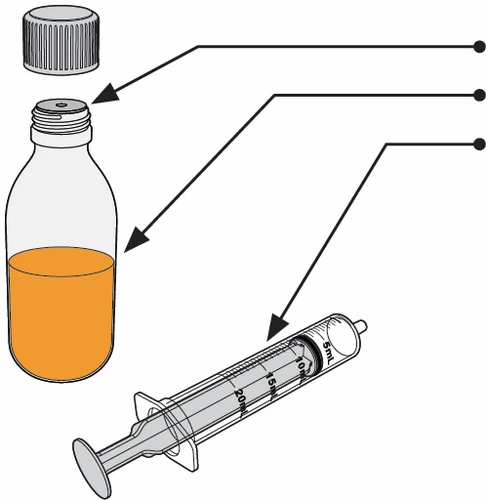
To administer Spexotras, you will need:
Bottle adapter (already inserted in the neck of the bottle)
Solution in bottle
Oral syringe
If Spexotras solution leaks or comes into contact with skin or eyes, follow the instructions in the section “CLEANING UP SPILLS”.
Wash and dry your hands before administering Spexotras.
Parts of the reusable oral syringe:
Tip, Dose increments, Plunger

Black cap cylinder
Check the solution preparation date on the box.
Do not administer Spexotras if more than
35 days have passed since the solution was
prepared.
Note: The expiry date printed on the right side
of the vial label DOES NOT apply to the
solution. The printed expiry date applies only
to the powder before it is reconstituted into a
solution by the pharmacist.
| 2 Gently shake the bottle for 30 seconds to mix the solution. If foam appears, let the bottle stand until the foam disappears. | 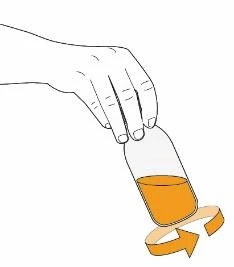 |
| 3 Remove the child-resistant cap by pushing down and turning it counterclockwise. | 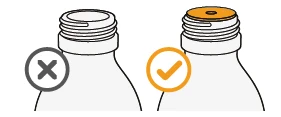 |
| 4 Check whether a bottle adapter is already present in the neck of the bottle. If not inserted, contact the pharmacist. | 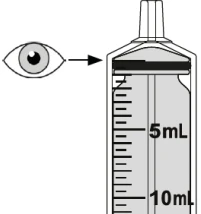 |
| 5 Push the plunger of the oral syringe fully into the syringe barrel to remove all air inside. | |
| 6 Place the bottle on a flat surface and hold it upright. Insert the tip of the oral syringe into the opening of the bottle adapter. Make sure the oral syringe is securely attached. IMPORTANT: Due to air pressure, the plunger may move on its own when measuring the dose during step 7. Hold the plunger to prevent it from moving. | 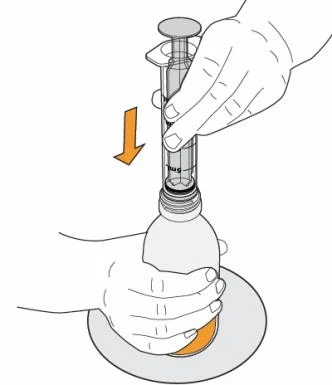 |
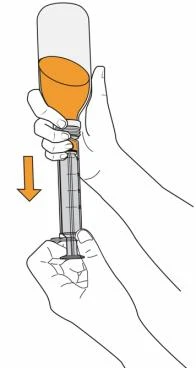
Carefully invert the bottle and pull
the plunger to measure the dose. With the tip
pointing upwards, the top part of the black stopper
must align with the prescribed dose.
Step 7
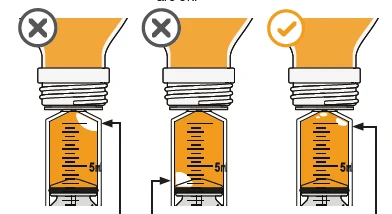
If large air bubbles appear in the syringe, as
shown in the figures, return the
medicinal product to the bottle and withdraw
the dose again.
Repeat this process until no large air bubbles remain.
Small air bubbles are acceptable.
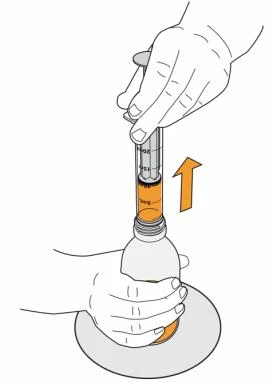
Keep holding the plunger in place, turn the bottle
upright and place it on a flat surface. Remove the oral
syringe from the bottle by gently pulling it upwards.
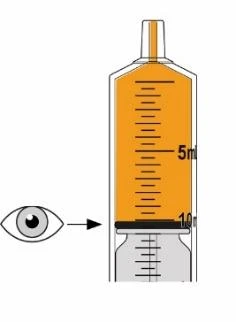
Double-check that the e on the black stopper
is aligned with the prescribed dose. If not, repeat
steps 6–8.
If administering via oral syringe, proceed to step 10.
If administering via feeding tube, go to section B.
Place the tip of the oral syringe
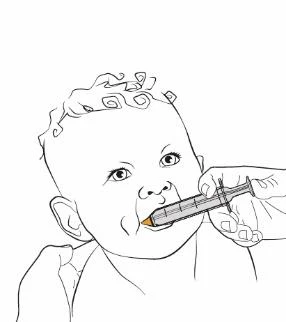
inside the mouth, with the tip touching the inside
of both cheeks.
Slowly push the plunger fully to administer
the entire dose.
WARNING: Administering Spexotras into the
throat or pushing the plunger too quickly may
cause choking.
| 11 Check that there is no more Spexotras left in the oral syringe. If there is still some solution in the oral syringe, administer it. Note: if the dose is greater than the capacity of the oral syringe, repeat the administration until the total volume has been delivered. | |
| 12 Replace the cap on the bottle and rotate it clockwise to close. Make sure the cap is securely attached to the bottle. Do not remove the bottle adapter. | |
| 13 Clean the oral syringe according to the instructions in "SECTION C", then store the solution and oral syringe according to the instructions in the "STORAGE" section. |
SECTION B ADMINISTRATION VIA FEEDING TUBE
Please follow this section only if you are administering Spexotras via a
feeding tube.
For administration via feeding tube, read the following information, then
proceed to Step 1.
- The solution is suitable for administration through a feeding tube.
- Use a Nasogastric (NG) or Gastric (G) feeding tube with a minimum size of 4 French gauge.
- Always use the 20 mL oral syringe supplied in this package to administer Spexotras.
- An ENFIT adapter (not included in this package) may be required to connect the 20 mL oral syringe to the feeding tube.
Flush the feeding tube according to the manufacturer’s instructions immediately before
administering Spexotras.
Follow Steps 1 to 9 in SECTION A, then proceed to Step 3 in this section.
Connect the 20 mL oral syringe containing Spexotras to the feeding tube. An ENFIT adapter may be required to connect the oral syringe to the feeding tube.
Apply steady pressure to deliver the solution through the feeding tube.
Check that no Spexotras remains in the oral syringe. If any solution remains in the
oral syringe, administer it.
Flush the feeding tube again according to the manufacturer’s instructions.
Proceed to “SECTION C” for cleaning.
SECTION C CLEANING
To avoid contact of Spexotras with other kitchen items, always clean the oral
syringe separately from other kitchen items.
To clean the oral syringe:
- Fill a glass with warm soapy water.
- Place the oral syringe in the glass with warm soapy water.
- Draw water into the oral syringe and expel it again 4 or 5 times.
- Separate the plunger from the barrel.
- Rinse the glass, plunger, and barrel under warm tap water.
- Allow the plunger and barrel to air-dry on a dry surface before next use.
CLEANING UP SPILLS
If Spexotras spills onto the skin, wash the area thoroughly with water and soap. If Spexotras gets into the eyes, rinse the eyes with water.
Follow these steps if the Spexotras solution is spilled:
- Put on plastic gloves.
- Completely absorb the solution using absorbent material, such as paper towels.
- Place the absorbent material into a sealed plastic bag.
- Clean all surfaces exposed to the solution with an alcohol-soaked wipe.
- Place the gloves and wipes into the same plastic bag and seal it.
- Ask your pharmacist how to dispose of the plastic bag.
- Wash hands thoroughly with water and soap.
STORAGE
Keep the Spexotras solution and the oral syringe out of the sight and reach of children.
Store the solution upright, in the original box, with the cap tightly closed.
Store below 25°C. Do not freeze.
Store the oral syringe in the original package together with the Spexotras solution.